
Engelbert Humperdinck - Hansel and Gretel (Wexford, 2019)
Irish National Opera, 2019
Richard Peirson, Muireann Ahern, Louis Lovett, Raphaela Mangan, Amy Ní Fhearraigh, Miriam Murphy, Ben McAteer, Carolyn Dobbin, Emma Nash, Raymond Keane, Amelie Metcalfe, Ronan Millar
National Opera House, Wexford - 22 February 2020
In the last couple of years the Irish National Opera have managed to strike a good balance between creative direction and audience accessibility, fearlessly bringing something new and imaginative even to popular standards like Madama Butterfly, Aida and The Magic Flute. It perhaps takes a bit more nerve however to mess with the traditional storytelling of Humperdinck's Hansel and Gretel which even for someone who has never been to the opera, has specific expectations as a fairy-tale. The INO's 2020 production turns out to be as adventurous as usual, but it doesn't quite hit the mark here as far as doing justice to Humperdinck, losing much of his work's own inherent value for something less compelling.
Compromises inevitably have to be made when it's a touring production and this production of Hansel and Gretel is admirably heading out to far-flung corners of Ireland that never see anything with this level of production values and quality, even with a reduced orchestration of seven players. On its own terms, this production looks and sounds terrific, setting its own entertaining mood, style and character, and it is indeed refreshing to hear the pureness of the composer's melodies and how successfully they combine to tell the story, neither the music nor the storytelling however are wholly successful in getting across the real character of Humperdinck's opera. Or at least not as successful as some other productions, and for me Opera North set a very high bar there for anyone else to reach.

It's a fairy-tale so there's no requirement for realism in the Irish National Opera production created in collaboration with directors Muireann Ahern and Louis Lovett. Although it's possible to hint at contemporary concerns in Hansel and Gretel, there's no emphasis placed here on the idea of the two children living in poverty, victims of austerity cuts or even neglectful parenting. The family do appear to have lost their home here however, being forced to move around but somehow able to afford to stay at the Forest Edge Hotel, whose sinister appearance is enhanced by the notice that children are welcome.
It's the sinister that the INO production does well, much of it established in Jamie Vartan's superb set design, creating a space that is adaptable for touring but still maximises impact. It doesn't settle for the obvious fairy-tale or Gothic settings, but finds rather a seedy character in the neon signs, the old-fashioned font of the projected signs and notices with their subtle undercurrents of menace. That character is also established early with the use of an extra actor (Raymond Keane) in a silent role playing the part of the Night Watchman, a character who is part illusionist amusing the children with tricks, part Childcatcher from Chitty Chitty Bang Bang tempting them with sweets and treats, and part Sweeney Todd figure serving them up for the witch to bake into pies.
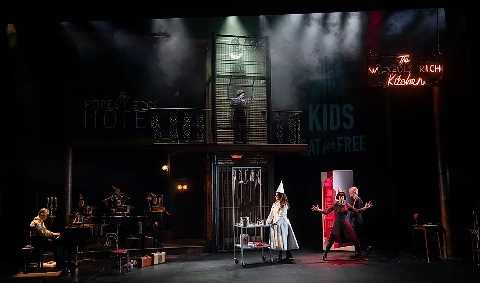
There's nothing too sinister here mind, nothing to scare the children in the audience. I'm sure they could take a little more of the thrill of horror in a fairy tale setting, but that's largely avoided which feels like it is to the detriment of the character of the original work. In its place the directors bring some knowing humour and a play up the rivalry, bossiness and naughtiness in the interaction between Hansel and Gretel, which works well and is entertainingly played by Raphaela Mangan and Amy Ní Fhearraigh, a little broadly pantomime in places but with some lovely details and reactions when called for.
It's also very much a stylised production in that way that sees the starving Hansel and Gretel clean and smartly dressed in grey outfits, the overall look more storybook than social realism. Even the orchestra and Richard Peirson, leading the seven-piece Irish National Orchestra ensemble from the piano, get in on the act wearing incongruous party-hats and taking up position to the stage rather than being confined to a pit, although their movements suggest that they may well have risen from a pit of a different kind. All of this is great, all very much in character of the production as a whole, but none of it seems to add up to a consistent worldview much less one that has anything to say about child poverty, child abuse or warnings of child abduction.
There's no reason why it ought to but it should at least relate to or be on a par with the power of children's imagination and storytelling that lies at the heart of the work. If you're going to jettison the traditional fairy-tale elements in depictions of the gingerbread house, the sandman, the dew fairy and the fourteen guardian angels, and offer stylised characters and projections in their place, it would be nice if it was in service of an alternative take on the story. The fairy-tale can sustain it and indeed its whole purpose is to carry subtext, so Hansel and Gretel surely merits a deeper exploration of its themes. So too does Humperdinck's music.

What we did get from the reduced orchestration was a clearer sense of the folk song melodies and the storytelling character of Humperdinck's compositions, but with the mainly piano-led accompaniment it was all very evenly paced, lacking in colour and variety and not really successful in conveying the different tones and textures that you get in the orchestral arrangements. The dramatic performances were fun, playing for humour more than horror, and the singing was marvellous from all the main performers, particularly the bright Raphaela Mangan and Amy Ní Fhearraigh as Hansel and Gretel.
The other roles were also well sung with plenty of character on the parts of Carolyn Dobbin as the witch, Emma Nash as the Dew Fairy and Sandman and Miriam Murphy as the mother. Only Ben McAteer's proven abilities felt under-exploited here as a rather nondescript father. As entertaining as it was, under-exploited was also the general impression of the production as a whole, looking and sounding marvellous, but lacking in the depth that is there to be found in this rich work.

Links: Irish National Opera
Christoph Willibald Gluck - Orfeo ed Euridice
Irish National Opera, 2019
Peter Whelan, Emma Martin, Sharon Carty, Sarah Power, Emma Nash, Dominica Williams, Fearghal Curtis, Matthew Mannion, Robyn Byrne, Stefaniw Dufresne, Javier Ferrer, Sophia Preidel
The Pavilion Theatre, Dún Laoghaire - 28 February 2019
The absolute wonder of Gluck's Orfeo ed Euridice, the reason for its reputation as one of the greatest works of opera ever composed and the ability of the work to deeply move audiences some 350 years after it was composed, lies undoubtedly in its simplicity. Or rather its apparent simplicity since it relates to deep human feelings that connect us to myth, Gluck's work fully employing all the artistic musical, theatrical and dance elements that are the essence of opera. Refinement rather than simplicity of all those elements and how they work together was at the heart of Gluck's reformist agenda for opera, and it's in adherence to those principals that the Irish National Opera succeed in their beautifully simple but refined production.
Such indeed is the refinement and unadorned beauty of Orfeo ed Euridice and the deeper sentiments that underlie its purpose, that it can sustain all manner of interpretations. It is mythology after all. At the heart of the work is perhaps the rawest and most relatable of human emotions, those connected to love and loss, Orpheus's desire to bring his beloved wife Eurydice back from the dead practically serving as a model for Kübler-Ross's five stages of grief; denial, anger, bargaining, depression and acceptance. Gluck's ability to make those sentiments behind Orpheus's dramatic/symbolic journey vividly real in musical terms lie at the heart of the work.
Unquestionably then, even though La Fura dels Baus have successfully been let loose on the work with their enhanced stage techniques, they recognised nonetheless that it was essential to forge a connection between the music/musicians and the drama. In rather more stripped back conditions, while still presenting a theatrical presentation of extraordinary beauty, director and choreographer Emma Martin likewise, but through entirely different means, succeeds in making the essence of Gluck's timeless musical moods and melodies visible on the stage in the Irish National Opera's production.

First performed last year for the Galway Festival, but taken this year on a wider provincial tour of Ireland, the venues chosen remain (for the most part) small scale, permitting an intimate closeness with the drama and the production. Indeed, my front row seat at the Pavilion Theatre in Dún Laoghaire placed me practically in the 'orchestra pit', sharing a ground level space almost between the orchestra ensemble and 'stage'. Immersive theatre is nothing new, nor indeed is immersive opera, but it's quite another thing to be immersed in the same space that Gluck's Orfeo ed Euridice occupies, particularly one that in every other way strives to make the work's every sentiment tangible.
Stripping back the orchestra to its essential components, Peter Whelan's arrangement and conducting of the Irish Baroque Orchestra permits the beauty of each of the instruments and the part they play in each of the scenes to stand out all the more vividly. Emma Martin's production likewise reduces the vocal ensemble down to the main roles of Orpheus, Eurydice and Amore, with Amore also part of the four-way harmonised voices of the chorus for the Mourners, Furies and Blessed Spirits. Nothing was lost with this reduction, but rather the refinement of Gluck's musical scoring only even more apparent.
Orfeo ed Euridice was of course originally intended to make use of another element of opera that in the subsequent century after its writing tended to not have such a prominent role, and that's dance. Orfeo ed Euridice is written for movement, it's not the static stand-and-sing solitary aria expressions of the requisite numbers and sentiments of baroque opera, nor is it the stop-start division of singing and ballet of the French tragedie-lyrique, but an essential integration of dance into the whole flow and pace of the work. Orfeo ed Euridice indeed has been staged purely as a dance work, but more often opera productions tend to cut the instrumental/dance passages to suit modern tastes.

As a choreographer Emma Martin however knows the value of dance in Orfeo ed Eurydice adding another dimension to the opera and bring those sentiments to life. The INO production accordingly has a four-person troupe of dancers that symmetrically balance and in a way supplement the four-part chorus, flowing and weaving thought the work like the notes of Gluck's score brought to life. They vividly express all those stages of Orpheus's grief, as much as the impassioned singing of Sharon Carty's Orpheus himself/herself; the anger and the struggle with the Furies (even transforming into a horrifying multi-limbed creature that stalks Orpheus across the stage, wrapping him in his submission to the Blessed Spirits, standing as a barrier between this world and the unreachable other.
The superb flow and choreography extends its mood and reaches outward to take in the stage itself. It doesn't need much in the way of set dressing but everything is purposefully employed, the lighting effective for the mood, the drapes at the back of the stage and the veils wrapped around the figures drawing everything together. It's not just the choreography or even the impressive technical blocking of the singers with the dancers and the sets, it's the direction of every scene to match and express those deeper human sentiments at the heart of the work.
The qualities of the human voice are essential to that purpose and Sharon Carty (Orpheus), Sarah Power (Eurydice) and Emma Nash (Amore) made them soar with love, anger, fear and regret. The essential moral of the mythological take, which was unfortunately lost under the stage requirement of the period to present a happier ending, must also be taken into consideration. Romeo Castellucci managed to address that brilliantly in his living-death element to his production for La Monnaie, and Emma Martin also takes the reality of the nature of bereavement into account here, consigning the happy ending to a kind of postlude that reminds us that after loss, life still goes on.


Links: Irish National Opera
Andrew Synnott - Dubliners
Opera Theatre Company, Wexford Opera Festival, 2017
Andrew Synnott, Annabelle Comyn, Emma Nash, Anna Jeffers, Andrew Gavin, David Howes, Peter O' Donohue, Cormac Lawlor
Clayton White's Hotel, Wexford - 1 November 2017
The two short stories that Andrew Synnott chooses from James Joyce's Dubliners don't strike you as being the sort of thing that operas are made of, but then again I'm sure that it would have been hard to imagine The Dead from the same short story collection being adapted into a feature film. Composer Andrew Synnott and librettist Arthur Riordan however succeed with Counterparts and The Boarding House in exactly the same way that John Huston did with The Dead; they give due attention to the fact that the forces that exist in and around the characters are far more important than the narrative itself.
These are more than just stories to be told, and they are more than just depictions of Dublin life at a certain, albeit significant time in Ireland's history at the beginning of the 20th century. There are all kinds of social and political undercurrents running around in 1914, with the Great War just around the corner and with the Republican Easter Rising not far away, but the idea of identity and change, of the times mirroring a significant moment in individuals' lives can also be found in Dubliners.

In Counterparts and The Boarding House (and indeed The Dead), events come to a point where there is no return to the past. The characters find themselves obliged to reassess their lives and try to assert some kind of authority over their own destiny, only to find that there are external forces that are beyond their ability to control or influence. The stories that make up Synnott's two short Dubliners operas are not connected and the tone and the revelations reached in each is markedly different, but Synnott's brilliantly brings out the respective commonalities, differences and qualities that lie at the heart of both works.
There's an almost impressionistic flow to both pieces, but in Counterparts it's one that is determined by the alcoholic haze and rush of emotions that course through the day of a Dublin office clerk. Farrington has already nipped out for a few quick ones during his breaks and all he can think about is getting back out to the warm happy glow of being in a pub with his friends. There are however all kinds of competing forces at work that prevent Farrington from mastering his situation, and not just in the workplace where his boss is putting pressure on him to urgently to copy documents for a contract.
Alcohol is a force, desire is a force, conceit is a force, masculinity is a force and all of them give Farrington a misplaced sense of self-worth. His bragging to his friends of his witty put-down of his boss when he asks him if he takes him for a fool ("I don't think that's a fair question to put to me") only carries so much weight, and as his money runs out, the alcohol buzz wears off and Farrington receives a few injuries to his pride, so too does his sense of humour. None of his efforts have brought him any satisfaction, and when he returns home he exerts his dwindling sense of control and authority by beating one of his children.

It's hardly the stuff of opera, but Synnott on piano with a string quartet, gives this narrative a wonderful coherence and a feeling for mood, but it only really holds together when it is played alongside and contrasted with The Boarding House. It's a story that seems even less likely to work on the stage, but Synnott's response to that is to just be even more creative with rhythms, with the overlaying of vocal lines and with a construction that wonderfully leap-frogs from one character focus to the next.
It even starts with a narrator, Jack Mooney, who lets it be known that the moment of truth is dawning for one of the guests at his mother's boarding house. Bob Doran has been carrying on with Polly who works there, and it appears that her mother Mrs Mooney has permitted the liberty to be taken or at least turned a blind eye to it; but in reality she has just been biding her time. Doran's fate is sealed before the opera even starts, but he just hasn't realised it yet. He thinks he still has a say in the outcome, but when the summons comes from Mrs Mooney, his bachelor days are effectively numbered.
The forces he has to contend with are brute force (Jack Mooney), the bonds of family, the ideas of right and wrong that are ingrained in this society by religion, and with it the irrefutable certainty that one has to pay for one's sins. The personal wishes of the individual are rendered insignificant in the face of such huge social and cultural forces, and the inevitability with which they pile up on Bob Doran, as well as the inherent humour that lies in the situation, are brilliantly brought out in this wonderfully constructed opera version of the story.

The flow of words and impressions, the flow from one character's perspective to another is brilliantly brought out in the flow of the musical score that Andrew Synnott leads from piano, but this is more than just musical accompaniment and more than an exercise in craft. Between the music, the words and the staging, the operas bring out the deeper essence and universality of these timeless stories. The gorgeous set designs by Paul O'Mahony who also worked on the OTC's gorgeous Acis and Galatea (there's a man who knows his pubs!) and Joan O'Clery's costumes retain something of the period, but Annabelle Comyn's direction ensures that the situations, experiences and the nature of the characters remains recognisable and relevant, and not just to early twentieth century "Dubliners".
The complementary nature of Counterparts and The Boarding House can also be found in the lyrical treatment and Synnott and Riordan have created wonderfully lyrical and poetic vocal lines with rhyming couplets for both pieces. Using the same cast members for the two short operas allows further connections to be drawn; not so much in characters as in their predicaments and expression of them. Cormac Lawlor however only has a singing role in Counterparts as Farrington, but it's one that evidently carries the whole tone of the piece and his timing and delivery of each of the varied moods the alcoholic clerk goes through is superb. The Boarding House has a larger number of leads from Emma Nash's Polly, Anna Jeffers's Mrs Mooney, Andrew Gavin's Bob Doran and David Howes's Jack, who all impress on an individual level, as well as giving wonderfully complementary performances.
Premiered at the 2017 Wexford Festival Opera, Opera Theatre Company's production of Andrew Synnott's Dubliners has a further three performances at the Samuel Beckett Theatre in Dublin from the 9 - 11th November 2017, but I would hope and expect that this lyrical, thoughtful and entertaining work will have a longer life beyond its initial run.
Links: Wexford Festival Opera, Opera Theatre Company


