
Engelbert Humperdinck - Hansel and Gretel (Wexford, 2019)
Irish National Opera, 2019
Richard Peirson, Muireann Ahern, Louis Lovett, Raphaela Mangan, Amy Ní Fhearraigh, Miriam Murphy, Ben McAteer, Carolyn Dobbin, Emma Nash, Raymond Keane, Amelie Metcalfe, Ronan Millar
National Opera House, Wexford - 22 February 2020
In the last couple of years the Irish National Opera have managed to strike a good balance between creative direction and audience accessibility, fearlessly bringing something new and imaginative even to popular standards like Madama Butterfly, Aida and The Magic Flute. It perhaps takes a bit more nerve however to mess with the traditional storytelling of Humperdinck's Hansel and Gretel which even for someone who has never been to the opera, has specific expectations as a fairy-tale. The INO's 2020 production turns out to be as adventurous as usual, but it doesn't quite hit the mark here as far as doing justice to Humperdinck, losing much of his work's own inherent value for something less compelling.
Compromises inevitably have to be made when it's a touring production and this production of Hansel and Gretel is admirably heading out to far-flung corners of Ireland that never see anything with this level of production values and quality, even with a reduced orchestration of seven players. On its own terms, this production looks and sounds terrific, setting its own entertaining mood, style and character, and it is indeed refreshing to hear the pureness of the composer's melodies and how successfully they combine to tell the story, neither the music nor the storytelling however are wholly successful in getting across the real character of Humperdinck's opera. Or at least not as successful as some other productions, and for me Opera North set a very high bar there for anyone else to reach.

It's a fairy-tale so there's no requirement for realism in the Irish National Opera production created in collaboration with directors Muireann Ahern and Louis Lovett. Although it's possible to hint at contemporary concerns in Hansel and Gretel, there's no emphasis placed here on the idea of the two children living in poverty, victims of austerity cuts or even neglectful parenting. The family do appear to have lost their home here however, being forced to move around but somehow able to afford to stay at the Forest Edge Hotel, whose sinister appearance is enhanced by the notice that children are welcome.
It's the sinister that the INO production does well, much of it established in Jamie Vartan's superb set design, creating a space that is adaptable for touring but still maximises impact. It doesn't settle for the obvious fairy-tale or Gothic settings, but finds rather a seedy character in the neon signs, the old-fashioned font of the projected signs and notices with their subtle undercurrents of menace. That character is also established early with the use of an extra actor (Raymond Keane) in a silent role playing the part of the Night Watchman, a character who is part illusionist amusing the children with tricks, part Childcatcher from Chitty Chitty Bang Bang tempting them with sweets and treats, and part Sweeney Todd figure serving them up for the witch to bake into pies.
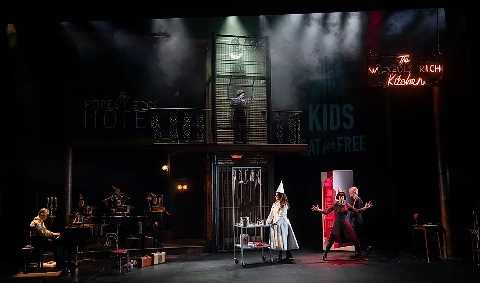
There's nothing too sinister here mind, nothing to scare the children in the audience. I'm sure they could take a little more of the thrill of horror in a fairy tale setting, but that's largely avoided which feels like it is to the detriment of the character of the original work. In its place the directors bring some knowing humour and a play up the rivalry, bossiness and naughtiness in the interaction between Hansel and Gretel, which works well and is entertainingly played by Raphaela Mangan and Amy Ní Fhearraigh, a little broadly pantomime in places but with some lovely details and reactions when called for.
It's also very much a stylised production in that way that sees the starving Hansel and Gretel clean and smartly dressed in grey outfits, the overall look more storybook than social realism. Even the orchestra and Richard Peirson, leading the seven-piece Irish National Orchestra ensemble from the piano, get in on the act wearing incongruous party-hats and taking up position to the stage rather than being confined to a pit, although their movements suggest that they may well have risen from a pit of a different kind. All of this is great, all very much in character of the production as a whole, but none of it seems to add up to a consistent worldview much less one that has anything to say about child poverty, child abuse or warnings of child abduction.
There's no reason why it ought to but it should at least relate to or be on a par with the power of children's imagination and storytelling that lies at the heart of the work. If you're going to jettison the traditional fairy-tale elements in depictions of the gingerbread house, the sandman, the dew fairy and the fourteen guardian angels, and offer stylised characters and projections in their place, it would be nice if it was in service of an alternative take on the story. The fairy-tale can sustain it and indeed its whole purpose is to carry subtext, so Hansel and Gretel surely merits a deeper exploration of its themes. So too does Humperdinck's music.

What we did get from the reduced orchestration was a clearer sense of the folk song melodies and the storytelling character of Humperdinck's compositions, but with the mainly piano-led accompaniment it was all very evenly paced, lacking in colour and variety and not really successful in conveying the different tones and textures that you get in the orchestral arrangements. The dramatic performances were fun, playing for humour more than horror, and the singing was marvellous from all the main performers, particularly the bright Raphaela Mangan and Amy Ní Fhearraigh as Hansel and Gretel.
The other roles were also well sung with plenty of character on the parts of Carolyn Dobbin as the witch, Emma Nash as the Dew Fairy and Sandman and Miriam Murphy as the mother. Only Ben McAteer's proven abilities felt under-exploited here as a rather nondescript father. As entertaining as it was, under-exploited was also the general impression of the production as a whole, looking and sounding marvellous, but lacking in the depth that is there to be found in this rich work.

Links: Irish National Opera
Giuseppe Verdi - Macbeth
NI Opera, Belfast - 2014
Nicholas Chalmers, Oliver Mears, Bruno Caproni, Rachel Nicholls, Paul Carey Jones, Miriam Murphy, Andrew Rees, John Molloy, Aaron Cawley, Doreen Curran, Nathan Morrison, Christopher Cull, Roy Heaybeard, Tom Deazley, Patrick Donnelly
Grand Opera House, Belfast - 21st/22nd February 2014
Although it's commonly known in theatrical circles as "the Scottish play", it's rare that there's much made of the actual setting of Shakespeare's 'Macbeth' in dramatic productions or in Verdi's opera version of the work. The themes of Macbeth go far beyond mere location or historical context to consider the nature of war (usually with troops in modern combat gear), of ambition and social aspirations, and - evidently - the darker side of human nature that is brought out by such matters. You very rarely see or need to consider the question of Scotland itself in either traditional or modern updatings of the work. NI Opera's production of Verdi's early masterwork (a co-production with the Welsh National Opera) however goes right back to core issues at the heart of the work in more ways than one.
Maybe it's because there's considerable attention drawn to all matters Scottish with the country's forthcoming vote on independence, but nationalistic matters and flag-waving were very much in evidence in NI Opera's production of Verdi's Macbeth. The displaying of flags is of course a controversial and unresolved issue in the current Northern Irish political climate and such displays would undoubtedly have a resonance with the local audience, but Oliver Mears, the Artistic Director of NI Opera, manages nonetheless to avoid any overt contemporary references or political commentary on whether Scotland and the UK (or indeed Northern Ireland) are "better together" or not.

That's not to say that NI Opera's director doesn't cleverly exploit the power of such imagery and recognise its significance when one is dealing with questions of power and ambition. When the arrival of Duncan is announced to much pomp, ceremony and nationalistic flag-waving here, you almost expect to see Alex Salmond appear on the stage. It would be tempting also to imagine a version of Nicola Sturgeon as ambitious first-lady in waiting, but Lady Macbeth here has more of an appearance of an Imelda Marcos, wasting little time on her ascension as wife of the newly crowned king to accumulate a couple of large wardrobes for fur coats and shoes. There's nothing too obvious here, but enough references for an audience to recognise familiar trappings of power, ambition and success.
Beyond all the kilts, sporrans and saltires however, Mears also managed to dredge up other deeper aspects of the work that are perhaps not so commonly explored in either theatrical or opera presentations of Macbeth. In addition to those main themes, which were covered only as well as Verdi and his librettist Frencesco Maira Piave's imperfect interpretation of Shakespeare allow (ie. not terribly effectively), there are however other rich themes to be explored and for Mears, one of those relates to several references to innocence, children and death. Fearing the prediction of the witches, Macbeth's Herod-like fear of Banquo and his son becomes pathological in relation to the future generations that will eventually supplant him from a position that he has taken it into his own (bloody) hands to obtain for himself.
In what is becoming something of a running theme with Mears (the darker side of the children/adult relationship and Death are also evident in Britten's Turn of the Screw, and it's there also in the more disturbing fairytale undercurrents of Humperdinck's Hansel and Gretel, not to mention that another notorious child-murderer, Herod, features in the forthcoming 2014-15 NI Opera production of Strauss' Salome), the director makes much of this theme and references to it in the work. Most evidently here, it's in the novel witches' dismemberment of babies as ingredients for their cauldron (where apparitions in the form of children again make fearful predictions to Macbeth), and it's there also in the procession of baby-faced apparitions of Banquo's line that haunt Macbeth's dreams.

This undoubtedly helped to bring about Macbeth's descent into a murderous and paranoid tyrant in the later acts much more successfully than Verdi and Piave manage, but there's little the production can do about the dramatic failings of the opera in making real the motivations of the greed and dangerous ambition of Macbeth and Lady Macbeth. The weakness of the libretto in this respect is compounded by it being performed in English here. Not only does it expose the poor translation of the Shakespearean text when translated back into English, but it also loses what little lyricism the Italian singing brings in its stead. The use of English translations supposedly for accessibility perhaps needs a rethink, since without surtitles it means that you can only actually hear about 50% of what is sung.
None of that however is through any fault of the singing here on the first of only three performances of the production at the Grand Opera House in Belfast. From the moment that she read Macbeth's letter with clear, resonant diction, there was little doubt that Rachel Nicholls had the measure of Lady Macbeth, and it didn't take long for the sheer force and control of her voice to become fully apparent, sailing over over the robust performance of Verdi's dramatic score conducted by Nicholas Chambers. The English language performance however did no-one any favours, 'Daylight is fading', for example, passing by without any of the show-stopping qualities that usually accompany 'La luce langue'.
Bruno Caproni's Macbeth suffered from the same problem of the weakness of the libretto being exposed by the English back-translation, his 'Mal per me' finale never quite hitting the emotional heights that it achieves in Verdi's original scoring of the work. (The version used here a well-judged blend of the best of the 1847 and 1865 versions). Caproni wasn't able to make much of the dramatic content either, his acting being mostly confined to being in a perpetual state of stupefaction at the eerie apparitions leading to events spinning out of his control. In terms of singing however, he was everything that the role required, commanding and in perfect control. Alongside Rachel Nicholl's impressive Lady Macbeth, this was casting as good as you could hope for in these great Verdi roles. The alternate cast of Paul Carey Jones and Miriam Murphy also performed capably, but without managing to bring any greater edge of wild danger to the Macbeth/Lady Macbeth partnership.
The specific challenges of singing Verdi were revealed in the difficulty that John Molloy had with the delivery of Banquo. Molloy, so fleet and flitting as Dulcamara in L'Elisir d'Amore earlier this season, couldn't quite sustain the rather more difficult dramatic Verdi line. Andrew Rees, on the other hand, really entered into the spirit of the Verdian melodrama as Macduff. It was this kind of melodrama that you realised was missing from the Nicholas Chalmers' conducting of the Ulster Orchestra. The beauty of Verdi's wonderful melodies was all there, but it lacked the unrestrained drive and force that the work really needs to make its full impact. Early Verdi doesn't require this much subtlety.
The chorus of NI Opera were on form throughout. As elsewhere, 'Patria Oppressa' might have lost something in translation, but it was superbly staged and sung. One of Mears' more clever touches was to cast the witches into three groups of composite forms, a trick that worked marvellously, the witches creating the kind of eeriness and menace when they were onstage that should also have been there but wasn't in the dagger apparition and the sleepwalking scenes. Even in woollen bobble hats and bomber jackets, the male chorus also exuded menace where required, particularly in the killing of Banquo scene. Whether it's true or not in terms of the Scottish question, "Better Together" can certainly at least be applied to the joint effort of this NI Opera and the Welsh National Opera production of Macbeth.


