Showing posts with label Pyotr Ilyich Tchaikovsky. Show all posts

Thursday, 2 July 2026

Tchaikovsky - The Maid of Orleans (Amsterdam, 2025)


Pyotr Ilyich Tchaikovsky - The Maid of Orleans

Dutch National Opera, 2025

Valentin Uryupin, Dmitri Tcherniakov, Elena Stikhina, Allan Clayton, Nadezhda Pavlova, Vladislav Sulimsky, Andrey Zhilikhovsky, John Relyea, Oleksiy Palchykov, Gábor Bretz, Patrick Guetti, Eva Rae Martinez, Tigran Matinyan

ARTE Concert

It may have inspired at least one of the greatest films ever made, but Joan of Arc is a problematic work for an opera, at least as far as Verdi and Tchaikovsky are concerned. The focus on the spiritual side of Joan of Arc, the strength of her inner light and purpose and use her determination to inspire others is perhaps what makes Dryer's The Passion of Joan of Arc and Bresson's The Trial of Joan of Arc deeply moving. Opera, particularly in this period (Verdi's Giovanno d'Arco in 1845, Tchaikovsky's in 1879), demanded a little more conventional romance and drama built into the exigencies of wartime duty. That's not to say that the spiritual side of the story is neglected, but can get overwhelmed by the roar of battle cries. Or at least that's been my experience of those rarely performed works.

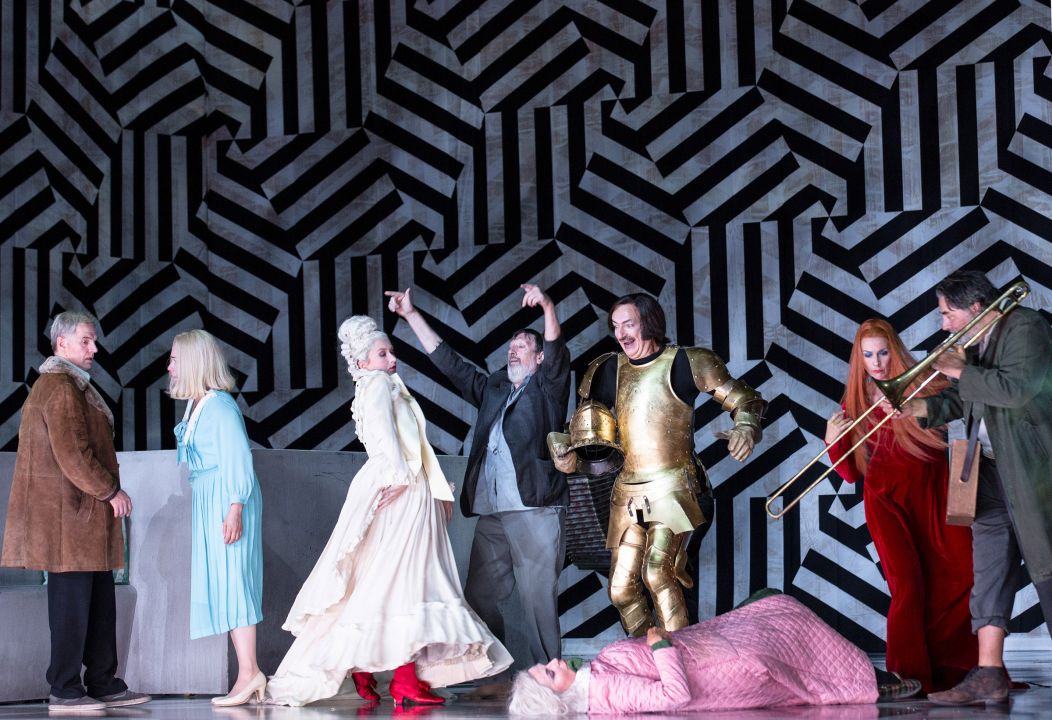
Dmitri Tcherniakov, controversial in his manner of often reworking or twisting original scenarios to suit his own vision for them but in my opinion infallible when it comes to drawing the inner essence out of great Russian operas, can hardly be faulted then for attempting to 'fix' Tchaikovsky's The Maid of Orleans. Typically he sets this production far from its historical 15th century battlefield, but not only that, to further downplay any idea of war heroism, he already has Joan placed under arrest and on trial at the start of the opera. In Act I that successfully straddles the line between courtroom and town hall meeting, where Joan's refusal to behave as she is expected to do as a young woman and submit to marriage is already a crime laid against her, the events leading to it then viewed as scenes in flashback.

Seven weeks into her trial, some of the town folk are getting frustrated with the young woman's deranged visions, but with war threatening Orléans, fear takes hold and the sense of grace that exudes from the charismatic Joan is nonetheless seductive, bringing hope. Opera has the advantage here of being able to convey that characteristic in the voice (although the lack of a speaking voice certainly did not detract from Carl Th. Dreyer's 1928 silent movie masterpiece). Inevitably messing with time lines and locations in Tcherniakov's version causes some misalignment with the opera plot, but rightly the intent is not to make the slightly ludicrous or at least unfashionable dated dramatic historical action credible, but rather to serve to bring out the deeper spiritual side of the work.

Spiritual maybe, but as he has made plain in everything from Dialogues des Carmélites to Parsifal, Tcherniakov is not going to depict any of Joan's visions in terms of religious or quasi-religious mysticism, but from a profoundly humanistic viewpoint. Which does not mean idealistic either, particularly in this case where the outcome of those deep convictions lean towards fighting and killing. Joan receives her messages from the lights above the fans in the town hall/courtroom, rather than any celestial visitation. There is no time either for earnest stilted declamation (or subtitles), which I thought undermined this work the last time I viewed it, and accordingly characters here are seen behaving irreverently or mockingly whenever it occurs. The long scene between King Charles VII and Agnes Sorel works partly due to this but credit must also be given to the singing performances of Allan Clayton and Nadezhda Pavlova, who are outstanding here. That's also a measure of good direction, subverting pomposity without undermining the work, just shifting the focus towards the work's real strengths and the purpose which is to highlight the experience and fate of Joan subjected to the judgement of her society.

The same applies to Tchaikovsky's roaring choruses and bombastic score which, as I observed before, is somewhat over the top in his vaunting the nationalistic heroism of warriors, but when turned inward it can be very powerful indeed, and it is well directed towards that in Valentin Uryupin's conducting of the Netherlands Philharmonic. It's not entirely possible to eliminate the jingoism in the libretto, but Tcherniakov never lets that side of the declamations dominate. Evidently, taking it out of the historical period and adopting a more modern perspective on the actions of the state helps make that case; the abuse of the prevailing religious and political establishment is more recognisable in this context and it hits all the harder for it. Even Joan's glorious acclaim from the people is subverted here, seen as nothing more than a hallucination of her own fevered mind having been locked up and abused in a prison cell. Aligned with Tchaikovsky's music it's incredibly powerful, setting up the underlying tragedy of the young woman's treatment in the run up to the dramatic conclusion. 

If you were to take the opera's libretto and setting literally as the historical Joan of Arc, you would have to think that Joan's divinity or position as a national hero and feminist is compromised here in Tcherniakov's vision. She becomes a tool, her mental illness (the titles above the stage clearly indicating that these are "hallucinations") turning towards religious fervour and used as a way of controlling the war narrative, leading the people to killing and death for the benefit of the ruling powers. But whatever perspective you want to place on her legacy, it's not the historical Joan that is of interest to Tcherniakov, but her underlying humanity and her mistreatment at their hands of the authorities. The DNO production uses Tchaikovsky’s operatic version of Friedrich Schiller's dramatic account, whose adherence to historical facts is hardly the most accurate account (nor meant to be), as a way of bringing all those forces together, showing how they work and how they use people for their own ends.

There are no real surprises there as far as the look, feel and outlook of a typical Dmitri Tcherniakov interpretation of an operatic work, which for all its apparent divergence from the original intent, supports the music, brings the opera up to date and indeed validates its deeper truths. What stands out then are indeed those musical qualities of Tchaikovsky at full tilt, yet maintaining those familiar lyrical qualities and tragic elements more familiar from Eugene Onegin, Iolanta (both of which Tcherniakov has directed) and The Queen of Spades; lyrical qualities that particularly when sung with authentic Russian voices can be very impressive. All the cast are excellent in that regard, but Elena Stikhina as Joan is hugely impressive, giving a breathtaking, committed performance that rises to the occasion, holding you captivated through the young woman's glory and torment as much as Falconetti did when she immortalised Joan of Arc in Dreyer's film version. High praise indeed.


Links: Dutch National Opera, ARTE Concert

Monday, 23 September 2024

Tchaikovsky - Eugene Onegin (Belfast, 2024)


Pyotr Ilyich Tchaikovsky - Eugene Onegin (Belfast, 2024)

NI Opera, 2024

Dominic Limburg, Cameron Menzies, Yuriy Yurchuk, Mary McCabe, Norman Reinhardt, Sarah Richmond, Carolyn Dobbin, Jenny Bourke, Aaron O'Hare, Niall Anderson, Matthew Jeffrey, Seamus Brady, Anne Flanagan, Adam Ashford, Gerard Headley, Alice Johnston, Maeve McGreevy, Sean O'Neill, Mira Renilheiro, Emma Scott

Grand Opera House, Belfast - 17th September 2024

I know I have complained in the past about the Northern Ireland Opera programme being reduced to one fully staged opera a year, but if you are going to do one opera and have already got the usual suspects of Italian opera out of the way (La BohèmeLa Traviata, Tosca), now is the time to be a little more adventurous. If you want to introduce the Belfast audience to a glorious work that will still please those who will be less familiar with the opera world (and one opera a year doesn't provide much opportunity), then with a little nod to the glamour of Bridgerton, Downton Abbey and the currently popularity of TV costume dramas to give the audience something familiar to latch onto, you can't do much better than Tchaikovsky’s masterpiece Eugene Onegin.

Taking on a great Russian opera however can't have been an easy decision when the more obvious route would have been Carmen or a Mozart opera, all the more so considering the current ambivalence towards some Russian artists due to the war in Ukraine. A Russian opera however brings it own artistic challenge for a relatively young opera company, singers and orchestra, not least in choosing to present the opera in the original Russian, but Eugene Onegin is worth it, the opera having all the elements to engage an audience in a heartfelt emotional, romantic and human drama. And so it proves to be in its short run of four performances at the Grand Opera House in Belfast. If not quite hitting the full range and dynamic of the work, NI Opera under the direction of Cameron Menzies delivered an impressive account of an exceptionally beautiful work that has all the deep personal engagement of the composer poured into every note.

Incredibly, aside from the role of Onegin, most the other main roles were taken by local artists and there were few weaknesses of any significance in the singing. That's quite an achievement. Usually a more mature singer, preferably of Russian or East European origin, is required for the role of Tatyana, so it's all the more astonishing that a young Northern Irish singer with limited experience of leading soprano roles can handle the demands of the role so impressively. A little more depth to the voice would add to the character, but since the larger part of the opera features Tatyana as a young and inexperienced young woman, Mary McCabe is able to make her character much more convincing. That pays dividends for the opera's final scene when the older Tatyana is assailed by doubts on her re-encounter with Onegin, her assurance crumbling as she reverts back to the emotions and circumstances of her younger self that shaped her life. It's a faultless singing performance, perhaps only let down by a lack of clear direction.

There have been many ways of bringing out the reflective nature of Tatyana’s life experience, her journey from a naive young woman in the country to a mature lady of elegance and outward assurance who nevertheless holds searing memories and past regrets. It's not unusual to see other productions relying on doubles - actors or dancers - to bridge the scope of her enthusiastic youthful bookish idealism into mature acceptance of duty and routine. And indeed, Menzies method of bringing this element out of the opera is to view the events as the revisiting of the past by an elderly lady in a wheelchair in the present day. She remains onstage almost throughout, at least in all the scenes where Tatyana appears, which suggests that it is Tatyana herself. Although she engages with her younger self on one or two occasions, it's hard however to reconcile the time discrepancy between the two periods.

More than that however, it's really not enough to bring the fullness and richness of the emotional range required here, or the complexity of the misplaced or mistimed feelings that exist in the Tatyana/Onegin relationship. Ukrainian baritone Yuriy Yurchuk sang Onegin well, but the direction here also didn't allow much space to explore the character. In the first part of the opera Onegin is somewhat arrogant, aloof and detached, in his relationship with Lensky he is apparently oblivious of any fault - although it's true that Lensky here appears to be unreasonably jealous to the minor social indiscretion of Onegin dancing with his partner - and in the final scenes all his character seems to have precipitously dissolved into him becoming a figure of regret, disappointment and disillusionment, seeking to find a way out of it by trying to return to the past.  

These are challenges that exist in the opera itself, which Tchaikovsky envisioned as seven fairly austere scenes based on Pushkin's verse novel rather than an opera with a cohesive dramatic flow. Nonetheless, what is elided is alluded to and given weight in the huge emotional undercurrent of the music score, and a production can make use of other means to bring those elements out. Set in what looks like an abandoned warehouse of concrete blocks, on one hand the director adheres to the intended austerity of the piece, the costume drama taking place within this environment highlighting the romantic ideal of the elderly woman viewing it from the sidelines. With projection on the back wall of the changing conditions of the seasons contributing to a sense of this being more of an emotional and mental representation than a physical environment, it does succeed in finding it own way of presenting the conflict of romance and tragedy, the painful memories lived afresh within the opera. Just not strongly or convincingly enough for the deeper complexities of the work.

By any standard however, the musical and singing performances gave an impressive account of the work. Aside from the two main leads, Norman Reinhardt’s rather Italianate Lensky was strong and emotionally charged. As Olga, Sarah Richmond was as ever excellent, but again without the direction sufficiently differentiating her nature from her sister Tatyana. Carolyn Dobbin was a strong Madame Larina, making an great impression particularly in her first scene and Jenny Bourke was a sympathetic Filipevna. Well done to Aaron O’Hare for a stand-out performance as a suitably flamboyant Monsieur Triquet. It can be a trivial role, but he brought real character to the part and its place in the opera. Although only appearing at the close of the opera Gremin is not an easy role to sing and usually requires a bass singer to intone the dull and serious but genuinely devoted nature of Tatyana's husband, but baritone Niall Anderson handled it well.

It was such deeper resonance that was missing here, as much in the music and singing as in the direction. There is no getting away from the impact of the key scenes that Tchaikovsky so brilliantly arranged and composed, and the sweeping tug of the melodies and dances under the direction of conductor Dominic Limburg and NI Opera Orchestra concert master Joanne Quigley was superb, but it could definitely have had a little more of the depth and impact that is usually more apparent when you have native Russians in the chorus and singing roles. You can't justifiably criticise anyone for not being Russian however, particularly these days, or NI Opera for the ambition to present such a work under current arts funding restraints.

External links: Northern Ireland Opera

Tuesday, 30 January 2024

Tchaikovsky - The Maid of Orleans (Düsseldorf, 2023)


Pyotr Ilyich Tchaikovsky - The Maid of Orleans

Deutsche Oper am Rhein, 2023

Vitali Alekseenok, Elisabeth Stöppler, Maria Kataeva, Sami Luttinen, Aleksandr Nesterenko, Sergej Khomov, Luiza Fatyol, Thorsten Grümbel, Evez Abdulla, Richard Šveda, Beniamin Pop, Johannes Preißinger, Žilvinas Miškinis, Mara Guseynova

OperaVision - 20th August 2023

Cinema has shown us that there can be a number of ways of presenting the Joan of Arc story. On the one side you have Carl Theodore Dryer's silent masterpiece of spiritual interiorised conflict The Passion of Joan of Arc and Bresson's austere recounting of the court records of the Trial of Joan of Arc. On the other side you have Luc Besson's actioner The Messenger with Jacques Rivette’s two-partner Jeanne la pucelle divided between 'The Battles' and 'The Prisons' seeking somewhere in-between. The question that all of the films grapple with to one extent or another, or fall to one side or the other on, is whether Joan is a warrior or saint.

When it comes to opera however it's a different story. Although this warrior/saint dichotomy presents great material for an opera, it represents different things to Verdi and Tchaikovsky in their versions of the story. Using Schiller as the source material for both, each find their own particular way into the story which also appeals to the operatic tradition, even if it perhaps takes it a little further off course. For Verdi's Giovanna d'Arco, the father/daughter relationship is emphasised and Joan's ignited passions give expression to the idea of a nation and a people struggling oppressed under wartime conditions and given dramatic force through huge stirring choruses. Tchaikovsky makes use of these musical elements also but with greater focus on the spiritual drive, giving that additional emphasis through the romantic melodrama of a love story.

The force of these feelings of spiritual and emotional conflict can't be ignored in any staging and director Elisabeth Stöppler's 2023 production of The Maid of Orleans for Deutsche Oper am Rhein draws on that right from the dramatic overture. The Virgin/angel appears to Joan as a mirror image of herself in white shift and chainmail dress. At this stage it's just an awareness that she has a calling, but Joan is not yet ready and conflict rages within her (if Tchaikovsky's stirring music is anything to go by). To be fair, she's not getting a lot of support from her father who wants her to be a nice little housewife and arrange a husband for her protection, but the advancing forces on Orléans and Joan's prediction of Salisbury's fall means that this idea is resisted and the urgency of war takes precedence. It's at the end of Act 1 that the angel gives voice to her calling to take to the sword and the battlefield.

It's only really then that the urgency of Tchaikovsky music takes flight. Not that it's been anything less than intense up to now, but it's finally given revelation and purpose. Much like Tatiana's ecstatic letter to Onegin, there is a sense of fatalism in this, Joan throwing herself fully and irrevocably into the service of her inner passion and voice. If that perhaps doesn't seem quite as convincing as an expression of whatever it is that drives Joan, it's perhaps less to do with Tchaikovsky's handling of the material than the opera libretto's reliance on rather old-fashioned overly-earnest and solemn declamatory expression. There's a danger that the passion can be subsumed by nationalistic fervour but Tchaikovsky's opera does manage to give expression to the drama and what is at stake at a human level. Verdi faced the same problem with the same mixed results until he found a librettist like Boito who could give him better material to work with.

It still means that a lot of this is declamatory of feelings and conflict and little to support all this fervour in dramatic terms. There's no real action other than reports from the battlefield which are reflected and commented upon in arch terms like "he sleeps the eternal sleep". The libretto is a horror to work with and if it is to succeed on the stage, it's going to need something more than the rather unconvincing passion that is ignited in Joan's impossible love for an enemy soldier, Lionel. The director and singers here try their best to make that work with the rather bombastic expressions, but it just leads to an extraordinary amount of grasping and grappling with each other on the part of Joan and Lionel. It looks ridiculous in the middle of a war, but in terms of giving expression to those inner feelings through the singing, it's given full voice and commitment.

All of the singers are fully committed and impressive - as is the chorus (some members a little more overly enthusiastic than others) - but Maria Kataeva's Joan and Richard Šveda's Lionel in particular have to rise up to the over-the-top demands of Tchaikovsky score. We're on the heavier side of the Tchaikovsky of the 1812 Overture variety, and then some. Lionel's love for Joan truly feels life or death here, but that only leaves the director Stöppler with a challenge to bring a little more realism and humanism to the situation. There's a need to recognise at the same time that Joan of Arc is an uncommon character in a modern age, driven indeed by an internal fire, inspired by god, heaven and the angels as well as nationalistic pride. Playing it as period won't cut it, so Stöppler chooses to give it a more modern-day look and feel. And, considering it's Tchaikovsky, the current situation of the Russian invasion of Ukraine can't be ignored.

The choice of setting all four acts of the opera in the same location of a church serves to at once rein in the excessive elements of the opera, while at the same time attempting to focus it on Joan's experience being an internal transcendental spiritual experience. The same idea perhaps applies to contrasting of the modern day East European dress of the people and their experience of war with the heroic declamation of the choruses and the libretto. The reality of the situation and the reality as we know it from images from present-day Ukraine are there to see without any need to overstate the case or the parallel. King Charles VII here is more like an extravagant wealthy man with Dunois his bodyguard, both Sergej Khomov and Evez Abdulla succeeding also in giving strong performances that support both the work and the stage presentation. 

Updating the work to underplay any nationalistic expression or heroic glorification of war as being a God-given command is perhaps a necessary condition for a director, but the question is whether it doesn't end up undermining what Joan of Arc represents. Can The Maid of Orleans really work without the period Joan of Arc or does it have any more universal quality that allows us to see the same passions and sentiments in the present day? Is it still relatable? Of course it may be possible, but I didn't get too great a sense of it here. The plot too never really adds up to anything meaningful. Joan's crime in this version appears to be falling in love with an enemy and thereby losing the approval of heaven and the people. She is no longer la pucelle.

Rather than being burned at the stake for this, the Deutsche Oper am Rhein production uses the single location of the church finally being destroyed as a symbol for the fire of Joan's passion burning out and becoming an object of pity to the confused populace. Or something like that. It doesn't really make a lot of sense in the original stage directions or in the stage production here. The single location of the church also reminds me of Tcherniakov's recent take on War and Peace, but that was more towards distancing from the militaristic and nationalistic side of Prokofiev’s version of the drama, while here it seems to be harder to put any such distance from the work's romantic heroism, religious and sentimental fervour.

Under Vitali Alekseenok, the conducting and musical performance of the opera is however clearly exceptional. The passion on stage is replicated in the music which works hand-in-hand with the drama. It's a little bombastic with the huge choruses on top, but it's meant to be, Tchaikovsky giving early Verdi a run for his money in the lack of subtlety stakes. All the passion is there however in the music and there too unquestionably in the efforts of the director to get it across somehow on the stage, reaching a conclusion of a kind of ecstatic transcendence. The point of it escapes me, the worthiness of the work remains in question, but it is still marvellous to hear this work and this side of Tchaikovsky given such a full blooded performance.


External links: Deutsche Oper am Rhein, OperaVision

Photos : © Sandra Then

Monday, 13 February 2023

Tchaikovsky - The Queen of Spades (Brussels, 2022)


Pyotr Ilyich Tchaikovsky - Pikovaya Dama

La Monnaie-De Munt, Brussels - 2022

Nathalie Stutzmann, David Marton, Dmitry Golovnin, Laurent Naouri, Jacques Imbrailo, Anne Sofie von Otter, Anna Nechaeva, Charlotte Hellekant, Alexander Kravets, Mischa Schelomianski, Maxime Melnik, Justin Hopkins, Mireille Capelle, Emma Posman

OperaVision - 23 September 2022

Although visually it clearly takes place in late Soviet-era USSR, everyone wearing 1970s' costumes in the courtyard exterior and assumed interiors of a Soviet tenement block, it is of course tempting to see something of the current conflict in Ukraine in David Marton's 2022 production of Tchaikovsky's Pikovaya Dama/The Queen of Spades for La Monnaie, the production playing out much at the same time in September 2022 as the Russian invasion was at its height. While the period sets it apart and prevents it from making any ill-fitting and facile commentary on a serious and complex contemporary situation, Tchaikovsky's opera and indeed Pushkin's original ghost story do have something to say about the dangers of myths fuelling nationalistic delusions and war.

That's touched on in the children's chorus of the opening scene which otherwise has apparently little to do with the opera, a scene that would be difficult to imagine playing straight in the current circumstances and an example of how quickly 'innocent' intent can suddenly appear more sinister as times change. With this chorus of schoolboys lining up in a play-acted military march against Russia's enemies, Tchaikovsky could easily be outlawed (and has indeed been in some places) in the current climate where Russian artists and musicians are now viewed with suspicion. Marton however turns this into a more abstract scene, a Russian pianist centre stage, a radio playing the marching song, while a group of mothers listen to the broadcast of their sons with horror for what lies ahead.

It neatly sidesteps any controversy, not that La Monnaie ever work on the basis of playing safe in their productions, but it also sets the tone for what follows. The period and setting emphasise the divide between the rich and the poor, Liza the prize of the Prince that Hermann, hanging out with his chums in the tenement block, gambling, spending his money on black market goods, cannot hope to win. He knows he is a loser, not just in cards but in the game of life, and he feels that despair deeply, in the way that only the tragic figures of Russian literature can. And in a way that only a composer like Tchaikovsky, it his own troubled personal life, can put into music - as demonstrated in Stefan Herheim's 2016 production of this opera.

A creative director can of course delve into many different layers of this work, as Hans Neuenfels also did at Salzburg, using the children's march as a means of emphasising the strict rules of society that Hermann feels he has the right to place himself outside. What gives him the confidence to follow his own path in Marton's production is, like the empowerment of nationalistic exceptionalism expressed in the march, the lie of the myth of the Countess and the three cards that he chooses to believe in. He buys into it, but also buys a gun from a black market dealer to give him a little more power and influence. 

Marton of course doesn't keep it as simple as that and recognises the complexity of Tchaikovsky's music and the fact that art, opera and music have their part to play in exposing or examining the workings of the human mind, and indeed inspiring to go to war. Throughout the opera we see a man writing in a book, a libretto perhaps, and a pianist at the centre of the scene, Marton resisting however the temptation to go down Herheim's use of a Tchaikovsky doppelganger (or many of them, reflecting various sides of the composer). The two come together at the conclusion of the opera to reflect what they have experienced in the preceding episodes.

But art has other means and uses, particularly for ordinary people in the impoverished circumstances depicted in this era and this is also reflected in the setting. While the men are gambling, black market dealing or finding other ways of escape through alcohol, the women are seen looking to escape their surroundings, reading books, gazing into a glass of spirits, trying to catch a radio signal from the outside world. A young girl gazes at a globe, and Polina sings a melancholic song that observes: "What did I find in those enchanting dreams? A grave." Such scenes, as well as Tchaikovsky's pastorale and the arrival of Catherine the Great would feel out of place in this context, a divertissement in the middle of the near-contemporary realism depicted here, but it actually serves as another illusion to keep the peasants dreaming.

With a wealth of such material already provided by Tchaikovsky for a good director to use purposefully, there is no need then to bring any current conflict - which would certainly have been imminent during rehearsals - into the production. It's enough to perhaps just reference it to avoid any controversy of performing a Russian composer and let the opera deliver its own commentary on it, which it does most powerfully by taking things to their inevitable conclusion. Hermann is afflicted by madness to his 'cause', believing the words of an old woman on a payphone as if they are speaking a secret message to him. It means ruin and death and that is all that is left for Liza too. Dragged to her death by the same delusions of escape that had given her comfort.

Christian Friedländer set designs pitch the production into this ambiguous and divided world, somewhere between brutalism and romantic fantasy. The tenement block is stark enough to capture the romanticised view of the opera's ghost story running up against the harsh reality of ordinary people's lives, the contrasts of riches (or dreams of riches), with the impoverishment of their lives. Using the period, contrasting costumes of the real and the imagined, turning reality into art through the dreams of the secondary characters and chorus, in its own way it creates a visual representation of what opera does when art meets reality.

Conducted by Nathalie Stutzmann it's a strong musical performance, the orchestra delivering the high drama, matching the subtleties of Tchaikovsky's score to the underlying romantic sentiments and mad delusions. The singing performances are also a good fit for the roles, for the attack of the music and the intent of the stage direction. The Russian principals are excellent in this capacity, Dmitry Golovnin as Hermann and Anna Nechaeva as Liza both impassioned in their own ways. Jacques Imbrailo is fine as the Prince as is Anne Sofie von Otter, now at that stage in her career where she has the personality and character to take on the role of the Countess. There is good work also from the supporting roles and the chorus. It's not a classic production but one that is necessarily connected to a view of the times we are living under, a time of madness and a reminder that the only thing we can be sure of is death.


Links: La Monnaie streaming, OperaVision

Thursday, 12 November 2020

Tchaikovsky - Eugene Onegin (Vienna, 2020)


Pyotr Ilyich Tchaikovsky - Eugene Onegin


Wiener Staatsoper, 2020

Tomáš Hanus, Dmitri Tcherniakov, Liubov Orfenova, Helene Schneiderman,
Nicole Car, Anna Goryachova, Larissa Diadkova, Andrè Schuen, Bogdan Volkov, Dimitry Ivashchenko, Dan Paul Dumitrescu, Mykola Erdyk, Johanna Mertinz

Staatsoper Live - 31 October 2020

The perspective that the present gives us on the past should be one of age and wisdom looking back on the foolish acts of youth, but all to often the view from a comfortable distance is just as untrustworthy, leading us to look back fondly and nostalgically on times that were actually painfully difficult to live through and, for better or worse, character forming. Perspective and the passing of time is very much at the heart of Tchaikovsky's Eugene Onegin, and that's the focus of Dmitri Tcherniakov's new production for the Vienna State Opera.

Always at his best when directing Russian masterpieces, Dmitri Tcherniakov alerts us to the untrustworthiness of memory and nostalgia right from the outset of this production. There are no peasants and labourers toiling in the fields singing songs that ennoble the nature of working the land. Here in the Vienna production rather we see a large family gathered around a dinner table in a room that is a comforting sea of beige ("a golden dream"), where the guests join in and make fun of Madame Larina's nostalgic reminiscences. The old harvesting songs are also romanticised and sung as a dinner party recital by Tatiana and Olga.

It's a frivolous world, comfortably detached from real world feelings and concerns. Even Lensky's effusive poetry to Olga here seems playful, a fond recognition of the ways of a more innocence age. No doubt the sentiments are genuine, but they are made to look out of place here. Even Madame Larina no longer retains any of the romantic novelistic illusions of her youth. This opening setting proposes diametrically opposed views of the world between the dreamer and the reality, which of course only enforces and emphasises the distance between the impressionable bookish dreamer Tatyana and the aloof, arrogant 'man of the world' Onegin.

Although that delves further into the melancholy of such sentiments expressed in the music than most, it's far from the most original observation to make about Tchaikovsky's masterpiece. The queer interpretation by Krzysztof Warlikowski (Munich 2012), the expansive view of Russian society and culture in Stefan Herheim's production (Amsterdam, 2011), the doubling with dancers in Kasper Holten's production (Royal Opera House, 2013) autumnal moods of light and colour of Robert Carsen (The Met, 2007) all found innovative ways to tap into the many undercurrents that lie within this extraordinary opera. Tcherniakov more recently does seem to rein in indulgences and seem to play a little safer using beige-coloured living-rooms as a way to satirise the middle class, using them as a microcosm of society, but it can still be challenging and appropriate. Here the mood is intensified by the production never leaving the dining room, neither to spend the sleepless night in Tatyana's bedroom, nor even the duel scene.

Evidently then, the more pointed commentary is revealed in other little touches and in the direction of performers, all of them contributing to emphasise the central themes. The utter sincerity of Tatyana's depth of feeling at the conclusion of the letter scene is in heartbreaking contrast to the frivolity of Onegin and all the others around her. It even seems to embody that distinctly paradoxical Russian characteristic of frivolous sincerity and sincere frivolity that lies very much at the heart of the work. Perhaps it's in that character that Tcherniakov dispenses entirely with Monsieur Triquet and instead has Lensky sing the birthday ode to Tatyana (in Russian), the party descending into sheer playful mayhem that is in complete contrast to how Tatyana is feeling. And indeed Lensky.

In this production, it seems that Lensky has an even greater shattering of illusions than Tatyana, or it can certainly seem as such when it is sung and performed with such heartfelt sincerity as it is here by Bogdan Volkov. Lensky's experience proves to be just as critical to the impact and meaning of the work as a whole when it's permitted to be (Warlikowski also for example using the quarrel between him and Onegin as a way of tapping into those deeper sentiments). Here only Tatyana understands how he feels while the others laugh and mock. The duel is no less shocking for taking place in front of all the family and friends in the dining room, reduced to a tussle over a shotgun that accidentally goes off. The impact is every bit as tragic and devastating as it ought to be in the context of this highly charged romantic masterwork.

Considered against Lensky and Tatyana, Onegin is reduced to a mockery in the opera named after him. His return to society in Act III and his self-important tale of his difficult years is met with icy disdain and casual dismissal at the high society function in another elegant dining room, this one a blaze of rich red and formality compared to the easy golden nostalgia of the Larin estate dining room. Onegin finds himself unwelcome, not some tragic romantic figure as he is in Deborah Warner's somewhat misguided 2013 Met production, and certainly not the one he thinks he is. The Russian society here is changed too, now one of ostentatious wealth where outsiders are not made comfortable, detached from their roots and the past.

Tomáš Hanus carried much of Tchaikovsky's romantic melancholy and Russian-ness in his conducting and it was played well; a little bit broad in its sweep I felt, but the music has a lot to cover. Onegin is an inconstant man, difficult to really grasp, particularly when he is played as someone superficial and unsympathetic here. André Schuen never really convinces of any sincerity but that seems to be what Tcherniakov is aiming for here. It's only at the conclusion that he lets go and reveals or becomes aware of his true feelings and expresses everything of the ignominy of a rejected lover. It put one in mind at this time of the level of self-delusion turning to realisation of a populist US President who can't quite believe that he has been rejected by an electorate who used to hang on his every word and tweet. As mentioned earlier, Bogdan Volkov raises Lensky to a new level of importance in this opera with a heartfelt performance that is in complete contrast to Onegin.

The role of Tatyana is a difficult one, needing a singer capable of covering the range of naive youth with a more reflective mature experience. And yet, do we ever really change? Is Tatyana not the same, even after the passing of years? Doesn't she prove to be still capable of making a foolish mistake, still capable of following her heart, following a self-destructive urge and throw caution to the wind. Is she not Russian? No one is immune to such feelings at any age, as Prince Gremlin also testifies in "All men surrender to love's power". Tcherniakov recognises and so does Nicole Car, presenting a consistent vision of the romantic that lies at the heart of anyone who has seen, understood and been moved by the extraordinary beauty and sadness of life through love as its portrayed in Tchaikovsky's Eugene Onegin.

Links: Vienna State Opera, Wiener Staatsoper Live

Thursday, 18 July 2019

Tchaikovsky - Eugene Onegin (Buxton, 2019)


Pyotr Illiych Tchaikovsky - Eugene Onegin (Buxton, 2019)

Buxton International Festival, 2019

Adrian Kelly, Jamie Manton, Shelley Jackson, Angharad Lyddon, David Webb, George Humphreys, Gaynor Keeble, Ceri Williams, Joshua Bloom, Joe Doody, Christopher Cull, Phil Wilcox

Buxton Opera House - 10th July 2019


The Buxton Festival usually concentrates on presenting rarely heard works, and for their 40th anniversary two or three works that you are unlikely to see performed anywhere else, and a good bit of imagination and variety in the programming too. A work like Eugene Onegin wouldn't normally fit on the bill, but if you are going to put on a more familiar opera to appeal to a wider audience then Tchaikovsky's undisputed masterpiece is a good choice. Buxton put on a fabulous production too, one that didn't strive to impose any extravagant reinterpretation, but rather focussed on the mood and undercurrents that give the work its extraordinary character.


There are any number of ways of portraying that underlying character of doomed romance (not least Tchaikovsky's own horrendous experience of it) or the underlying Russian traits in Pushkin's hugely important work of Russian literature. Buxton's production however isn't interested in going for any deep Stefan Herheim or Krzysztof Warlikowski explorations and deconstructions of the work, but on first glance Justin Nardella's set designs did at least seem to reference Robert Carsen's NY Met production. With a stage strewn with autumnal leaves and back screen glowing with colours, the focus seems to be on the light and the seasons, factors that unquestionably exert an enormous influence on the work.


The luminous back panel might change colour to reflect the seasons and moods, turning green when Lensky quarrels with Onegin in jealousy over his perceived flirtation with Olga, wintry white while they turn up for their duel, and blood red when Lensky is killed, but Buxton's production has more to it than just colour coding and it recognises that there is more to Tchaikovsky's score than fluctuations of mood. There's another dominant character that suffuses the whole work and that's its dark melancholic reflection on romance and the twists of fate and time that swirl people in and out of each other's lives, exerting a huge tug that can disrupt the larger patterns of life and emotional stability.

Or, to put that force into more recognisable terms, it's the power of love, but it's wrong to just see Eugene Onegin as a tragic romantic melodrama or indeed to put the emphasis just on the romance. It is surely one of the most heartrending tragi-romantic works you can imagine, and only Massenet's Werther comes close. Actually Massenet's opera is perhaps the closest comparable work for how it is also tied to the seasons, to love out of time with the seasons. Tatyana and Onegin's love has the potential to be boundless, a love like no other, but perhaps all love has that potential were we not human and subject to other forces, to time, to our own weaknesses, to our own lack of self-awareness and inability to foresee what is ahead, or perhaps allow that potential to be stifled by looking too far ahead in anticipation. Life too has its own rhythms that we only see in retrospect.


Quite how you put that into music - along with all the momentous character of Pushkin's work - is something only the genius and personal experience of Tchaikovsky could have done without unnecessary explanation or elaboration, but those characteristics certainly arose out of the elegant and well-performed Buxton production. Somehow Jamie Manton's direction managed to capture all these moods tied into seasons, the sense of melancholic reflection, the fatality of a doomed romance and the tides of time all within its design and performances. In contrast to the Robert Carsen light-box production, the tone of Justin Nardella's set design is actually very dark, the Larin house all black walls and floor, with mirrors when indoors that only reflected the darkness inward.

With period costumes, it managed to look both elegant and austere, elegant in terms of the outward manners, the means by which characters want to present themselves, while the world around them is much less controllable. Those outside factors are depicted in other ways, Tatyana feeling the presence of dark silent figures watching, pressing in on her, closing her down, Onegin faced with a mirror of self-reflection that he can't see past. With extras and chorus play their part, including sweepers who pushed the leaves and the snow past in choreographed rhythms, all of this feeding into an expression of vast forces at work and clashing in the opera.


Of course nowhere is that more effective than in the music itself. I don't think the Northern Symphony Orchestra's playing was the most sweepingly lush and romantic version of Eugene Onegin I've heard, but while it is nice to hear the glorious elegance of Tchaikovsky's beautiful melancholic melodies and themes, conductor Adrian Kelly made the case that there should be a little tug or barb of rawness behind them. The test of the effectiveness of this is in how the music works hand-in-hand with the production to stir up the deepest feelings in the work that cannot be expressed in words alone. Truly Tchaikovsky finds the heart of Pushkin's narrative and character that connects on a more direct emotional level with the audience.


If there are any caveats to be applied to the production, it's in the understandable necessity to sing the work in English. If you can't get Russian singers or singers experienced in singing Russian, it can be difficult to get the necessary expression in Eugene Onegin. English is not a perfect match, no matter how good the translation and its fitting to the cadences of the music, but on the other hand, it was good to be able to listen and see the detail that the cast brought to performances without the distraction of surtitles. Perhaps surtitles were more necessary for the quartets, ensembles and choruses, but even there the overlapping expressions are conveyed more by the delivery and harmony than what is said in the words.

Even with the libretto translated a little stiffly in English, the singing was excellent. The main roles were handled exceptionally well by Shelley Jackson and George Humphreys above and beyond the vocal delivery. You must feel sympathy for both Tatyana and Onegin. It's not just naive young girl meeting aloof arrogant self-obsessed man, but there is great depth to both, the tragedy being that they both come to recognise this at times when it's too late to do anything about it. The performances however were excellent right across the board, Angharad Lyddon's Olga and David Webb's Lensky bringing another essential character and tone to the work, Gaynor Keeble's Larina and Ceri Williams's Filipyevena bringing another vital perspective on how love is ignited and dies as time and life exert other forces and pressures on it. This was consequently a beautifully moody Eugene Onegin that stirred deeply.


Links: Buxton International Festival

Wednesday, 26 September 2018

Tchaikovsky - The Queen of Spades (Salzburg, 2018)

Pyotr Ilyich Tchaikovsky - The Queen of Spades

Salzburg Festival, 2018

Mariss Jansons, Hans Neuenfels, Brandon Jovanovich, Vladislav Sulimsky, Igor Golovatenko, Evgenia Muraveva, Oksana Volkova, Hanna Schwarz, Alexander Kravets, Stanislav Trofimov, Gleb Peryazev, Pavel Petrov, Margarita Nekrasova, Oleg Zalytskiy, Vasilisa Berzhanskaya, Yulia Suleimanova, Imola Kacso, Márton Gláser, Juan Aguila Cuevas

Medici.tv - 16 August 2018

No matter how familiar you might be with an opera, there is always the potential for a new production to bring something new out of it. Mariss Jansons exploring the richness Tchaikovsky is always a great experience, finding a human warmth in it where other conductors find Russian coldness and stiff formality. Both aspects are actually present in The Queen of Spades and Jansons controls and paces wonderfully to bring that out here in Salzburg, as he has done elsewhere.

A good director can also find something new and surprising to explore in the work of a great composer, and while he can be controversial and somewhat 'out there' at times, the very least you can say about Hans Neuenfels is that he has a unique vision that will be quite unlike any other interpretation of the work. Expectations and conventions must be put aside as you never know what will come next, and it can be very revealing to see a familiar work afresh, as it were, see it from a different perspective. If a work is rich enough, it is capable of endlessly revealing new truths and interpretations.

Even a work that is ostensibly a ghost story? Yes, certainly. Stefan Herheim most recently and convincingly demonstrated how much of Tchaikovsky (it's a lot!) is in The Queen of Spades at the Dutch National Opera (soon to be transferring to the Royal Opera House), again with Mariss Jansons conducting there. Hans Neuenfels not unexpectedly has an entirely different outlook on the opera for the 2018 Salzburg production, but surprisingly, while abstraction holds out over naturalism in the set designs, he sticks fairly closely to the stage directions, finding other ways to delve deeply into the subject and themes of the work.


And to some extent that is determined by the variety of tones, by the hot and cold nature of the work itself that Jansons brings out here, from the heat of passion to the chilling cold-bloodedness of murder and ghostly revenge. As with his Lohengrin for Bayreuth, those divisions are expressed visually in a black-and-white manner, and the chorus also have an important role to play in highlighting those extremes between the darkness of inner torment and the longing for the light of purity and innocence.

That's brought out right upfront in the opening scene of The Queen of Spades, where the children's chorus are subjected to almost militaristic control. It's always been a strange way to open and it doesn't seem to have much direct relevance to anything else that develops in the opera unless you contrast it with other parallel and equivalent scenes. For Hans Neuenfels, that's a matter of setting things in black or white, so the children are all dressed in white, while Liza, Pauline and her 'Circle of Friends', in the following scene quite literally form a circle, dressed in black like some kind of secret society. Pauline's song of life's morning looking towards the grave certainly takes on a different complexion here.

Quite what this contrast is precisely trying to say is hard to pin down and it seems a little reductive - as it often did in his Bayreuth Lohengrin - to mark divisions this way, but it is effective and makes an impression that forces you to reconsider how you look at the opera. What it does clearly mark out however is the contrast between how Hermann (in red) and the Countess dress colourfully in contrast to everyone else. The key to this can perhaps be found in the nurses with the children and with Liza's governess's words to her and her friends, that you must follow the "rules of society", know what is "proper and right" and "observe the conventions". Hermann and the Countess lie outside those strict black and white principles.


The structure of the work and its music also throws up such contrasts, from singing about happy days and enjoyment of life to being besieged by sudden storms, and that is the kind of emotional turmoil that Liza (who wears both black and white) seems to be most susceptible to. Hermann is just another blazing, burning ember on the fire of the confusion, uncertainty and naivety that lies with her, attractive and exciting in how he acts and behaves in a way that lies totally outside those normal rules of acceptable social behaviour.

If Neuenfels breaks the work down into such abstract terms while still holding to the familiar dramatic line, it's supported well by Jansons' elegant and passionate response to the music, alive to the precision of detail within it. The human element is brought out much more effectively by the characterisation and performances of a cast that boasts two exceptional leads in Brandon Jovanovich and Evgenia Muraveva as Hermann and Liza. I've become too used to Misha Didyk monopolising the role recently, but Jovanovich brings a much more lyrical and sympathetic interpretation to the madness of Hermann. Muraveva brings out Liza's innocence likewise in a sympathetic manner and sings marvellously, her Act III aria on the bridge absolutely heart-breaking.

With secondary roles all well cast and sung and a strong chorus that expresses all the variety of colour in the work with its little Pastorale and other diversions, this is an outstanding production at Salzburg that dispenses with operatic mannerisms, touches on its deeper themes and makes the ghost story at the centre of the work feel real and truly tragic.

Links: Salzburger Festspiele

Friday, 29 June 2018

Tchaikovsky - Eugene Onegin (Belfast, 2018)


Pyotr Ilyich Tchaikovsky - Eugene Onegin

Scottish Opera, 2018

Stuart Stratford, Oliver Mears, Samuel Dale Johnson, Natalya Romaniw, Peter Auty, Sioned Gwen Davies, Alison Kettlewell, Anne-Marie Owens, Graeme Broadbent, Christopher Gillett, Alexey Gusev, James Platt, Matthew Kimble

Grand Opera House, Belfast - 28 June 2018

Pushkin's Eugene Onegin has been praised as "an encyclopaedia of Russian life" but it's one of those works that manages to encapsulate the characteristics and behaviours of a nation within a story of the intimate sadness and tragic fate that life holds in store for many of us. Pushkin wrote his own tragic Russian story, killed in a duel over a romantic dispute like Lensky in his great masterpiece, and Tchaikovsky poured his own personal, marital and emotional struggles into his work here, and the personal input of both creators can be deeply felt in Eugene Onegin.

It's not much to ask to have that reflected and expect to feel deeply moved by a performance of Tchaikovsky's Eugene Onegin, and while it rarely fails to hit the mark, there are many ways of approaching the subject. At one extreme you can have Stefan Herheim turning the work indeed into "an encyclopaedia of Russian life" complete with cosmonauts, Red Army troops and a dancing bear taking it right up to the present day, making the point that the Russian character - as well as the essential human character - remains largely unchanged. At the other minimalist extreme, Robert Carsen ties the emotional impact of the work and the course of a life to the colours of the seasons. Others, such as Krzysztof Warlikowski, have focussed on how much of Tchaikovsky's life and troubled sexual identity can be clearly mapped onto the characters in the story.

Oliver Mears, the current artistic director of the Royal Opera House in Covent Garden and former director of NI Opera, makes a return visit with his Scottish Opera production of Eugene Onegin and doesn't attempt anything quite as radical as the above examples, but in another way it taps into the idea of simple lives caught up in something greater. What it does manage to do is grasp that sense of the scope of life and love, of the personal and intimate placed within the greater context of life, memory and the passing of time; the madness and insensitivity of youth that can have an impact that resonates through a whole life and that we can only grasp the enormity of it when it's far too late to change anything.


Mears employs a simple enough device to get this across, having the silent figure of an elderly Tatyana recall and rewatch a significant event in her youth that would forever determine its future direction, all of it taking place in a single room of fading memory. I was immediately resistant to the idea, since the ending in Tchaikovsky's opera - and the melancholic tone of the work throughout - already places the work into the context of memory and the passing of time. Tatyana's rejection of the repentant Onegin at the end of the opera, even though she is clearly in love with him, is an immensely powerful conclusion that could hardly be delivered in a more effective manner with the addition of another rejection of Tatyana finally tearing up the letter and forever setting the matter to rest.

On the other hand it's quite plausible that the matter between Tatyana and Onegin might certainly be over, but both will still carry the regret for the rest of their lives. If it doesn't make the conclusion any more devastating, it succeeds in driving the point home, particularly as Stuart Stratford and the Scottish Opera Orchestra deliver the final blows mercilessly after succeeding in holding the audience in a state of romantic melancholy for the larger part of the performance, conserving those energies for the other real moments of emotional impact; in Onegin's rejection of Tatyana's love letter and in the tragic and foolhardy death of Lensky in the duel.

There are other ways of showing how we can end up paying for the folly of youth later in life, but most obviously it's Onegin who carries this burden. One of the best ways I've seen this done is in the 2013 Royal Opera House production, where Onegin is led during the Polonaise on a dance through a constant progression of women that gradually wears him down with the passing of the years. It leaves him in the perfect state to have his eyes opened to the opportunities of real love and stability in his life that have been lost. Interestingly, with an elderly Tatyana coming back to a dusty, decaying Larin mansion, once filled with life, Mears's direction makes you consider everything else that has been lost over time. For the first time really the Lensky's tragedy carried through for me, and I wondered what had become of Olga and the direction her life subsequently must have taken. Would Lensky's death have stayed with her or would the memory have faded with time and the other needs of life?


It's essential that, like Pushkin and Tchaikovsky, the reader or listener identify with the characters in the story and see their lives in that kind of context; Onegin as tragedy plus time. By casting the net of time further - Herheim's production certainly does this, and so too does Kasper Holten's doubling of the older Tatyana and Onegin looking back on their younger counterparts - Oliver Mears captures that sense of the work not so much as an encyclopaedia of Russian life, but just an encyclopaedia of life. There are many perspectives you can place on Eugene Onegin, but the most important one is what the individual listener and spectator brings to it; and the passing of time, the changes it brings and the regrets that still sting are something that everyone can relate to.

That's not to say that the viewer has to do all the work. Far from it. While the perspective Oliver Mears introduces sets the work in a wider context, Stuart Stratford and the Scottish Opera Orchestra permit the listener to feel the heat of life and the complexity of sentiments associated with it in every note of Tchaikovsky's beautiful melodies and dances. The singing and characterisation are critical however, particularly for Tatyana and Onegin, and the casting was nigh on perfect here. Natalya Romaniw was simply stunning. If she was a little blank and cool in her acting, frozen mortification works well for Tatyana, and all the yearning was there in a superbly sung performance. She had a perfect counterfoil in Samuel Dale Johnson's Onegin, initially aloof (making an entrance on a live horse!) and little by little falling prey to his own personality flaws. There were certainly no flaws in his singing. The quality of singing and characterisation of Olga and Lensky by Sioned Gwen Davies and Peter Auty was evident in how much you cared about their fates.

Eugene Onegin can sometimes risk being a little aloof and cool in its mannerisms of detachment if the music and singing aren't all perfectly aligned to bring out the true sentiments. That necessarily goes beyond the principals, the larger picture of life and the impact of time extending to the supporting characters, from Madame Larina and the nurse Filippyevna's views and life experiences, to Prince Gremin's reflections on married life and love later in life. The chorus, the dancers, also all contribute to the sense of life viewed comprehensively in all its richness, but with an underlying melancholy for the impact of that time exerts on it. Everything that is great about Eugene Onegin comes together perfectly in this Scottish Opera production.


Links: Scottish Opera