Showing posts with label John Relyea. Show all posts

Thursday, 2 July 2026

Tchaikovsky - The Maid of Orleans (Amsterdam, 2025)


Pyotr Ilyich Tchaikovsky - The Maid of Orleans

Dutch National Opera, 2025

Valentin Uryupin, Dmitri Tcherniakov, Elena Stikhina, Allan Clayton, Nadezhda Pavlova, Vladislav Sulimsky, Andrey Zhilikhovsky, John Relyea, Oleksiy Palchykov, Gábor Bretz, Patrick Guetti, Eva Rae Martinez, Tigran Matinyan

ARTE Concert

It may have inspired at least one of the greatest films ever made, but Joan of Arc is a problematic work for an opera, at least as far as Verdi and Tchaikovsky are concerned. The focus on the spiritual side of Joan of Arc, the strength of her inner light and purpose and use her determination to inspire others is perhaps what makes Dryer's The Passion of Joan of Arc and Bresson's The Trial of Joan of Arc deeply moving. Opera, particularly in this period (Verdi's Giovanno d'Arco in 1845, Tchaikovsky's in 1879), demanded a little more conventional romance and drama built into the exigencies of wartime duty. That's not to say that the spiritual side of the story is neglected, but can get overwhelmed by the roar of battle cries. Or at least that's been my experience of those rarely performed works.

Dmitri Tcherniakov, controversial in his manner of often reworking or twisting original scenarios to suit his own vision for them but in my opinion infallible when it comes to drawing the inner essence out of great Russian operas, can hardly be faulted then for attempting to 'fix' Tchaikovsky's The Maid of Orleans. Typically he sets this production far from its historical 15th century battlefield, but not only that, to further downplay any idea of war heroism, he already has Joan placed under arrest and on trial at the start of the opera. In Act I that successfully straddles the line between courtroom and town hall meeting, where Joan's refusal to behave as she is expected to do as a young woman and submit to marriage is already a crime laid against her, the events leading to it then viewed as scenes in flashback.

Seven weeks into her trial, some of the town folk are getting frustrated with the young woman's deranged visions, but with war threatening Orléans, fear takes hold and the sense of grace that exudes from the charismatic Joan is nonetheless seductive, bringing hope. Opera has the advantage here of being able to convey that characteristic in the voice (although the lack of a speaking voice certainly did not detract from Carl Th. Dreyer's 1928 silent movie masterpiece). Inevitably messing with time lines and locations in Tcherniakov's version causes some misalignment with the opera plot, but rightly the intent is not to make the slightly ludicrous or at least unfashionable dated dramatic historical action credible, but rather to serve to bring out the deeper spiritual side of the work.

Spiritual maybe, but as he has made plain in everything from Dialogues des Carmélites to Parsifal, Tcherniakov is not going to depict any of Joan's visions in terms of religious or quasi-religious mysticism, but from a profoundly humanistic viewpoint. Which does not mean idealistic either, particularly in this case where the outcome of those deep convictions lean towards fighting and killing. Joan receives her messages from the lights above the fans in the town hall/courtroom, rather than any celestial visitation. There is no time either for earnest stilted declamation (or subtitles), which I thought undermined this work the last time I viewed it, and accordingly characters here are seen behaving irreverently or mockingly whenever it occurs. The long scene between King Charles VII and Agnes Sorel works partly due to this but credit must also be given to the singing performances of Allan Clayton and Nadezhda Pavlova, who are outstanding here. That's also a measure of good direction, subverting pomposity without undermining the work, just shifting the focus towards the work's real strengths and the purpose which is to highlight the experience and fate of Joan subjected to the judgement of her society.

The same applies to Tchaikovsky's roaring choruses and bombastic score which, as I observed before, is somewhat over the top in his vaunting the nationalistic heroism of warriors, but when turned inward it can be very powerful indeed, and it is well directed towards that in Valentin Uryupin's conducting of the Netherlands Philharmonic. It's not entirely possible to eliminate the jingoism in the libretto, but Tcherniakov never lets that side of the declamations dominate. Evidently, taking it out of the historical period and adopting a more modern perspective on the actions of the state helps make that case; the abuse of the prevailing religious and political establishment is more recognisable in this context and it hits all the harder for it. Even Joan's glorious acclaim from the people is subverted here, seen as nothing more than a hallucination of her own fevered mind having been locked up and abused in a prison cell. Aligned with Tchaikovsky's music it's incredibly powerful, setting up the underlying tragedy of the young woman's treatment in the run up to the dramatic conclusion. 

If you were to take the opera's libretto and setting literally as the historical Joan of Arc, you would have to think that Joan's divinity or position as a national hero and feminist is compromised here in Tcherniakov's vision. She becomes a tool, her mental illness (the titles above the stage clearly indicating that these are "hallucinations") turning towards religious fervour and used as a way of controlling the war narrative, leading the people to killing and death for the benefit of the ruling powers. But whatever perspective you want to place on her legacy, it's not the historical Joan that is of interest to Tcherniakov, but her underlying humanity and her mistreatment at their hands of the authorities. The DNO production uses Tchaikovsky’s operatic version of Friedrich Schiller's dramatic account, whose adherence to historical facts is hardly the most accurate account (nor meant to be), as a way of bringing all those forces together, showing how they work and how they use people for their own ends.

There are no real surprises there as far as the look, feel and outlook of a typical Dmitri Tcherniakov interpretation of an operatic work, which for all its apparent divergence from the original intent, supports the music, brings the opera up to date and indeed validates its deeper truths. What stands out then are indeed those musical qualities of Tchaikovsky at full tilt, yet maintaining those familiar lyrical qualities and tragic elements more familiar from Eugene Onegin, Iolanta (both of which Tcherniakov has directed) and The Queen of Spades; lyrical qualities that particularly when sung with authentic Russian voices can be very impressive. All the cast are excellent in that regard, but Elena Stikhina as Joan is hugely impressive, giving a breathtaking, committed performance that rises to the occasion, holding you captivated through the young woman's glory and torment as much as Falconetti did when she immortalised Joan of Arc in Dreyer's film version. High praise indeed.


Links: Dutch National Opera, ARTE Concert

Saturday, 4 March 2023

Wagner - Das Rheingold (London, 2023)


Richard Wagner - The Rhinegold

English National Opera, London - 2023

Martyn Brabbins, Richard Jones, John Relyea, Leigh Melrose, Frederick Ballentine, Madeleine Shaw, John Findon, Christine Rice, Katie Lowe, Julian Hubbard, Blake Denson, Simon Bailey, James Creswell, Eleanor Dennis, Idunnu Münch, Katie Stevenson

The Coliseum, London - 26th February 2023

I wouldn't expect every production of Das Ring des Niebelungen to be as elaborately layered and provocative as a Frank Castorf Ring cycle, as irreverently humanising as a Dmitri Tcherniakov production or as distinctive and gloriously impenetrable as the Achim Freyer Mannheim Ring, but you would like a new production of Das Rheingold to open with at least some new ideas and twists that you could look forward to being developed further down the line. Such expectations however have already been suitably adjusted in view of the fact that Richard Jones's Die Walküre, or The Valkyrie, has already made its appearance at the ENO before the first part of the tetralogy and it didn't seem to offer anything new or promising. The same goes even more so for The Rhinegold which, aside from modern costumes, plays it fairly straight and safe, having nothing much new to add to Wagner Ring mythology, but as with the first/second installment, nonetheless putting it across in an entertaining and enjoyable manner.

What is perhaps more notable about the performance I attended at the Coliseum was the audience that turned out to fill the hall; an audience on average younger than you would often see at opera and it turned out to be also an appreciative one for what Wagner's Das Rheingold has to offer, or at least for Richard Jones's version of what The Rhinegold has to offer. That's all the more interesting since this is the first opera I've seen there since the Arts Council England's shortsighted, misguided and philistine threat to cut and remove funding for the ENO. While the future of this Ring cycle and the company still lies in the balance, it was nonetheless heartening to see this kind of turnout and support for the artform. The ENO's programme brings me, like many others, into London to see productions like this every year and has done for many years in the past, paying for flights, accommodation and meals that contribute to the UK economy, and I hope to continue to be able to do so in the future...

...As I did for The Valkyrie in 2021, and what largely was written then - by me as well as others - holds true to The Rhinegold. As engaging as it was, engaging also to a significant extent with the narrative of Wagner's original stage directions, it didn't have anything new or insightful to say about the work. By the same token, other than perhaps for a few moments, neither did it betray the tone and character of the work. There were certainly a few quirks and some ideas that didn't quite strike the right note in the right place - the sombre contemplative notes of the opera's origin myth flowing into the shimmer of the Rhine were somewhat sacrificed to a semi-comic routine of a naked man dragging a large branch from the world ash tree across the stage that is eventually crafted into Wotan's staff/spear. There is a meaningful point to be made here, the ecological exploitation of the planet setting us on a path to destruction, but the message is somewhat lost in this routine. Elsewhere however the key scenes were at least delivered with appropriate impact, musically, narratively and in the fine singing.

You would think that if you are going to make such an issue of the forging of Wotan's staff - or spear in its eventual form - that it might become a prominent feature or motif throughout, and while it certainly featured and was wielded to such effect, it wasn't to any evident purpose, and certainly not to any purpose that I can recall becoming any clearer in Die Walküre. In fact, the downside of performing the two operas out of order tends to emphasise the disconnect between them, in the overall look and appearance, in the inconsistency of the costume design (Wotan in a purple-blue neat suit here for some reason takes to sporting a bright red puffa jacket in Die Walküre) and set design (the steel shuttered Valhalla becoming more of a log cabin in Die Walküre). Should the ENO's Ring cycle make it to its conclusion (one can only hope, as it is still very much worth it), the idea of each of the constituent parts being distinct from each other is a unique feature (Castorf's aside, even though they were all connected by a very strong and consistent anti-capitalism theme) that should at least keep things interesting.

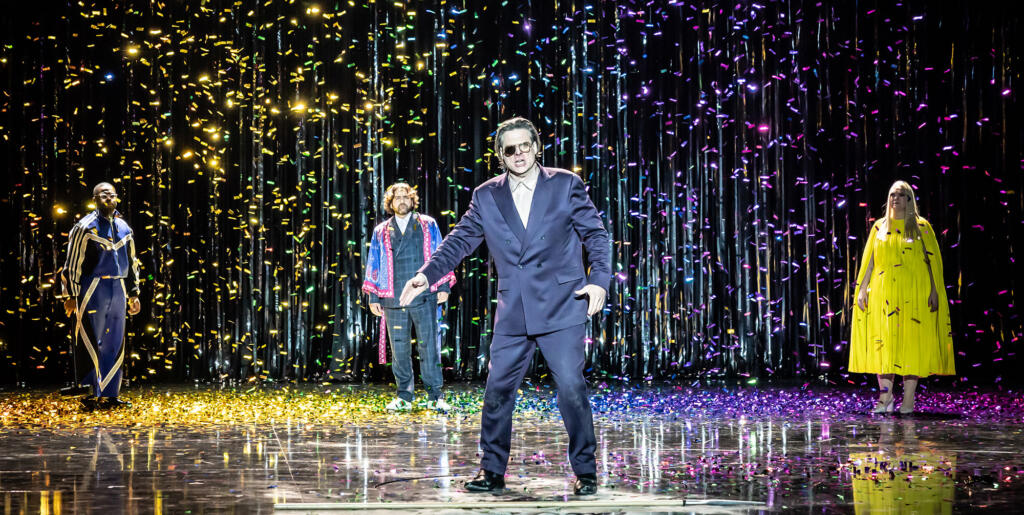
Other than that, Jones didn't give you too much to think about, or at least - like the Rhinemaidens wearing gym gear - nothing worth thinking to hard about to try to see any kind of rhyme or reason behind it (too fit for Alberich to catch? - as I said, you could find reasons if you like, but nothing worth the effort). In terms of look and appearance, the scene of Alberich being bewitched and teased by the Rhinemaidens was, as you would expect, colourful, attractive and slightly camp in a simple basic way, the Rhine represented by a surrounding curtain of glitter, Alberich arising from a hole in an otherwise fairly bare stage (making it all less effective if you are viewing it from a high vantage point in the Gallery). As with The Valkyrie, black clothed 'invisible' figures helped move things around, here permitting Alberich and the Rhinemaidens some swimming and floating movements, which worked well enough.

Aside from the obligatory avoidance of anything in terms of traditional costumes, it was pretty much according to the libretto, or at least to the same intent and purpose. The gold of the Rhine was initially shaped as an child-size baby puppet (manipulated by the black figures), but soon took a more traditional form, again through a series of transitions, from a crumpled sheet to flattened ingots and eventually, believe it or not, to an actual ring of a size that you can fit on your finger. An actual ring, I tell you! I'm not used to such literal fidelity in a modern production of Das Ring des Nibelungen. Nibelheim on the other hand resembled not so much a heavy industry factory as a production line in a bakery, with the dwarfs wearing chef caps. As I said, don't think too much about it...

The majority of Das Rheingold of course takes place in Valhalla and Jones didn't reveal too much of that, the giants presumably withholding the keys to the newly constructed abode of the Gods until they had received the agreed remuneration for their labours (nope, no hint of any commentary approaching Castorf's emphasis on that aspect), so it might well have been the log cabin we see in Die Walkure. The shimmering curtain remains in the surround, and we have conglomerations of white globes on stilts that could be abstract clouds. Again, I wasn't inclined to think to much about it other than it was all pleasant and decorative enough. What matters more is what take place within it.

What takes place within it sticks fairly closely to the original storyline. Aside from Freia being transported on the back of the Giants' work van, the exchange rate for her is indeed measured against the accumulation of trays of Rhine gold ingots to her height - and don't forget to throw that tiny Ring in. That's fine as far as it goes, but essentially what Richard Jones and conductor Martyn Brabbins working together successfully achieve is getting the necessary impact for each of those key moments and scenes. The brutal killing of Fafner by Fasolt (a dummy brought on in an off-stage switch) battered about the head with a gold ingot was particularly forceful. The arrival of Erda (with the Norn as three schoolgirls? Your guess is as good as mine), sung impressively by Christine Rice, also created the necessary gravity and impact, together heralding the tragedy of the curse of the Ring that will (we hope) play out in future installments. The shimmering fall of rainbow glitter for the bridge to Valhalla, and the lockdown against the Rhinemaidens at the conclusion seemed an appropriate way, in Richard Jones terms if nothing else, for everything that came before.

Some moments of levity in the Tarnhelm episode were balanced in this way by the gravity of what the Ring's preliminary evening prologue lays down, and the balance was supported by the characterisation and singing. As noted above, Christine Rice in particular made that small but significant and truly Wagnerian impression as Erda, but there were notable performances also from John Relyea as Wotan, Leigh Melrose as Alberich, and a suitably shifty portrayal of Loge by Frederick Ballentine. Madeleine Shaw's Fricka and Katie Lowe's Freia contributed to the family dynamic alongside the entertaining comic action hero shapes thrown by Julian Hubbard's Froh and Blake Denson's Donner. The giants might not have had much physical stature in this production but I enjoyed Simon Bailey and James Creswell's Fasolt and Fafner.

I can't say that Martyn Brabbins' conducting of the orchestra made a huge impact - maybe I was focussing too much on giving the production and sets design more thought than it merited after all - but neither did I notice anything that felt out of place in pacing, delivery, the surge of leitmotifs or in the whole continuous flow of this marvellous work. Some of the music press appear to have been more generous about this production - whether it's a show of solidarity with the proposed fate of the ENO, I couldn't say, but such sentiments can be excused, as the loss of the ENO in London would be a serious blow for opera lovers, for London, for arts, culture and for tourism. I don't expect Bayreuth at the Coliseum, but who in any other part of the country - certainly not here in Belfast - is going to have the resources to present not only an entertaining and accessible Ring cycle to a diverse audience, but a solid programme of great opera every year? If not in the Coliseum, at least keep the ENO funded and in London. Its loss would be very much regretted and missed by this opera-goer at least.


Links: English National Opera

Saturday, 25 April 2020

Wagner - Parsifal (Palermo, 2020)


Richard Wagner - Parsifal

Teatro Massimo, Palermo - 2020

Omer Meir Wellber, Graham Vick, Tómas Tómasson, Alexei Tanovitski, John Relyea, Thomas Gazheli, Julian Hubbard, Catherine Hunold

ARTE Concert


The unique nature of Parsifal as a Good Friday celebration, as a consecration for the stage of Bayreuth and as a spiritual journey in its own right, means that there are many ways of exploring it in a stage setting. There's no one way that works better than another but the most effective are those that simultaneously tap into and draw on the work for its unique source of power while also bringing something to it. When it comes to Graham Vick you have a director who is capable of doing just that in his own way, which is in a manner that relates it to the world we see around us. That's not so easy with a work that delves into the philosophical and spiritual and areas of religious mysticism, but Parsifal is a work that remains relevant for all time. Somehow Vick and conductor Omer Meir Welber manage to get all those essential qualities together in this January 2020 production at the Teatro Massimo in Palermo, or at least in some places better than other.

You can never tell if it's a good thing with an opera but in the case of Parsifal it's not exactly a disadvantage that you can't immediately see the direction a production is going to take even when a full hour and a half of Act I has elapsed. If it adheres however to the underlying sentiment of the work then it will hold and move you and Vick certainly manages to make you feel viscerally what the opera is all about. It might sound like an excuse but more than anything this is an opera you need to feel before you can understand it. It's no surprise that Vick uses familiar modern military and war imagery for Act 1 as a way of establishing that the world is in the midst of a deep crisis, one that it is badly in need of a saviour, a healing and renewing force. In Act I, more than anything, you can feel the pain. And it's not just Amfortas who is in agony, but Gurnemanz, the knights of the Grail and ultimately Parsifal too who comes to feel their pain and suffering.


The setting of Act I is visually simple and minimalised. There's a sandy-looking floor of chipboard with a canvas screen behind, giving the impression of a contemporary Middle Eastern military base with troops in army uniform and Kundry wearing a burka. Vick doesn't appear to intend to impose any political commentary, he just uses images that you will be familiar with as a way to get through to the idea of pain and feeling compassion. As such, the progression of Act I is straightforward but there are unusual touches that stand out. The first is the very Christ-like image of Amfortas, which isn't anything new he makes the first striking impression here wearing a brutal crown of thorns. Gurnemanz's story of the spear is played out in shadows on the canvas, showing images of war, victory and submission. The procession of troops lining up for the unveiling of the grail is not ineffective for it being a tin cup, as the symbolism of what it stands for is fully felt in Amfortas shedding a blood sacrifice. More than that, the shedding of blood is also endured by the troops/knights who painfully open up cuts on their arms. Set to Wagner's miraculous score, it's an immensely powerful first Act.

I've made no mention of Parsifal in Act I as he is purposely nondescript here, which is no reflection on Julian Hubbard who sings the role well here, but this is not his time, nor space for that matter. He's not even 'Parsifal' yet. That comes in an Act II which when it opens quickly undercuts any sense of Klingsor being an otherworldly agent of evil and instead depicts him as a very human one. He's a rogue soldier in fatigues, smoking a cigar, dropping his trousers to reveal the bloodstain of his emasculation. You might expect the flowermaidens to also be wearing burkas in Vick's contemporary Middle Eastern setting, and indeed that is how we see the chorus, but initially the maidens are semi-clad in underwear only, looking on as Parsifal cuts his way through their men, later coming to him seductively in coloured wraps.


The strangest scene in Act II however is the appearance of Kundry as a head only, buried under the sand, positioned in the same place as the grail buried under the sand in Act I. Establishing the nature of Kundry is vital in any Parsifal and here she is not so much the temptress and seductress as having a surrogate motherly quality, bringing an Oedipal edge to her encounter with Parsifal. An iconic image of Mary Magdalene opening up from the floor hints at another side, and Kundry as a woman of course has many sides and many incarnations, weaving a web of illusion that Parsifal brings crashing down with his newly gained wisdom and the power that such wisdom conveys on him.

Just as you can't expect Parsifal to come to knowledge and understanding without undergoing the whole laborious process of learning, you can't expect to know what direction Vick is pointing towards until you get to the conclusion of this Palermo production. It is of course a variation on the idea of a return to the paradise, a return to lost innocence, but Graham Vick depicts this persuasively as the need to become like a child again, throwing off the artificial constructs of religion, war and racism that have led to a corruption of true nature of humanity, and aspiring to be something better. It's there in the Easter message of healing, of Death and Resurrection, wiping away the sins of mankind. In Act III the salvation is that the Knights are no longer called upon to fight wars and bleed. They no longer have the spiritual nourishment that the Grail once provided, a gift that was used in a corrupted way to sustain nationalistic pride and wage war. Now it is turned towards healing and compassion.


Again, this is something that has to be fully felt in order to be fully understood. Some of the shadowplay imagery in Act III is consequently quite shocking, the result of a world thrown into chaos, where coldness and horror hold sway. Amfortas, as a leader of men is tired of it all, even more unwilling to continue to wage an endless war; reluctant to give sustenance and countenance to its continuance he topples Titurel out of his coffin. In the healing of the wound, Parsifal opens up a new way guided only by love and compassion. That is the Holy Grail.

In order to feel that the production obviously needs rather more than visual references and cues, and fortunately it's a beautiful interpretation in terms of musical and singing performances. Omer Meir Wellber rushes it along a little fast in places, or maybe I've been listening to too many slow versions recently, but there is a deep flow to the performance, completely Wagnerian, and it supports and helps bring out all those undercurrents that Vick hints at in his direction. Catherine Hunold doesn't quite get under the skin of Kundry the way another interpretation might, but she proves to be a fine replacement for Eva Maria Westbroek, providing some lovely lyrical singing in Act II with Parsifal, but she is also able to bring an edge of chilling drama when it's needed.


I've seen Julian Hubbard a number of times - he's a regular in Irish National Opera productions - but I've never seen him take on anything as big as Parsifal. I believe he also was engaged as the understudy before having to take over the main role and he acquits himself exceptionally well, making it look almost too easy, but also essentially human. The other principal roles are all superb. John Relyea is a fine Gurnemanz, his solemn intoning warm and reassuring, his storytelling compelling, his belief unshakable, his joy at the end overwhelming. Tómas Tómasson is wholly enveloped in the painful distraction of Amfortas, and Alexei Tanovitski's Klingsor is one that shows up the weak foundation of his blustering menace in the face of a greater power.  Strong singing and good characterisation all around, the Good Friday message of the Palermo Parsifal hits home exactly the way it should.

Links: Teatro Massimo Palermo, ARTE Concert

Sunday, 2 June 2013

Meyerbeer - Robert Le Diable

Giacomo Meyerbeer - Robert Le Diable

Royal Opera House, Covent Garden - 2012

Daniel Oren, Laurent Pelly, Bryan Hymel, John Relyea, Jean-François Borras, Marina Poplavskaya, Patrizia Ciofi, Nicolas Courjal, Jihoon Kim, Pablo Bemsch, David Butt Philip, Ashley Riches, Dušica Bijelić

Opus Arte - Blu-ray

The folly and the controversy surrounding the Royal Opera House's production of Meyerbeer's Robert Le Diable have been extensively reported elsewhere, from the cast changes and departures through to its critical mauling in the press. While I've no doubt that a full evening of a misconceived five-act Meyerbeer opera could well have been a painful experience live at the Royal Opera House, a filmed recording of the production is however another thing entirely. That's not to say that some of the problems with the production are any less evident, but there are compensating factors that one can perhaps better appreciate from the comfort of one's own living room.

Even the undoubted weaknesses in the production can be offset to a large degree in this case just by the rare opportunity to see one of the greatest works of 19th century opera performed on the stage. Meyerbeer was one of the most important and composers of his time, an influence on both Verdi and Wagner, but his extravagant style and grandeur hasn't remained fashionable, and even his greatest works - huge successes in their day - have fallen from the popular repertoire. Such is the case with Robert le Diable, a work which drew wide acclaim from fellow composers, critics and achieved wide popular international success following its premiere in 1831. The work was last performed at Covent Garden however in 1890, and it hasn't been performed much anywhere in the world over the last century.


The fundamental difficulty with putting on a staging a work of 19th century Grand Opera does indeed have to do with it being at odds with popular tastes and fashions. It's not so much a reflection on the quality of the work as the fact that modern audience has very different expectations from opera, and the old-style can be hard to swallow for a modernist, post-modernist, post-post-modernist audience. It's like expecting a reader of Harlan Coben thrillers to adapt to reading Walter Scott, or for readers of Ian McEwan to engage with the themes of Victor Hugo. The challenge that faced director Laurent Pelly then is not an enviable one. He may not entirely have succeeded, but although his production for the Royal Opera House was heavily criticised in a way Pelly does capture the spirit of Meyerbeer to some extent. Perhaps it's more of a case that audiences still aren't ready for Meyerbeer.

Which is understandable, but a pity nonetheless. If nothing else Robert le Diable is an opera experience like no other. Musically and in terms of plotting it's not the most sophisticated, but Meyerbeer packs the five acts of the opera so full of melodies and dramatic development, underlining it with grand choral refrains, lyrical expression, comic interplay and over-the-top gothic imagery with some ballet sequences thrown in for good measure, that it's never anything less than pure value-for-money entertainment. Pelly's production, unfairly criticised I feel, attempts to put all the colour and the darkness of the work up there on the stage in the sets and costumes, and he does so rather well. It's faithful to the spirit of the work, playing it straight where it ought to be, exaggerating in other places, but never stooping to making fun of the melodramatic developments and wild declarations.


Aiming for the middle ground between period fidelity and modernism, there's a "cardboard cutout" feel to the scenery then that is reminiscent in places of David Hockney's designs for the Glyndebourne production of Stravinsky's The Rake's Progress. It's like an ancient black and white engraving that has been garishly hand-coloured, or even a medieval tapestry that might lack realistic detail and proportion, but nonetheless has the power to evoke the history and the values of another period far from our own. Sometimes this works exceptionally well (Act III's vision of Hell on a mountain pass like something out of an Hieronymus Bosch painting), at other times the imagery feels a little forced (the ultimate battle between the good of Alice and the evil of Bertram in Act V), and sometimes it's just a little too kitsch and reminiscent of Monty Python and the Holy Grail to take seriously (the colour of the medieval tournament in Act II).  

In most cases however, even those mentioned above, these are valid responses to the nature and tone of the material itself. Stravinsky and Meyerbeer may have little in common (Gounod's Faust might be a better model to consider), but Robert le Diable does indeed relate an exaggerated morality tale of the battle between good and evil similar to the one in The Rake's Progress. Here, Robert of Normandy is rumoured to be the son of beautiful princess who married a demon from Hell. Robert however has the choice to follow a path of righteousness, and demonstrates his leniency by sparing the life of the minstrel Rimbaut who relates the story of Robert the Devil to assembled knights at an inn in Palermo. He could choose also to win the hand of Isabelle in the traditional way through a tournament, but despite the warnings of his late mother and his foster sister Alice, is laid astray by the machinations of his companion Bertrand, the real devil of the work. If he steals a magic branch from the tomb of Saint Rosalie, he can win Isabelle by other means.

Barring some questionable choices - I'm still in two minds about the choreography of the zombie sisters of St Rosalie during the opera's most famous/notorious Dance of the Nuns ballet - Pelly's staging is sympathetic to the shifts of tone in the work itself and gets fully behind it, never attempting to make it into something else entirely with conceptual cleverness. Daniel Oren too shows great feeling for the work, its rhythms and variations, and - regardless of what you think of the merits or otherwise of Meyerbeer's score - it's simply a delight to see this type of work being put through its paces. There is however one other problem associated with putting on a Meyerbeer opera that the best efforts of the conductor, director and the Royal Opera House seem powerless to influence. It seems like we really don't have the singers for this type of work any longer.


It's understandable that singers who would be suited to or capable of singing Meyerbeer are obviously more focussed on the greater career opportunities afforded by singing Wagner or bel canto. Even good Verdi singers are thin on the ground nowadays and the demands of Meyerbeer are often greater. Singing the title role, Bryan Hymel proves that he is up there and his performance is not only commendable, it's almost heroic. His voice might not be to everyone's taste, and it does start to grate and go a little bit wayward as the opera progresses through the final acts, but the effort is considerable. No less demanding is the role of Bertram and John Relyea handles it superbly and with great character. Despite her commitment, Marina Poplavskaya however is terribly miscast here, as is Patrizia Ciofi, who really doesn't have a large enough voice for this style of work, her singing sounding like a whimper that is lost in the orchestration and big choruses.

It's this aspect of the production that is the most problematic. While there are advantages to watching Robert le Diable on the screen that allow one to better to appreciate the full Meyerbeer experience that Oren and Pelly recreate, it only emphasises the unsuitability of some of the singing. There's no doubting the commitment of the performances however, and for all its flaws this is a sincere and a valiant effort to stage one of the great opera masterworks of yesteryear. The recording of the work and its presentation on the Opus Arte Blu-ray (which comes in a die-cut slipcase) is of course of the highest quality in both image and sound. The extra features however are slim, with only a Cast Gallery and a five-minute presentation on the legacy of the work, which does nonetheless give you an idea of the challenges of putting on this work. There's an essay and a full synopsis in the enclosed booklet. The disc is BD50, Full-HD, Region-free, with subtitles in English, French, German, Japanese and Korean.