Emmanuel Chabrier - L'Etoile
De Nationale, Amsterdam, 2014
Patrick Fournillier, Laurent Pelly, Stéphanie d’Oustrac, Christophe Mortagne, Hélène Guilmette, Jérôme Varnier, Elliot Madore, Julie Boulianne, François Piolino, François Soons, Harry Teeuwen, Jeroen van Glabbeek, Richard Prada
Culturebox - 16 October 2014
Aside from Offenbach, we don't often get the opportunity to see much French comic operetta outside of France. In Paris, the Opéra Comique do outstanding work in keeping this distinctive lyric tradition alive and presented in its best light. And, it might be a bit of an obvious remark to make but it's true - Chabrier's L'Etoile is one of the brightest stars of the repertoire that is rarely performed nowadays. It's surprising then to see it performed and done so well in this recent production at DNO in Amsterdam, but there's a well-appointed French production team in place here with Patrick Fournillier conducting and Laurent Pelly directing, that does justice to the musical and comic qualities of the opera.
What makes Chabrier's L'Etoile great are the same things that make any opéra-comique or opéra bouffe great. It's funny and it has great tunes. It does however need a good comic actors/singers and direction that plays to these advantages, and that's all perfectly in place here with Stéphanie d’Oustrac leading the cast and Laurent Pelly bringing his colourful and often absurd sense of style and fun to the proceedings. Optionally, a great comic opera can have a satirical leaning, or it can have one worked into it by the director, but I don't detect any particularly subtle social commentary in L'Etoile or much opportunity for including one. The plot, as silly as it is, is however a lot of fun and moves along well, providing plenty of opportunity for comic situations, romance and lovely music.
We're in the kingdom of King Ouf I. He's a ruler who likes to keep his people entertained. A few fireworks on special occasions and the odd impalement - what better way to keep the populace happy and maintain order? Traditionally, it's a troublesome rebel who is executed on these occasions, but such is the terror among the general public that even in his best disguise, setting traps and making provocations, Ouf can't find a single unruly citizen. But the king has another problem. According to the constitution, the ruler must announce his successor by his 40th birthday, and King Ouf is 39. Ouf depends on the court astrologer Siroco to help guide him though this dilemma through observation of the stars.
Princess Laoula has however just arrived incognito from a neighbouring kingdom to sound out the possibility of a marriage alliance, but on their way they meet Lazuli, a travelling salesman who falls in love with the Princess. Rebuffed by her minder, the ambassador Hérisson de Porc-Épic, Lazuli strikes out at the next person he meets, who just happens to be King Ouf. Ouf is livid and delighted that he now has a legitimate victim to execute. Siroco however warns the king that the stars indicate that his and Lazuli's destinies are connected, and that the king's death will follow within 24 hours of Lazuli's. Lazuli is therefore treated like a Prince at the palace, until the Mataquin royal delegation arrives and Lazuli's elopement with the Princess throws everything into turmoil.
As inconsequential as the plot might seem - despite the contrivances, it's not even particularly involved - Chabrier's music for L'Etoile is beautiful, melodic and sophisticated. In contrast to much comic operetta and even Offenbach's straightforward arrangements, Chabrier's music is much more operatic and fitted to the mood as well as the dramatic context. It's also wonderfully paced, the spoken dialogue sections kept to a minimum, moving rapidly from one situation with a beautiful aria to another. Much of the work revolves around solo singing in this respect, but there are also some duets - appropriately in those love scenes, of course - and some wonderful chorus work, all of which enlivens the work with great variety.

It's this colour and variety that is reflected in Laurent Pelly's direction and in the set designs by Chantal Thomas. The setting of the opera is abstract enough that it can work in any time period, but Pelly resists modernising what is an old-fashioned work too much and keeps it playful. The idea that we are in a police-state is indicated in Act I not with spy cameras but with loudspeakers on numerous poles, with fearful citizens scurrying around in trenchcoats. Later we see secret police with hound heads, and Ouf himself is depicted as a pantomime Teutonic dictator in oversize shorts. Stylised old-fashioned vehicles are used for Lazuli's mobile shop and for the Mataquin entourage, and the devices for impalement and astrological observation are clockwork cog, wheel and pulley operated. Even the pink puffball dresses of the maids of honour fit in perfectly with the cartoon look and feel of the work.
Pelly's direction of the cast also contributes greatly to the success of the production. The acting is comically exaggerated, but not overly so, letting the delivery of the libretto carry the humour. Stéphanie d’Oustrac is particularly good here in her inhabiting the trouser-role of Lazuli. I'm more used to seeing the mezzo-soprano in rather more glamorous roles and in Baroque opera, but her opéra bouffe work is just great. It's a tricky role to sing, and the physical acting required doesn't make it any easier, but that lovely rich voice is full of colour and character. Christophe Mortagne is an energetic Ouf, perfectly pitched in the comic acting with a lovely lyrical tenor voice. Hélène Guilmette's Laoula is also well sung. Patrick Fournillier and the Residentie Orkest fairly romp through Chabrier's delightful score, and the De Nederlandse chorus are as impressive as ever.
Links: Culturebox, Dutch National Opera
Richard Wagner - Parsifal
Royal Opera House, London - 2013
Antonio Pappano, Stephen Landridge, Simon O'Neill, Angela Denoke, Gerald Finley, René Pape, Willard White, Robert Lloyd, Dušica Bijelić, Rachel Kelly, Sipho Fubesi, Luis Gomes, Celine Byrne, Kiandra Howarth, Anna Patalong, Anna Devin, Ana James, Justina Gringyte, David Butt Philip, Charbel Mattar
Opus Arte - Blu-ray
Richard Wagner's Parsifal is a work of supreme brilliance, the final work of a musical genius. It's the summation of a career that marked the highest achievement in the world of opera not only up to that point, but it's debatable whether it has ever been surpassed. More than just standing as one of the greatest works of opera ever composed however, it's also a work of art that is practically a philosophical summation of everything it means to be a human, suffering in an imperfect world while searching for meaning and a higher sense of purpose. Musically, the work even seems to go beyond itself and expand into another realm or dimension that lies outside conventional space and time, and it can even take the listener there with it. If you've experienced Parsifal, you'll understand that is not hyperbole.
No pressure then for any opera house who has to put it on and live up to such high expectations. While there are ideological problems and contradictions inherent within Parsifal, there is at the same time a degree of openness to interpretation in how to present a work that is far from conventional and difficult to stage as a traditional opera that makes it an intriguing prospect, but there are dangers in trying to pin it down to any one meaning. It's perhaps unreasonable then to expect anyone to have anything new to add to what is inherently great in itself, just that the work be allowed to weave its magic. As such, it's hard to find any fault with the Royal Opera House's 2013 production of Parsifal, but inevitably some parts fare better than others.

In terms of just the pure performance of the work and indeed the purity of the performance, the concept, the casting, the attention to meaning in the musical detail and the manner in which every element of the work contributes to the piece as a single interlocking whole, everything about this production is well-considered and judged to near-perfection. Every element brings out the quality of Wagner's writing to its fullest expression and is performed with passion, purpose and complete commitment. Other than René Pape singing Gurnemanz, the cast might not have been the Wagnerian's first-choice for these roles, but my goodness, they all perform like they ought to be.
Most extraordinary of all is Angela Denoke, who gives an utterly magnetic performance, seemingly possessed with the spirit of Kundry. Kundry is evidently no ordinary woman but something mythical and superhuman, so it's a bit much to expect anyone to really embody this character to the extent that Wagner developed her but... well, there you go, Denoke is something of a phenomenon here. It's such a strong and committed performance, from a vital central role, that it anchors all the others - not that they aren't spectacular in their own right. Gerald Finley feels the pain as Amfortas, director Stephen Landridge working with this aspect of the work as the driving force for the stage conceptualisation. Finley's singing is as smooth, precise and as measured as his Hans Sachs for Glyndebourne, but perhaps just a little too calculated. Combined with the pain of the grail itself (a new idea of which more anon) and the pain of Kundry's long, troubled existence that Denoke takes to a new dimension, it all serves to underpin the central concept in a variety of complementary ways.

Simon O'Neill might not quite have the character or the acting ability to lift Parsifal up to a similar level, but you can't really find any serious fault his singing or his unstinting commitment here. He gives it everything and perhaps over-expresses when sometimes a singer just needs to surrender to the role. His stamina however is impressive, and he doesn't just hold firm and steady throughout, but finds near-impossible reserves to keep up a consistent level of performance across the almost four hours that the role of Parsifal calls for. You know that you can rely on that level of professionalism and consistency from René Pape as Gurnemanz and we aren't disappointed. I'd say we get even a little more from Pape this time around, particularly in his third act performance as a shuffling near-broken knight who finds his long suffering and his faith have been rewarded. It's all there in those finely sung lines and Pape delivers them with self-contained dignity.
Knights of the Grail are there in name only in Stephen Landridge's abstract-modern production, all of them wearing immaculate grey suits rather than suits of armour. The staging is a little bit cold and clinical in this respect, Alison Chitty's symmetrical geometric stage design dominated by a large cube that serves principally as a hospital room for the bed where Amfortas was being looked after by concerned doctors. The use of lights and sometimes projections however also use the cube to reveal backstory elements in flash-frames and live-action slow motion. Nothing should overwhelm the senses more than the music or the expression in the singing in Parsifal, and every element here seemed well-judged to suggest and engage the audience rather than over-emphasise or impose a false reading. The bloody depiction of Klingsor's auto-castration, for example, is a strong image, but it ties into the sense of pain, of the image of sick world in need of healing that is there throughout the work and brought out in Landridge's production. And it must be said, brought out also in Willard White's performance and his presence throughout much of the second act.

Landridge's production continually engages with imagery that relates very closely to the original stage directions, but with a distinct twist that makes you re-examine what it all means. Most striking (and controversial) of all is the image of the Grail itself. There might be an inward rolling of the eyes when the cube opens up at the behest of the knights to reveal that the Grail is actually a child wearing nothing but a loin cloth, but the sense of a sacrificial act and the question of blood - both so vital to the underlying message of Parsifal - as well as the sheer pain of Amfortas's role as the keeper of the Grail, is unquestionably intensified when the ritual involves the actual cutting of the child and spilling his blood for the faithful.
Such touches don't perhaps reveal any new vision for the work, but they certainly find a thought-provoking way to touch on the philosophical mysteries and the religious significance of the work without having to rely on over-used Christian imagery that has become detached from its original significance and meaning. The meaning of Parsifal may remain elusive but as Simon Callow succinctly put it in his perceptive commentary during the intervals when I viewed this at the cinema screening, it's really just about the world being in a mess and being healed by a return to innocence. The Royal Opera House's production, led from the pit by Antonio Pappano with attention to detail and with genuine feeling for the work's Good Friday message, ensures that it touches upon and brings together every aspect of the transcendent beauty of Wagner's great masterpiece.
On Blu-ray, the clinical qualities of the production design are perhaps made even more evident. The image quality in the High Definition transfer is however impressive, and it benefits considerably from the DTS HD-Master Audio 5.1 mix that warmly expresses the detail and the beauty of the orchestral playing. The BD is a two-disc set, with Act I and II on disc one, and Act III on disc two. There are only a few short features on the discs - a 6-minute Introduction to Parsifal that takes into account the production and the characters, and a five-minute piano run through of a scene from Act II between Simon O'Neill and Antonio Pappano. The booklet explains the significance and the intent of Alison Chitty and Stephen Landridge's production design, and there's a fascinating essay by Lucy Beckett on the writing of Parsifal, with reference to Wolfram von Eschenbach's 13th century text that serves as a basis of the libretto.
Richard Wagner - Tannhäuser
Wiener Staatsoper
Peter Schneider, Claus Guth, Kwangchul Youn, Robert Dean Smith, Christian Gerhaher, Camilla Nylund, Iréne Theorin, Norbert Ernst, Sorin Coliban, James Kryshak, Dan Paul Dumitrescu, Annika Gerhards
Wiener Staatsoper Live Streaming - 2 November 2014
First performed in 1845, Tannhäuser was Wagner's first great success and notwithstanding the musical developments first advanced in Der fliegende Holländer, its scale and the coherence of its concept place it more recognisably in the familiar Wagner style. Fusing legends and mythology from a number of sources, Tannhäuser uses these stories as an examination of deep archetypal human desires and experiences and as an expression of Germanic character, but it's also a work that tells us a lot about the composer himself. Tannhäuser is inextricably linked with the philosophy and the struggle of Wagner as an artist, a revolutionary and a reformer.
The nature of the composer, the problematic and difficult and contradictory sides of his character and his thought, the expression of that in his music is perhaps more of interest to the modern-day opera-goer than what the 13th century writings of Wolfram von Eschenbach, the influence of Heinrich Heine and the arcane language of Wagner's own libretto. There are clear parallels between the figure of Heinrich Tannhäuser and Wagner himself as an artist struggling with and using his physical and sensual human nature as a means to reach a higher, spiritual truth. Setting himself against prevailing thoughts, customs and morals, he's a character that is fated to be misunderstood and forced into exile only to eventually return triumphant and vindicated.
Seen in that regard, Tannhäuser isn't the most modest portrait of the artist as a young man. There's an arrogant self-importance here but, arguably, all of Wagner's later works could be seen in that light as overblown ego-trips of a musical genius who was fully aware of his own talent and ability. It is worth examining then, just what makes them as great as they are, and Wagner's personal life can't be left out of the equation. It's clear from the greatcoats, top hats and neck-ties in Claus Guth's production of the music-drama for the Vienna State Opera, that the director is aiming closer to Wagner's own period, attempting to make the link between the composer and the work clearer and, hopefully, thereby making it a little more meaningful and accessible.

The settings are likewise 'closer to home' than the nymphs and satyrs in the grotto of Venusberg or the Wartburg castle of the middle ages in Eisenach. Act I is basically just a stage and a red curtain, Tannhäuser's time spent with Venus being rather more clearly signalled as the artist having an affair with his leading lady before coming to the realisation that he is neglecting his art and has to move on. Guth initially makes use of doubles on the part of Heinrich and Venus to emphasis the struggle between the sensual and the spiritual side of the artist, but this mirroring isn't taken much further on into the opera. The Wartburg scenes look like Wagner period Saxony or Thuringia concert halls, drawing rooms and bedrooms, but there's nothing that jars with the mythological setting of Wagner's imagination.
Other than transposing the period, Guth's production doesn't really appear to have anything more to add to the meaning of Tannhäuser, sticking fairly closely to the word and the intent of the libretto, but it has to be said that not much more actually happens over the three acts. That hasn't stopped other directors from imposing all manner of strange concepts on the work (I still haven't made much sense out of this year's Bayreuth production), and there's no major deconstruction of the author and the work in the manner of Herheim's Bayreuth Parsifal. It may not be an edgy or experimental production, but it's well designed, it looks lovely, and is appropriate and respectful of the work. Peter Schneider's conducting matches that tone, forging a close bond with the stage production. There are no surprises, it's played very much in a solid, classic Wagner style, and that seems appropriate for the purposes of this production.
There are however some notable differences with how Tannhäuser is traditionally viewed, and this creeps in more as the work progresses. Act II, Scene 4, for example is played like a scene from Die Zauberflöte, the nobles - masked and wearing cloaks - separating Tannhäuser and Elisabeth as if to prepare him a Masonic initiation. The Landgrave comes over as a kind of Sarastro, his purpose to win Tannhäuser away from sensuality and emotion to the side of order and rationality by fulfilling his destiny as an artist and Meistersinger. Act III however is the most powerful in how it expresses the reality against Wagner's poetic idealism. Tannhäuser doesn't make any literal pilgrimage to Rome, but is rather sick in bed having collapsed at the end of Act II. Elisabeth might be an angel who journeys over the hills to the Wartburg on a pathway to heaven in Wagner's eyes, but here, in her despair at his failure to "return", takes an overdose of pills and falls into an adjoining bed beside him.

The conclusion to Tannhäuser, if it's not exactly a happy one, should at least be spiritually uplifting. Guth's ending manages to be a little bleaker than most, but it does prove to be uplifting and incredibly moving. Wolfram's song (Act III, scene 2) becomes even more mournful as it follows the reality of Elisabeth's suicide sacrifice, particularly as it's sung impressively in this light by a wonderfully lyrical Christian Gerhaher. The only right ending then, since she has gone to meet Tannhäuser in heaven, is for Tannhäuser also to collapse and die beside her as the curtain falls and Wagner's Tannhäuser theme reaches its almost overwhelmingly beautiful conclusion. Whether it fits with the overall concept, whether it relates to the Wagner-period production design or not, it is nonetheless extraordinarily effective and, for me at least, it gives the work a more relatable human side.
The singers can contribute to bringing out that side of the work too, and that was well done in the Vienna production. As mentioned above, it was most evident in the performance of Christian Gerhaher, who received the loudest roar of approval from the audience at the curtain call. Robert Dean Smith gave his usual solid, untiring and finely sung performance. He faltered slightly when coming back after the long break before his appearance in Act II, but was right there on form again in the third act. Camilla Nylund's Elisabeth was beautifully and sweetly sung. The soprano role of Venus in the original 1845 version of the work performed here (as opposed to its scoring for mezzo-soprano in the 1861 Paris version) was however still just a little too low for Iréne Theorin to really sing with the necessary force. The chorus are also a vital force in Tannhäuser, and the Vienna chorus took up that role wonderfully.
The Vienna Staatsoper have an ambitious and impressive programme of pay-per-view live performances being streamed this season. The next performances being broadcast are La Bohème on November 7th, and Khovanshchina on November 21st. See the Live Programme on their website for details.
Links: Wiener Staatsoper Live Streaming programme; Staatsoper Live at Home video
Leoš Janáček - The Makropulos Case
Bayerische Staatsoper, 2014
Tomáš Hanus, Árpád Schilling, Nadja Michael, Pavel Cernoch, Kevin Conners, Tara Erraught, John Lundgren, Dean Power, Gustav Belácek, Peter Lobert, Heike Grötzinger, Reiner Goldberg, Rachael Wilson
Staatsoper.TV - 1 November 2014
The challenges that come with putting on a production of Janáček's The Makropulos Case are probably no more difficult or easier than dealing with the specific requirements of any of the composer's operas. In all of his works, it's not only vital to settle on a consistent tone and temperament that brings the music and the staging together, but the key singing roles have to be perfect - and singing in the Czech language is no easy matter for a non-native. It's only however when you get to see one of those works come together on every level, that you realise just what its most important ingredients are. The Bayerische Staatsoper's 2014 production of The Makropulos Case is revelatory in that respect.
While all the other elements are still important, it's clear from the Munich production that The Makropulos Case only really works as it should when you have a soprano of great charisma and ability singing the role of Emilia Marty. I'll come to that later, but the other elements are important to consider in how they relate to each other. Musically, everything was perfectly in place here. Tomáš Hanus has prepared a new critical edition of the work, and if it can be judged simply on how well Janáček's music delivers the intent of the libretto, it's a superb interpretation, but it's also clearly responsive to the composer's familiar rhythms and the advancements in the musical language that are evident at this late stage in the composer's career.

The value of Árpád Schilling's direction is less easy to determine. Visually, Márton Ágh's costume and production design doesn't appear to have a great deal to contribute to the drama, the message or the purpose of the work, but conceptually it's on solid ground and it provides a setting that suits the tone that has been carefully established. Act I in Dr. Kolenatý's office is somewhat Kafkaesque, the minimal set consisting of a marbled wall with chairs studded vertically into the narrow side of the revolving set. There are a few steps from this leading down to a snow-covered front-stage. It feels imposing, intimidating, confusing and otherworldly, which isn't a bad impression to give as the details of the Prus versus Gregor case are outlined, and the way that the enigmatic Emilia Marty becomes involved in it.
The stage of the opera-house, or the back-stage of an opera house in Act II, is bright, modern and clinical. Asylum-like almost, with stylised padded walls. Quite what the tone is meant to indicate isn't entirely clear, but if you want to see it that way, it's perhaps a view of Emilia Marty's inner world. Having lived in various guises for the last 300 years, it could be seen as a reflection of her needing to renew and refresh, clinically detach herself from the sentiments and emotions that would inevitably become a heavy burden over such an extended lifetime. There's nothing playful about the science-fiction concept for this opera. It's a serious attempt to examine what gives life meaning, and of course, what gives life meaning above all else is the fact that it will one day come to an end.
Schilling's directing takes this very seriously, as does the musical interpretation of the score by the conductor Tomáš Hanus. Picking up on several other incidents that occur in the work and some of the comments made, Schilling takes this a little further. As a few late additions to the set indicate - including a kind of sacrificial flagellation - what is considered here is not just what would it mean for a person to cope with the eternity of existence, but what it would mean to be a woman, to be a beautiful woman, and to be the object of constant attention, to be pursued, hounded and living permanently as an object of desire to men (and women, if we also consider Krista's fascination with Emilia Marty, which should not be discounted as something incidental). Imagine that and imagine being forever young, beautiful and talented.

Well, that's the challenge that the soprano singing Emilia Marty/Elina Makropulos has to be able to work with. Aside from the language and musical challenges, aside from having to carry the weight of 337 years of being a woman in this position, she also has to be ageless, alluring, enigmatic and charismatic. No small order. Enter Nadja Michael. Michael hasn't been the most consistent singer in the past - when I last saw her Lady Macbeth in Munich she was all over the place really - but there's no questioning her presence and commitment in a performance. Emilia Marty proves to be a perfect fit for Nadja Michael.
I don't know about her Czech - she occasionally sounds a little less than perfectly clear in enunciation - but there's no faulting her singing performance or her ability to enter into her character. Marty is of course an opera diva, and I think Michael can relate to that. She looks simply terrific here, having that necessary presence and allure, wearing short blonde curls here and a teasing dress in Act II that reveals rather a lot. Her performance however is utterly magnetic and otherworldly credible. It would be a bit of a problem if the great opera singer Emilia Marty couldn't sing her own role, but there's no danger of that here, and Michael's performance is enthusiastically and deservedly acclaimed at the curtain call of the live streamed broadcast.
This is the kind of performance that can carry a show, but the other roles are supportive in how exceptionally well they are sung. Pavel Cernoch gives a clearly sung and impassioned Albert Gregor ('Bertie') and John Lundgren's Prus is well-measured and wonderfully sung, his role and relationship to Emilia Marty considered within the context of what it adds to the concept. The other roles are all more then capably sung by the Munich troupe regulars, with Reiner Goldberg in particular giving a touching performance as the former lover of the Carmen-like Andalusian gypsy Eugenia Montez. (There's a whole other question in The Makropulos Case of opera as an eternal artform of passions, and that's not neglected here either). Lyrical, dramatic and passionate, this was everything that Janáček should be, and it will do much to continue to raise his profile as one of the greatest composers of the 20th century.
Gaetano Donizetti - Roberto Devereux
Wiener Staatsoper, 2014
Andriy Yurkevych, Silviu Purcarete, Edita Gruberova, Paolo Rumetz, Monika Bohinec, Celso Albelo, Peter Jelosits, Marcus Pelz, Hacik Bayvertian, Johannes Gisser
Wiener Staatsoper Live Streaming - 17 October 2014
Donizetti's Roberto Devereux is perhaps not the strongest of the composer's trilogy of Tudor operas, but it has similar characteristics and plot devices that, with some good direction and a star performer in the principal female role, can put it up onto the same level as Anna Bolena and Maria Stuarda. In Roberto Devereux the significant role is Queen Elizabeth I, and it's played here at the Vienna State Opera by Edita Gruberova. The principal role might be in experienced hands then, but the work itself still needs a stronger sense of purpose and direction than it gets in this production.
Like Donizetti's other two Tudor operas, Roberto Devereux has the same advantages of romantic intrigue in a royal and political setting that raises the stakes of jealousy, rivalry, intrigue while at the same time putting a human face on historical affairs. This particular libretto however is contrived and fairly poor at humanising the characters. It's full of romantic declarations and dire pronouncements of the 'alas, woe is me', 'heavens, I have been betrayed' type. The plot is contrived, but it's the kind of material that would nonetheless give Donizetti tremendous scope for a score of stirring passions. Musically, and in terms of how the score has been written specifically for those human elements to be expressed in the singing, Roberto Devereux can be a thrilling experience.
Dramatically however, it needs a little extra effort. Roberto Devereux's fate and sentence of death for his actions in Ireland rest on the decision of a queen who feels that she has trifled with her affections, and that he loves another. Devereux however is determined that he will die before he reveals that his secret lover is Sara, the wife of the Duke of Nottingham. The contrivance rests on whether Devereux will save himself by presenting to the Queen a ring she has promised will always permit clemency towards him, but the ring is in Sara's hands. The Duchess of Nottingham has however been locked up ever since her husband's suspicions have been confirmed, recognising a misplaced scarf belonging to her. Even if she were able to deliver the ring to the Queen, it would reveal that she is her love rival. Oh, what a bind...

As melodramatic as the plot and the arch pronouncements might be, there's good symbolic use of objects in the opera - a scarf, a ring - to forge connection between characters and instigate revelations about their inner natures. If highlighted in the direction, they can be an effective visual hook to help move things along, unless a director has other ideas. Silviu Purcarete doesn't make a big deal of these contrivances, but he doesn't appear to have much else to contribute in its place to aid the dramatic progression. Costumes are mostly stage period with Elizabeth I in her familiar traditional costume and wig. The backdrop used throughout appears to be a row of opera boxes with the royal box tier slightly askew.
It's more than adequate as a set for representation of the locations, but the problem with the direction is that there'd not much thought given to getting across the heart of the work as a drama of extreme passions and historical adventure. Most of the acting and delivery of the arias within it is fairly static. Donizetti brings good dramatic tension in his score, and it's given a strong account under the direction of Andriy Yurkevych, but on stage, too much relies on the singers to make the deficiencies of the romantic declarations in the libretto credible and the give the characters a real human dimension. To their credit, the cast are all very good, but only one or two of them manage to rise above the limitations of the direction to this level.
The strongest singing performance here is Monika Bohinec's Sara. The Duchess of Nottingham has a substantial role in terms of the range of expression that Donizetti writes for the role. Bohinec expresses all the anguish and repressed feelings in her singing, and it's a good voice, undaunted by the high coloratura. She's a good actress too, but she's not given much direction and falls back consequently on traditional operatic gestures and delivery. Her confrontation scenes with Nottingham could be much more intense, but Paolo Rumetz is too static and, although very capable in the singing of the role, rather one-note in delivery. There's not enough to spark their scene to life. Celso Abelo sings well too as Devereux. He has a fine voice and good technique that carries some weight in an aria like 'come uno spirto angelico' as he vows to take his secret to the grave, but elsewhere he's not terribly exciting.

Edita Gruberova is however in a league of her own. As far as the Vienna Staatsoper's 2014 production of Roberto Devereux goes, she's the chief attraction and everything rests on her performance. Unquestionably one of the finest singers in the world in this kind of role, Gruberova has however been there for a long time now. When I last saw her perform in person in La Straniera in Zurich last year, I thought that her voice wasn't quite as steady and sure as it once was, becoming a little piercing and forced on those challenging top notes, but Gruberova was still capable and still had the presence and personality to fill a role like that. That assessment holds true of her Elizabeth I for Vienna's Roberto Devereux.
Gruberova might no longer be in her prime and might not have much in the way of direction to work with, but she has the experience to take this role and run with it herself. She understands the character, knows how she feels and knows exactly how to pitch her response to events. There's a little retained here from Christoph Loy's production of Roberto Devereux, with Elizabeth removing her wig, divesting herself of her public face to show her human vulnerability, but it doesn't have the same impact when there isn't the same consistency to the production as a whole. Even despite that, Edita Gruberova has the star quality to make this ending as bring-the-house-down compelling as it ought to be. No allowances need be made when you have that.
The Vienna Staatsoper have an ambitious and impressive programme of pay-per-view live performances being streamed this season. See the Live Programme on their website for details.
Links: Wiener Staatsoper Live Streaming programme; Staatsoper Live at Home video
Wolfgang Amadeus Mozart - Idomeneo
Wiener Staatsoper, 2014
Christoph Eschenbach, Kasper Holten, Michael Schade, Margarita Gritskova, Maria Bengtsson, Chen Reiss
Wiener Staatsoper Live Streaming - 14 October 2014
Until fairly recently, you wouldn't have seen much baroque or opera seria at the Vienna State Opera - although I'm sure an exception was made for the city's adopted son, Mozart. It's only fairly recently too that we've started to see Mozart played more authentically, with period instruments and in the scaling back of the size of the orchestra. It's marvellous then to see that kind of approach applied to the Wiener Staatsoper's production of Mozart's early opera seria Idomeneo, but in Kasper Holten's producton, it's not slavishly traditional either.
It may be one thing to play it with authentic period instruments, but opera seria brings with it expectations of a lot of static standing and declaiming long arias of anguish, torment and unrequited love, with some choral praise-giving for variety. A stage production needs to find a way of making that more accessible to a modern audience, and often that involves a great deal of cutting of da capo arias and ballets. Kasper Holten's production for Vienna finds a good balance between conceptual and traditional presentation, but his cuts and reorganisation of the structure of the work could be seen as rather more controversial.
Visually, the production has a strong design and state of the art stage craft, but there's not a lot visually or in terms of direction that expresses any great insight into the characters. The opening scene has impact, depicting the captivity of Ilia and the Trojans by having them bound in thick ropes, hanging high from the rafters. Ilia descends during her recitative and aria, as Idamante arrives and announces the freeing of the captives in thanks for the safe arrival (a little prematurely) of his father, the king Idomeneo, who was believed lost at sea. There are less effects in the subsequent acts - it doesn't even bother to show the traditional storm spectacle for Idomeneo's arrival - relying more on the stylised design of an ancient map of Crete and attractive, colourful costume designs to sustain visual interest.
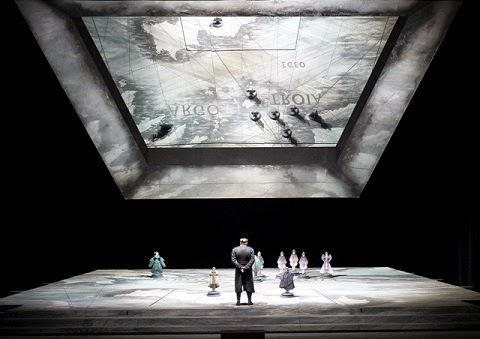
It's pretty to look at, but although there are a few stylised touches that attempt to get into the minds of the characters - most significantly in Idomeneo being haunted and tormented by bloody, faceless dark figures from the Trojan war in Act II's 'Fuor del mar' aria - there's not much in the way of interpretation in the traditional stage direction of the characters. That's not to say that Holten hasn't considered the work seriously and tried to find the best way of presenting it. It's clear from his efforts to restructure the work by reordering the musical numbers that he has thought about the characters motivations and has attempted to 'correct' things that Mozart himself might have done had he more time to work on it.
'Fixing' Mozart sounds a bit conceited and a foolhardy enterprise, but Holten's restructuring - although it goes a little too far in some of the cuts - does actually allow the work to flow better and make more sense. In opera seria, there can be a sense that arias have been included randomly just to suit specific performers, give each person their fair share of the spotlight, and just because an aria/lament/ballet/chorus is needed for variety at that specific point. (In the worst cases, works would even be corrupted by singers inserting their own favourite arias by other composers just to please the audience). Holten's editing is a serious attempt to bring greater dramatic and character consistency to the work, and largely, it succeeds.
The main change is in the placement of Ilia's aria and love duet 'Zeffiretti lusinghierei' with Idamante, which is removed from Act III to the opening of Act II. Coming immediately after securing the freedom of the Trojans and learning that Idamante may have lost his father, 'Se il padre perdei' consequently has more depth of feeling, and more convincing reason for Ilia to fall in love with the prince. The principal reason for its displacement however, is that it frees up the action of Act III and allows the drama of Idomeneo's dilemma to flow better without the interruption of the love scenes. This also allows the director to portray Idomeneo as a weak figure, bullied and punished by the gods, indecisive and willing to sacrifice Idamante, but ultimately unable to help his people. There is no sea monster here, it's Idomeneo who is the monster. At the end, his statue is toppled and he is unceremoniously dumped into a pit of demons with Electra as Ilia and Idamante are crowned the new rulers. Very much a case of out with the old...

Electra has always had a bit of a raw deal in Idomeneo, but in Kasper Holten's reworking of the opera she doesn't even get the opportunity to rage against the injustice of the daughter of King Priam of Troy replacing her in Idamante's affections. Act II - Scenes IV, V, and VI, where Electra comes into her own, are clearly considered superfluous to the drama and are all cut in this production. It's a pity as we seem to have a good Electra here in Maria Bengtsson, although admittedly we don't see here stretch her singing or acting abilities. On the other hand, Holten and conductor Christoph Eschenbach manage through the restructuring to include the new aria written for Idamante in the Vienna version of the work, and it fits in well.
What you also want to hear in Mozart are beautiful voices. Not so much for bel canto improvisation in the da capo arias, as much as in the purest sense of bel canto meaning sweet singing, as this is the way the characters express the sincerity of their feelings. The cast all fit this requirement admirably, with Margarita Gritskova most impressive as Idamante. Michael Schade's soft timbre perfectly suited a conflicted Idomeneo who has suffered and has depths of feeling for his son and his people, but not the strength to overcome the challenges he faces. Chen Reiss was a strong Ilia, her character benefitting most from the restructuring of the work (unlike Maria Bengtsson's Elettra), giving her arias and duets more depth of feeling. Eisenbach's reading of the score was light and refreshing, the clarity of the interpretation brought out wonderfully by the orchestra.
The Vienna Staatsoper have an ambitious and impressive programme of pay-per-view live performances being streamed this season. See the Live Programme on their website for details.
Links: Wiener Staatsoper Live Streaming programme; Staatsoper Live at Home video
Richard Wagner - Tristan und Isolde
Staatsoper Berlin, 2014
Daniel Barenboim, Harry Kupfer, Peter Seiffert, Stephen Milling, Waltraud Meier, Boaz Daniel, Stephen Chambers, Ekaterina Gubanova, Florian Hoffmann, Maximilian Krummen
Staatsoper am Schiller Theater, Berlin - 18 October 2014
How representational do you really need to make Tristan und Isolde? Isn't the journey undertaken by the two protagonists more an emotional journey than one taken at sea from Ireland to Cornwall? Should you not be thinking more about the philosophical content of Schopenhauer and Feuerbach that Wagner is exploring in the opera rather than wondering where the characters are physically located? Can you represent all that, for example, in the huge figure of a fallen angel?
Well, that image - based on a photograph by Isolde Ohlbaum - is the basis of the set for Harry Kupfer's original 2000 production for the Berlin Staatsoper, and it seems to be a powerfully iconic image to build a production around, even if it is difficult to relate it in any direct way to the tragedy of Tristan und Isolde (or Schopenhauer or Feuerbach for that matter). Dominating the stage, the huge angel lies prone, fallen forward, its elbows sunk into the ground, its right wing splayed, the left one shattered. Other than a few headstones scattered on either side of it, this giant is the only set for each of the three acts, occasionally slowly revolved and viewed from 360°. Tristan, Isolde, Brangäne, Kurwenal, King Marke and the others climb over it, lie on it and crawl beneath the broken wings.
There's a post-apocalyptic quality to the imagery which is also reminiscent here of the place beyond space and time occupied by Nikolaus Lehnhoff's production of Parsifal. There is something similarly apocalyptic about the subject of Wagner's retelling of the legend of Tristan und Isolde, the majority of the work taking place far beyond any physical place where the laws of man and rational behaviour hold sway. The forbidden love of Tristan and Isolde, freed from any inhibitions, knows no boundaries, subverts day and night, transcends life and only really finds its purest form in death. This is a work that likewise seeks to destroy the world as we know it and be reborn into something that transcends the physical and aspires to the divine.

That's something of a challenge for any composer to undertake, but I don't think anyone would question the genius of Richard Wagner's ability to convert that into the most sublime musical expression. Much like its abandoned first performances, the work itself still remains a challenge to perform, but the pay-off when it works and when everything comes together is enormous. There really is nothing else like it in all of opera - Wagner's own final masterpiece Parsifal excepted. The Berlin Staatoper, still currently residing at the Schiller Theatre while their Unter den Linden opera house undergoes renovation, with Daniel Barenboim at the helm for Kupfer's production, have one of the best teams in place to do this work justice, and the assembled cast for its 2014 revival certainly impresses.
The actual directing of Tristan und Isolde, as opposed to the production design, is undoubtedly just as complex as it appears to be simple. The motivation of the characters is to all basic intents that of all-consuming love, but obviously it goes beyond that to life-consuming love. You get a true sense of that in the Berlin production. By the end of Act I, having imbibed the love potion, it's not so much a case here of Tristan and Isolde barely being able to restrain themselves, as much as Brangäne and Kurwenal being scarcely able to prise them apart, even as they (notionally) arrive in Cornwall and King Marke strides up the back of the fallen angel to claim the wife Tristan has brought back for him.
Much intensified then, the same sense of burning ardour seeking consummation has therefore to be correspondingly heightened in each of the subsequent acts. That is undoubtedly the strength of this production and much of the reason for its success is down to Daniel Barenboim, one of the finest Wagnerian conductors in the world today. Barenboim seems to have an unerring ability to navigate the complex tidal surges in Wagner's operas, knowing when to hold back the immense forces, how to measure their release and when to let them completely overwhelm. In Tristan und Isolde, that force is deep, intense and slow-building, occasionally rising to an almost unbearable need for release. It's hard to believe that you can raise the stakes this early in Act I and continue to build intensity, but Barenboim and Kupfer's production does just that.

The complex nature of Tristan und Isolde however means that it also needs space to open up and expand, even as the outer world closes down on the two lovers. It needs a human-aspiring-to-superhuman quality to keep the metaphysical thinking grounded in reality and not merely floating off into the realm of abstract philosophical theorising. It needs great singers basically. I've detected some weakening in Waltraud Meier's voice in recent recordings and performances, but working perfectly with Barenboim's management of Wagner's score, her Isolde here was simply outstanding. It's true that her voice doesn't have the same soaring quality that is evident in the 2007 Barenboim/Chéreau Tristan und Isolde on DVD, and some adjustments have to be made, but she remains one of the foremost interpreters of the role. It was a gripping and utterly mesmerising performance.
Peter Seiffert was an impressive Tristan, the intensity of the performance stretching him once or twice, but he was equal to the challenge. Stephen Milling sang wonderfully and with gravity, but there wasn't great personality to his King Marke. Boaz Daniel was a last minute stand-in for a stranded Tómas Tómasson as Kurwenal, and he made a terrific impression, his singing energetic and passionate, making his presence fully felt. Likewise Ekaterina Gubanova gave us a beautifully sung Brangäne that was warm and heartfelt. If there were any weak link this perhaps mightn't have worked so well, but with such a fine cast and a strong conceptual approach backing up the unbeatable combination of Meier, Barenboim and the Staatskapelle Berlin, this was every bit as emotionally devastating and transcendentally uplifting as you would expect Tristan und Isolde to be.


