Showing posts with label Dean Power. Show all posts

Sunday, 28 May 2023

Mozart - Così fan tutte (Dublin, 2023)


Wolfgang Amadeus Mozart - Così fan tutte

Irish National Opera, 2023

Peter Whelan, Polly Graham, Anna Devin, Sharon Carty, Benjamin Russell, Dean Power, Majella Cullagh, John Molloy 

The Gaiety Theatre, Dublin - 27th May 2023

For a long time sceptical about whether Lorenzo Da Ponte's libretto of farce and misogyny had withstood the test of time and changing attitudes, I've certainly been won around to the true qualities of the work in modern productions that have actually revealed Così fan tutte to be far more layered and meaningful than you would think. I still don't envy any director having to choose how best to bring those qualities out, whether to play it as a straight comedy or whether to mine the deeper attitudes expressed for contemporary relevance. The Irish National Opera production, a touring production directed by Polly Graham, tries to pitch it somewhere in between and doesn't really succeed in doing full justice to either side of the work.

Where it does bring a distinctive touch is in the Irish historical setting. Opera should be tailored to and relatable to its audience, not presented as some stuffy period costume drama museum piece, but that doesn't necessarily mean that it has to be updated and made contemporary. Opera can still speak of contemporary issues if it can be related to a significant period, and such a period in Ireland (and elsewhere in the world) can be found in the early twentieth century. The nature and status of women is a theme worth exploring in Così fan tutte and Ireland has been slow to deal with women's rights which were the subject of interest with the rise of the suffragettes around this time, and that is certainly highlighted here.

War and revolution too since it's revealed that the year is 1914, but that's a little more problematic to add into the farce of this opera, with Guglielmo and Ferrando pretending to head off to fight in the trenches as part of an Irish battalion. It fits well enough though for the purposes of the production, and when the two return disguised as filmmakers with berets and moustaches, making a silent movie about Fionn mac Cumhaill and the Fianna, it's a little more meaningful and acceptable than making fun of oriental costumes, customs and appearances. That's fine as far as it goes, but in terms of direction it feels a little forced, flat, haphazard and inconsistent in its approach, gaining neither sufficient laughs nor significance in exploring the nature of women and men or indeed providing a lesson in the vagaries of love.

The resultant production design then was also something of a mixed bag. Sure, it has necessarily has to be basic in terms of set designs and effects, designer Jamie Vartan using projections to open it out a little and establish the period with newspaper articles and a sketched big house on the hill. I never quit grasped what the stately manor was about, other than perhaps how chorus of Irish women were treated as servants and second class citizens by the landed gentry. It wasn't a particularly impressive or eye-catching set, a huge hard plastic looking green blob representing a hill with a tiny 'big house' on top that was picked up and carried around by the cast for no discernable reason. Nor could I figure out the nature of Don Alfonso in this setting, walking around in a long house coat in a somewhat professorial manner with Ferrando and Guglielmo his students. None of it quite hit the mark.

To be fair, as ambitious as the Irish National Opera can be, even with reinterpretations of the standards of the opera repertoire, playing to the darker side of Così fan tutte is perhaps not really what they want to do with an opera buffa, particularly for a touring production. Leave that to the likes of Michael Haneke (Madrid, 2013) and Christophe Honoré (Aix-en-Provence, 2016). What they really want to get across is the wonder and beauty of Mozart, and there is no denying what we have here is a light and enjoyable production that certainly entertained the audience at the Gaiety in Dublin. Even though the Votes for Women scenes felt a bit forced in places, like a well meaning corrective for any misinterpretation of misogyny in the comedy. I have to admit, I enjoyed it more after the interval when I accepted the simple pleasure of seeing an amazing Mozart opera performed well, and was able to put aside any expectations of it having something significant to say.

There was certainly plenty to enjoy in the delivery of the singing performances. Anna Devin and Sharon Carty were everything you could hope for as Fiordiligi and Dorabella, their delivery bright and sparkling, filled with emotional sentiments, even if their predicament wasn't fully brought out in the direction of the acting. The same can be said for Dean Power's Ferrando and Benjamin Russell's Guglielmo. Neither were convincing in their disguises, but the emotional impact of the revelations they have about their girlfriends were wholly felt in their singing, which was powerful and true. The ever reliable John Molloy similarly made a great impression, even if his role as a manipulator was undervalued in the direction. On the other hand, Majella Cullagh delivered a fine comic performance in Despina's various guises and was the prime motivator in bringing the two sisters into the new sisterhood, but was slightly underpowered in her singing. It just shows how difficult all the singing roles are in Mozart - there are no secondary or minor roles here.
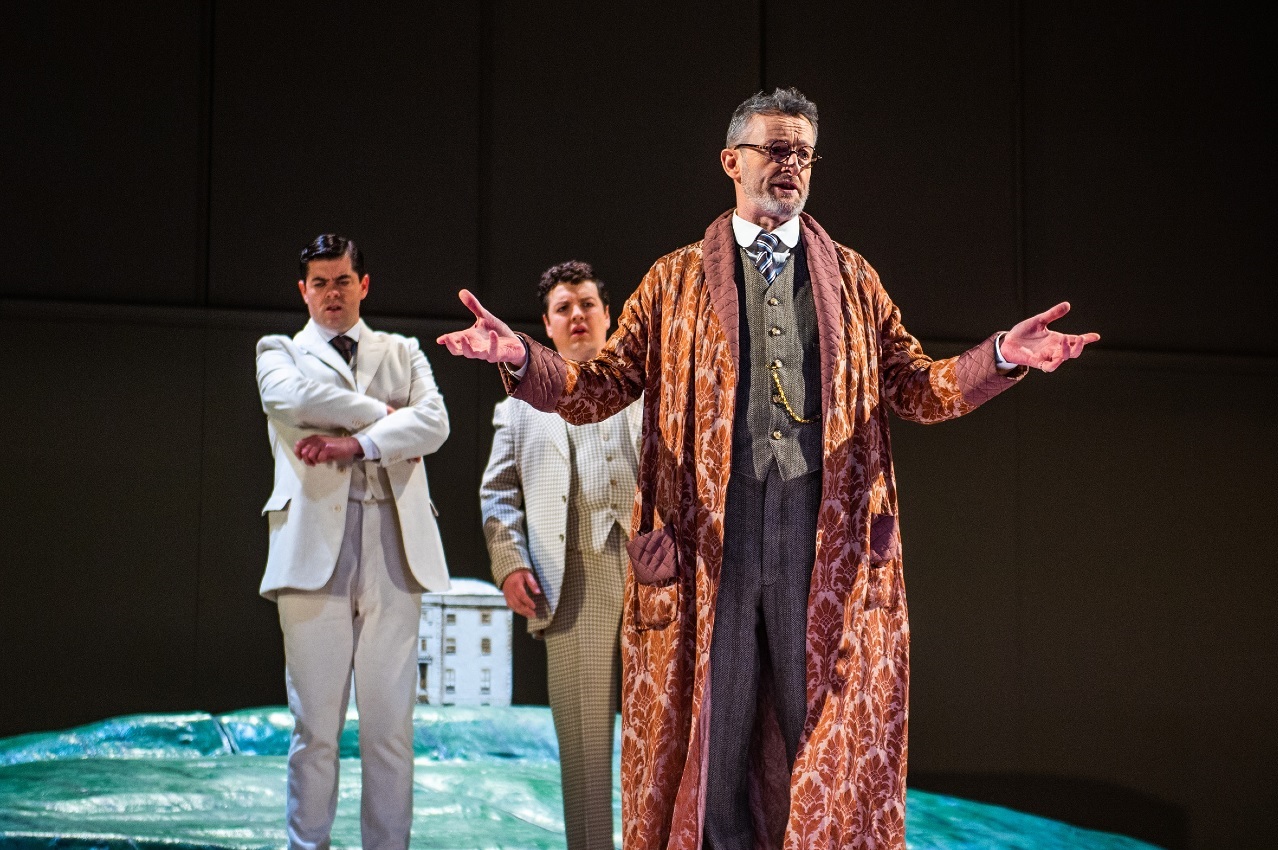
All credit to the principal roles then (and great idea of the INO to display the cast names in the surtitles as they took their bows at the curtain call), but you can't have any weaknesses at all in a meticulously constructed opera like this. The chorus played their part and the orchestra delivered the musical delights under the direction of Peter Whelan. The niggling inconsistencies in the setting and purpose were easily put aside then, as was any attempt to seek something deeper in Polly Graham's direction of the INO's Così fan tutte. The 'they're all the same' message here was simply that we all deserve to be loved and treated equally, and that was as truthful a reflection of the opera's intent as any.

Links: Irish National Opera

Tuesday, 9 November 2021

Beethoven - Fidelio (Dublin, 2021)


Ludwig van Beethoven - Fidelio

Irish National Opera, 2021

Fergus Sheil, Annabelle Comyn, Sinéad Campbell Wallace, Robert Murray, Daniel Sumegi, Brian Mulligan, Kelli-Ann Masterson, Dean Power, David Howes, Jacek Wislocki, Matthew Mannion

The Gaiety Theatre, Dublin - 7th November 2021

Fidelio is very much an opera shaped by the time in which it was written and the difficulties the composer had in bringing it to the stage. The composition of Beethoven's only opera was a notoriously long and difficult process, going through several different versions and an ignominious debut in 1805 that was considered a failure. Little of those initial problems are evident now in whichever version is produced, whether as Fidelio or its earlier incarnation as Leonore. Its reputation as an opera relies on it being Beethoven's only opera to some extent, which is no small matter of course, but there are indisputably greater qualities evident in the work's themes. Those themes are related to the period when Vienna was occupied by French forces, but they can still have powerful resonance and meaning today if you can get over some of the work's problems. I don't think the Irish National Opera were entirely able to do that in their current production.

Fidelio is purest Beethoven, a composition that rates with the very best of his work, but the operatic conventions do age the work somewhat, and as opera was clearly not somewhere the composer was entirely comfortable, it doesn't really strike out any new or original ground. The libretto, one of the main problems with the composition that needing continuous rework and revision over its development, has some opera-comique elements and dry recitative that don't sit well alongside the rather more serious main subject, which is that of a story inspired by French Revolutionary ideals of a prisoner being held captive in secret and treated horrifically in captivity without trial.

There are ways to bring these two stories together. Evidently they are connected in the fact that the main character Fidelio - who is the object of the prison warder's daughter Marzelline's attentions, and consequently the love rival of Jaquino - is actually a woman, Leonore, the wife of the prisoner Florestan. She is seeking to find and rescue her husband from the prison, despite his existence and presence there not being recognised, as he is being kept there is secret as an act of personal revenge by Don Pizarro. With word of the prison governor due to visit, Pizarro wants to cover up his crimes by executing the prisoner being kept in the deepest darkest dungeon, the man already practically dead from starvation.

The element that notionally holds the two parts together in its original incarnation is the theme of married love; of a wife who will go to desperate lengths to save her husband from an unjust fate for the love that lies between them. There are of course many other aspects, both political and humanistic - and even proto-feminist - that can be drawn from this situation, from the tyranny of Pizarro's injustice and the determination of Florestan to suffer the consequences of his belief in truth and freedom, but the rather domestic and conventional rescue opera situations involving a woman disguised as a man leads to some forced comedy in the opening act that really does little for the work. If this were Mozart, those themes can feed though to a more rounded character development and expression of sentiments that deepens the themes. Here in Fidelio, it just seems conventional and perfunctory. 

Or at least in as far as you can ever find anything in Beethoven conventional or perfunctory. There is much to admire even in the opening scenes of the opera, which has some beautiful arias in there amidst the rather stiff recitative and the formality of the musical arrangements and romantic complications. If there is any real purpose to the opera revealed in these scenes aside from the consideration of what is important in a marriage and what is not (and a same-sex marriage would be one thing that would never have been considered in the original), it's in the way that the opera begins to really define what is and what is not important, establishing areas of light and shade, lightness and darkness, captivity and freedom, and viewing them as two sides of the same coin. Even behind the ordinary everyday matters there can be an underlying darkness. Fidelio's great achievement is in showing how even with that, hope can still exist and not be extinguished.

There are clear references to that in several scenes of the first act, not least in the brief release of the prisoner from their dark cells to spend a moment in the sunlight and fresh air. The prisoners chorus is simply a glorious moment, the gross inhumanity of what they have endured overshadowed/enlightened by a small act of kindness that means so much. It's a beautifully expressed sentiment and it is hope that holds it together; the belief and indeed even holding onto the memory that there is something better out there, something that it is not beyond reach.

Directing the Irish National Opera production Annabelle Comyn rightly focusses on light/dark and hope as being the humanistic heart of the work and its importance is no more clearly brought out than at the start of Act II. There is a noticeable shift in Beethoven's music, the heaviness that has been gradually alluded to now becoming inescapable as we are taken to the dark depths of the cell where Florestan is being detained, bound in chains, starving to death, about to be executed. All hope is almost snuffed out and yet we see the almost dead Florestan crawl towards a thin sliver of light that somehow manages to penetrate the utter darkness of this dank hole. It's chilling and a heart soaring moment at the same time.

The greatest expression of this human ability to endure and strive to hold onto hope and the fight for truth and justice is of course in the singing. In Florestan's voice we sense that purpose and determination, much as we have already seen it to a similar extent in the bravery of his wife Leonore's actions. It's interesting that the same qualities were evident in the performance of Satyagraha that I saw in London last week, about how it becomes possible not to submit to despair when you know you have truth and right on your side. Comparing Glass with Beethoven might raise eyebrows, but the same principle applies; the meaning and its ability to reach out to an audience is expressed through the music and through the human voice much more so than the dramatic presentation.

Fortunately, Beethoven's music - long laboured over to achieve just such an effect - and the performance of it under Fergus Sheil manage to get this across superbly at the Gaiety Theatre in Dublin on the opening night of this production. So too did the singing, with notably fine performances from Robert Murray as Florestan and Sinéad Campbell Wallace as Leonore. Kelli-Ann Masterson also stood out as Marzelline, but all the singing performances were excellent, finding the truth to their characters situation even if the libretto, the English translation of the recitative and the delivery of it left something to be desired.

This is something that the director never managed to get to grips with. The fact that the opera was sung in German and the recitative spoken in English wasn't really a problem, that was an easy enough switch to make. The way it was delivered however was completely lacking in any naturalistic intonation and it just contributed to the early scenes feeling inauthentic and lacking any real drama or emotion. The set designs didn't particularly help. They were basic and functional in the presentation of a relatively modern prison or containment facility - a computer screen, the prisoners wearing orange jumpsuits - but there could have been much more done to make this relatable and relevant to contemporary struggles for truth, freedom and justice.

Putting aside what it wasn't or what it maybe should have been, the little touches and emphases of light and dark were enough to win over an appreciative Dublin audience to the brilliance of Fidelio as an opera and highlight the important expression of humanistic qualities within it. If the production was lacking and didn't manage to address the dialogue/acting weaknesses that remain hazardous in this particular opera, the musical performances and the singing were nonetheless of the usual high standard we have come to expect from the Irish National Opera.


Links: Irish National Opera

Tuesday, 10 August 2021

Wagner - Tristan und Isolde (Munich, 2021)


Richard Wagner - Tristan und Isolde

Bayerische Staatsoper, 2021

Kirill Petrenko, Krzysztof Warlikowski, Jonas Kaufmann, Mika Kares, Anja Harteros, Wolfgang Koch, Sean Michael Plumb, Okka von der Damerau, Dean Power, Christian Rieger, Manuel Günther

Staatsoper TV Live Stream - 31 July 2021

The final production of Nikolaus Bachler’s exceptional tenure as General Manager of the Bavarian State Opera may not be a perfect send-off, but it's certainly one that typifies his time there. It's a style that is adventurous, takes chances and divides audiences, and putting Krzysztof Warlikowski on Tristan und Isolde is something of a gamble. It's not uncommon to be left confused about what is going on and what the point of a production is, but more often than not, Munich productions manage to find a way to connect with a work in new and interesting ways. Warlikowski production of Tristan und Isolde actually doesn't appear that adventurous or controversial, or at least no more absurd and bizarre than a work with magic love potions, over-fervent raptures and philosophical ideas wrapped up in flowery language.

This time it looks - as with his Don Carlos - as if Warlikowski has again run out of ideas when confronted with the big beasts of opera. On one level, Tristan und Isolde takes place mainly within the ordinary surroundings of a wood-panelled 1920s' hotel room, while on another level, projections show an alternate - perhaps heightened emotional or fantasy - playing out of events. On one level it's Christoph Loy and another it's Bill Viola, whose extraordinary art installation screens for the Paris Tristan und Isolde separated the physical or material with projections of the ecstatic spiritual heights that would otherwise be difficult to translate into purely human actions on the stage. And when music and visuals come together, this opera can certainly achieve that level of transcendence.

Warlikowski's lack of any new ideas to separate those states (and connect them) is most evident in Act II. There's a build-up here that is expressed as the secret lovers meet that demands a corresponding gradual increasing intensity of feeling before they almost dissolve in rapture, but where little happens on a dramatic level other than the inevitable release of tension - a false release - with their discovery by Marke. On the stage in this production, there's not a lot going on and little visual sign of such deep feeling as it is expressed in the music. Warlikowski takes it to the other level in the projections that show the lovers physically separate but tantalisingly close, as water rushes out beneath the bed they lie on and submerges them.

The director emphasises this separation of the world we see and the one we feel right from the start, using people dressed as dummies with no distinguishing features to stand in for Tristan and Isolde during the Vorspiel. Its not so much an idealised form as a negation of one, where the physical characteristics don't matter as much as the interior lives. Without wishing to 'body shame' any performers, there's nothing new about that idea, and opera viewers have had to use their imagination to see less than perfect human forms and shapes aspire to an image of sublime godlike perfection ever since opera was invented.

You can take this idea too far - and Warlikowski inevitably does - bringing the dummies back as a doubles for Tristan and Isolde in Act III, populating Kareol with baby Tristans who, for some obscure reason, sit around a table in the wood-panelled room setting that the director also seems to have settled upon for no discernible reason. It takes more than a few odd references and mannerisms however to hold Tristan und Isolde back from reaching its goal, and it does seem to be the case that there's no need to be hasty in judgements; you need to wait and see where this takes us, and if any work repays delayed gratification, it's surely this one.

Warlikowski, for all his mannerisms and lack of any imaginative response to Tristan und Isolde (compared for example to Simon Stone's recent production at the Aix-en Provence festival that I viewed just a week before this), does however bring out one element of the work that hadn't really struck me before. I'm not quite sure how he does it, since there is little that visually alludes to it, but between him and Jonas Kaufmann, it's possible to see the commonalities of themes in Tristan that are developed further in Parsifal. The pain of the wound, the enlightenment through pain to consider one's origins, birth and mother's suffering on the way to achieving an enlightened state. Kaufmann - and very much Harteros too - at least made it feel that there is something deeper behind the pathology of both characters in their conflation of love and death, and it has nothing to do with a magic love potion. Their love-death union is derived from an awareness of human existence and love as a path to attain spiritual bliss that can only be completely fulfilled in the union of death.

Anja Harteros in fact embodies this much better than Kaufmann. She is a fine singer and a superb actress; you can practically see the music and every emotion it provokes flow through her. Her embodiment and communication of a role I find is always unerringly accurate - or makes you believe it so - but her voice isn't always able to match the same heights, particularly in the Wagnerian range. She's good, a true artist, but just not fully up to the demands of Isolde here right across the board. Kaufmann is also very weak, struggling to gain volume over the surge of the orchestra, but he is also simply unconvincing in a role that demands total and utter commitment. Kaufmann and Harteros have been much more convincing as a duo in Verdi, in Otello, in La Forza del destino and in Giordano's Andea Chenier, but most assuredly not in their role debuts as Tristan and Isolde.

There's no question however that both give it their all and Kaufmann is actually quite impressive in the critical Act III. I thought he might hold back from the exceptional demands placed on Tristan in this Act, and holding back is not something you can do in this opera. As committed as his Act III is, and as well as it is delivered, it still seems to lack the underlying conviction, of someone dying and longing to die, but unwilling to do so while his soulmate is still alive and separated from him - on several planes of existence. It's a lack of connection to his character here that I've felt in some of Kaufmann's performances; in some it might not matter so much in some works, but in Don Carlos and in Tristan und Isolde - two of the pinnacles of opera - half-measures and almost-theres are not good enough. 

With neither Kaufmann, Harteros nor Warlikowski being entirely up to the admittedly huge task of Tristan und Isolde, Kirill Petrenko - another person who has a huge impact in making Munich one of the centres of exciting opera in Europe - has his work cut out for him. In the absence of any kind of real stirring of passion on the stage, he has to make the music do most of the work. He doesn't quite manage it and in fact, judging by the sound purely on the live stream performance, it feels like he is trying too hard. He pushes the orchestra to those extremes, trying to conjure up day and night, light and dark, but there is little on the stage to match the intent, and the work often sounds aggressive. He is of course aware of the dynamic and pace and is able to rein it in and slow it down for 'O sink hernieder, Nacht der Liebe' in Act II, before building up the rush of emotions (the preparation of lethal injections, the lovers awash in a hotel room) that is shattered by the arrival of Melot and Marke. If it's fury you want to show, this is the way to play it, but it should be disappointment and resignation, shock and disillusionment. And credit where its due, you can see it in Harteros, if nowhere else.

Think what you will of the singing and the production - and there's good support from Wolfgang Koch and Okka von der Damerau as Kurwenal and Brangäne - but there is nothing else in all opera like the Liebestod and the finale of Tristan und Isolde. It's one of the most sublime expressions of human feeling put into music or indeed any form of art, unparalleled in its capacity to reach deep inside and express something wonderfully mysterious and sublime. Despite the imperfections elsewhere, Kaufmann's final utterance of "...Isolde" and Harteros's soaring Liebestod touch on the work's extraordinary and unmatched core of emotions, the essence of life and death, of striving for a love that surpasses human boundaries and attains something spiritual and sublime. Despite the failings of the production as a whole, this moment as ever is worth waiting for. And if it still achieves its purpose, what has come before and the contributions of the performers must have succeeded on some level.

Wednesday, 20 March 2019

Krenek - Karl V (Munich, 2019)


Ernst Krenek - Karl V

Bayerische Staatsoper, 2019

Erik Nielsen, Carlus Padrissa, La Fura dels Baus, Bo Skovhus,,Okka von der Damerau, Gun-Brit Barkmin, Dean Power, Anne Schwanewilms, Janus Torp, Scott MacAllister, Kevin Conners, Wolfgang Ablinger-Sperrhacke, Michael Kraus, Peter Lobert, Mirjam Mesak, Anaïs Mejías, Natalia Kutateladze, Noa Beinart, Mechthild Großmann

Staatsoper.TV - 23 February 2018

Ernst Krenek is one of a small number of composers to compose and actually complete a full opera using the twelve-tone system, a technique that you would think might reduce the musical forces and resources commonly at the disposal of a composer dealing with such a complex historical subject as the life and death of the 16th century Holy Roman Emperor Charles V. One need only look Verdi's Don Carlo, which opens (in some versions) with the death of Charles V and the ascension to the throne of Carlo's father Philip II to see a very different musical and dramatic enactment of the death of the same king.

Like Schoenberg's take on questions of faith and dogma in his only (uncompleted) twelve-tone opera Moses und Aron, the technique however does have a unique ability to explore those issues from an intimate and personal perspective while also considering them in the light of something more vast and infinite. Krenek's Karl V sets about doing just that, the opera taking place on the death bed of the Holy Roman Emperor as he looks back retrospectively on the personal family matters and the childhood experiences that may have had an influence on the actions taken in his more public role.


Karl V is an ambitious work, a difficult work in its subject and musical presentation. Like any work with a historical figure as its subject it inevitably must reduce a life down to a few incidents, but like the best works of this kind - Boris Godunov comes to mind - Karl V somehow captures their importance and power for that period of their lives, but at the same time it reflect them as flawed human beings who ultimately become an irrelevance with death. There's very much a sense in Karl V that Charles is all too aware of that outcome as he lies sick and dying in the monastery of San Jeronimo de Yuste.

The proximity of death focusses the mind to some extent, but the king's illness and his need to justify his actions to his maker also skews his perspective on events. It's far from an impartial, objective or impassive view on the past, but one that, since Karl has believed that he is enacting God's will to unite the world to the faith, is very much the perspective of a self-important, self-pitying, egocentric (or deus-centric if I may coin a word) man faced with his own human weaknesses and mortality. Was this all preordained? What were the signs that set him on this path?


Karl's reflections take in a number of significant events, or events that once appeared significant but now seem to have less or no less importance than his family relationships; and even those have troubling concerns. On his deathbed, he remembers his mother Joanna the Mad, finding an apple in a worm as a child and seeing in it now corruption eating through the heart of the world. That leads him to the Diet of Worms and the rise of Martin Luther, to the defeat of Francis I at the Battle of Pavia, his sister Eleonore's marriage to Francis, as a way of suing for peace, and his enrichment through Pizzaro's plundering of the riches of Central and South America.

"Are these not anecdotes conditioned by the contingent nature of transitory individuals?" his sister accuses. Is that all history amounts to? Krenek's Karl V takes in the complex nature of the individual and their place in history, in the elements of chance, fate and the volition of the individual to effect not change, to make a mark on the world, but without ever being able - up until the last minute of their lives - to know whether they actions were right or how they will be judged by history. That's a tall order, but Krenek bundles those temporal shifts into the musical structure, running line forward and then reverse. Such details might not be obvious to every listener, but - like Schoenberg's Moses und Aron - the form is meaningfully tied to the content.

Like Castellucci's 2015 production of Moses und Aron in Paris, Carlus Padrissa of La Fura dels Baus tries to find an equivalent language to express the intimate and the infinite. Visually it's stunning, as La Fura dels Baus productions usually are, the scale of it incorporating heaven, hell and everything in-between. It captures the ambition of the work and the subject abstractly without being over-elaborate, over-literal or overloading information, and without having to rely too heavily on conventional symbolism other than where it is called for. The worm in the apple that is a globe of the world and Karl's mother Juana with his dead father shown in Pietà pose both attesting to Karl's elevate view of his own importance.


But it's an importance that, notwithstanding its approaching decline into irrelevance through death, is significant and worth reflecting on. Reflections feature heavily with mirrors in the background and even the floor covered in a shallow layer of water. Projections are used, acrobats hang down from the heavens on wires in elaborate formations, every state-of-the-art theatrical effect is employed, but purposefully for a work and a subject that has layers of complexity and ambitions of scope. It's a huge collaborative effort that impresses greatly, from lighting and choreography to the musical direction of Erik Nielsen and the commanding central performance of Bo Skovhus as Karl V. The Munich regular repertory players and the chorus are also impressive, all of it showing due consideration, effort and appreciation for what is clearly a challenging and ambitious opera.

Links: Bayerische Staatsoper, Staatsoper.TV

Tuesday, 9 February 2016

Srnka - South Pole (Munich, 2016 - Webcast)


Miroslav Srnka - South Pole

Bayerische Staatsoper, 2016

Kirill Petrenko, Hans Neuenfels, Rolando Villazón, Thomas Hampson, Mojca Erdmann, Tara Erraught, Dean Power, Kevin Conners, Matthew Grills, Joshua Owen Mills, Tim Kuypers, John Carpenter, Christian Rieger, Sean Michael Plumb

ARTE Concert - 5th February 2016

Commissioned to write a new opera for the Bayerische Staatsoper, the young Czech composer Miroslav Srnka and Tasmanian writer Tom Holloway have found a subject that is inherently dramatic and even operatic in South Pole. Working from the existing documentation of Captain Robert F. Scott and Roald Amundsen's race to be the first to reach the South Pole, all the rivalry between the two explorers is laid out; the personalities, the tensions and the drama and danger of the expeditions. The setting itself offers great possibilities for exploration in the musical treatment and for the stage production, and both certainly offer a great deal of inventiveness even if ultimately the subject and the inconsistencies within the treatment can't help but invite its own defeat.

Unless, of course, you consider inconsistency to be an essential part of the make-up of the work and its subject. It's very evident from early on that South Pole wants to tell the two stories of Scott and Amundsen simultaneously but separately, a 'double opera' that contrasts the experience of one with the other. The opera opens with the famous telegram message sent by Amundsen to Scott, where the British team learn that, contrary to reports that the Norwegian team were setting off for the North Pole, they are now in direct competition with the British explorers on their Antarctic expedition to the South Pole. The morse tapping, sung out by Amundsen, establishes a rhythmic connection between the two teams and it holds for a while as they each encounter similar challenges and problems in their preparations. By the second half those paths have gradually diverged, and the opera itself also seems to lose direction, even if that is to some extent intended.


The opera then is successful in as far as it adheres to the tone and content of its source material and subject, but it's also a victim to the challenge of maintaining the complexity that these divergent paths take. Using the source material available, South Pole does establish well the personality of the two explorers, but it also attempts to speculatively delve more deeply into aspects of their personality and love-lives. As far as outward appearances go, both are practical and single-minded men - and the John Adams-like musical arrangements of the beginning, hold them in this rhythm. There are minor differences in their preparation, Scott fatally choosing ponies for the expedition, Amundsen dogs, but first and foremost in their mind is the determination to beat their rival and the unthinkable consequences of failure.

The two expeditions take place then simultaneously on the stage, and the gaps between the men and their attitudes grow as they face the challenges of the merciless conditions in the Antarctic. Amundsen shows little concern for the deprivations of his colleagues, much less any sentimentality they show for loved ones back home, refusing to even let them keep journals or write letters but keeping one of his own to be published after the adventure. Scott is also very practical-minded and necessarily so, but any sympathy he has for the pain endured in the suffering of his team is tempered by the greater torment he feels that Amundsen will beat him to the South Pole and render his efforts meaningless.

That much might be interpreted by the historical facts and public face of the individuals concerned, but South Pole is not an all-male affair. Kathleen Scott appears as a figure to show a deeper side to Scott as more than just an explorer, but more than just the wife of the explorer, a projection or a vision conjured by letters, the creators of the opera attempt to depict her as a person in her own right. A similar approach to Amundsen proves more problematic but it serves to provide a strong contrast. Amundsen refuses to discuss his love-life with his colleagues, but is nonetheless 'visited' by the figure of the 'Landlady' - whether this is a fictional creation or not I don't know - who he once had an affair with. Whether all this works, or intentionally fractures the divisions between the men - their loneliness emphasised more than any purpose or sentiment that unites them - it all comes together in a marvellous, if somewhat unconventional quartet close to the end of the first half of the opera.


After that, it becomes harder to hold the work together and the music becomes more complex in its unconventional rhythms and tonal levels, with up to 100 individual parts being played at any one time by the orchestra. The two halves of the story take very different turns and the music accompanying them accordingly jars atonally in their individual experiences and in how they sit uneasily side-by-side. If there's anything that holds South Pole together as two sides of a related story that almost never overlaps, it's Hans Neuenfels' stunning stage direction for the piece. Brightly lit in a blinding white background - as you might expect - the set is nonetheless highly stylised and expressionistic, a black X marking the spot up at the back of the stage, reminding us constantly of the importance of the goal. A line divides the stage down the centre, with Scott's expedition on the left and Amundsen on the right, both playing out simultaneously.

Principally then, although the other roles are all well developed, the opera plays out as a two-hander between Scott and Amundsen, and consequently it needs two strong personalities in the creation of these roles. If both Rolando Villazón and Thomas Hampson could be said for one reason or another to have had better days, there's no sign of it in South Pole. Both men imprint a strong character into their singing and performance in what are evidently very intense roles. The unconventional rhythms of the drama and characterisation don't favour much in the way of lyricism, and the staccato English-language libretto doesn't always help, but the performances of both men are impressive. Tara Erraught and Mojca Erdmann likewise do much to bring Kathleen Scott and the Landlady to life and widen the dimension of the opera. It still never entirely feels like it's successfully of a whole and it becomes harder to maintain interest or find a central core that holds it together as the work progresses, but South Pole is an ambitious piece that has much of interest in its component parts.


Links: ARTE Concert, Bayerische Staatsoper

Thursday, 6 August 2015

Puccini - Manon Lescaut (Munich, 2015 - Webcast)


Giacomo Puccini - Manon Lescaut

Bayerische Staatsoper, 2015

Alain Altinoglu, Hans Neuenfels, Kristine Opolais, Markus Eiche, Jonas Kaufmann, Roland Bracht, Dean Power, Christian Rieger, Ulrich Reß, Christoph Stephinger, Petr Nekoranec, Evgenij Kachurovsky, Okka von der Damerau

Staatsopertv

While it's always interesting to see what the Bayerische Staatsoper come up with in their efforts to reinvent and revitalise familiar opera works, sometimes I think they try too hard and end up missing the point. In the case of Hans Neuenfels' productions, the approach is undoubtedly well-considered, purposeful and usually has something meaningful to say about the works themselves, but it rarely does the work any favours. In the case of Manon Lescaut, the attempt to explore and comment on the work itself seems to miss the main point that opera is to provide dramatic as well as musical coherence. And entertain. Much of those vital aspects were missing from the new Munich production.

Then again, although it is rapidly finding its way in recent years into the Puccini canon and has undoubted merits, Manon Lescaut is far from perfect and has evident musical, dramatic and structural flaws. It's infuriatingly lacking in any kind of through narrative and, set as a number of almost standalone acts that make it more Scenes from Manon Lescaut, there are huge gaps in the narrative that lead to inconsistent characterisation. It's structured much like La Bohème then, but Puccini would make up for it there with the most extraordinary arias, melody and melodrama. In Manon Lescaut, you rely on either knowledge of the Abbé Prévost original or - more likely - you can fill in some gaps from familiarity with Massenet's more satisfying version of the work, Manon.


Most obviously and fatally, there's a whole act missing between Act I and Act II of Puccini's version. Des Grieux and Manon run away to Paris after their meeting at the end of Act I. Act II then starts with Manon established as the mistress of Geronte. There's no scene to show the brief period of happy poverty of her time in Paris with Des Grieux that becomes so important a bond that it brings them back together and persuades Manon to (almost) give up her life of luxury in Geronte's apartment. It's alluded to but never shown, making what follows - not least the bizarre out of nowhere Act IV scene of them dying in the Utah desert - much harder to relate to or piece together.

Considering that there is nonetheless some terrific music and situations even within this mangled adaptation of the story, most productions and directors tend try to make the most of it and strive to give it a greater coherence. Not Neuenfels. His production seems to follow my own personal dissatisfaction of the work by following it to the letter and letting it stand in its own imperfect state. The bare minimalist stage for Act I, for example - lit only by a box-like neon frame - shows the characters and the setting as something unsubstantial and vacant. Act II gains nothing much more than trinkets in a room with no walls and a floating ceiling, with chorus figures and secondary characters dressed and behaving absurdly. By the time we get to Act IV in the desert, the stage is again completely bare.

According to Hans Neuenfels, his production is an attempt to reach an "emotional truth", but it seems more of a commentary on the weaknesses of the work itself than an attempt to mitigate against its failings. It also seems to either ignore the deeper "emotional truth" in Puccini's musical compositions, or else - and it's a valid response - doesn't find them to hold any real emotional content. I don't think the latter is the case, personally, and I don't really think that's what Neuenefels believes either. It's true that the orchestration and the Romantic sweep can be hugely overwrought, never really making the connection with the characters that you will find (arguably) in later Puccini works, but Neuenfels isn't consistent in his approach where the set design seems to be at odds with the musical and singing performances.


Alain Altinoglu recognises and gets across all the rich colour of Puccini's score, hammering out all its overblown dynamic and force, but it lacks subtlety. That's obviously as much as a failing with Puccini on this particular work, and you could argue that Neuenfels' minimal staging is an attempt to under-compensate, but it does leads to an uncomfortable disjoint between the music and the characterisation. The singing unfortunately isn't able to do a great deal to strike a balance between them. Kristine Opolais is a fine singer, but she doesn't have the size of voice that is required to fill out Manon's character across the range. She can't compete with Jonas Kaufmann in terms of volume evidently, but it's more than that. Unsupported on a bare stage, without Antonio Pappano's more sympathetic conducting to give her more room, those weaknesses are more evident here than in the recent Royal Opera House production opposite Kaufmann.

Jonas Kaufmann is of course still incredible, his performance just about flawless, and he's still clearly just about the most gifted tenor in the world today. He has the power to sing Des Grieux like every note of Puccini comes from a deep, meaningful place, even when it doesn't, which is the case in this insubstantial production. There's a sense that Neuenfels recognises that a credible Des Grieux might be the key to making Manon Lescaut work. Passages from his point of view are quoted at length between scenes and acts, but it's not really enough to make up for the lack of coherence in the approach elsewhere. This is exemplified beyond any question by the lack of emotional connection that results in the intense melodrama of Act IV's death scene in the desert. If that doesn't hit you hard, something has gone badly wrong somewhere, and once again Manon Lescaut fails to convince.

Links: Staatsoper.tv