Showing posts with label Irish National Opera. Show all posts

Friday, 8 August 2025

Walshe - MARS (Dublin, 2025)


Jennifer Walshe - MARS

Irish National Opera, 2025

Elaine Kelly, Tom Creed, Jennifer Walshe, Nina Guo, Jade Phoenix, Sarah Richmond, Doreen Curran

Abbey Theatre, Dublin - 7th August 2025

It's high time that we had a full-length opera from Jennifer Walshe, internationally recognised as one of Ireland's most original contemporary musicians and performers. Working primarily with the voice, it had to be a natural progression and there were signs of her heading in that direction with her short work Libris Solar (2020) for Irish National Opera's 20 Shots of Opera and Ireland: A Dataset (2020), both presented during the COVID lockdown. Describing the latter piece as a 'radiophonic play', it was however a total musical-theatrical experience, albeit one unable to be performed before a live audience; an opera in all but name. It may not have been conventional but nothing Walshe does is conventional. MARS, her new work for Irish National Opera, employs many of the same techniques used in Ireland: A Dataset, taking a theme, exploring it from a number of angles rather than as a linear plot, and of course providing the usual injection of humour and not taking things too seriously.

Finding her voice, so to speak, at a time when there are serious wider contemporary issues to consider, the composer has worked with writer Mark O'Connell to develop a libretto for an opera on a more global scale, or perhaps one even more expansive that that. MARS takes us beyond the confines of the planet with a crew of four women astronauts in order to consider the petty problems of the world from a distance, only to find that we bring our petty problems with us. And not just the 'petty problems' but the big ones that we can see troubling us in the present day. If you think there is danger in the power being placed in the hands of a small group of wealthy individuals with authoritarian leanings and their own space programmes, imagine what will happen when other planets come within reaching distance...

As far as it concerns the four women on the Buckminster on a nine month journey to Mars, the future is under new ownership, and that includes ownership of the crew just as they are about to touch down to explore the planet for underground water supplies to support the colony that has already been established on the planet. The company or international consortium that was financing the mission have been taken over by a corporation owned by 'tech bro' Axel Parchment, who has some 'innovative' ideas for developing and expanding the colony. Sally, Valentina, Judith and Svetlana have revised orders and a new mission; Mars needs women. But, in-between sending AI assisted messages and videos back home to raise the morale and gain new recruits, the crew make an important discovery that may enable them to take control (and control over their own bodies) back again.

The situation as outlined would seem to present the opportunity for some thoughtful contemplation on the essence of humanity, on the need to explore, stretch the boundaries of what we consider to be the human experience to incorporate new developments in technology and society; and to consider what to do when things go wrong, because things always go wrong. And indeed it does in MARS and Walshe does take a realistic response to those questions, but perhaps not initially in the way you might expect; like how these four adventurers react to the critical error that occurs when the USB drive containing the complete Criterion Collection set of movies is left behind and all they have is Shrek 3 and Seasons 3 to 6 of The Housewives of Beverley Hills to get them through the isolation. It can't get much worse than that surely?

It would be a mistake to take it all too seriously, but it's more than just a joke. All too much of what happens here is recognisable in the almost unrecognisable world we are waking up to every morning, with developments in technology and AI advancing rapidly every day, distorting our familiar sense of reality, with wealthy individuals accruing more money, power and influence and exerting that control through populist appeal and dubious libertarian ideologies. Others might take a more conventional path through the challenges that face an all-woman space crew on a future expedition to Mars given this current direction of travel, but this is Jennifer Walshe and she takes the Jennifer Walshe way. Which is to say that the work is made up of a series of sketches and routines, playful in nature but with a little edge of satire.

There are some spoken work dialogues, some funny episodes, but mainly a lot of playing around with the opportunities suggested by the out of familiar world setting. Aside from the template established in Ireland: A Dataset, some sequences reminded me of Glass and Wilson's Einstein on the Beach, just simply revelling in the purity of the musical-theatrical situation with no concern of 'advancing the plot', emulating floating in zero gravity, running through wordless vocalisations and blending them with electronic sounds that also bring to mind Stockhausen's Licht, with a lament on a planetary exploration that seems to echo Ligeti's Atmosphères from 2001: A Space Odyssey. All of this is of course filtered through Walshe's sense of anarchic humour, with a few mordant swipes at popular culture and populist politics.

What is abundantly evident, even in the least serious of moments, is that Walshe has explored everything related to Mars exploration and even incorporates the sounds of space in the instrumentation through the use of synthesisers, in addition to more conventional instruments making unconventional sounds. Co-directed between Tom Creed and Walshe herself, the stage production - all credit to the incredible team that pulled this together - does exactly the same and it is genuinely groundbreaking in how the medium is also the message. Walshe has taken advantage of AI before and used it in Ireland: A Dataset, but the way the music, the sounds, the use of videos, live hand-held cameras, live distortion of voices are not just used for satire and parody, but to emphasise how much technology can be used and messages distorted. There is a lot going on and some of it just flashes by, but it all works alongside the plot and the content, an integral and equal part of the conception of the piece.

Which not to say that the human element of the work is relegated by the use of technology, otherwise that would negate the point of the work. Nina Guo, Jade Phoenix, Sarah Richmond and Doreen Curran are just superb, totally engaging in all-round performances that require acting, timing, collaboration and - despite necessarily being microphoned for mixing with the orchestra - all are experienced and brilliant opera singers that have their range fully put to the test. Those moments are used well and to terrific effect. Following its opening at Galway International Arts Festival in July and three sell-out performances at the Abbey Theatre in Dublin, don't let anyone say there isn't an appetite for challenging contemporary opera and thankfully the INO seasons are always tremendously rich and varied, including contemporary Irish works, baroque opera, popular favourites and the odd rarity.

I'll be honest and say that despite the considerable efforts that have gone into the composition and marrying it to an inventive integrated production design, MARS is very entertaining and very much of the moment, but it doesn't feel like a substantial piece. Personally, I would have preferred if Walshe had just fully indulged the scenes in her random episodic fashion and left any conclusions to be drawn without the need (by writer Mark O'Connell?) to provide a conventional plot resolution, but maybe that's just me. MARS unquestionably has many other angles that are wholly Jennifer Walshe and couldn't be anyone else, and we can't ask for more than that. And perhaps there is more to the work than I'm giving her credit for; the world is indeed becoming increasingly absurd, heading into an unknown that is genuinely frightening, and MARS offers some hope that we can navigate our way through it.


External links: Irish National Opera, Jennifer Walshe on MARS in the Guardian

Wednesday, 26 March 2025

Wagner - Der fliegende Höllander (Dublin, 2025)


Richard Wagner - Der fliegende Höllander

Irish National Opera, 2025

Fergus Sheil, Rachael Hewer, Jordan Shanahan, Giselle Allen, James Creswell, Toby Spence, Carolyn Dobbin, Gavan Ring

Bord Gáis Energy Theatre, Dublin - 23rd March 2025

After a number of ambitious productions in the seasons following their 2018 inauguration, it seemed to me that post-pandemic the Irish National Opera had settled down to productions that are a little less challenging and perhaps more accessible to a wider audience that might not regularly go to the opera. That would seem to continue to be the case with their latest production of Der fliegende Höllander, the most accessible of Wagner's works, although performing any Wagner opera can be seen as challenging enough really. While there was no extravagant contemporary reinterpretation of the meaning of the work or sign of any imaginative play on its themes, it can sometimes be enough just to let a 'respectful' production of Wagner's work speak for itself, and in the case of the INO's 2024-25 season Der fliegende Höllander, that proved to be the case.

Not distracted by trying to work out how the meaning of the work could be aligned with contemporary events, it struck me instead that there are two essential qualities that the INO's production chose to focus on for this Der fliegende Höllander. It was not really the commercial considerations of attracting audiences and filling the Bord Gáis Energy Theatre, which is important evidently but that should ideally come naturally as a consequence of ensuring that all the other essential elements are right. To successfully achieve that in Der fliegende Höllander it's necessary to recognise above all the importance of the role of mythology in Wagner's world, and the two qualities that the Irish National Opera employed to achieve that were through the specific attention given to the musical treatment and, to a lesser degree, through the direction of the stage production. Getting the basics right, in other words.

I'll take the direction of the stage production first, since my initial impression was that Rachael Hewer didn't appear to have anything special to bring to the work. It was impressively designed and looked spectacular in places, but offering little in the way of commentary on the meaning of the work. The long overture is one way of introducing such ideas and it seemed that this one was heading towards what is now, in the United States anyway, a rather unfashionably 'woke' re-envisioning of the opera as a feminist statement. For those of us not under the influence of a resetting of the world to the agendas of rich white American billionaires however, it's an interesting idea that could have a certain validity if you can carry it off. I'm not sure that Wagner would have seen it that way, but it does reflect belief in the power of myth and art to offer redemption and transformation.

The overture sees a young child in a red coat - a familiar device it has to be said and you could confidently expect to see the older Senta sporting a similar one later - being introduced to all manner of women in traditional small community working roles from teacher to governess to the role eventually mapped out for her as a worker in a factory gutting and packing fish. Young Senta respects all these women's choices but she has other wild ideas for herself inspired by her book of fairy tales. She becomes obsessed with the myth of the Flying Dutchman, but really what she believes in is her ability to make her own choices, the myth giving her the courage to believe in herself, in her inner values.

These are recognised by the Dutchman when they meet, something he describes as a woman's greatest quality; her eternal fidelity. Whatever way you choose to see it however, it's essentially Senta's own self-belief in the value of a deeper truth, one which allows her to feel compassion for the injustice of the fate of the Dutchman. It's a minor distinction or small point used to bring the opera into focus, but it proves to be a critical one as far as the production overcoming its limitations elsewhere.

Fergus Sheils' musical direction and conducting of the INO however was simply masterful. There is no other word for it. Wagner's music for this opera - and indeed any of his operas - should hit you right between the eyes, in the ears and in the heart and that's what we got here. Musically of course Der fliegende Höllander is a bit of a curate's egg, the composer on his way to his long through-composition and radical reinvention of what could be achieved in music drama, but there are a few odd left-over elements like Daland's Bellini-influenced aria that breaks up the flow. Under Sheils this however had a coherence and consistency, the whole composition of the opera and its whole purpose being in the telling of myth through music and singing.

It seems self evident, but Der fliegende Höllander is a sung opera. By which I mean Wagner almost totally dispenses with any idea of naturalism and makes it a condition of the characters that they sing of their life. The Helmsman sings a song of longing for return to land and the love of the woman waiting for him, the women sing while they work, Senta relates the myth of the Dutchman in a song, Act III features a drunken boisterous singalong. It's a way of tying life up with myth in the ritual of song, because the opera is all about the power of myth (and Wagner) to change the world. That's what Senta recognises, that is what sets her apart from the other women - and indeed men, her father dreaming only of wealth - giving her the strength to believe in herself.

Sheil gets that and he gets that Wagner provides everything that is needed in the score. As conductor he gets the right mood for every scene, knowing when to slow the pace down for contemplation, when to let an edge of tension and horror creep in, and when to deliver an effective dramatic or emotional punch. That goes hand in hand with the stage direction here. The raising of the tattered, drenched red sails from the depths of the dark ocean below the stage, dripping water in an eery silence, is just such a moment. The choral challenge of the townspeople to the ghostly crew of the Flying Dutchman is another, loud and boisterous, resulting in a flaming torch being thrown and setting the sails alight. (The fire fortunately a projection this time after an earlier fire alarm resulted in an evacuation from the theatre during the interval). All of this - and elsewhere too - established a highly charged atmosphere, not least in the powerful conclusion with the child Senta being winched out of the sea.

All of which might raise a question over Senta’s lifestyle choices, but there are answers waiting to be found there if you want to take the time to think about it. But you didn't need to. The power of Wagner's opera (one that I'm increasingly coming around to consider underrated in as far as measuring up against his great masterpieces) needs no interpretation or translation. The strength of the singing is certainly another vital aspect in getting that across and Giselle Allen's Senta, Jordan Shanahan's Dutchman, James Creswell's Daland and Toby Spence's Erik all fulfilled all those roles admirably as did Carolyn Dobbin as Mary and Gavan Ring as the Steersman, but it's the INO's note-perfect account of the musical interpretation and the mood of Wagner's work - a supreme account of the power of mythology and practically a legend in its own right - that leaves the necessary lasting impression.


External links: Irish National Opera

Saturday, 11 May 2024

Vivaldi - L'Olimpiade (Dún Laoghaire, 2024)


Antonio Vivaldi - L'Olimpiade

Irish National Opera, 2024

Peter Whelan, Daisy Evans, Gemma Ní Bhriain, Meili Li, Alexandra Urquiola, Sarah Richmond, Chuma Sijeqa, Rachel Redmond, Seán Boylan 

Pavilion Theatre, Dún Laoghaire - 7 May 2024

The last time I saw Vivaldi's setting of L'Olimpiade was in 2012 at Buxton during the summer of the London Olympics, and here we are now 12 years later with the Paris Olympics just around the corner. If there isn't one already, there really ought to be some kind of rule about performing this work every four years, or even one of the many other versions of the work (Pergolesi's version is one of the best). At least then you might have half a chance of getting your head around the complications of Metastasio’s libretto.

It's not as if you really need to follow all the twists and turns or accept all the coincidences that take place in L'Olimpiade, nor does the opera really even feature sporting events but maybe because we are in an election year (in Ireland and likely in the UK as well), it struck me that the olympiade of the opera is more about the idea of a competition to choose a winner, and our hope that that this outcome - as unpredictable as the results might be - will resolve all our troubles. This is something that the director Daisy Evans acknowledges as a factor in the choices made in this staging the work for the Irish National Opera, that it's more about renewal, rebirth and the chance of new beginnings. It shouldn't be too much of a stretch to compare the misery of lives thrown into turmoil in this opera with the reality for many people in the current cost of living crisis.

Not that this needs to be explicitly pointed out. In fact, the idea of renewal can even be felt from the very fact that a 300 year old opera that can still speak to a modern audience, that its themes and treatment can be renewed with the passing of time to reflect and connect with our own concerns about the world around us. That idea of renewal is also something that the director chooses to feed into the production, and indeed it's probably a necessity for a Baroque opera. This is something that the Irish National Opera have recognised from early on and successfully continued to apply to their progamming of such ancient works. With its references to ancient Greek drama then, the choice is made to play out L'Olimpiade on a small ampitheatre set, the Baroque period of composition acknowledged in the form of the stylised costumes, but all of it brought up to date with modern trainers and neon lighting. 

It's essential to acknowledge the Baroque character of the work in this way; not parody it, but find a way to make it relatable to a modern audience. That is never easy for a work with passages of recitative exposition and arias of various types of woe and lament, with a complicated backstory and some laughable coincidences, but Evans keeps it simple, including amusing little pantomime acted interlude scenes (with additional Vivaldi music) to help the audience understand the strange twists of a plot that you never seem to be able to get your head around, not matter how many times you read the synopsis in the programme. This succeeds wonderfully, keeping it engaging and relatively easy to follow, even if it demands a certain amount of willing credulity.

In terms of plot, well it would serve no purpose to try to unravel it here, but it's the typical Metastasio plot of star-crossed lovers separated by the whims of fate and the thoughtless self-interested actions of ruler and kings. Licida hopes to use the upcoming Olympic games to win the hand of the woman he loves, Aristea (her hand offered as a prize by the King Clistene), by getting his athletic friend Megacle to win the games for him, both of them unaware that in so doing Megacle will be giving to Licida the woman he loves and who loves him, but unable to marry because the King hates Athenians. Oh, the misery and soul searching this is going to cause. And that's not even the half of it! The complications of the opera’s plot - as improbable as they seem - do nonetheless reflect the reality of challenges we all face, even as we do our best to aim towards a favourable outcome. How can we trust our hearts and chose to believe in when there is much deceit, when people turn out not to be who they say they are, when fate throws misfortune our way? L’Olimpiade suggests that things work out for the best in the end, which might not be realistic but hope is important too.

There are a number of factors that help make this work, which you can simply and accurately summarise as just being the magic of opera. Making the plot understandable is the most obvious challenge and as noted above, the director does everything possible to ensure it works. Vivaldi however is evidently also an important factor, his music not only being characteristically invigorating and entertaining, but perfectly attuned to their emotional states, giving each of them a sympathetic hearing and with a distinct character rather than the usual generic interchangeable expressions of woe. In terms of making that work in live performance, the authenticity of the sound in the use and marvellous playing of period instruments by the Irish Baroque Orchestra, conducted with superb pacing and dynamism from the harpsichord by music director Peter Whelan, give the opera the necessary kick and drive to take you along with it.

Most importantly perhaps, vital at least in this opera for making the dramatic developments feel true, is the singing. The casting for the range of characters and voices is superb, and - like Mozart's operas - it helps that these are all fresh young fresh singers. Without in any way wishing to underplay the challenges involved in singing these roles, Vivaldi doesn't provide the usual show-offy arias, but writes for the voice in a way that brings out the underlying sentiments hidden behind the typical Metastasian nautical and meteorological metaphors (weathering the stormy seas of fate). It's more important to imbue the characters with personalities and not just ciphers with the generic feelings that are described in the libretto. That's by design of course, not chance, and it's undoubtedly the reason why this same libretto has been employed so often, first by Antonio Caldara before Vivaldi, and after that over 100 settings by Pergolesi, Scarlatti and Piccini among others in the 18th century, with even Donizetti and Beethoven having a go at it in the 19th century.

Simplicity then is the key to the presentation, trusting in the original and not over-complicating it by imposing a modern concept upon it. It will resonate with the listener itself if it is done right and that is exactly what the creative team and the singers do here. The main players are Megacle, sung by here by a mezzo-soprano Gemma Ní Bhriain and Aristea, sung by another mezzo-soprano Alexandra Urquiola. Their central importance and the quality of their performance is revealed in a beautiful Act 1 duet that combines the ecstasy of their reunion with the tragedy of what they know lies ahead for them, Megacle left with no choice but to give it up his love for the sake of his friend Licida who once saved his life. Both Ní Bhriain and Urquiola demonstrate how critical it is to bring a human element to the work, and so too do the rest of cast, each of whom get the opportunity to put their side across in arias and ariosos, each similarly inviting compassion and understanding. Licida and Aristene, the other key figures with a troubled history (to say the least), are well performed here by Meili Li and Sarah Richmond.

With this kind of treatment, attention to character, music and the efforts to make something of the plot, everything comes together and when you are able to do that with a work like this, it can be breathtaking. We know to expect this now from the INO, with this now being the third Vivaldi opera undertaken by Whelan and the Irish Baroque opera, which no doubt accounts for a 300 year old opera selling out three nights at the Pavilion theatre in Dún Laoghaire. It's also gratifying to see that it is touring more widely with no less than eight upcoming performances at the Royal Opera House's Linbury Theatre in London all already sold out as well. Audiences can still enjoy the work's spirit of renewal and continue to something new from L'Olimpiade 300 years later. Whether they get something new and hopeful in renewal of government is another matter.


Links: Irish National Opera

Production photos: Ros Kananagh

Thursday, 14 March 2024

Strauss - Salome (Dublin, 2023)


Richard Strauss - Salome

Irish National Opera, 2024

Fergus Sheil, Bruno Ravella, Sinéad Campbell Wallace, Vincent Wolfsteiner, Imelda Drumm, Tómas Tómasson, Alex McKissick, Doreen Curran, Julian Close, Lukas Jakobski, Christopher Bowen, Andrew Masterson, William Pearson, Aaron O'Hare, Eoghan Desmond, Wyn Pencarreg, Eoin Foran, Kevin Neville, Leanne Fitzgerald

Bord Gáis Energy Theatre, Dublin - 12th March 2024

Although the musical and performance standards remained very high, I was left with the feeling that of late the Irish National Opera productions and musical choices were playing a little on the safe side in recent years. As I noted at the end of my review of La bohème however, the promise of Salome - one of the most controversial and groundbreaking operas of the 20th century - suggested that they were ready to take up the challenge of their adventurous earlier years and challenge the audience at the same time. There isn't much more challenging than a blood-soaked woman making love to a decapitated head to the discordant notes of Strauss's thunderous finale of Salome. You should be left semi-stunned at that conclusion, and soprano Sinéad Campbell Wallace and the INO's chief musical director Fergus Sheil made sure on that account.

Thankfully however, the INO at least avoided the advance promotional material's tenuous and opportunistic attempt to portray the opera as "a royal, Succession-like power struggle". There are certainly strong opposing individual positions in Oscar Wilde's Victorian-era drama, and much that can be left open to interpretation, but drenched in decadent poetic imagery of the Symbolists, the principle power struggle in Salome is between the spiritual side of humanity and the physical, sensual side. That's indeed how it is played out in this production, the focus and attention of that internal battle played out in the exchanged between Salome and Jochanaan/John the Baptist, but Herod's intervention and position is also essential to the dynamic and that is also given due attention in the drama, the music and Bruno Ravella's direction of this production.

The struggle as it is then does not need a biblical context, and indeed the entire description of the story amounts to little more than a couple of lines in the Bible. So other than the names of the principal figures there is no visual indication that this take place in biblical Judea. The terrace of Herod's palace designed by Leslie Travers is an impressive semi dome of concrete with a semi circular array of steps leading down to a tree at the front and centre of the stage, the tree in full glorious bloom surrounded by a small circular verdant garden. Herod's guards all wear contemporary grey camouflage military uniforms and carry guns. It's a beautifully abstract set, one designed to draw focus, using bold symbolist imagery in the style of the work without being slavish to the stage directions. The whole mood that it evokes is enhanced with superb lighting and use of shadows.

Some productions of this work tend nowadays to focus on the corruption of Herod's court as a way of understanding or justifying the corrupting influence it would exert on the young woman Salome. She is clearly indulged by her stepfather/uncle and lusted after incestuously by Herod, the drama making no bones about. There is little shown of the excesses of Herod's party, which remains firmly behind a locked door (unlike the recent French production for example). In this production you have to take Salome on her own terms. She is foremost a spoilt child, bored with what conventional privileges the family's riches have to offer. She longs for forbidden fruit - one of the images used in Wilde's wild extravagant and florid writing - and like Wilde himself - the writing almost premonitory of what would come - she is willing to pay the price for stepping outside the boundaries of what is acceptable in this religious and superstitious society detached from or denying certain human impulses.

That of course is in the erotic lust that transforms into a bloodlust for the prophet Jochanaan. The production highlights the battle that rages between them, the battle between his call for her spiritual salvation from the sinful family she is part of and her struggle with her dark sexual desires. Those are amply demonstrated in their exchanges, in Salome's petulant turns between pleading and rejection, but Bruno Ravello finds other visual ways to express this and enhance it. The blossoming tree that covers the pit raised above the stage to reveal a circular platform with shallow water. More water rains down from its roots on Salome and Jochanaan, which the prophet tries to use it as a baptism, but Salome is just drenched in lust.

The Dance of the Seven Veils can and should be used to further enhance expression of sexual desire and how it can be employed, but too often it tends to be underplayed. Not so here. What is even more unusual about how this production makes use of the dance is that it is a rare occasion where Salome actually dances provocatively for Herod. Sinéad Campbell Wallace's movements feel natural and sinuous, using the whole of the stage, drawing close to and away from Herod who attempts to remove her drenched clothing. The use of shadows are also effectively used to draw and hold attention to those moves. Salome reaches the climax of the dance again splashing in the shallow water, spraying it around with her hair. It's a well-choreographed dance that makes its point at this critical juncture in the opera.

There is perhaps no deep analysis of the themes or the character of Salome that others have explored, and the work is certainly open to interesting interpretations, but leaving the work to speak for largely for itself is another option and it can be just as effective. The focus here is on the essential and the essential is the exceptionally good singing performance of Sinéad Campbell Wallace and the musical direction of Fergus Sheil conducting the INO orchestra. Campbell Wallace is every bit as impressive as should be, commanding attention in every movement, gesture and note, embodying Salome's unapologetic lust, unflinching corruption and blindness to all else but her object of desire. It is indeed a love that leaves a bitter taste in the mouth. Tómas Tómasson is an excellent Jochanaan, but there is a strong case for Herod being the true opposition that Salome is rebelling and testing her power against, and that is very much down to a superb performance from Vincent Wolfsteiner. Alex McKissick also made a strong impression as the young Syrian captain, Narraboth.

For me personally, the greatest pleasure was in hearing Strauss's remarkable score performed by INO orchestra under Fergus Sheil at the Bord Gáis Energy Theatre in Dublin. This is how you want to hear what for me is the greatest opera work of the 20th century performed. There are other many other great works, but inspired by the extraordinary subject matter, Richard Strauss was the first to push music in a new direction that permitted further breaking of conventions and taboos in music. Sheil's attention to the detail is impressive, the music by turns seductive and brutal, dark and discordant, the conductor making full use of the thunderous dynamic that Strauss employs with an orchestra of this size. Combined with the singing performances and the stage production, this Salome had all the nuance and drama that this outrageous and shocking opera demands. The INO are back on full form.


External links: Irish National Opera

Saturday, 2 December 2023

Puccini - La Bohème (Dublin, 2023)


Giacomo Puccini - La bohème

Irish National Opera, 2023

Sergio Alapont, Orpha Phelan, Celine Byrne, Sarah Brady, Merūnas Vitulskis, Iurii Samoilov, Gyula Nagy, Lukas Jakobski, Eddie Wade, Fearghal Curtis, David Scott, Kevin Neville

Bord Gáis Energy Theatre, Dublin - 26th November 2023

If you think there is nothing radical you can do to enhance Puccini's La bohème, then you've probably only seen variations of John Copley's Royal Opera House warhorse or the classic Franco Zeffirelli stage production and haven't seen the extraordinary versions over the last decade by Stefan Herheim and Claus Guth. Whether that is strictly necessary, whether it adds anything to what is already there and more than sufficient on its own in Puccini's score is another matter. Updated to a different time period but not contemporary (or in outer space) you get the feeling that this is the direction taken by Orpha Phelan for the Irish National Opera production. Why risk spoiling what is already perfect by trying to impose a contemporary situation upon it.

It's arguable in any case that Henry Murger's original 1851 novel 'Scènes de la vie de bohème' is very much about a specific time and place, but there is clearly much that can be read in the interrelated story collection that says much about society, poverty and artists. That however is not the main concern of Puccini's La bohème, or perhaps it is but with a shift of emphasis onto the romantic relationships that are also present in Murger. Puccini's La bohème is at heart a love story, two love stories even, supported by some of the most soaring romantic and tragic music composed for an opera. The best thing about Phelan's INO production is that it doesn't get in the way of this, but supports it almost exactly the way an audience expects. The worse thing about is that it gives you exactly what you expect.

Indeed, as the other (extreme) versions mentioned above indicate, since they make such a huge impression, it's a long time since I've seen a La bohème so lacking in surprises or inspiration. Even the current Royal Opera House production from 2018 had a freshness to it. The danger of this is that with familiarity the opera comes across as little more than a series of set pieces, and when it adds up to set pieces there's little sense of true emotion or drama. Well, that's a risk in the first half at least, and no matter what the production does (even in the hands of Guth), it would be hard not to feel almost devastated by the progression of the final two acts as scored by Puccini.

La bohème's enduring appeal as a tragic romantic opera drama needs little critical support or analysis on that front. The balance of the work is masterful, its contrasting of Rodolfo and Mimi's spark of love on a downward trajectory from its moment of ignition contrasted by Musetta and Marcello's relationship heading in the opposite direction. Puccini plays these two troubled relationships out simultaneously to the same music, with superb use of motifs and repeated refrains that play out in contrasting contexts. As familiar as it has become, there is no question that it's still a masterwork.

Whether it has anything deep or important to say depends on the experience of the individual listener. Certainly I've seen little in opera that comes close to the ecstatic experience of discovering love and the agonising pain of losing it (only Shakespeare can match this in Romeo and Juliet and in Othello). More specifically, it's how Puccini's music captures the rush of young love, the sensation of wanting to have it all and have it now, only later having to deal with the realities of life and relationships. And it has to be said that the realities of poverty and its impact on relationships is not underplayed, even if it's often shown in the context of the brevity of happiness grasped by the bohemian artists in Paris in a specific historical period.

Poverty, illness and death impacting on love and relationships is of course not something that only relates to a distant past. Orpha Phelan however is not too ambitious in her setting of this between WWI and WWII apparently, although like the last INO production, the Jack Furness directed Faust, it's somewhat random and non-specific. There are few twists in each of the scenes in the four acts of this La bohème, although they do flow together well, creating the necessary climate, light and conditions you would expect to find in each of those scenes. It all feels rather perfunctory, trying not to impose on it anything beyond what is necessary for those scenes to work, but in consequence, not really inviting you to consider them in a new light. It has a tendency to just wash over.

Indifference to the situation of the bohemians is the last thing you want from this opera, but there is one considerable factor that prevents this from happening (aside from Puccini's score conducted well here by Sergio Alapont) and it's the fact that you have you have everything you expect from a Rodolfo and a Mimi in the casting of Merūnas Vitulskis and Celine Byrne. In fact, you'd be hard pushed to find any better today, not just in terms of their ability to meet the technical challenges, but also in terms of the necessary passion that goes into performing these roles. Unfortunately, that's more down to the professionalism of the singers and their familiarity with the roles, as the stage direction didn't really add a great deal of conviction to dilemma that Rodolfo and Mimi find themselves in. The same can be said for all the main roles, especially the fabulous performances of Sarah Brady as Musetta and Iurii Samoilov as Marcello.

Irish National Opera were I feel a little more adventurous in their first few seasons since they were formed in 2018, even in their approach to the big operatic standards. Orpha Phelan has also been much more adventurous in the past with beautiful interpretations for the INO's La Cenerentola and Lalla Roukh for Wexford. Following the first opera this season Faust, it feels like post-pandemic they are focussing on bringing an audience back and taking them along with them. It might not appeal to those who like their opera productions a little more avant-garde but I'll say this for their La bohème; playing out to full houses at the Bord Gáis Energy Theatre in Dublin with an opera like this, performed to this kind of standard, there are a lot of people who will be back for the next one. And the next one is Salome, and there's no playing safe with that one. 


Links: Irish National Opera

Saturday, 7 October 2023

Gounod - Faust (Dublin, 2023)

Charles Gounod - Faust

Irish National Opera, 2023

Elaine Kelly, Jack Furness, Duke Kim, Nick Dunning, Nicholas Brownlee, Jennifer Davis, Gyula Nagy, Mark Nathan, Gemma Ní Bhriain, Colette McGahon

Gaiety Theatre, Dublin - 1st October 2023

Goethe's Faust brings up some essential and always relevant big questions about the nature of humanity and the meaning of life. The quest for knowledge, love versus lust, science versus religion, war and peace, forgiveness versus revenge, all are considered, as well as the consequences to our actions. Gounod's Faust takes up all these into his opera but seems to have little serious consideration or point to make about any of them and instead focusses almost exclusively on the tragic love story at the centre, and using the rest of the material as colour for some admittedly fantastic dramatic set pieces and thrilling music. That can be enough but it doesn't have to be, and an adventurous production can bring all these elements together into something more coherent and thoughtful. Jack Furness's production for the Irish National Opera at best pays lip-service to some of the bigger questions, but it is ultimately more successful in serving those set pieces with strong musical and singing performances.

The INO Faust at least has a very distinctive look and feel and Furness succeeds in putting the drama across very much in its own way, with little of the obvious traditional period settings. It seems to be set against the beginning of the Great War in the costumes and period detail, but not strictly so, which is enough to give this plenty of mood and menace for the work of the devil to be unleashed. Right from the start it makes its mark, finding a unique way of presenting the tricky transformation scene of Faust from an old man - who nonetheless has a soaring tenor voice - into a younger man followed his renouncement of his studies and his soul along with it, and gives it all up to Mephistopheles in exchange for reliving a life filled with true possibilities. The tenor, Duke Kim, appears as a younger shadow version of an actor playing the aged scientist (Nick Dunning), who is eventually freed from the shackles of his old age.

This works well enough without any real distraction, the older Faust reappearing only now and again as if to remind him of the fate that still awaits him. There is a similar adventurous approach to several of the other key scenes, the simple adaptable set designs moving into place to set mood and background more than serving strictly as literal locations. This allows things to similarly move fluidly with all the quality of a nightmarish flow of time and place, all under the control of Mephistopheles. Mainly there are three large chimneys that look like setting the scene of a dark industry of people working in factories. These turn into ovens that are used in the manufacture of armaments for the war that Valentin is off to fight in with his comrades, the largest one eventually revolving downward to present a huge cannon.

The nature of war is a constant theme throughout, the evidence of Mephistopheles at large in the world or perhaps the misadventures of men of science having consequences far beyond the actions of one man, Faust. The contrasts and ambiguities of war are also reflected in the imagery, with a huge cross made of a rocket bomb and crossed rifles in the church scene where Marguerite is condemned, and there are retina-searing explosive incidents elsewhere. You can't deny that the production makes the necessary impact on such scenes, not least in the arrival of Mephistopheles rising up in a blinding red light from beneath the stage, but right through the Act II drinking song and waltz, the Jewel Song, the soldier's chorus, and the hallucinatory Walpurgis night scene. The production looks great and is particularly well-choreographed in those crowd and choral scenes.

But somehow, as a whole, it never seems to amount to a great deal, and ultimately Gounod's focus on Faust's chase, treatment and abandonment of Marguerite which makes up the bulk of the dramatic thread that ties up the work, overshadows any attempt to draw deeper meaning or resonance out of the subject. It doesn't have to be like that and many productions have striven to overcome the dramatic limitations of the opera (Frank Castorf, Vienna 2021 - being one of the most recent and extreme), but Jack Furness doesn't really push those ideas anywhere interesting. The focus appears to be just to ensure that full justice is done to Gounod's music and there at least there is much to enjoy in the performance at the opening performance at the Gaiety Theatre in Dublin.

The orchestra was very capably handled by Elaine Kelly, capturing the melodic invention of Gounod's score and its dramatic setting. It was the singing however that really stood out here. Arguably, this is an opera made for showing off great singers and the performances here were simply outstanding. South Korean tenor Duke Kim's Faust soared, delivering one of the best performances I've seen in the role, playing off a fine Mephistopheles from Nicholas Brownlee and Jennifer Davis's sympathetic Marguerite. Gyula Nagy was an impressive Valentin, delivering a terrific "Ecoute-moi bien Marguerite" dire warning to his sister. There were no weaknesses anywhere here, with Mark Nathan as Wagner, Gemma Ní Bhriain as Siébel and Colette McGahon rounding out a great cast. You couldn't fail to entertain an audience with that, which - more than trying to draw anything deeper out of Faust - was clearly the intention and successfully achieved.


External Links: Irish National Opera

Sunday, 28 May 2023

Mozart - Così fan tutte (Dublin, 2023)


Wolfgang Amadeus Mozart - Così fan tutte

Irish National Opera, 2023

Peter Whelan, Polly Graham, Anna Devin, Sharon Carty, Benjamin Russell, Dean Power, Majella Cullagh, John Molloy 

The Gaiety Theatre, Dublin - 27th May 2023

For a long time sceptical about whether Lorenzo Da Ponte's libretto of farce and misogyny had withstood the test of time and changing attitudes, I've certainly been won around to the true qualities of the work in modern productions that have actually revealed Così fan tutte to be far more layered and meaningful than you would think. I still don't envy any director having to choose how best to bring those qualities out, whether to play it as a straight comedy or whether to mine the deeper attitudes expressed for contemporary relevance. The Irish National Opera production, a touring production directed by Polly Graham, tries to pitch it somewhere in between and doesn't really succeed in doing full justice to either side of the work.

Where it does bring a distinctive touch is in the Irish historical setting. Opera should be tailored to and relatable to its audience, not presented as some stuffy period costume drama museum piece, but that doesn't necessarily mean that it has to be updated and made contemporary. Opera can still speak of contemporary issues if it can be related to a significant period, and such a period in Ireland (and elsewhere in the world) can be found in the early twentieth century. The nature and status of women is a theme worth exploring in Così fan tutte and Ireland has been slow to deal with women's rights which were the subject of interest with the rise of the suffragettes around this time, and that is certainly highlighted here.

War and revolution too since it's revealed that the year is 1914, but that's a little more problematic to add into the farce of this opera, with Guglielmo and Ferrando pretending to head off to fight in the trenches as part of an Irish battalion. It fits well enough though for the purposes of the production, and when the two return disguised as filmmakers with berets and moustaches, making a silent movie about Fionn mac Cumhaill and the Fianna, it's a little more meaningful and acceptable than making fun of oriental costumes, customs and appearances. That's fine as far as it goes, but in terms of direction it feels a little forced, flat, haphazard and inconsistent in its approach, gaining neither sufficient laughs nor significance in exploring the nature of women and men or indeed providing a lesson in the vagaries of love.

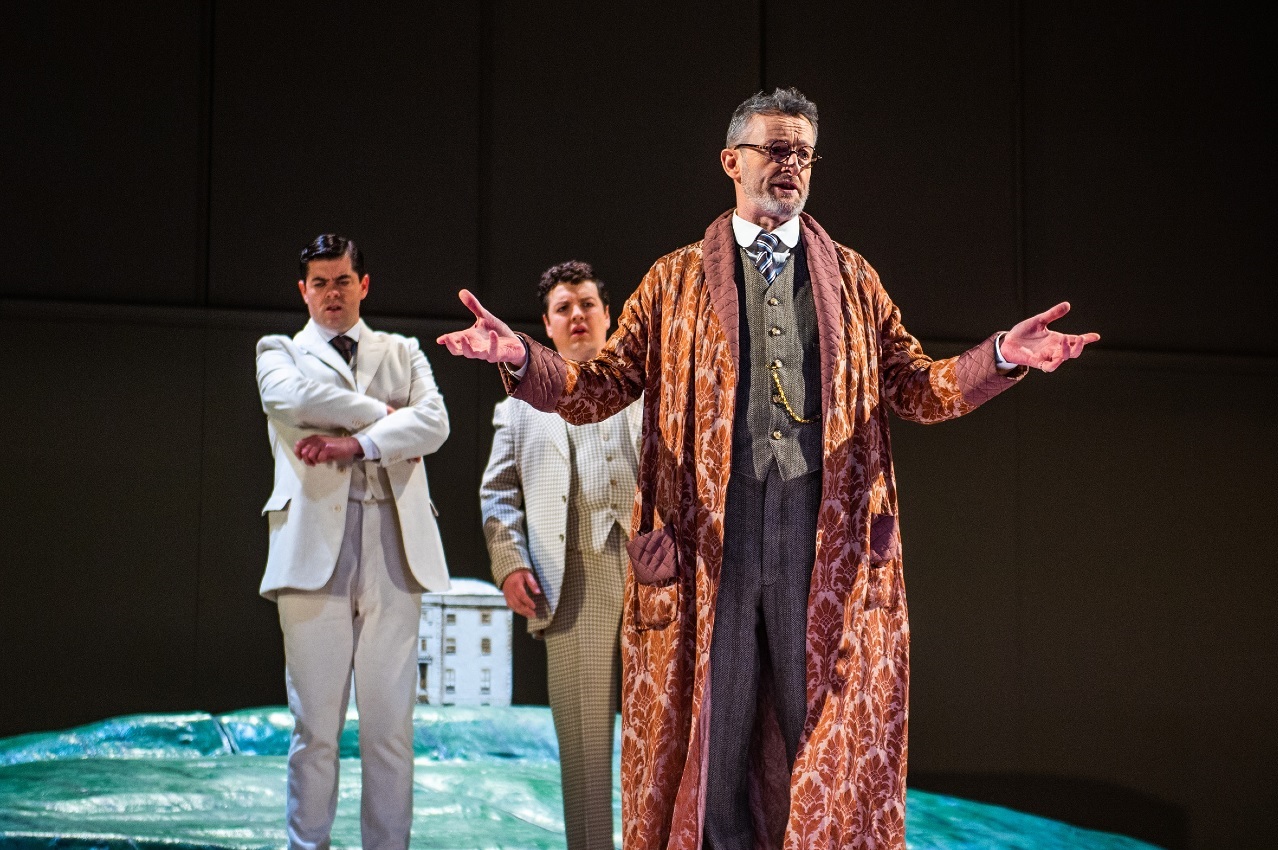
The resultant production design then was also something of a mixed bag. Sure, it has necessarily has to be basic in terms of set designs and effects, designer Jamie Vartan using projections to open it out a little and establish the period with newspaper articles and a sketched big house on the hill. I never quit grasped what the stately manor was about, other than perhaps how chorus of Irish women were treated as servants and second class citizens by the landed gentry. It wasn't a particularly impressive or eye-catching set, a huge hard plastic looking green blob representing a hill with a tiny 'big house' on top that was picked up and carried around by the cast for no discernable reason. Nor could I figure out the nature of Don Alfonso in this setting, walking around in a long house coat in a somewhat professorial manner with Ferrando and Guglielmo his students. None of it quite hit the mark.

To be fair, as ambitious as the Irish National Opera can be, even with reinterpretations of the standards of the opera repertoire, playing to the darker side of Così fan tutte is perhaps not really what they want to do with an opera buffa, particularly for a touring production. Leave that to the likes of Michael Haneke (Madrid, 2013) and Christophe Honoré (Aix-en-Provence, 2016). What they really want to get across is the wonder and beauty of Mozart, and there is no denying what we have here is a light and enjoyable production that certainly entertained the audience at the Gaiety in Dublin. Even though the Votes for Women scenes felt a bit forced in places, like a well meaning corrective for any misinterpretation of misogyny in the comedy. I have to admit, I enjoyed it more after the interval when I accepted the simple pleasure of seeing an amazing Mozart opera performed well, and was able to put aside any expectations of it having something significant to say.

There was certainly plenty to enjoy in the delivery of the singing performances. Anna Devin and Sharon Carty were everything you could hope for as Fiordiligi and Dorabella, their delivery bright and sparkling, filled with emotional sentiments, even if their predicament wasn't fully brought out in the direction of the acting. The same can be said for Dean Power's Ferrando and Benjamin Russell's Guglielmo. Neither were convincing in their disguises, but the emotional impact of the revelations they have about their girlfriends were wholly felt in their singing, which was powerful and true. The ever reliable John Molloy similarly made a great impression, even if his role as a manipulator was undervalued in the direction. On the other hand, Majella Cullagh delivered a fine comic performance in Despina's various guises and was the prime motivator in bringing the two sisters into the new sisterhood, but was slightly underpowered in her singing. It just shows how difficult all the singing roles are in Mozart - there are no secondary or minor roles here.

All credit to the principal roles then (and great idea of the INO to display the cast names in the surtitles as they took their bows at the curtain call), but you can't have any weaknesses at all in a meticulously constructed opera like this. The chorus played their part and the orchestra delivered the musical delights under the direction of Peter Whelan. The niggling inconsistencies in the setting and purpose were easily put aside then, as was any attempt to seek something deeper in Polly Graham's direction of the INO's Così fan tutte. The 'they're all the same' message here was simply that we all deserve to be loved and treated equally, and that was as truthful a reflection of the opera's intent as any.

Links: Irish National Opera

Sunday, 30 January 2022

Vivaldi - Bajazet (Dún Laoghaire, 2022)


Antonio Vivaldi - Bajazet

Irish National Opera, 2022

Peter Whelan, Adele Thomas, James Laing, Gianluca Margheri, Niamh O’Sullivan, Eric Jurenas, Claire Booth, Aoife Miskelly

The Pavilion Theatre, Dún Laoghaire - 29 January 2022

The fact that Vivaldi's 1735 opera Bajazet has made it through to us intact through the centuries feels like something of a miracle. That's obviously partly through chance but it's also partly through design. It's by chance that this opera has survived where many, including many by Vivaldi, have not, but it's also by the fact that Vivaldi created Bajazet as a kind of greatest hits, a pasticcio where he would create recitatives to string together famous arias by other composers and add a few of its own - so yes it's bound to be good. What is also great by design as far as claiming it to be something miraculous is that it communicates its brilliance through to today, and that is by design of the director, cast and orchestra of this Irish National Opera production.

Reading the synopsis beforehand for a refresher, even knowing how the plot of baroque operas usually play out and even having seen several productions of Handel's Tamerlano, I despaired of getting my head around the characters and the typically complicated struggle for power and love between each of them. Maybe it was just the long journey down to Dún Laoghaire. Surely there must be a simpler way of getting the plot and characterisation across? Well of course there is, and after abandoning taking in more than the events of Act I, I trusted that it would all become clear in the delivery in the performance. Making the complicated simple is no easy matter of course and it's down to how good the director and the cast are, and well, this was just thrillingly put across.

Baroque opera can be dry, with not much in the way of dramatic action. There are passages of recitative and a lot of arias with flowery metaphors that have little lyrical relation to the drama. Even more so in a pasticcio, where the arias have been lifted almost wholesale from other works and dropped into a new, usually generic, plot. That is true to some extent with Bajazet, including one aria where Idaspe sings of a boat in a storm at sea, despite their being no naval scene in the opera, although evidently you can take that as a metaphor for emotional turmoil. Writing his own linking recitative for Bajazet however, Vivaldi clearly manages to tie things together very well into a tense dramatic situation.

That however is still only as tense and dramatic as it is allowed to be. The underlying sentiments, rather than being just generic expressions of love, anger, revenge and despair need to be wholly and convincingly played without operatic or period mannerisms. Here Adele Thomas has clearly worked hard to ensure that the performances are robust and related realistically to the situation, with the added bonus that every singer here manages to bring individual life and personality to the characters. It's rare that you see the drama of a baroque opera enacted as if it really mattered.

Molly O'Cathain's impressive gold box set design is also robust and it needs to be because Bajazet and Tamerlano fairly bounce off the walls in aggression and there is much slamming and bursting open of side doors. No walk-on-walk-off scenes here. The other performers wisely give the two principal figures a wide berth and when they aren't able to get out of the way, they get caught up in some rough and tumble that is more than just boisterous. There is anger and violence here that is commensurate with the nature of the figures involved and the implications of the historical drama. It's a tense situation, life or death, and you can feel it. We know what Tamerlano's fate will be, but we can't be sure in this production that his will be the only death.

That's another element of danger and unpredictability that Adele Thomas has introduced into the already tense drama. Anyone familiar with Tamerlano or many similarly themed baroque operas like this can usually expect the insensitive, misguided, proud and cruel ruler to eventually come to his senses and resolve matters, at least as far as affairs of the heart are concerned. Not so here, which is fitting as this Tamerlano is particularly cruel and irredeemable. So, while Bajazet nobly sacrifices himself to be spared the humiliation of his daughter Asteria as is traditional, the lame Tamerlano also meets a just fate through a means that has been hinted at throughout but which also feels in keeping with the amount of pent up anger that has built up.

Where do you start with a cast like this who all have significant roles to play? Probably with the two roles that have the most impact in terms of drama and singing. Stalking the stage with menace James Laing made this Tamerlano really a figure to be feared, his countertenor only adding a sinister quality. He's the only person you could imagine capable of subduing this Bajazet and even then he must have employed some dirty tricks to do it, as Gianluca Margheri's muscular bass-baritone Bajazet was only matched by his physique, straining at the bonds like a rabid dog. He practically shook the walls with every fiery utterance. 

We didn't get to hear Claire Booth's Irene until the close of the first Act, but she more than made up for the late appearance with high-flown coloratura expressing her fury - and like Bajazet you could feel that very real fury of a woman scorned and hurt. Niamh O'Sullivan's Asteria was also an impressive ball of coiled anger, spitting imprecations against her faithless lover Andronico as much as against her captor Tamerlano. The conflicted and inconstant Andronico was brilliantly characterised and sung by countertenor Eric Jurenas, skulking and diving from the formidable forces, no match for any of the forces on the stage around him. Aoife Miskelly's Idaspe also had a vital role to play here dramatically and in the delivery of challenging arias. Vital also is the role of the ensemble of voices, the six creating a stunning array of complementary and contrasting timbres and voices. All close together on the stage too, playing off on another, even when they weren't singing, all adding to the hothouse atmosphere.

I had forgotten how powerful it can be to hear live baroque opera played on period instruments. I can't blame Covid entirely for this, although it certainly delayed this production to the extent that it was almost cancelled entirely and was only allowed to play to a full house this week with the lifting of most restrictions in Ireland, but it's just rare enough to get the opportunity to hear rare works like this close up. In fact my last time might indeed have been at the Pavilion in Dún Laoghaire in 2019 when Peter Whelan led the Irish Baroque Orchestra through Gluck's Orfeo ed Euridice. Once again, they provided a thrilling and revelatory experience, Vivaldi's music (and that of others) just pinging around the hall with crystal clear precision and put to good dramatic use.

This is Irish National Opera doing what it does best, taking on a challenging and wide ranging repertoire. Whether working with familiar standards, new contemporary opera or reviving rare baroque repertoire, they are equally good at bringing opera to life. That's a team effort and when that combines in actual live performance that is ultimately what makes something like Bajazet miraculous, magic or whatever you want to call it. Just 'opera' says it all, I suppose. It's about finding a way to make notes on a page written centuries ago come back to life and this Bajazet makes it into the 21st century alive and kicking.