Showing posts with label Jade Phoenix. Show all posts

Saturday, 25 October 2025

Verdi - Le trouvère (Wexford, 2025)

Giuseppe Verdi - Le trouvère

Wexford Festival Opera, 2025

Marcus Bosch, Ben Barnes, Eduardo Niave, Lydia Grindatto, Giorgi Lomiseli, Kseniia Nikolaieva, Luca Gallo, Conor Prendiville, Jade Phoenix, Philip Kalmanovitch, Vladimir Sima, Conor Cooper

O'Reilly Theatre, National Opera House, Wexford - 21st October 2025

No-one would consider Il trovatore a rarely performed opera, but the French version that Verdi reworked for the Paris Opera definitely qualifies for Wexford Festival Opera's focus on lost and scarcely known works. Being a lost and forgotten opera is no indication of lack of quality: there are many reasons why operas fall into neglect. It's a fate suffered even by many worthwhile Verdi operas and Verdi's French operas are always fascinating and all too rarely seen. That's definitely the case with Le trouvère, and Marcus Bosch's production for the festival managed to breathe a little bit of new life and meaning into a work that in its more popular Italian form has become quite stale.

In whichever version you present it however, Il trovatore is always going to be a problematic opera or at least a challenge. Aside from the overheated plot, the music has been overplayed over the years and there is a danger of it losing its impact through familiarity, or perhaps not losing its impact - since those famous arias and choruses still resound powerfully - but allowed to become too 'operatic' and detached from real human stories. Le trouvère, at the very least, provides an opportunity to hear the opera afresh, and indeed the Wexford production - for their 2025 Myths and Legends themed programme - managed to delve deeper beneath the surface storytelling and find some extra character in the work.

In comparison to some of the operas that Verdi rewrote or adapted for the Paris Opera, Le trouvère remains very much the familiar Il trovatore. With a few exceptions of course, not least the fact that the libretto was rewritten in French with suitable minor changes of music for the flow of the language, but perhaps the biggest revision or concession is of course the addition of a new 30-minute ballet sequence at the start of the third Act. In terms of musical character and plot melodrama however, Le trouvère is essentially the same as the Italian version. If you want to draw a distinction of differences between the two, there's not much new here to go on - unless you are Robert Wilson of course (but there was only one of those) - but the ballet sequence alone gives more scope to develop and establish a different character for the opera.

Director Ben Barnes rightly recognises that the medieval historical setting is hardly relevant to that, so much so that even though bringing it closer to our own time in this production to the period of the Spanish Civil War, it still has no significant impact or additional relevance, and in itself doesn't lend the opera any greater depth. Not that Le trouvère or Il trovatore needs it. It's a full-blooded melodrama, a Verdi blood and thunder melodrama, and all the impact is there in the dramatic writing, the tortured souls, the overwrought plot of hidden switched identities and fateful mistakes that take a shocking turn of events. Legends and stories should be on this kind of grand scale, but they can and should still retain the essence of humanity in them. It's there in Verdi, to some extent, and it helps if a director can find a way to bring that out.

The war context of each of the scenes is effectively staged, the images and impact of war on the people is evident, the Spanish setting well defined, but in terms of direction of the singers it was rather stiffly choreographed and all too often would fall back on opera mannerisms. A lot of this of course is 'in-built' in the opera, which amounts to a number of set pieces and star turns for the artists. Despite the strong passionate singing it was hard to feel any real human story in the fragmented structure, the stop-starting as the drama stopped to allow the singers to take their take their aria before entering back into the real (opera) world.

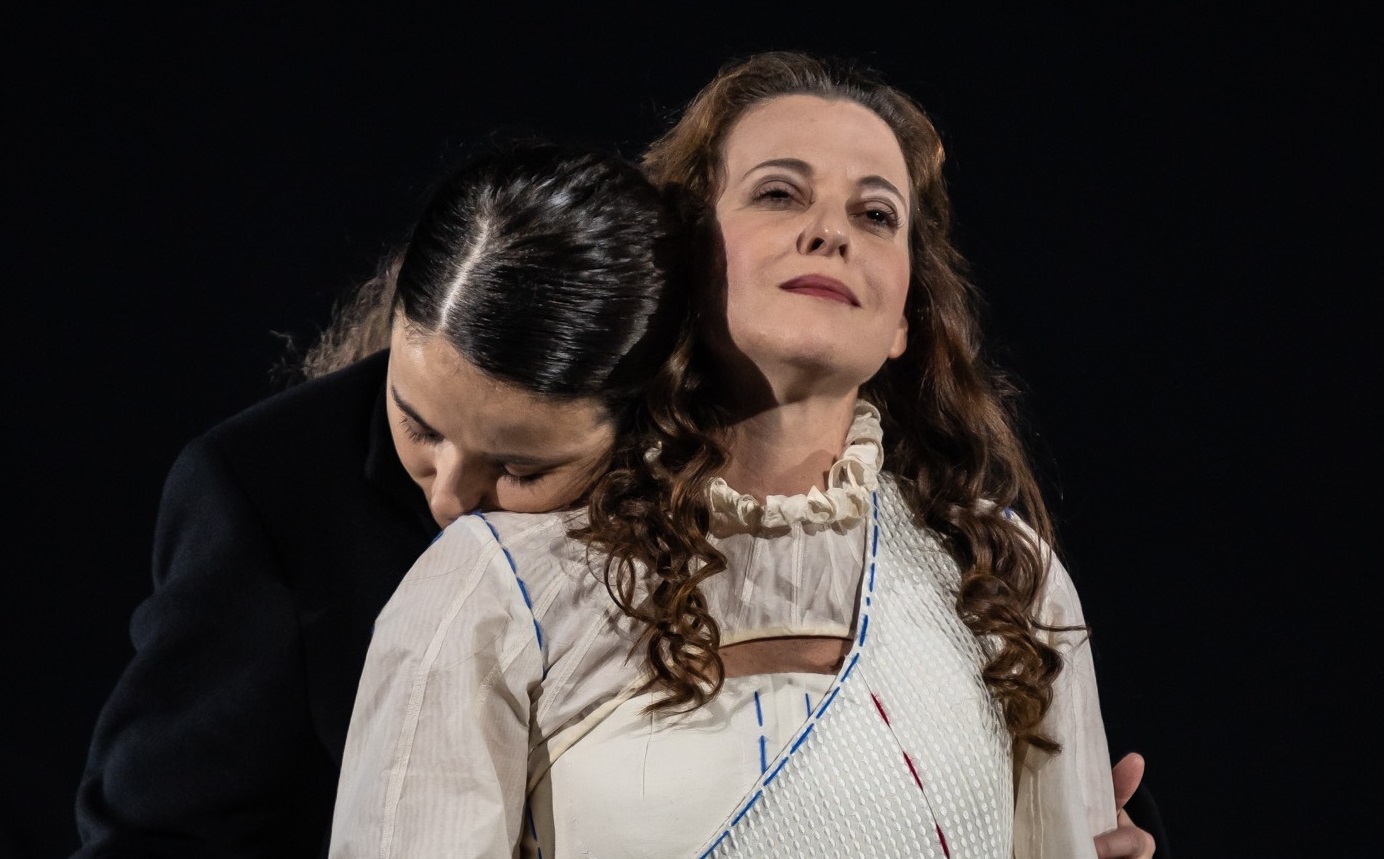
As good as the singing was, there was very little sense of any real interaction or drive to the love-hate drama between them. For individual performances of those classic roles however we had fine voices in Mexican tenor Eduardo Niave as Manrique and soprano Lydia Grindatto as Leonore. Giorgi Lomiseli sounded a little hesitant initially as Le Comte de Luna, but very much came into the as the drama unfolded. The most exciting performance came from Kseniia Nikolaieva's Azucena. It's a role of course designed to introduce that wildcard element of danger and unpredictability, seeking to find not so much vengeance as justice, and Nikolaieva made every one of her scenes count in raising the tensions. The rising star Irish soprano Jade Phoenix, who made a great impact in 2023 in Wexford in Marco Tutino's La ciociara, was underused as Inés but made an impression nonetheless.

There didn't appear to be much that was going to distinguish this Le trouvère from the many other productions of Il trovatore seen through the ages, but it was at the start of the third act when the inserted ballet music written by Verdi came into play and made a little more sense of it. Presenting it as a dream/nightmare of the Count, there was nothing particularly revelatory in the use of the generic Spanish Civil War footage mostly of troops marching and people on the streets, but with three dancers and some shadow play it effectively blended the human love story with the imagery of the wider war. What it captured was the weight of history, of long feuds between nations and mistrustful neighbours. It reminded you that Il trovatore or Le trouvère is not as excessive as you might think in its horror story or in the passions it evokes. Worse things happen in wartime, as the news reminds us every day now.

There are a number of Ukrainian refugees in Ireland at the moment (and scandalously on the very night I attended this performance, a mob of thugs was attacking a hotel of asylum seekers in Dublin) and many are finding success in Ireland as in the rest of Europe on the opera stage. That was the case with this opera's Azucena, Kseniia Nikolaieva, and I would imagine her own experiences and emotions would have fed into her performance. It showed. And if the production as a whole succeeded in relating those heightened Verdi rhythms, pacing and emotional overload of the brutality and suffering of war for the audience, imagine how much more it meant to the Ukrainian contingent. Without having to make any grand gestures - in an opera that usually calls out for grand gestures - Wexford's production of Le trouvère paid tribute in its own way by doing justice to those caught up in the horror of war.


Friday, 8 August 2025

Walshe - MARS (Dublin, 2025)


Jennifer Walshe - MARS

Irish National Opera, 2025

Elaine Kelly, Tom Creed, Jennifer Walshe, Nina Guo, Jade Phoenix, Sarah Richmond, Doreen Curran

Abbey Theatre, Dublin - 7th August 2025

It's high time that we had a full-length opera from Jennifer Walshe, internationally recognised as one of Ireland's most original contemporary musicians and performers. Working primarily with the voice, it had to be a natural progression and there were signs of her heading in that direction with her short work Libris Solar (2020) for Irish National Opera's 20 Shots of Opera and Ireland: A Dataset (2020), both presented during the COVID lockdown. Describing the latter piece as a 'radiophonic play', it was however a total musical-theatrical experience, albeit one unable to be performed before a live audience; an opera in all but name. It may not have been conventional but nothing Walshe does is conventional. MARS, her new work for Irish National Opera, employs many of the same techniques used in Ireland: A Dataset, taking a theme, exploring it from a number of angles rather than as a linear plot, and of course providing the usual injection of humour and not taking things too seriously.

Finding her voice, so to speak, at a time when there are serious wider contemporary issues to consider, the composer has worked with writer Mark O'Connell to develop a libretto for an opera on a more global scale, or perhaps one even more expansive that that. MARS takes us beyond the confines of the planet with a crew of four women astronauts in order to consider the petty problems of the world from a distance, only to find that we bring our petty problems with us. And not just the 'petty problems' but the big ones that we can see troubling us in the present day. If you think there is danger in the power being placed in the hands of a small group of wealthy individuals with authoritarian leanings and their own space programmes, imagine what will happen when other planets come within reaching distance...

As far as it concerns the four women on the Buckminster on a nine month journey to Mars, the future is under new ownership, and that includes ownership of the crew just as they are about to touch down to explore the planet for underground water supplies to support the colony that has already been established on the planet. The company or international consortium that was financing the mission have been taken over by a corporation owned by 'tech bro' Axel Parchment, who has some 'innovative' ideas for developing and expanding the colony. Sally, Valentina, Judith and Svetlana have revised orders and a new mission; Mars needs women. But, in-between sending AI assisted messages and videos back home to raise the morale and gain new recruits, the crew make an important discovery that may enable them to take control (and control over their own bodies) back again.

The situation as outlined would seem to present the opportunity for some thoughtful contemplation on the essence of humanity, on the need to explore, stretch the boundaries of what we consider to be the human experience to incorporate new developments in technology and society; and to consider what to do when things go wrong, because things always go wrong. And indeed it does in MARS and Walshe does take a realistic response to those questions, but perhaps not initially in the way you might expect; like how these four adventurers react to the critical error that occurs when the USB drive containing the complete Criterion Collection set of movies is left behind and all they have is Shrek 3 and Seasons 3 to 6 of The Housewives of Beverley Hills to get them through the isolation. It can't get much worse than that surely?

It would be a mistake to take it all too seriously, but it's more than just a joke. All too much of what happens here is recognisable in the almost unrecognisable world we are waking up to every morning, with developments in technology and AI advancing rapidly every day, distorting our familiar sense of reality, with wealthy individuals accruing more money, power and influence and exerting that control through populist appeal and dubious libertarian ideologies. Others might take a more conventional path through the challenges that face an all-woman space crew on a future expedition to Mars given this current direction of travel, but this is Jennifer Walshe and she takes the Jennifer Walshe way. Which is to say that the work is made up of a series of sketches and routines, playful in nature but with a little edge of satire.

There are some spoken work dialogues, some funny episodes, but mainly a lot of playing around with the opportunities suggested by the out of familiar world setting. Aside from the template established in Ireland: A Dataset, some sequences reminded me of Glass and Wilson's Einstein on the Beach, just simply revelling in the purity of the musical-theatrical situation with no concern of 'advancing the plot', emulating floating in zero gravity, running through wordless vocalisations and blending them with electronic sounds that also bring to mind Stockhausen's Licht, with a lament on a planetary exploration that seems to echo Ligeti's Atmosphères from 2001: A Space Odyssey. All of this is of course filtered through Walshe's sense of anarchic humour, with a few mordant swipes at popular culture and populist politics.

What is abundantly evident, even in the least serious of moments, is that Walshe has explored everything related to Mars exploration and even incorporates the sounds of space in the instrumentation through the use of synthesisers, in addition to more conventional instruments making unconventional sounds. Co-directed between Tom Creed and Walshe herself, the stage production - all credit to the incredible team that pulled this together - does exactly the same and it is genuinely groundbreaking in how the medium is also the message. Walshe has taken advantage of AI before and used it in Ireland: A Dataset, but the way the music, the sounds, the use of videos, live hand-held cameras, live distortion of voices are not just used for satire and parody, but to emphasise how much technology can be used and messages distorted. There is a lot going on and some of it just flashes by, but it all works alongside the plot and the content, an integral and equal part of the conception of the piece.

Which not to say that the human element of the work is relegated by the use of technology, otherwise that would negate the point of the work. Nina Guo, Jade Phoenix, Sarah Richmond and Doreen Curran are just superb, totally engaging in all-round performances that require acting, timing, collaboration and - despite necessarily being microphoned for mixing with the orchestra - all are experienced and brilliant opera singers that have their range fully put to the test. Those moments are used well and to terrific effect. Following its opening at Galway International Arts Festival in July and three sell-out performances at the Abbey Theatre in Dublin, don't let anyone say there isn't an appetite for challenging contemporary opera and thankfully the INO seasons are always tremendously rich and varied, including contemporary Irish works, baroque opera, popular favourites and the odd rarity.

I'll be honest and say that despite the considerable efforts that have gone into the composition and marrying it to an inventive integrated production design, MARS is very entertaining and very much of the moment, but it doesn't feel like a substantial piece. Personally, I would have preferred if Walshe had just fully indulged the scenes in her random episodic fashion and left any conclusions to be drawn without the need (by writer Mark O'Connell?) to provide a conventional plot resolution, but maybe that's just me. MARS unquestionably has many other angles that are wholly Jennifer Walshe and couldn't be anyone else, and we can't ask for more than that. And perhaps there is more to the work than I'm giving her credit for; the world is indeed becoming increasingly absurd, heading into an unknown that is genuinely frightening, and MARS offers some hope that we can navigate our way through it.


External links: Irish National Opera, Jennifer Walshe on MARS in the Guardian

Monday, 30 October 2023

Tutino - La ciociara (Wexford, 2023)

Marco Tutino - La ciociara

Wexford Festival Opera, 2023

Francesco Cilluffo, Rosetta Cucchi, Na’ama Goldman, Jade Phoenix, Leonardo Caimi, Devid Cecconi, Alexander Kiechle, Allen Boxer, Carolyn Dobbin, Conor Prendiville, Erin Fflur, Julian Henao Gonzalez, Grace Maria Wain, Meilir Jones, Christian Loizou, Will Searle, Peter McCamley

O'Reilly Theatre, National Opera House - 26th October 2023

Wexford Festival Opera may be noted for its unearthing of rare works mainly from the 19th century, but the reviving of works as a way of keeping opera alive and vital also extends to programming new and recent 20th and 21st century works. It's in the context of the 72nd festival's Women & War theme that even against some notable historical competition it was a contemporary composer Marco Tutino and his opera La ciociara that proved to be the most musically and dramatically satisfying work in programme. You might think that the task of composing an opera on the subject of war might have been made easier by having the cinematic source material of the master of post-war neo-realism Vittorio de Sica to work with, which in turn is adapted from Alberto Moravia's war time experiences in Italy, but there is clearly much more to making all that into a successful opera. And indeed a challenge to stage it successfully, so we were fortunate that conductor Francesco Cilluffo and director Rosetta Cucchi were key to realising the full dramatic potential of the work for Wexford.

Composed in 2015 where it was premiered at San Francisco Opera, it's a newly revised version of La ciociara that was being performed for the first time at Wexford. For a festival specialising in reviving old and forgotten opera, Wexford manage to rack up a surprising number of premieres, also managing this year to put on the first ever staged production of the original version of a rare Donizetti opera, Zoraida di Granata. La ciociara was however even more of a coup, since in its new form at least it's an extraordinary piece of opera. It has the opera-cinematic quality of Richard Strauss in its huge dramatic and romantic sweeps, matching the dynamic and range of human experience during a time of war, but it is also thoroughly modern in how it adapts to those changes of tone and provides a consistent accompaniment to the dramatic action without ever resorting to film soundtrack backing.

Photo: Clive Barda

It's a work that more fully realises the Women & War theme of the 72nd Wexford Festival Opera. Where Zoraida and L'aube rouge struggled to get a satisfactory balance, La ciociara also has a romantic core but fully humanises it in while placing it in the context of war. And by humanising that also includes the dehumanising effect of war. There is no holding back here on the brutality and the horror that war inflicts on society and the individual. The individuals in question are Cesira and her daughter Rosetta, the 'two women' of the English version of the Moravia book and film, and Michele, the school teacher Cesira meets in the village of Sant'Eufemia when she returns to her home region of Ciociara escaping from the war in Rome.

Another aspect of the impact that war has on individuals comes in the form of Giovanni, a brute who has followed Cesira and Rosetta from Rome who joins a fascist militia. He hears that the two women and Michele have given aid to a wounded American soldier and, in a jealous rage over Cesira's blossoming relationship with Michele, he informs the local Nazi commander Von Bock - a Scarpia-like figure - which leads to a similar anguished confrontation and eventual execution of Michele, not to mention a rape scene. It's hard not to associate the musical connection and heritage of the brutality pushed by Puccini in Tosca in such scenes.

Photo: Clive Barda

You can detect the post-Wagner and post-Verdi approach to opera of Strauss and Puccini in Tutino's music, but the composer nonetheless puts a neo-Romantico spin on ot, the music dramatic, theatrical and emphatic. Musically everything goes hand in hand with the drama, enhancing the narrative and emotional tone of the piece at every stage. Not a moment is wasted, the opera simply flowing from one scene to the next. The director Rosetta Cucchi (also the artistic director of the Wexford Festival Opera) has a hand in that of course, using filmed segments to link the journey of the two women, Tutino helpfully providing linking music to mark the passage of time and distance. 

Cucchi also takes inspiration from Vittorio De Sica (Peter McCamley), the director of the film version of La Ciociara, including him as a silent figure in the drama during preparations for filming, taking in the location and imagining what he will make of each scene. That gives Cucchi licence to include a dancer figure, a representation of his inspiration perhaps, the emotional core of what he wants to capture on film, the essence of woman maybe? Strength? Endurance? It doesn't necessarily need a name or single definition, since it is really something deeper that arises out of the music that can connect on a different level with the personal experience and reaction of each person in the audience.

This is vital to the human aspect of the work, to the connection it makes with the listener and as a reflection of how the experience of war can be different for different people. It can dehumanise and inflict horror, as Zoraida di Granata and L'Aube rouge made clear earlier in the opera festival, but it can also bring out the better human qualities. Cesira in fact was not such a nice person while she was in Rome, using the war as an excuse to inflate prices in her store. Returning to what was known as the Ciociara region south of Rome, in the country, she finds a closer relationship with nature, naming the flowers and trees, finding secret paths in the woods, finding love, the contrast of the war revealing what is truly important.

Photo: Clive Barda

The opera evidently requires a strong central performance in Cesira, and you couldn't ask for better than Na'ama Goldman, or indeed praise her performance enough. She held the work together as its heart, her singing and dramatic performance absolutely exceptional. Just as remarkable was Jade Phoenix as Rosetta, the young soprano giving an amazing performance through some challenging scenes, singing absolutely superbly. The scene where she took to the front of the stage to offer up a song of prayer was a revelation, winning over the audience as she lived through the trauma and post-trauma brilliantly. Leonardo Caimi was excellent as Michele and Devid Cecconi marvellous in the thankless role of the fascist brute, Giovanni, but neither overshadowed the outstanding performances of the "two women" at the heart of the work.

Superbly directed by Rosetta Cucchi with no expense spared on the impressive production design, the staging couldn't have been in better hands. The same goes for the musical direction of Francesco Cilluffo, and the Wexford orchestra were on fire as they tend to be under this conductor. I look forward to the work he directs at Wexford every year in the assurance that it will be among the best of the festival. That was certainly the case this year in a very good main programme, but in terms of being the full package, La ciociara topped the bill and that was recognised by fierce applause and a standing ovation at the curtain call. I don't think there is any such thing as the perfect opera, but when music, drama, performance and presentation come together as well as they do here, this is as good opera gets.


External links: Wexford Festival Opera

Monday, 7 November 2022

Halévy - La Tempesta (Wexford, 2022)

Fromental Halévy - La Tempesta

Wexford Festival Opera, 2022

Francesco Cilluffo, Roberto Catalano, Nikolay Zemlianskikh, Hila Baggio, Giorgi Manoshvili, Giulio Pelligra, Jade Phoenix, Rory Musgrave, Richard Shaffrey, Gianluca Moro, Emma Jüngling, Dan D'Souza

O'Reilly Theatre, National Opera House, Wexford - 3rd November 2022

You never know if you might discover an unknown gem at Wexford and with Fromental Halévy it could go either way. On the one hand he can provide an interesting work like La Juive, on the other hand something like Clari isn't likely to improve with age. His grand opéra version of Shakespeare's The Tempest it has to be said, turns out to be, at best, serviceable. That's not exactly high praise, but then few operatic adaptations of Shakespeare's plays come anywhere near to the level required and an unknown work from Halévy - despite being a fine composer for his time - isn't likely to come up with any musical equivalent for the noises, sounds and sweet airs of Shakespeare's late work on the poetic contemplation on his craft. That doesn't mean it shouldn't be attempted (Wikipedia notes that at least forty-six operas or semi-operas based on The Tempest exist) and often such works can still surprise when revived here at Wexford. La Tempesta is at least given a vigorous shake and a worthy hearing that drops out a few points of interest.

Like most adaptations of Shakespeare to opera, the play itself is shaken up so much that it loses a lot of its original character, purpose and poetry. You basically have to forget Shakespeare or just see his play as a starting point for a fresh interpretation of the story. All the more so since Halévy is working in the field of grand opéra here and restricted to some degree by the conventions of the form. Strangely however, or perhaps mercifully, it is not a five-act grand opera, there are no ballet scenes and the libretto is in Italian - the libretto commissioned as such for London theatre - rather than French as you would have expected. With the drunken Stephano included, there is at least a good excuse for the obligatory drinking song.

There are no new characters added as some opera adaptations have done - it's not wise to mess too much with the Bard on his home soil - but one notable 'addition' is Sycorax or Sicorace, the witch who formerly presided over the island, mother of Caliban. She is not present in Shakespeare's play by the time Prospero has been long exiled there, wresting control and imprisoning the witch in a rock, but she is included in La Tempesta, at least in voice. There is an inventive scene where Sicorace advises her son Caliban to help both of them break free from the power of Prospero and Ariel, directing him to a flower whose petals can grant the owner three wishes. Caliban of course is such a villain that he refuses to help his own mother and rescue her from her captivity, and instead uses the powers for his own pleasure.

Here, as they often do in theatre productions of The Tempest, Caliban and Ariel tend to overshadow the rather dull naive romantic situation between Miranda and Ferdinand, as well as the power games played by Prospero and the older shipwrecked nobles of Naples. Or perhaps not so much overshadow as extend the range, a double act that take high and low contrasting positions on either side of - or perhaps beyond - the familiar scale of human nature. Ariel is a spiritual creature, lyrical and magical, aspiring to higher sense of order and associated musically and singing voice with high notes. Caliban is low and dark, unthinking and uncaring about anything other than his own base instincts.

Other than the voice range however, Halévy doesn't bring quite the same kind of musical creativity to La Tempesta that Shakespeare brings to his poetic imagining and representation of a world where such capabilities exist in all their fearsome richness. Roberto Catalano's presentation of the work as director for this Wexford Festival Opera production attempts to fill that out a little, representing the unseen magic and spirits on the enchanted island as figures in dark clothing that accompany, observe and occasionally intervene in the drama, compensating to some degree for the dearth of musical creativity that should lift the story into other realms.

Having said that, you couldn't ask for a better musical interpretation that draws the full potential out of Halévy's score than you get here from musical director and conductor, Francesco Cilluffo. The score is fairly attacked by the orchestra to play up all the range and impact of the grand opéra, this one all the better for its lack of indulgences. There is also some fine singing to enjoy, Giorgi Manoshvili's Caliban taking honours as far as I was concerned, alongside Jade Phoenix as an excellent Ariel. Nikolay Zemlianskikh is a fine Prospero, although the character is rather bland in Halévy's version. Hila Baggio's singing was a little on the light side, but she shone with some fine coloratura. Giulio Pelligra bravely (hopefully not unwisely) took to the stage as Ferdinand despite being noticeably unwell.

No-one can say that Wexford didn't give La Tempesta a fair hearing and showing. Emanuele Sinisi's sets worked alongside Catalano's direction to enhance the score and libretto as far as possible, finding their own way of getting the magic of the enchanted island setting across. The opening scene of the storm that brings down the King of Naples' ship was dramatic and yet not exactly as you might expect it to be staged, with magical figures of the chorus in black visiting the beds of the King and his crew and wrapping them in black binbags. With bricks and a broken wall with 'Nostalgia' engraved on it, a huge head statue that seemed to just be randomly left there (almost like something parodied in Viva la Diva at Buxton this summer), the production nonetheless captured the grandeur of the score and found its own ways of placing it in a magical setting.

Much as you shouldn't and much as you might try, it's hard not to set Shakespeare's and Halévy's versions of The Tempest side-by-side and La Tempesta inevitably suffers from the comparison. On its own terms, taking into account the changes that have to be employed in adapting any work and operate within the musical conventions of the time, it is possible to enjoy the work and appreciate its message of putting aside our instinctive impulses and embracing nature, reconciliation and balance. There is balance and measure in Halévy's score at least and plenty to enjoy in the singing and musical interpretation, as well as the fine staging of this rare work at Wexford.