Showing posts with label Giorgi Manoshvili. Show all posts

Saturday, 28 October 2023

Erlanger - L'Aube rouge (Wexford, 2023)

Camille Erlanger - L'Aube rouge

Wexford Festival Opera, 2023

Guillaume Tourniaire, Ella Marchment, Andreea Soare, Andrew Morstein, Emma Jüngling, Ava Dodd, Dominica Williams, Giorgi Manoshvili, Philippe-Nicolas Martin, Rory Musgrave, Thomas Birch, Ami Hewitt, Leah Redmond, Corina Ignat, Judith Le Breuilly, Conor Baiano, Hannah O’Brien, Andrii Kharlamov, Rory Lynch, Gabriel Seawright, Vladimir Sima

O'Reilly Theatre, National Opera House - 25th October 2023

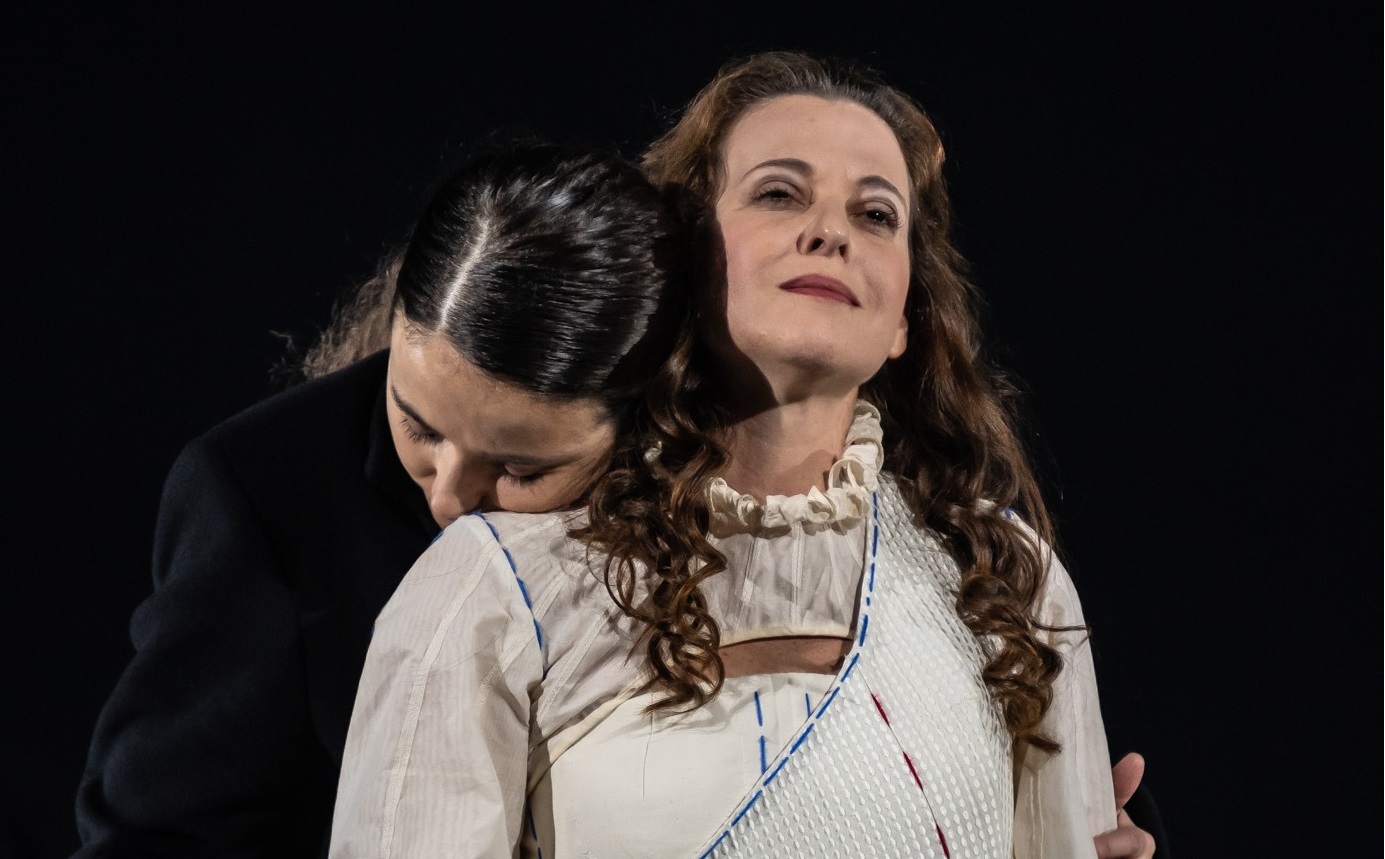
You would expect things to get a little serous in a festival season based on the theme of Women & War. Without having to emphasise the point, sticking closely to the original 15th century setting, the Wexford Festival Opera production of Donizetti's Zoraida di Granata nonetheless succeeded in bringing out those themes strongly in such a way that you could hardly fail to see it echoed in contemporary real world events. That theme is should be just as effective in L'aube rouge (The Red Dawn), an early 20th century work of verismo character by Camille Erlanger that involves the action of a band of Nihilists in pre-revolutionary Russia plotting the assassination of the Grand Duc. Composed in 1911, not far removed from the historical events it depicts, director Ella Marchment gives the stage production a closer contemporary feel that should also relate to today, but as intriguing as it is to consider this forgotten work and as well performed as it is, it doesn't succeed in making the impact you feel it ought to.

It's an interesting subject for an opera by a French composer of Jewish origin at a time when the divisions caused by the Dreyfuss affair had revealed deep-rooted prejudice and divisions in French society, and when the Russian Revolution was stirring not far around the corner. Much is made of this in the festival programme notes for L'Aube rouge  but other than to provide context and suggest a connection with the Italian verismo movement, neither political element really appears to exert much influence on the opera. Apart from a police raid in the first act on the anarchist group in St Petersburg that is quickly dispersed and the shock finale of Act III when Sergei is shot by a member of his own group, the emphasis in L'Aube rouge appears to be more concerned with setting up the tragic and impossible romance between Olga and Sergei.

Olga is the daughter of General Lovarov, the despised chief of police, so she is immediately distrusted when she appears at a meeting of the anarchist group. Sergei however vouches for her and falls in love with her, but there is no future for their romance in such a place, and so they move to Moscow. Olga's family however have other plans for her that include a marriage to Pierre De Ruys, a surgeon and important establishment figure, but Sergei, who Olga's father has convinced her has died in a Siberian prison camp, shows up at the wedding and the two of them run away together to Paris. 

Sergei however is shot by another member of the Nihilist group when it is believed that he is no longer dedicated to the cause. He is saved only by the intervention of Olga, who convinces the man she deserted at their wedding, Pierre De Ruys, to perform life-saving surgery. Determined to prove himself however Sergei on recovery embarks on a mission that will assure his death, attempting to assassinate the Grand Duc. It's enough to drive Olga herself to madness and death.

It's high melodrama, but as far as the themes go L'Aube rouge undoubtedly emphasises the impact that war has on preventing people living ordinary lives, and as Olga is the central character of the opera (with in Andreea Soare, a gifted soprano capable of really making her the central focus and heart of the opera), the plight of women and any hope of living in peace and love is emphatically shown as being doomed. Certainly all the indications of that are there in the music which, even if the main part of the opera revolves around an impossible romance, has a deep undercurrent of tragedy within it. Even the second Act wedding scene and the fourth Act dances are all powerfully and dramatically scored in a way that suggests that any celebration is fleeting and only a brief respite before the real world crashes in again.

Photo: Clive Barda

It may be powerfully scored by Erlanger, but there is little that stands out as memorable in either the plot development or in any distinct flair of musical expression. Even so, like many neglected opera's from the beginning of the 20th century, it remains fascinating to consider where it fits in and how, along with many other composers, it seeks to find a new voice and a place for opera in a post-Wagner and post-Verdi age. Certainly you can here echoes of the verismo composers, the dramatic writing fitting in well with the darker side of Puccini (Tosca in particular), the overall tone and subject matter reminding one of Alfani's Risurrezione (performed at Wexford in 2017) and Giordano's Siberia.

Two things however stand out in this performance however that make it very much worthwhile, aside from it being an intriguing rare opera. Conducted by Guillaume Tourniaire, the playing of the orchestra was exceptional, the warmth and dynamism of the music enhanced by the beautiful acoustics of Wexford's O'Reilly Theatre. The other stand out was the commanding performance of Andreea Soare as Olga. She demonstrated beautiful clarity, control and lyricism even at the most anguished of moments, but was also capable of dropping to softness and even playfulness in the singing of a Russian song. It was a great, fully rounded performance that is essential to the character of the work. Andrew Morstein as Sergei/Serge also had a lovely tenor voice, but didn't have the volume behind it to carry the dramatic import. Giorgi Manoshvili's Kouragine was also worthy of note.

Much as Ella Marchment's direction and ideas for the Wexford production tries to give it a contemporary feel that aligns with the festival theme of Women & War, the opera's uneven balance of love and war doesn't allow it to have the same impact as the production of Donizetti's Zoraida di Granata the previous evening. The final act here should bring back the dramatic tension of the activities of the Nihilists that end up taking the lives of both Sergei and Olga, but it ends up feeling less of a humanitarian issue than a romantic one. 

The director can only work as best as the material allows however, and the production design strived to keep the drama grounded in concrete reality heading towards inevitable tragedy and not idealise the romantic aspect, using a multi-purpose staircase and a grim concrete background that feels oppressive and inescapable. Even in Paris, the set holds the same basic feel, the frenzied dancing of the final act likewise unable to shake the inevitability that it is leading towards a bleak finale.


Links: Wexford Festival Opera

Monday, 7 November 2022

Halévy - La Tempesta (Wexford, 2022)

Fromental Halévy - La Tempesta

Wexford Festival Opera, 2022

Francesco Cilluffo, Roberto Catalano, Nikolay Zemlianskikh, Hila Baggio, Giorgi Manoshvili, Giulio Pelligra, Jade Phoenix, Rory Musgrave, Richard Shaffrey, Gianluca Moro, Emma Jüngling, Dan D'Souza

O'Reilly Theatre, National Opera House, Wexford - 3rd November 2022

You never know if you might discover an unknown gem at Wexford and with Fromental Halévy it could go either way. On the one hand he can provide an interesting work like La Juive, on the other hand something like Clari isn't likely to improve with age. His grand opéra version of Shakespeare's The Tempest it has to be said, turns out to be, at best, serviceable. That's not exactly high praise, but then few operatic adaptations of Shakespeare's plays come anywhere near to the level required and an unknown work from Halévy - despite being a fine composer for his time - isn't likely to come up with any musical equivalent for the noises, sounds and sweet airs of Shakespeare's late work on the poetic contemplation on his craft. That doesn't mean it shouldn't be attempted (Wikipedia notes that at least forty-six operas or semi-operas based on The Tempest exist) and often such works can still surprise when revived here at Wexford. La Tempesta is at least given a vigorous shake and a worthy hearing that drops out a few points of interest.

Like most adaptations of Shakespeare to opera, the play itself is shaken up so much that it loses a lot of its original character, purpose and poetry. You basically have to forget Shakespeare or just see his play as a starting point for a fresh interpretation of the story. All the more so since Halévy is working in the field of grand opéra here and restricted to some degree by the conventions of the form. Strangely however, or perhaps mercifully, it is not a five-act grand opera, there are no ballet scenes and the libretto is in Italian - the libretto commissioned as such for London theatre - rather than French as you would have expected. With the drunken Stephano included, there is at least a good excuse for the obligatory drinking song.

There are no new characters added as some opera adaptations have done - it's not wise to mess too much with the Bard on his home soil - but one notable 'addition' is Sycorax or Sicorace, the witch who formerly presided over the island, mother of Caliban. She is not present in Shakespeare's play by the time Prospero has been long exiled there, wresting control and imprisoning the witch in a rock, but she is included in La Tempesta, at least in voice. There is an inventive scene where Sicorace advises her son Caliban to help both of them break free from the power of Prospero and Ariel, directing him to a flower whose petals can grant the owner three wishes. Caliban of course is such a villain that he refuses to help his own mother and rescue her from her captivity, and instead uses the powers for his own pleasure.

Here, as they often do in theatre productions of The Tempest, Caliban and Ariel tend to overshadow the rather dull naive romantic situation between Miranda and Ferdinand, as well as the power games played by Prospero and the older shipwrecked nobles of Naples. Or perhaps not so much overshadow as extend the range, a double act that take high and low contrasting positions on either side of - or perhaps beyond - the familiar scale of human nature. Ariel is a spiritual creature, lyrical and magical, aspiring to higher sense of order and associated musically and singing voice with high notes. Caliban is low and dark, unthinking and uncaring about anything other than his own base instincts.

Other than the voice range however, Halévy doesn't bring quite the same kind of musical creativity to La Tempesta that Shakespeare brings to his poetic imagining and representation of a world where such capabilities exist in all their fearsome richness. Roberto Catalano's presentation of the work as director for this Wexford Festival Opera production attempts to fill that out a little, representing the unseen magic and spirits on the enchanted island as figures in dark clothing that accompany, observe and occasionally intervene in the drama, compensating to some degree for the dearth of musical creativity that should lift the story into other realms.

Having said that, you couldn't ask for a better musical interpretation that draws the full potential out of Halévy's score than you get here from musical director and conductor, Francesco Cilluffo. The score is fairly attacked by the orchestra to play up all the range and impact of the grand opéra, this one all the better for its lack of indulgences. There is also some fine singing to enjoy, Giorgi Manoshvili's Caliban taking honours as far as I was concerned, alongside Jade Phoenix as an excellent Ariel. Nikolay Zemlianskikh is a fine Prospero, although the character is rather bland in Halévy's version. Hila Baggio's singing was a little on the light side, but she shone with some fine coloratura. Giulio Pelligra bravely (hopefully not unwisely) took to the stage as Ferdinand despite being noticeably unwell.

No-one can say that Wexford didn't give La Tempesta a fair hearing and showing. Emanuele Sinisi's sets worked alongside Catalano's direction to enhance the score and libretto as far as possible, finding their own way of getting the magic of the enchanted island setting across. The opening scene of the storm that brings down the King of Naples' ship was dramatic and yet not exactly as you might expect it to be staged, with magical figures of the chorus in black visiting the beds of the King and his crew and wrapping them in black binbags. With bricks and a broken wall with 'Nostalgia' engraved on it, a huge head statue that seemed to just be randomly left there (almost like something parodied in Viva la Diva at Buxton this summer), the production nonetheless captured the grandeur of the score and found its own ways of placing it in a magical setting.

Much as you shouldn't and much as you might try, it's hard not to set Shakespeare's and Halévy's versions of The Tempest side-by-side and La Tempesta inevitably suffers from the comparison. On its own terms, taking into account the changes that have to be employed in adapting any work and operate within the musical conventions of the time, it is possible to enjoy the work and appreciate its message of putting aside our instinctive impulses and embracing nature, reconciliation and balance. There is balance and measure in Halévy's score at least and plenty to enjoy in the singing and musical interpretation, as well as the fine staging of this rare work at Wexford.