Showing posts with label Francesco Cilluffo. Show all posts

Wednesday, 29 October 2025

Delius - The Magic Fountain (Wexford, 2025)

Frederick Delius - The Magic Fountain

Wexford Festival Opera, 2025

Francesco Cilluffo, Christopher Luscombe, Dominick Chenes, Axelle Saint-Cirel, Kamohelo Tsotetsi, Meilir Jones, Seamus Brady

O'Reilly Theatre, National Opera House, Wexford - 23rd October 2025

After a previous year of operas dedicated to humour and triviality, this year's Wexford Festival Opera programme suitably went for a wider balance that took in 18th, 19th and an almost 20th century opera, but covered many other centuries and millennia in the period settings of those works. There was also a measure of lightness of touch in the treatment of the overall theme of Myths & Legends, but there was a rather more solemn and reverential tone evident in Delius’s The Magic Fountain. That was clearly suggested by the spiritual awakening message of the work itself, and it consequently received a similarly respectful treatment by the director Christopher Luscombe and conductor Francesco Cilluffo. It's an approach that suits the opera and its post-Wagnerian atmosphere, evoking Tristan und Isolde in its quest for the eternal, but it couldn't help but feel a little dry and ponderous at the same time.

The opera even opens with a kind of Flying Dutchman legend in reverse. In the 16th century, aboard a ship crossing the Atlantic, Don Juan Solano dreams of finding the mythical fountain of youth and the possibility of living forever. His ship however is stuck somewhere off the coast of Florida, to the consternation of the crew. When a sudden storm dutifully casts him ashore, destroying his ship and crew in the process, it is not an adoring 'Senta' Solano meets, but a young native woman called Watawa, who does not welcome this foreign intruder. Most white men come to their lands to pillage, destroying everything in their search for gold. Watawa expects no different from Solano and his quest for the magical fountain.

But in some ways, the white man is indeed expecting it to come easy for him and have it handed to him on a plate. The tribal seer Talum Hadjo warns him however that he hasn't put in the hours of contemplation, preparation and understanding of what it means to live eternal youth, and that his goal will elude him. There is a message here about respect and veneration for those who are seen as being 'closer to nature', but there is good reason to think so and much truth in that sentiment. Those who have lived destroying and fighting nature would not have the maturity or understanding of those who have passed down knowledge from generations, respecting the power of nature, using it to their benefit without exploiting it.

The dream of finding a more closer spiritual way of living is one that appealed to Delius. Sent to Florida on his father's business managing an orange plantation in 1884, the nascent composer instead used the experience to soak up the musicality of the spirituals of the African-American slave workers, the sounds and the people of the land, as well as reportedly enjoying the favours of the local native girls. The experience clearly marked him deeply and his own quest to express those discoveries in his music led to a totally unique approach and distinctive musical expression. In The Magic Fountain there is a sense of momentarily glimpsing a sense of truth and enlightenment and constantly searching to regain it, but it remains as elusive as trying to regain innocence.

That sensibility is indeed revered in the music and the story, so it's unsurprising that the stage direction and musical production seek to adhere as closely as it can to the original intentions of the work and let it express it own truths. There's no attempt to make what is abstract and symbolic real or realistic, but rather through the music seeking to express or touch on the possibility of deeper enlightenment, a pure love, of the value of striving for an unattainable ideal. On a simple level there are only a small number of roles and no elaborate need for reinterpretation. The music is the key to the work and all the work is done there in the Wexford production under the baton of Francesco Cilluffo. There is little that is conventional in the orchestration, yet - as if indeed the composer has found a truer form of expression - little that is complicated either. The music buoys you along, sweeping, fluttering, imitating or evoking the sounds of earth, of nature, of an inner spiritual character or of a yearning to reach it.

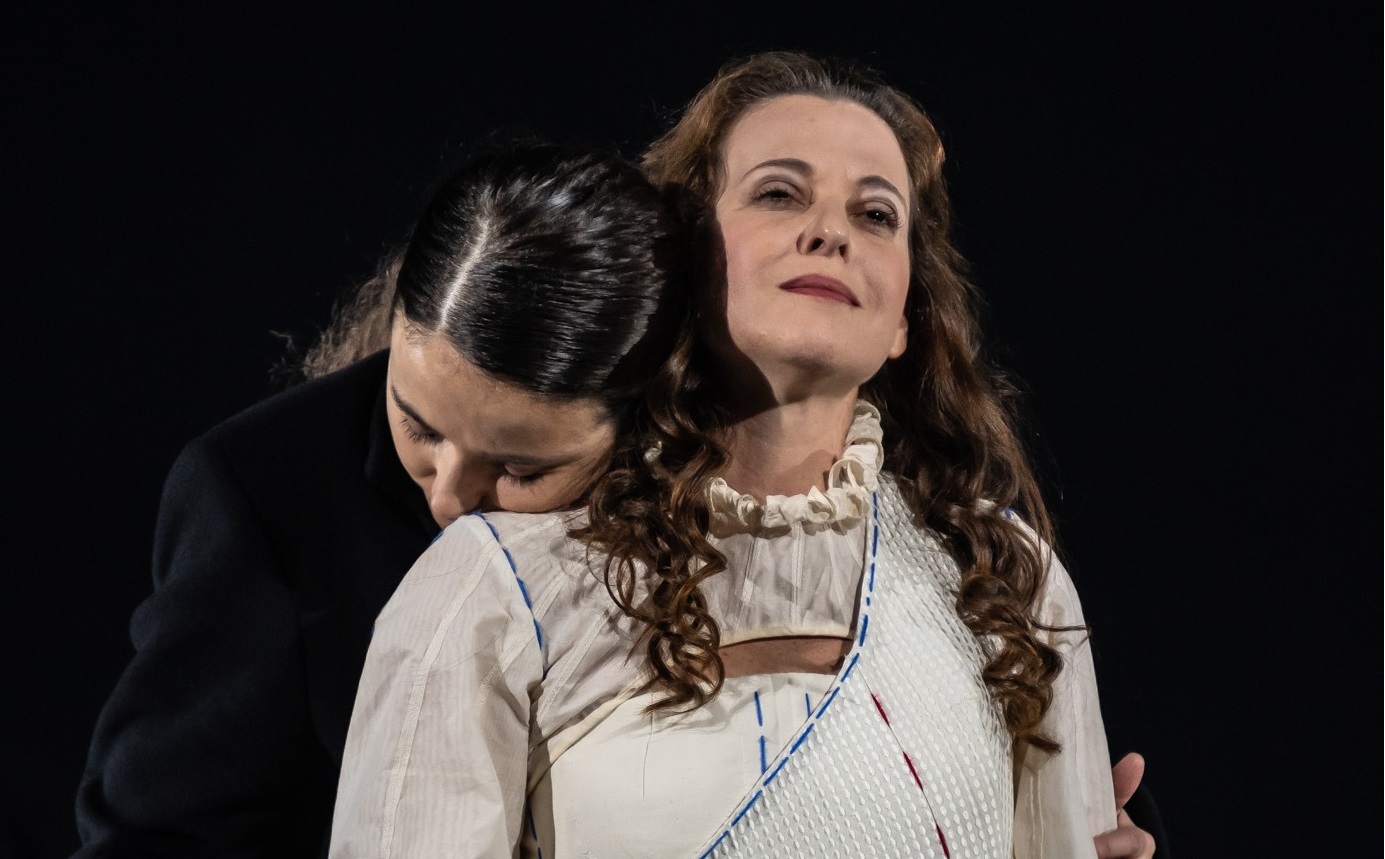
Simon Higlett's set designs likewise kept it simple in line with director Christopher Luscombe's sober direction, not trying to overstate or overawe while the opera itself and its music remained understated. The production is at its most elaborate on the early scene on the ship, but once in Florida everything is stripped back to bold imagery of fronds, lights, stars and moonlight, with only the scene of Solano's meeting with the seer Talum Hadjo and a sequence native girls dancing presenting more elaborate scenes, neither of them entirely escaping an air of stereotypical imagery. The magical fountain of youth, when discovered, is also a little disappointing, looking like a tilted paddling pool with strands of glittering tinsel above it. On the other hand, it served the purpose of it being something symbolic, not representative of a physical place but an ideal where Solano and Watawa reach a mutual understanding, one however that cannot be achieved on any earthly plane. That ship (or plane) has long since sailed.

Composed between 1893-95, like many of Frederick Delius's works until championed by Thomas Beecham, The Magic Fountain was not fully staged until almost one hundred years later. As an opera, while it appears to aspire to the heights of Tristan und Isolde, it nonetheless achieves its own kind of spiritual awakening or integrity by finding a balance between the earthly paradise and a spiritual one in its music and voices. The voices have a freedom to give expression of what they are looking for, without being tied to any high-flown ideals or compositional technicalities, finding their voice rather in the sense the harmony in and with the music. The two lead roles were taken well by Dominick Chenes and Axelle Saint Cirel with bass Kamohelo Tsotetsi as Wataka's father Wapanacki, grounding the proceedings with a more earthy sensibility and gravity.

There is no question that The Magic Fountain is a very distinctive work and one from a composer largely and unjustly neglected, an absolute treat for those seeking out rare operas worthy of greater recognition. Wexford Festival Opera certainly handled this one with the respect it deserved, but there was a feeling that it was maybe too sombre and respectful in its 16th century setting and lacked a meaningful context for the conflicts of cultural and ideological difference that Solano seeks to resolve. Whether it's the work itself that doesn't quite meet the elevated expectations it sets out for itself - as beautiful and enchanting as it is - or whether the production could have benefitted from a little more adventurous interpretation is open to question, but it was a wonderful opera to experience on the National Opera House stage nonetheless.


External links: Wexford Festival Opera, Wexford Festival Opera Streaming on RTE Lyric FM

Tuesday, 29 October 2024

Mascagni - Le maschere (Wexford, 2024)

Pietro Mascagni - Le maschere

Wexford Festival Opera, 2024

Francesco Cilluffo, Stefano Ricci, Lavinia Bini, Benoit Joseph Meier, Ioana Constantin Pipelea, Gillen Munguia, Matteo Mancini, Rory Musgrave, Andrew Morstein, Peter McCamley, Giorgio Caoduro, Mariano Orozco

O'Reilly Theatre, National Opera House, Wexford - 23rd October 2024

There is always a risk that Pietro Mascagni's Le maschere - like many operas that operate in a metatheatrical style - can appear to be too clever for its own good. Le maschere's conceit is not so much the 'Theatre within Theatre' theme of this year's Wexford Festival Opera however as in how it plays on traditional commedia dell'arte archetypes. Those closer to that theatrical tradition that was prominent from 16th to 18th century tend to fare rather better - Mozart's Le nozze di Figaro and Rossini's Il barbiere di Siviglia, for example. Later works - Prokofiev's The Love for Three Oranges and Strauss's Ariadne auf Naxos tend to be a little more self-referential and need to be handled more carefully, with perhaps a little bit of tongue-in-cheek. The 2024 Wexford production of Le maschere attempts to minimise the danger of the opera running away with itself by taking a more simplied approach that humanises by unmasking the commedia dell'arte figures.

Simplify maybe, but in doing so it also risks missing the point of the work, not really fulfilling the intentions of the composer or indeed the premise of Wexford's Theatre within Theatre theme. A spoken introduction attempts to introduce the commedia characters and their associated behaviour for an audience who might not be familiar with the tradition, before they remove their costumes and become 'real' people. It feels a little unnecessary, but it is one way of keeping in with the intentions of Mascagni and his librettist Luigi Illica, suggesting that we all wear the masks of roles we are expected to fulfil, and they have to be removed to find the truth and overcome the challenges that those roles - whether social, class, familial or otherwise - can end up boxing us in and come to define us.

If the choice is made to abandon the commedia dell'arte imposition of masks as a way of presenting the opera on a modern stage, the director and designer Stefano Ricci finds another amusing and suitable way of showing these 'masks' that we sometimes wear, masks that are imposed rather than those we would consciously chose for ourselves. Here, set in a Wellness Centre which doesn't overly impose on the drama, they initially even wear facial masks which works well and even suggests cleansing and detoxification. It has to be said however while there is some amount of convention in the use of a 'magic powder' to rectify the troubled situation that the characters find themselves in, Mascagni's score works its own magic to intoxicate the listener into acceptance of the familiar devices of the plotting.

Because essentially it's the age-old plot of an arranged marriage being proposed that is going to break up one or more couples, preventing them from choosing to be with the one they love. Rosaura, the daughter of Pantaleone, the owner/manager of the wellness spa here, is in love with Florindo but discovers that her father intends to marry her to Captain Spavento, a horrible military man full of his own power and proud of his killing prowess. Her maid/friend Colombina who has intentions towards Brighella, the 'medicine man' of the wellness centre, is also threatened by the advances of Spavento's sidekick Arlecchino. Spavento has no time to waste and hasty arrangements are made for a wedding the very same evening. Brighella comes up with the idea of using a 'magic powder' that will reveal truths 'in vino veritas'-like that will upset the wedding plans, but unfortunately all of them end up imbibing the powder as well.

For all its conventionality, Mascagni clearly had tremendous fun with the plot of Le maschere, the ability to play with commedia dell'arte characters and the resultant chaos that ensues between they roles they play and the truth of their inner selves when unmasked. What is also evident is the composer's desire to engage with the essential Italian character that is unique to Italian opera. It's a character that he of course more famously expressed in his hugely successful Cavalleria Rusticana - now the only work of his that still remains popular and just as powerful today - and there are signs of the epic greatness of that work in Le maschere, but somehow the subject doesn't seem to merit the passion poured into it. There is a beautiful heartfelt duet between Rosaura and Colombina, for example, that expresses the women's dilemma, but it doesn't have the tragic sense of life or death behind it. 

Mascagni also introduces lovely instrumental passages and intermezzos which might lack dramatic intensity and meaning, but are at least imaginatively staged here with dancers and comic routines. There is even an amusing homage to Rossini in Tartaglia, who stutters and stammers, but after imbibing some of the magic powder becomes a rapid fire fluid tongue-twisting Rossinian singer. If Mascagni's ambitions get a little bit above themselves with a grand celebratory conclusion that proclaims the commedia dell'arte as the great Italian art that brought the world laughter and tears, that claim could perhaps have some validity for opera, which has incorporated so many of the elements of commedia. Mascagni, less influential now, but at the time more popular than Puccini, certainly still has an important part to play in bringing that to the world.

With wonderful singing and invigorating music it's like the opera itself wears a mask, imposing heartfelt sentiments upon a slight plot. In simplifying and modifying the opera's ambitions, Stefano Ricci redirects it towards the necessary complexity of human interaction and sensitivity that Mascagni pours into the score, the production design itself another mask that serves to present another version of the truth, bringing out those human elements of warmth, love and humour. Whether the opera merits it, it's a delight nonetheless, further enhanced by some superb singing from Lavinia Bini as Rosaura and Ioana Constantin Pipelea as Colombina. The quality of the singing was fine all around and the performances wonderful, but it seemed harder for the others to break out of their character's defined and caricatured roles and express a deeper human side.

Le maschere is about masks coming off as well as being put on and the Wexford production successfully dressed this one up beautifully, striking a wonderful balance that brought the very best out of the work. The music itself is ravishing and conductor Francesco Cilluffo, as ever, succeeded in arranging, balancing and managing the sometimes overpowering sentiments of the music to match the wonderfully staged drama. Other than using a framing device, I'm not sure the opera fully lived up to the intent of the 'Theatre within Theatre' theme, but the production matched the spirit of the work in other ways and perhaps thereby may even have redeemed some of its weaknesses. 


External links: Wexford Festival Opera, RTE Streaming on YouTube

Monday, 30 October 2023

Tutino - La ciociara (Wexford, 2023)

Marco Tutino - La ciociara

Wexford Festival Opera, 2023

Francesco Cilluffo, Rosetta Cucchi, Na’ama Goldman, Jade Phoenix, Leonardo Caimi, Devid Cecconi, Alexander Kiechle, Allen Boxer, Carolyn Dobbin, Conor Prendiville, Erin Fflur, Julian Henao Gonzalez, Grace Maria Wain, Meilir Jones, Christian Loizou, Will Searle, Peter McCamley

O'Reilly Theatre, National Opera House - 26th October 2023

Wexford Festival Opera may be noted for its unearthing of rare works mainly from the 19th century, but the reviving of works as a way of keeping opera alive and vital also extends to programming new and recent 20th and 21st century works. It's in the context of the 72nd festival's Women & War theme that even against some notable historical competition it was a contemporary composer Marco Tutino and his opera La ciociara that proved to be the most musically and dramatically satisfying work in programme. You might think that the task of composing an opera on the subject of war might have been made easier by having the cinematic source material of the master of post-war neo-realism Vittorio de Sica to work with, which in turn is adapted from Alberto Moravia's war time experiences in Italy, but there is clearly much more to making all that into a successful opera. And indeed a challenge to stage it successfully, so we were fortunate that conductor Francesco Cilluffo and director Rosetta Cucchi were key to realising the full dramatic potential of the work for Wexford.

Composed in 2015 where it was premiered at San Francisco Opera, it's a newly revised version of La ciociara that was being performed for the first time at Wexford. For a festival specialising in reviving old and forgotten opera, Wexford manage to rack up a surprising number of premieres, also managing this year to put on the first ever staged production of the original version of a rare Donizetti opera, Zoraida di Granata. La ciociara was however even more of a coup, since in its new form at least it's an extraordinary piece of opera. It has the opera-cinematic quality of Richard Strauss in its huge dramatic and romantic sweeps, matching the dynamic and range of human experience during a time of war, but it is also thoroughly modern in how it adapts to those changes of tone and provides a consistent accompaniment to the dramatic action without ever resorting to film soundtrack backing.

Photo: Clive Barda

It's a work that more fully realises the Women & War theme of the 72nd Wexford Festival Opera. Where Zoraida and L'aube rouge struggled to get a satisfactory balance, La ciociara also has a romantic core but fully humanises it in while placing it in the context of war. And by humanising that also includes the dehumanising effect of war. There is no holding back here on the brutality and the horror that war inflicts on society and the individual. The individuals in question are Cesira and her daughter Rosetta, the 'two women' of the English version of the Moravia book and film, and Michele, the school teacher Cesira meets in the village of Sant'Eufemia when she returns to her home region of Ciociara escaping from the war in Rome.

Another aspect of the impact that war has on individuals comes in the form of Giovanni, a brute who has followed Cesira and Rosetta from Rome who joins a fascist militia. He hears that the two women and Michele have given aid to a wounded American soldier and, in a jealous rage over Cesira's blossoming relationship with Michele, he informs the local Nazi commander Von Bock - a Scarpia-like figure - which leads to a similar anguished confrontation and eventual execution of Michele, not to mention a rape scene. It's hard not to associate the musical connection and heritage of the brutality pushed by Puccini in Tosca in such scenes.

Photo: Clive Barda

You can detect the post-Wagner and post-Verdi approach to opera of Strauss and Puccini in Tutino's music, but the composer nonetheless puts a neo-Romantico spin on ot, the music dramatic, theatrical and emphatic. Musically everything goes hand in hand with the drama, enhancing the narrative and emotional tone of the piece at every stage. Not a moment is wasted, the opera simply flowing from one scene to the next. The director Rosetta Cucchi (also the artistic director of the Wexford Festival Opera) has a hand in that of course, using filmed segments to link the journey of the two women, Tutino helpfully providing linking music to mark the passage of time and distance. 

Cucchi also takes inspiration from Vittorio De Sica (Peter McCamley), the director of the film version of La Ciociara, including him as a silent figure in the drama during preparations for filming, taking in the location and imagining what he will make of each scene. That gives Cucchi licence to include a dancer figure, a representation of his inspiration perhaps, the emotional core of what he wants to capture on film, the essence of woman maybe? Strength? Endurance? It doesn't necessarily need a name or single definition, since it is really something deeper that arises out of the music that can connect on a different level with the personal experience and reaction of each person in the audience.

This is vital to the human aspect of the work, to the connection it makes with the listener and as a reflection of how the experience of war can be different for different people. It can dehumanise and inflict horror, as Zoraida di Granata and L'Aube rouge made clear earlier in the opera festival, but it can also bring out the better human qualities. Cesira in fact was not such a nice person while she was in Rome, using the war as an excuse to inflate prices in her store. Returning to what was known as the Ciociara region south of Rome, in the country, she finds a closer relationship with nature, naming the flowers and trees, finding secret paths in the woods, finding love, the contrast of the war revealing what is truly important.

Photo: Clive Barda

The opera evidently requires a strong central performance in Cesira, and you couldn't ask for better than Na'ama Goldman, or indeed praise her performance enough. She held the work together as its heart, her singing and dramatic performance absolutely exceptional. Just as remarkable was Jade Phoenix as Rosetta, the young soprano giving an amazing performance through some challenging scenes, singing absolutely superbly. The scene where she took to the front of the stage to offer up a song of prayer was a revelation, winning over the audience as she lived through the trauma and post-trauma brilliantly. Leonardo Caimi was excellent as Michele and Devid Cecconi marvellous in the thankless role of the fascist brute, Giovanni, but neither overshadowed the outstanding performances of the "two women" at the heart of the work.

Superbly directed by Rosetta Cucchi with no expense spared on the impressive production design, the staging couldn't have been in better hands. The same goes for the musical direction of Francesco Cilluffo, and the Wexford orchestra were on fire as they tend to be under this conductor. I look forward to the work he directs at Wexford every year in the assurance that it will be among the best of the festival. That was certainly the case this year in a very good main programme, but in terms of being the full package, La ciociara topped the bill and that was recognised by fierce applause and a standing ovation at the curtain call. I don't think there is any such thing as the perfect opera, but when music, drama, performance and presentation come together as well as they do here, this is as good opera gets.


External links: Wexford Festival Opera

Monday, 7 November 2022

Halévy - La Tempesta (Wexford, 2022)

Fromental Halévy - La Tempesta

Wexford Festival Opera, 2022

Francesco Cilluffo, Roberto Catalano, Nikolay Zemlianskikh, Hila Baggio, Giorgi Manoshvili, Giulio Pelligra, Jade Phoenix, Rory Musgrave, Richard Shaffrey, Gianluca Moro, Emma Jüngling, Dan D'Souza

O'Reilly Theatre, National Opera House, Wexford - 3rd November 2022

You never know if you might discover an unknown gem at Wexford and with Fromental Halévy it could go either way. On the one hand he can provide an interesting work like La Juive, on the other hand something like Clari isn't likely to improve with age. His grand opéra version of Shakespeare's The Tempest it has to be said, turns out to be, at best, serviceable. That's not exactly high praise, but then few operatic adaptations of Shakespeare's plays come anywhere near to the level required and an unknown work from Halévy - despite being a fine composer for his time - isn't likely to come up with any musical equivalent for the noises, sounds and sweet airs of Shakespeare's late work on the poetic contemplation on his craft. That doesn't mean it shouldn't be attempted (Wikipedia notes that at least forty-six operas or semi-operas based on The Tempest exist) and often such works can still surprise when revived here at Wexford. La Tempesta is at least given a vigorous shake and a worthy hearing that drops out a few points of interest.

Like most adaptations of Shakespeare to opera, the play itself is shaken up so much that it loses a lot of its original character, purpose and poetry. You basically have to forget Shakespeare or just see his play as a starting point for a fresh interpretation of the story. All the more so since Halévy is working in the field of grand opéra here and restricted to some degree by the conventions of the form. Strangely however, or perhaps mercifully, it is not a five-act grand opera, there are no ballet scenes and the libretto is in Italian - the libretto commissioned as such for London theatre - rather than French as you would have expected. With the drunken Stephano included, there is at least a good excuse for the obligatory drinking song.

There are no new characters added as some opera adaptations have done - it's not wise to mess too much with the Bard on his home soil - but one notable 'addition' is Sycorax or Sicorace, the witch who formerly presided over the island, mother of Caliban. She is not present in Shakespeare's play by the time Prospero has been long exiled there, wresting control and imprisoning the witch in a rock, but she is included in La Tempesta, at least in voice. There is an inventive scene where Sicorace advises her son Caliban to help both of them break free from the power of Prospero and Ariel, directing him to a flower whose petals can grant the owner three wishes. Caliban of course is such a villain that he refuses to help his own mother and rescue her from her captivity, and instead uses the powers for his own pleasure.

Here, as they often do in theatre productions of The Tempest, Caliban and Ariel tend to overshadow the rather dull naive romantic situation between Miranda and Ferdinand, as well as the power games played by Prospero and the older shipwrecked nobles of Naples. Or perhaps not so much overshadow as extend the range, a double act that take high and low contrasting positions on either side of - or perhaps beyond - the familiar scale of human nature. Ariel is a spiritual creature, lyrical and magical, aspiring to higher sense of order and associated musically and singing voice with high notes. Caliban is low and dark, unthinking and uncaring about anything other than his own base instincts.

Other than the voice range however, Halévy doesn't bring quite the same kind of musical creativity to La Tempesta that Shakespeare brings to his poetic imagining and representation of a world where such capabilities exist in all their fearsome richness. Roberto Catalano's presentation of the work as director for this Wexford Festival Opera production attempts to fill that out a little, representing the unseen magic and spirits on the enchanted island as figures in dark clothing that accompany, observe and occasionally intervene in the drama, compensating to some degree for the dearth of musical creativity that should lift the story into other realms.

Having said that, you couldn't ask for a better musical interpretation that draws the full potential out of Halévy's score than you get here from musical director and conductor, Francesco Cilluffo. The score is fairly attacked by the orchestra to play up all the range and impact of the grand opéra, this one all the better for its lack of indulgences. There is also some fine singing to enjoy, Giorgi Manoshvili's Caliban taking honours as far as I was concerned, alongside Jade Phoenix as an excellent Ariel. Nikolay Zemlianskikh is a fine Prospero, although the character is rather bland in Halévy's version. Hila Baggio's singing was a little on the light side, but she shone with some fine coloratura. Giulio Pelligra bravely (hopefully not unwisely) took to the stage as Ferdinand despite being noticeably unwell.

No-one can say that Wexford didn't give La Tempesta a fair hearing and showing. Emanuele Sinisi's sets worked alongside Catalano's direction to enhance the score and libretto as far as possible, finding their own way of getting the magic of the enchanted island setting across. The opening scene of the storm that brings down the King of Naples' ship was dramatic and yet not exactly as you might expect it to be staged, with magical figures of the chorus in black visiting the beds of the King and his crew and wrapping them in black binbags. With bricks and a broken wall with 'Nostalgia' engraved on it, a huge head statue that seemed to just be randomly left there (almost like something parodied in Viva la Diva at Buxton this summer), the production nonetheless captured the grandeur of the score and found its own ways of placing it in a magical setting.

Much as you shouldn't and much as you might try, it's hard not to set Shakespeare's and Halévy's versions of The Tempest side-by-side and La Tempesta inevitably suffers from the comparison. On its own terms, taking into account the changes that have to be employed in adapting any work and operate within the musical conventions of the time, it is possible to enjoy the work and appreciate its message of putting aside our instinctive impulses and embracing nature, reconciliation and balance. There is balance and measure in Halévy's score at least and plenty to enjoy in the singing and musical interpretation, as well as the fine staging of this rare work at Wexford.


Saturday, 23 October 2021

Catalani - Edmea (Wexford, 2021)

Alfredo Catalani - Edmea

Wexford Festival Opera, 2021

Francesco Cilluffo, Julia Burbach, Anne Sophie Duprels, Luciano Ganci, Leon Kim, Ivan Shcherbatykh, John Molloy, Conor Prendiville, Conall O'Neill

National Opera House, O'Reilly Theatre, Wexford - 19th October 2021

Like just about every other opera festival, Wexford Festival Opera didn't happen in the form of live performances last year but thankfully the attractive 2020 programme of rare Shakespeare related opera 'Shakespeare in the Heart' has been carried over to their 70th anniversary programme. The opening night opera Alfredo Catalani's Edmea only has a tenuous connection to Shakespeare - if any at all - with the notion that the original Dumas drama it is based on may have been inspired by Shakespeare. There's certainly an Ophelia quality to the lost drowned girl of Edmea, but it has more of A Midsummer Night's Dream quality in this production, even more so than Ambroise Thomas's opera of the name which was also included in the 2021 programme. At the very least Edmea suitably meets the festival's remit of unearthing deserving operatic gems that have been forgotten or never had the chance to reach a wider audience. Catalani's Edmea fit the opening night bill admirably.

Not that anyone would doubt the Wexford Festival Opera's choices - just because an opera is obscure and forgotten doesn't mean that it's not good (they've proven that point numerous times) - but there's not a lot of Alfredo Catalani heard nowadays to give even any real indication of the quality of his work. Like most Italian opera composers of the time, Catalani found himself overshadowed and somewhat neglected by his music publisher Ricordi putting much of their support to Puccini - whose success was of course richly merited- even though Catalani enjoyed the favour and support of Toscanini. His final and most successful opera, La Wally is pretty much all we have to go on, a work that certainly has its merits even if it is no longer fashionable and very rarely performed.

Fashions fade, as the saying goes, but style is eternal and Catalani was still in the process of developing his own style and voice when he died of tuberculosis at the age of 39. His work, like many of this time - it couldn't be ignored even if that reaction was negative - is influenced by Wagner, at least in terms of romanticism and the use of leitmotif, without sounding anything like Wagner. The question of whether Catalani might have presented an alternative to verismo, or whether he might still have been overshadowed by Puccini, whose progressive development was also tragically cut short, is one of those things that we will never know, but Italian opera never fully recovered from these losses or found new ground.

Edmea, first performed in 1886, marks the discovery of a popular direction for the composer that would culminate in La Wally in 1892, unquestionably the only work that Catalani is popularly known for in opera circles today. The story is adapted from the drama Les Danicheff by Alexandre Dumas fils, the author of La Dame aux Camélias which formed the basis for Verdi's La Traviata. It's a romantic drama that has something of the feel of a fairy tale, which  makes it sound frivolous, but fairy tales usually have dark origins and can point to deeper truths. You wouldn't think that you could say that about the melodramatic plot of Edmea, which is rather simplistic as a story, the kind of thing you would typically find in bel canto, but there is a slightly darker Verdi edge to the music and director Julia Burbach works to bring deeper qualities out of the work in the 2021 Wexford production.

The plot of Antonio Ghislalanzoni's libretto at least has some of the qualities of an early Verdi pot boiler. The orphan Edmea is in love with Oberto, the son of the family who raised her, but the Count of Leitmeritz is opposed to their union, seeing Edmea as more of a sister to Oberto. He arranges for Oberto to be sent away and for Edmea to be forced into a marriage with the house servant Ulmo. Ulmo is deeply conflicted by this turn of events, as he is madly in love with Edmea but knows that her heart lies with Oberto. Unable to tolerate the marriage she has been pushed into, Edmea throws herself into the river Elbe.

The romantic melodrama of Act I gives way to a more dreamlike fairytale quality in Act II, where we discover that Edmea has not drowned but has lost her mind. Ulmo has stood by her, pretending that he is her brother. The whole tone of the work has been transformed in the second Act - particularly in how it is presented in the Wexford production, opening with a tavern scene where court players and jesters surround them in boisterous but almost surreal scene with Edmea weaving in a daze around them. It has something of the feel of an extended mad scene; a mad scene one where we are all somewhat lost and caught up in Edmea's damaged mind.

That has already been hinted at in opening act as the line that this production is going to follow as a way of dealing with the operatic and theatrical mannerisms of the opera's drama. The stage in Act I shows Edmea's room split into two levels, the lower a dark inverse mirror the bright room above. Below, the female chorus in green dresses with red wigs act as the subconscious working of Edmea's mind, the young woman above wanting to enjoy life but knowing that trouble is brewing in her love for Oberto. In her madness Edmea transforms in Act II into the same red bobbed hair style of her subconscious, wearing a bright yellow dress, only returning to her familiar dress and room when matters are resolved (but still ambiguous) at the close of the opera.

The fantastical look and feel that Burbach strives for and achieves in Cécile Trémolières stunning set and costume designs works wonderfully to enhance the piece, with effective lighting probing further those dark corners of Edmea's mind. As ever with Wexford, if you are going to the trouble of unearthing a rare work, you want to do it justice and this is an ideal presentation of the work. It all works hand in hand with the music, the opera's ballet sequences - something characteristic of Catalani - similarly used to weave the spell. The reduced instrumentation on account of social distancing might also have helped prevent this slipping into whimsy, but it certainly didn't feel reduced. Francesco Cilluffo's vigorous conducting lent the work both the edge and romanticism it needed.

Act II brings a climactic resolution of its own as Edmea is reunited with Oberto and begins a path to regaining her mind, so you wonder where this is going to go in Act III. Then you remember that in the real world, Edmea is still married to Ulmo. The closing Act tidies that matter up in a dramatic but fairly conventional way with a tragic conclusion, one that at least is sympathetic not just to the heroine but also recognises that Ulmo isn't a villain. In some way he is the tragic pawn in this drama as much as Edmea. The music emphasises this, but it is also fairly conventional. Again the production design works to make this a little more interesting and follows through on the idea of exploring the mind of Edmea on two levels, with the sedate surface above and the emotional undercurrents beneath. It's not a wild idea but it does introduce an air of ambiguity about how much is real or the imagining of a young impressionable woman and it does prevent the opera slipping over into simply pure melodrama.

With Francesco Cilluffo conducting, there was never any chance of that. Again, not unlike how the festival's Artistic Director Rosetta Cucchi found a way to bring out the spiritual dimension of Alfano's Risurrezione in the revelatory 2017 Wexford Opera Festival production, the team here (again with Anne Sophie Duprels and Leon Kimfind a way to tap into the deeper nature of the subject that can be found in its music. Edmea too has all the vocal challenges of a typical Italian opera of this period, which means that it has conventional arias, love duets and a drinking scene in a tavern, but it also presents challenges for the emotional and vocal ranges. Anne Sophie Duprels was well cast to achieve that and bring something of the aforementioned human and spiritual character of Edmea. She was also impressive in her transformation to the dreamy Edmea of Act II who has lost her mind. Leon Kim was warmly received for a beautifully sung and sympathetic account of Ulmo. Luciano Ganci's warmly Italianate tenor worked well for Oberto and his Act II aria was one of the highlights of the evening.

The 22nd October performance of Catalani's Edmea will be streamed live from the Wexford Festival Opera on RTE and ARTE Concert.

Links: Wexford Festival Opera, RTEARTE Concert

Monday, 29 October 2018

Leoni/Giordano - L’Oracolo/Mala vita (Wexford, 2018)


Franco Leoni - L’Oracolo
Umberto Giordano - Mala vita

Wexford Festival Opera, 2018

Francesco Cilluffo, Rodula Gaitanou, Joo Won Kang, Sergio Escobar, Leon Kim, Benjamin Cho, Elisabetta Farris, Louise Innes, Francesca Tiburzi, Dorothea Spilger, Anna Jeffers

O'Reilly Theatre, National Opera House, Wexford - 25 October 2018

You can always count on some Italian verismo to give Wexford Festival Opera a bit of an edge. Alfano's Risurrezione at last year's festival packed quite a punch, and if anything the impact is even more intense in this year's double-bill of two concise little gems that Wexford with Francesco Cilluffo at the helm once again have rescued from semi-obscurity for the 2018 festival programme. Franco Leoni's L'Oracolo and Umberto Giordano's Mala vita proved to be a fine complementary pairing that doubled-up the verismo impact.

To all appearances the two works don't have that much in common. Leoni's L'Oracolo (The Oracle) is set in San Francisco's Chinatown, a sordid tale of opium dens, kidnapping, betrayal and murder all squeezed into a one-act one-hour package. Giordano's Mala vita is more Italian in its Neapolitan setting of passionate outpourings in the realm of love and betrayal. There are however a few interesting commonalities brought out by the pairing together of the two works.


Essentially, both works are about ordinary human lives where the poverty of their environment has a lot to do with their actions. With nothing left to live for, characters are forced to resort to other means to lift them out of the misery of their situation, with drugs and criminality one indication of this in the backstreets of Chinatown in L'Oracolo. In L'Oracolo however, some turn to superstition in fortune-telling, and in Mala vita others turn to religion - or superstition again, if you like. In both cases however human nature proves to be stronger and it's not the good side of it.

In terms of verismo, L'Oracolo, written in 1905 could probably be most closely associated with Puccini's Il Tabarro (from Il Trittico), not least in its shock conclusion of the fate of the victim of a murder being disguised. Musically however, Leoni is in advance of Puccini in his use of street sounds and noises feeding into the score as atmospherics. Dramatically, it's pure Grand Guignol, involving opium den owner Cim-Fen kidnapping her young brother so that he can impress Ah-Joe when he 'recovers' the child. His efforts are hampered however by a rival for Ah-Joe's affections when San-Lui discovers his plot, forcing Cim-Fen to brutally kill him.


As if this isn't colourful enough L'Oracolo also has a number of busy street scenes set around the beginning of the Chinese New Year, with partying, dancing, a dragon procession, a lantern festival and the fortune-telling scene by the oracle that gives the opera its title, predicting two deaths to come. It also embarks on a revenge killing when San-Lui's father, the owner of a Chinese medicine shop, goes off to exact bloody retribution on the murderer of his son. As if that's not enough, director Rodula Gaitanou piles on the gore in place of the attempt to hide the death from the unfortunate policeman who works on this beat.

If Leoni's score is more impressionistic and dynamic in its balance of light and shade, Giordano's goes for an all-out Italian passions in Mala vita in a manner that takes it closer to Cavalleria Rusticana. Like L'Oracolo however its tale of poverty and the law of honour killings in the countryside, but is set in the poor district of the city of Naples. Religion and community however still play an important part, and in Giordano's three-act short work, Vito who is suffering from tuberculosis is inspired to seek out and help an unfortunate woman on the streets as a way of atonement and a plea to God for a cure for his illness.


Vito pledges to take prostitute Cristina out of the den she works in and promises to marry her, much to the fury of Amalia his mistress who is married to Annetiello, a sleazy character who already 'knows' Chrstina. The fallen woman gratefully accepts Vito's promise of redemption (shades of Alfano's Risurrezione there too) but is ultimately let down by Vito, who finds that his feelings for the spiteful Amalia are greater than his sacred vows to God and to a lowly prostitute. Left destitute once again, Cristina in this production - again rather emphasising the tone of lives in desperation - kills herself.

Musically, Giordano's score is every bit as overpowering as Cavalleria Rusticana, filled with religious processions, singing and dancing and huge choruses that are almost declamatory in delivery. You would almost think it might be taking things a little bit over-the-top, but then you remember Mala vita is set in Naples, so it might even be considered understated in that light. Francesco Cilluffo brings the fire out of both works, with a more appropriate lighter touch for L'Oracolo, while the orchestra is boosted by a larger string section to draw out the darker tones for Mala vita.


The singing performances also exhibit a similar range and appropriateness of tone. Mala vita provides the best opportunities for the lead soloists to shine, particularly for the competitive female leads of Cristina and Amalia, which are sung superbly by Francesca Tiburzi and Dorothea Spilger. Sergio Escobar, also singing San-Lui in L'Oracolo, was really given a chance to let his ringing tenor shine as Vito in Mala vita, fearlessly and impressively hitting all the expressive high notes.

The set designs and costume design (vaguely 1930s backstreet poverty) by Cordelia Chisholm were impressive; a rotating block of tenement flats with lower-floor shops and buildings that moved fluidly form one scene to the next. How the cast managed to keep up with this from one moment to the next and get themselves into position in the crowded stage is another wonder of stage management. All that was required for the change was to turn the shop signs from Chinatown shops to Italian ones, even if it still retained more of a San Francisco feel than an authentic Neapolitan scene. More important however was that it permitted a direct comparison and transference of theme across the two works, and - with those superb musical and singing performances - both accordingly came over with tremendous power.


Links: Wexford Festival Opera

Saturday, 11 November 2017

Alfano - Risurrezione (Wexford, 2017)


Franco Alfano - Risurrezione

Wexford Festival Opera, 2017

Francesco Cilluffo, Rosetta Cucchi, Gerard Schneider, Anne Sophie Duprels, Charles Rice, Romina Tomasoni, Louise Innes

National Opera House, Wexford - 2 November 2017

Late in his life, Leo Tolstoy embraced a radical form of Christianity and would look back with disgust at the indulgence and sin of his former aristocratic upbringing. Adopting a more ascetic lifestyle he would also come to repudiate his greatest works, including War and Peace and Anna Karenina, believing that art and literature had no purpose unless it was instructive. Some of his descriptions of his former life of dissolution can be found in the early semi-autobiographical work Childhood, Boyhood and Youth, and a more reflective and penitent side of his rebirth can be found in later works like The Kingdom of God is Within You, The Forged Coupon and Resurrection.

The idea of penitence and rebirth is evidently very much to the fore in Resurrection. It might seem primarily like an exercise in guilt, but Resurrection is not so much about wallowing in self-pity and self-abasement as much as reflecting on how one's actions affect others, and whether any real good can be brought about by repentance and a change of heart. Tolstoy reportedly wasn't impressed by the indulgence of Resurrection being adapted into an opera that caters to a well-off audience, but you can also see why Franco Alfano's Risurrezione didn't set the world alight and even now remains a neglected piece. It is a gloomy affair for the most part and Alfano's treatment of the work is as serious as it gets, but it is also beautiful and ultimately uplifting.

The opera is structured neatly into four parts that, since the story is instructive and not bogged down with distracting sidelines, are easily summarised. Prince Dmitri reflects Count Tolstoy's early life of indulgence of the aristocratic lifestyle, without a thought or care for the needs and feelings of others. In Act I he seduces the maid Katiusha on a fleeting visit to the family mansion and then disappears again, forgetting about her.  In Act II we discover that Katiusha is pregnant from this encounter and as a consequence she has been thrown out of the house and her life has fallen into ruin. She abandons an attempt to tell Dmitri about the situation when she discovers him with a prostitute.


Dmitri belatedly discovers Katiusha's fate, which has ended up with her becoming a prostitute and falsely imprisoned, and he tries to make up for what has happened in Act III, visiting the fallen woman in prison. He pleads that he knew nothing of what had happened, that he is still in love with her and that he can help get her released from the harsh prison environment so that they can marry, but Katiusha remains impervious to his entreaties and doesn't believe that he can really change his ways.

Alfano sets Risurrezione very much in the Italian verismo style of the day, which proves to be quite appropriate, at least for these first three acts. It's actually not unlike La Bohème, the meeting of Dmitri and Katiusha in Act I similar to that of Rodolfo and Mimi; on shaky ground from the start, the brief spark between them soon extinguished by the cruel reality of their circumstances. In Risurrezione, Act II and III also relate closely to the situation in Act III of La Bohème, where attempts to rekindle the spark seem even more unlikely; the couple despairing of the impossibility of their union. Surely death is also on the horizon in Risurrezione?

Well yes and no, and that's the point of Tolstoy's work. Hard lessons have to be learned, there needs to be an acceptance of one's true self and true repentance and reparation. Dmitri tries to show this, but it is worthless without Katiusha's acceptance and forgiveness, which can also only come with an acceptance of her own true self. This is visually represented in Rosetta Cucchi's impressive Wexford production by a young girl seen briefly throughout, but to be fair it's hinted at in Alfano's score, which is not as relentlessly downbeat as it sounds, but alive to dynamic and emotional tone.

The focus is very much on Dmitri and Katiusha for most of Act I, much of Act II, the latter part of Act III and all of Act IV.  Considering the challenging nature of their characters' predicaments, that places a lot of pressure on Gerard Schneider and Anne Sophie Duprels, but both take their parts exceptionally well, remaining strong and consistently lyrical throughout. Alfano does however break the story down into memorable scenes with a greater variety of dramatic situation than might be expected, even if variation of the overall despairing tenor of the work up to the final scene is negligible.


That makes Risurrezione quite a challenging work also for a conductor trying to harness Alfano's verismo score towards the true character of Tolstoy's original work. Francesco Cilluffo however drew a magnificent performance out of the Wexford Festival orchestra that was entirely sympathetic to the sensibility of the work and the composer's treatment, holding to a consistent through-line while finding the right adjustments of volume and tempo to allow the score to hit all of its dramatic points. The Italianate orchestration might seem at odds with the spiritual Russian side of the work, but Cilluffo uses the verismo aspects of the score as another way of trying to find "truth", albeit in a very different way from Tolstoy.

The conclusion then in Act IV is worth waiting for, even though the treatment up to that point never drags or begs indulgence but is rather just earnest and purposeful. For the climactic moment of enlightenment Alfano has to abandon his verismo principles for a heavenly choir as an inner revelation dawns (literally) on both Dmitri and Katiusha and takes them to a spiritual awakening. It really does strike the perfect note of transcendental attainment that the work should be aiming to reach. The traditional operatic death that might be expected at the conclusion then is replaced by a metaphorical death, a letting go of the past and to ways that have held both Dmitri and Katiusha back from being open to their better nature, allowing them to be reborn, resurrected.


Links: Wexford Festival Opera