Showing posts with label Rory Musgrave. Show all posts

Sunday, 26 October 2025

Handel - Deidamia (Wexford, 2025)

George Frideric Handel - Deidamia 

Wexford Festival Opera, 2025

George Petrou, Sophie Junker, Sarah Gilford, Bruno de Sá, Nicolò Balducci, Rory Musgrave, Petros Magoulas

O'Reilly Theatre, National Opera House, Wexford - 22nd October 2025

For a festival that specialises in rare opera, it's not unknown for the occasional 18th century baroque and opera seria works to be performed at the Wexford Festival Opera, although to do so authentically usually requires a specialised early music orchestra or ensemble. Since the theme of this year's festival however is build around Myths and Legends - a mainstay of early opera - opera seria is the place to find plenty of great rarely performed operas, of which Handel's 1741 Deidamia is definitely a rarity. The composer's final opera before he turned his attention in later years to oratorio, it's perhaps not so great when measured alongside his next work Messiah, also in 1741, but all Handel's operas are worth exploring. If there was a brief from the Wexford Festival's artistic director that the focus of each of the operas should be on the human element to make the legend relevant to real people today, director George Petrou seems to have taken that brief literally.

Dealing with an obscure incident in Homer's Odyssey, where Odysseus travels to the island of Skyros searching for Achilles who is needed for the upcoming battle in Troy, it does seem a little bit strange just to overlay the Greek legend with some modern day tourists walking around the same Greek island taking selfies in the background, complete with projections of Wish You Were Here postcards. You would think the serious music of Handel wouldn't be able to sustain these two separate narratives, but by making some of the modern day travellers concerns similar to those of the ancient Greeks, it does succeed in making it a little more relevant, or at least sparks a little more interest. It's a good strategy since, taken on its own terms, Handel can often appear to be a bit dry, when - as David Alden recognised in the Dutch National Opera production of this work - there is actually quite a measure of humour built into the story and the music.

As both stage director and conductor, George Petrou is clearly aware of this and this concept consequently works very well, with both ancient and modern given equal attention. The little dramas of a bunch of privileged luxury tour holiday makers are perhaps not quite equal in importance (you might think), but Petrou strikes a balance where one gives equal emotional and meaningful weight to the other. The focus is of course on what is being sung and played out by the main figures in the ancient Greek drama, but essentially the concept emphasises the fact that the same concerns remain for all of us in the present day. Not that anyone today would start a catastrophic war with a nation over someone stealing their first lady. Or at least you would hope not, but you couldn't even count on that security in today's world.

If that were all that there was to it, presenting a necessary modern perspective on an ancient legend, it would be a valid approach, but Petrou doesn't settle for such simple parallels. Every scene ambitiously employs a new setting, using different special effects, new technology and projections in addition to traditionally impressive sets and effective lighting. All of it is in the service of making the production visually engaging, and if you engage visually as well as emotionally, you engage with the singing and the music, which can otherwise appear routine and repetitive. In reality, although Deidamia marked his retirement from writing opera, it is far from routine. Petrou, controlling the stage as well as the orchestra in the pit, knows how the music serves every scene with drama, emotion, tenderness and concern; all the necessary human qualities in the work, even if it is not the composer's most inspired or celebrated piece.

The plot and libretto don't exactly mark any important event in the story of the Odyssey. Well, it is based around the need to have the war machine that is Achilles join the assembled Greek fleet on its way to Troy, but since it has been foretold that Achilles will die on Trojan soil, his father has hidden him on the island, dressed as a girl under the name Pyrrha. Essentially the whole opera then is an attempt by two Greek commanders Odysseus and Phönix (both also going under assumed names) to discover the whereabouts of the warrior and get him to join the siege on Troy. Evidently, since there are disguises and cross-dressing involved and since Achilles is not great about hiding his manly interests in hunting and killing, this involves a few mishaps and misunderstandings, none of which in themselves are particularly original or humorous.

But George Petrou's Wexford production nonetheless makes the most of every situation. The sensitive direction, not without a sense of humour in where the two worlds cross over and occasionally interact, helps bring this out. The spectacular and inventive effects that set and costume designer Giorgina Germanou realises suit every mood from stormy seas, thunderous downpours, a classical vase design that turns out to be a modern fashion dress, animated sequences, an undersea scene and even a cheesy - and quite impressive - movie trailer. There is no end of inventiveness, none of it employed arbitrarily. The intention is to avoid static scenes, keep movement going and match the rhythms and moods of Handel's score without distracting from the essence of the dramatic flow.

In fact it actually supports the premise well. While all the plot revolves around Ulysses/Antilochus falling in love with a man dressed as a woman, or pretending to, and the (real) women trying to simultaneously fight off the advances of men while at the same time trying to woo them away from uncovering Achilles' true identity, (and in the case of Nerea falling in love in the process), the serious side is not neglected. It's the modern day inserts that help us to see this. At the end of the romantic comedy drama there is a long and brutal war that will take place and Achilles knows he will die in it. The duty and the solemnity of that hits home in the final scenes, again with projections contrasting the movie trailer epic seen earlier with the harsh reality of war that we are very familiar with witnessing at the moment.

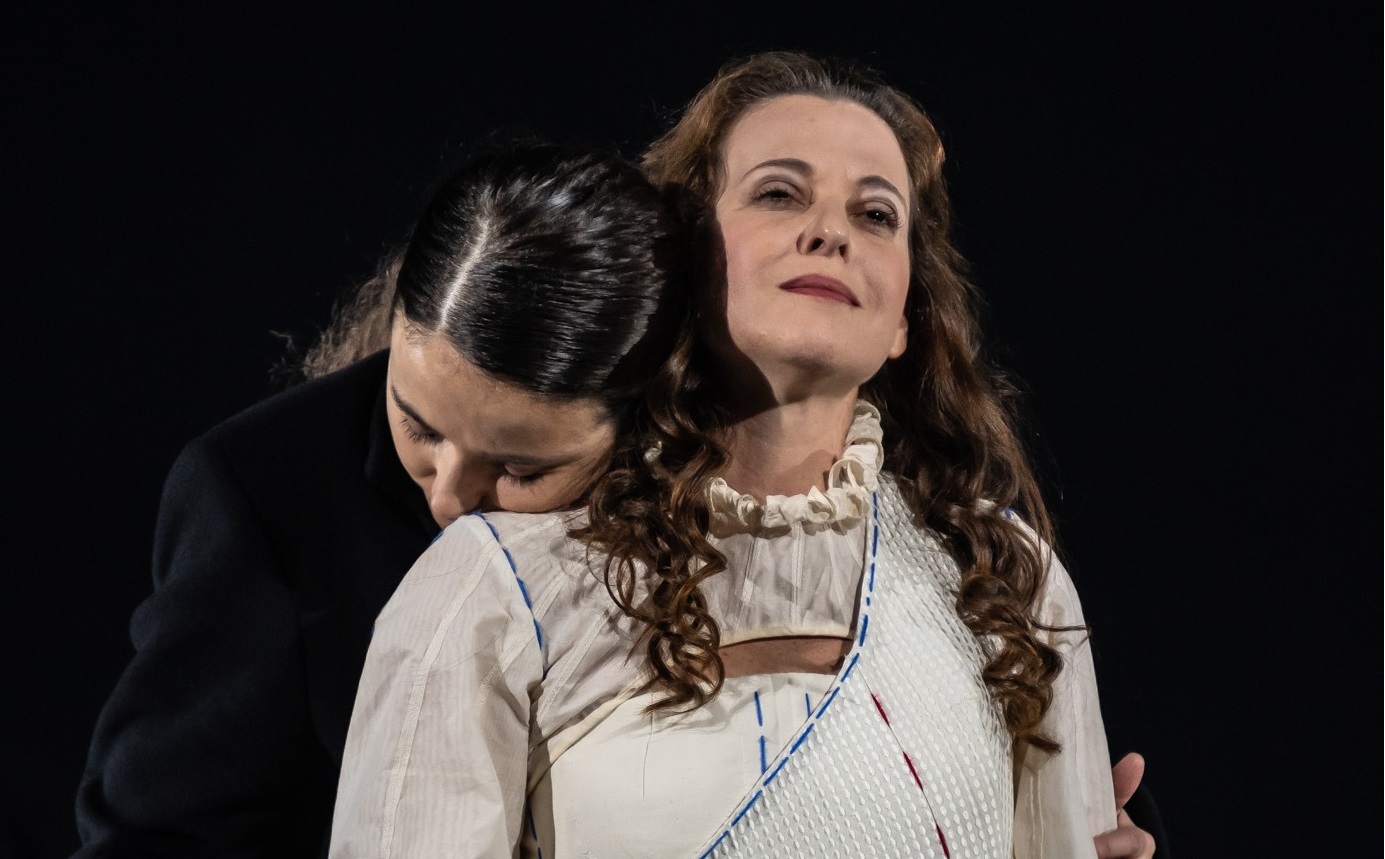
Deidamia has two main roles that can be played by females dressed as men: one a man (Antilochus), the other a man pretending to be a woman (Achilles as Pyrrha). It avoids some confusion and disorientation - but not much - if both roles are undertaken as they are here by male countertenors, and we had two fine countertenors here with Nicolò Balducci as Ulysses and Bruno de Sá as Achilles. Balducci in particular was a standout performer here, but de Sá played up the badly pretend-female role well in an energetic performance. Rather than it being a showcase for singers, Handel actually balances out the roles well for the requirements of the drama, giving just as much attention to Deidamia as her friend Nerea, sung well here by Sophie Junker and Sarah Gilford. Likewise it provided the opportunity for Rory Musgrave and Petros Magoulas to make significant contributions as as Phönix and Lycomede.

Still Deidamia is perhaps not a great Handel opera or the most thrillingly plotted, but it's a masterful one nonetheless and one that was definitely worthwhile reviving (among many potential Handel and opera seria candidates) for this year's Wexford Festival Opera's Myths & Legends theme. Like all baroque opera, there is always the danger of three hours of da capo arias being a bit of a chore if not handled sensitively and respectfully, but the key is also not to do it too reverentially. The balance here in this production conducted and directed by George Petrou is ideal, with the music providing dramatic drive and tone that the visual extravagance and performances matched impressively. Very impressively indeed.


Tuesday, 29 October 2024

Mascagni - Le maschere (Wexford, 2024)

Pietro Mascagni - Le maschere

Wexford Festival Opera, 2024

Francesco Cilluffo, Stefano Ricci, Lavinia Bini, Benoit Joseph Meier, Ioana Constantin Pipelea, Gillen Munguia, Matteo Mancini, Rory Musgrave, Andrew Morstein, Peter McCamley, Giorgio Caoduro, Mariano Orozco

O'Reilly Theatre, National Opera House, Wexford - 23rd October 2024

There is always a risk that Pietro Mascagni's Le maschere - like many operas that operate in a metatheatrical style - can appear to be too clever for its own good. Le maschere's conceit is not so much the 'Theatre within Theatre' theme of this year's Wexford Festival Opera however as in how it plays on traditional commedia dell'arte archetypes. Those closer to that theatrical tradition that was prominent from 16th to 18th century tend to fare rather better - Mozart's Le nozze di Figaro and Rossini's Il barbiere di Siviglia, for example. Later works - Prokofiev's The Love for Three Oranges and Strauss's Ariadne auf Naxos tend to be a little more self-referential and need to be handled more carefully, with perhaps a little bit of tongue-in-cheek. The 2024 Wexford production of Le maschere attempts to minimise the danger of the opera running away with itself by taking a more simplied approach that humanises by unmasking the commedia dell'arte figures.

Simplify maybe, but in doing so it also risks missing the point of the work, not really fulfilling the intentions of the composer or indeed the premise of Wexford's Theatre within Theatre theme. A spoken introduction attempts to introduce the commedia characters and their associated behaviour for an audience who might not be familiar with the tradition, before they remove their costumes and become 'real' people. It feels a little unnecessary, but it is one way of keeping in with the intentions of Mascagni and his librettist Luigi Illica, suggesting that we all wear the masks of roles we are expected to fulfil, and they have to be removed to find the truth and overcome the challenges that those roles - whether social, class, familial or otherwise - can end up boxing us in and come to define us.

If the choice is made to abandon the commedia dell'arte imposition of masks as a way of presenting the opera on a modern stage, the director and designer Stefano Ricci finds another amusing and suitable way of showing these 'masks' that we sometimes wear, masks that are imposed rather than those we would consciously chose for ourselves. Here, set in a Wellness Centre which doesn't overly impose on the drama, they initially even wear facial masks which works well and even suggests cleansing and detoxification. It has to be said however while there is some amount of convention in the use of a 'magic powder' to rectify the troubled situation that the characters find themselves in, Mascagni's score works its own magic to intoxicate the listener into acceptance of the familiar devices of the plotting.

Because essentially it's the age-old plot of an arranged marriage being proposed that is going to break up one or more couples, preventing them from choosing to be with the one they love. Rosaura, the daughter of Pantaleone, the owner/manager of the wellness spa here, is in love with Florindo but discovers that her father intends to marry her to Captain Spavento, a horrible military man full of his own power and proud of his killing prowess. Her maid/friend Colombina who has intentions towards Brighella, the 'medicine man' of the wellness centre, is also threatened by the advances of Spavento's sidekick Arlecchino. Spavento has no time to waste and hasty arrangements are made for a wedding the very same evening. Brighella comes up with the idea of using a 'magic powder' that will reveal truths 'in vino veritas'-like that will upset the wedding plans, but unfortunately all of them end up imbibing the powder as well.

For all its conventionality, Mascagni clearly had tremendous fun with the plot of Le maschere, the ability to play with commedia dell'arte characters and the resultant chaos that ensues between they roles they play and the truth of their inner selves when unmasked. What is also evident is the composer's desire to engage with the essential Italian character that is unique to Italian opera. It's a character that he of course more famously expressed in his hugely successful Cavalleria Rusticana - now the only work of his that still remains popular and just as powerful today - and there are signs of the epic greatness of that work in Le maschere, but somehow the subject doesn't seem to merit the passion poured into it. There is a beautiful heartfelt duet between Rosaura and Colombina, for example, that expresses the women's dilemma, but it doesn't have the tragic sense of life or death behind it. 

Mascagni also introduces lovely instrumental passages and intermezzos which might lack dramatic intensity and meaning, but are at least imaginatively staged here with dancers and comic routines. There is even an amusing homage to Rossini in Tartaglia, who stutters and stammers, but after imbibing some of the magic powder becomes a rapid fire fluid tongue-twisting Rossinian singer. If Mascagni's ambitions get a little bit above themselves with a grand celebratory conclusion that proclaims the commedia dell'arte as the great Italian art that brought the world laughter and tears, that claim could perhaps have some validity for opera, which has incorporated so many of the elements of commedia. Mascagni, less influential now, but at the time more popular than Puccini, certainly still has an important part to play in bringing that to the world.

With wonderful singing and invigorating music it's like the opera itself wears a mask, imposing heartfelt sentiments upon a slight plot. In simplifying and modifying the opera's ambitions, Stefano Ricci redirects it towards the necessary complexity of human interaction and sensitivity that Mascagni pours into the score, the production design itself another mask that serves to present another version of the truth, bringing out those human elements of warmth, love and humour. Whether the opera merits it, it's a delight nonetheless, further enhanced by some superb singing from Lavinia Bini as Rosaura and Ioana Constantin Pipelea as Colombina. The quality of the singing was fine all around and the performances wonderful, but it seemed harder for the others to break out of their character's defined and caricatured roles and express a deeper human side.

Le maschere is about masks coming off as well as being put on and the Wexford production successfully dressed this one up beautifully, striking a wonderful balance that brought the very best out of the work. The music itself is ravishing and conductor Francesco Cilluffo, as ever, succeeded in arranging, balancing and managing the sometimes overpowering sentiments of the music to match the wonderfully staged drama. Other than using a framing device, I'm not sure the opera fully lived up to the intent of the 'Theatre within Theatre' theme, but the production matched the spirit of the work in other ways and perhaps thereby may even have redeemed some of its weaknesses. 


External links: Wexford Festival Opera, RTE Streaming on YouTube

Saturday, 28 October 2023

Erlanger - L'Aube rouge (Wexford, 2023)

Camille Erlanger - L'Aube rouge

Wexford Festival Opera, 2023

Guillaume Tourniaire, Ella Marchment, Andreea Soare, Andrew Morstein, Emma Jüngling, Ava Dodd, Dominica Williams, Giorgi Manoshvili, Philippe-Nicolas Martin, Rory Musgrave, Thomas Birch, Ami Hewitt, Leah Redmond, Corina Ignat, Judith Le Breuilly, Conor Baiano, Hannah O’Brien, Andrii Kharlamov, Rory Lynch, Gabriel Seawright, Vladimir Sima

O'Reilly Theatre, National Opera House - 25th October 2023

You would expect things to get a little serous in a festival season based on the theme of Women & War. Without having to emphasise the point, sticking closely to the original 15th century setting, the Wexford Festival Opera production of Donizetti's Zoraida di Granata nonetheless succeeded in bringing out those themes strongly in such a way that you could hardly fail to see it echoed in contemporary real world events. That theme is should be just as effective in L'aube rouge (The Red Dawn), an early 20th century work of verismo character by Camille Erlanger that involves the action of a band of Nihilists in pre-revolutionary Russia plotting the assassination of the Grand Duc. Composed in 1911, not far removed from the historical events it depicts, director Ella Marchment gives the stage production a closer contemporary feel that should also relate to today, but as intriguing as it is to consider this forgotten work and as well performed as it is, it doesn't succeed in making the impact you feel it ought to.

It's an interesting subject for an opera by a French composer of Jewish origin at a time when the divisions caused by the Dreyfuss affair had revealed deep-rooted prejudice and divisions in French society, and when the Russian Revolution was stirring not far around the corner. Much is made of this in the festival programme notes for L'Aube rouge  but other than to provide context and suggest a connection with the Italian verismo movement, neither political element really appears to exert much influence on the opera. Apart from a police raid in the first act on the anarchist group in St Petersburg that is quickly dispersed and the shock finale of Act III when Sergei is shot by a member of his own group, the emphasis in L'Aube rouge appears to be more concerned with setting up the tragic and impossible romance between Olga and Sergei.

Olga is the daughter of General Lovarov, the despised chief of police, so she is immediately distrusted when she appears at a meeting of the anarchist group. Sergei however vouches for her and falls in love with her, but there is no future for their romance in such a place, and so they move to Moscow. Olga's family however have other plans for her that include a marriage to Pierre De Ruys, a surgeon and important establishment figure, but Sergei, who Olga's father has convinced her has died in a Siberian prison camp, shows up at the wedding and the two of them run away together to Paris. 

Sergei however is shot by another member of the Nihilist group when it is believed that he is no longer dedicated to the cause. He is saved only by the intervention of Olga, who convinces the man she deserted at their wedding, Pierre De Ruys, to perform life-saving surgery. Determined to prove himself however Sergei on recovery embarks on a mission that will assure his death, attempting to assassinate the Grand Duc. It's enough to drive Olga herself to madness and death.

It's high melodrama, but as far as the themes go L'Aube rouge undoubtedly emphasises the impact that war has on preventing people living ordinary lives, and as Olga is the central character of the opera (with in Andreea Soare, a gifted soprano capable of really making her the central focus and heart of the opera), the plight of women and any hope of living in peace and love is emphatically shown as being doomed. Certainly all the indications of that are there in the music which, even if the main part of the opera revolves around an impossible romance, has a deep undercurrent of tragedy within it. Even the second Act wedding scene and the fourth Act dances are all powerfully and dramatically scored in a way that suggests that any celebration is fleeting and only a brief respite before the real world crashes in again.

Photo: Clive Barda

It may be powerfully scored by Erlanger, but there is little that stands out as memorable in either the plot development or in any distinct flair of musical expression. Even so, like many neglected opera's from the beginning of the 20th century, it remains fascinating to consider where it fits in and how, along with many other composers, it seeks to find a new voice and a place for opera in a post-Wagner and post-Verdi age. Certainly you can here echoes of the verismo composers, the dramatic writing fitting in well with the darker side of Puccini (Tosca in particular), the overall tone and subject matter reminding one of Alfani's Risurrezione (performed at Wexford in 2017) and Giordano's Siberia.

Two things however stand out in this performance however that make it very much worthwhile, aside from it being an intriguing rare opera. Conducted by Guillaume Tourniaire, the playing of the orchestra was exceptional, the warmth and dynamism of the music enhanced by the beautiful acoustics of Wexford's O'Reilly Theatre. The other stand out was the commanding performance of Andreea Soare as Olga. She demonstrated beautiful clarity, control and lyricism even at the most anguished of moments, but was also capable of dropping to softness and even playfulness in the singing of a Russian song. It was a great, fully rounded performance that is essential to the character of the work. Andrew Morstein as Sergei/Serge also had a lovely tenor voice, but didn't have the volume behind it to carry the dramatic import. Giorgi Manoshvili's Kouragine was also worthy of note.

Much as Ella Marchment's direction and ideas for the Wexford production tries to give it a contemporary feel that aligns with the festival theme of Women & War, the opera's uneven balance of love and war doesn't allow it to have the same impact as the production of Donizetti's Zoraida di Granata the previous evening. The final act here should bring back the dramatic tension of the activities of the Nihilists that end up taking the lives of both Sergei and Olga, but it ends up feeling less of a humanitarian issue than a romantic one. 

The director can only work as best as the material allows however, and the production design strived to keep the drama grounded in concrete reality heading towards inevitable tragedy and not idealise the romantic aspect, using a multi-purpose staircase and a grim concrete background that feels oppressive and inescapable. Even in Paris, the set holds the same basic feel, the frenzied dancing of the final act likewise unable to shake the inevitability that it is leading towards a bleak finale.


Links: Wexford Festival Opera

Monday, 7 November 2022

Halévy - La Tempesta (Wexford, 2022)

Fromental Halévy - La Tempesta

Wexford Festival Opera, 2022

Francesco Cilluffo, Roberto Catalano, Nikolay Zemlianskikh, Hila Baggio, Giorgi Manoshvili, Giulio Pelligra, Jade Phoenix, Rory Musgrave, Richard Shaffrey, Gianluca Moro, Emma Jüngling, Dan D'Souza

O'Reilly Theatre, National Opera House, Wexford - 3rd November 2022

You never know if you might discover an unknown gem at Wexford and with Fromental Halévy it could go either way. On the one hand he can provide an interesting work like La Juive, on the other hand something like Clari isn't likely to improve with age. His grand opéra version of Shakespeare's The Tempest it has to be said, turns out to be, at best, serviceable. That's not exactly high praise, but then few operatic adaptations of Shakespeare's plays come anywhere near to the level required and an unknown work from Halévy - despite being a fine composer for his time - isn't likely to come up with any musical equivalent for the noises, sounds and sweet airs of Shakespeare's late work on the poetic contemplation on his craft. That doesn't mean it shouldn't be attempted (Wikipedia notes that at least forty-six operas or semi-operas based on The Tempest exist) and often such works can still surprise when revived here at Wexford. La Tempesta is at least given a vigorous shake and a worthy hearing that drops out a few points of interest.

Like most adaptations of Shakespeare to opera, the play itself is shaken up so much that it loses a lot of its original character, purpose and poetry. You basically have to forget Shakespeare or just see his play as a starting point for a fresh interpretation of the story. All the more so since Halévy is working in the field of grand opéra here and restricted to some degree by the conventions of the form. Strangely however, or perhaps mercifully, it is not a five-act grand opera, there are no ballet scenes and the libretto is in Italian - the libretto commissioned as such for London theatre - rather than French as you would have expected. With the drunken Stephano included, there is at least a good excuse for the obligatory drinking song.

There are no new characters added as some opera adaptations have done - it's not wise to mess too much with the Bard on his home soil - but one notable 'addition' is Sycorax or Sicorace, the witch who formerly presided over the island, mother of Caliban. She is not present in Shakespeare's play by the time Prospero has been long exiled there, wresting control and imprisoning the witch in a rock, but she is included in La Tempesta, at least in voice. There is an inventive scene where Sicorace advises her son Caliban to help both of them break free from the power of Prospero and Ariel, directing him to a flower whose petals can grant the owner three wishes. Caliban of course is such a villain that he refuses to help his own mother and rescue her from her captivity, and instead uses the powers for his own pleasure.

Here, as they often do in theatre productions of The Tempest, Caliban and Ariel tend to overshadow the rather dull naive romantic situation between Miranda and Ferdinand, as well as the power games played by Prospero and the older shipwrecked nobles of Naples. Or perhaps not so much overshadow as extend the range, a double act that take high and low contrasting positions on either side of - or perhaps beyond - the familiar scale of human nature. Ariel is a spiritual creature, lyrical and magical, aspiring to higher sense of order and associated musically and singing voice with high notes. Caliban is low and dark, unthinking and uncaring about anything other than his own base instincts.

Other than the voice range however, Halévy doesn't bring quite the same kind of musical creativity to La Tempesta that Shakespeare brings to his poetic imagining and representation of a world where such capabilities exist in all their fearsome richness. Roberto Catalano's presentation of the work as director for this Wexford Festival Opera production attempts to fill that out a little, representing the unseen magic and spirits on the enchanted island as figures in dark clothing that accompany, observe and occasionally intervene in the drama, compensating to some degree for the dearth of musical creativity that should lift the story into other realms.

Having said that, you couldn't ask for a better musical interpretation that draws the full potential out of Halévy's score than you get here from musical director and conductor, Francesco Cilluffo. The score is fairly attacked by the orchestra to play up all the range and impact of the grand opéra, this one all the better for its lack of indulgences. There is also some fine singing to enjoy, Giorgi Manoshvili's Caliban taking honours as far as I was concerned, alongside Jade Phoenix as an excellent Ariel. Nikolay Zemlianskikh is a fine Prospero, although the character is rather bland in Halévy's version. Hila Baggio's singing was a little on the light side, but she shone with some fine coloratura. Giulio Pelligra bravely (hopefully not unwisely) took to the stage as Ferdinand despite being noticeably unwell.

No-one can say that Wexford didn't give La Tempesta a fair hearing and showing. Emanuele Sinisi's sets worked alongside Catalano's direction to enhance the score and libretto as far as possible, finding their own way of getting the magic of the enchanted island setting across. The opening scene of the storm that brings down the King of Naples' ship was dramatic and yet not exactly as you might expect it to be staged, with magical figures of the chorus in black visiting the beds of the King and his crew and wrapping them in black binbags. With bricks and a broken wall with 'Nostalgia' engraved on it, a huge head statue that seemed to just be randomly left there (almost like something parodied in Viva la Diva at Buxton this summer), the production nonetheless captured the grandeur of the score and found its own ways of placing it in a magical setting.

Much as you shouldn't and much as you might try, it's hard not to set Shakespeare's and Halévy's versions of The Tempest side-by-side and La Tempesta inevitably suffers from the comparison. On its own terms, taking into account the changes that have to be employed in adapting any work and operate within the musical conventions of the time, it is possible to enjoy the work and appreciate its message of putting aside our instinctive impulses and embracing nature, reconciliation and balance. There is balance and measure in Halévy's score at least and plenty to enjoy in the singing and musical interpretation, as well as the fine staging of this rare work at Wexford.


Monday, 25 October 2021

Goldmark - Ein Wintermärchen (Wexford, 2021)

Karl Goldmark - Ein Wintermärchen

Wexford Festival Opera, 2021

Marcus Bosch, Burkhard Fritz, Sophie Gordeladze, Ava Dodd, Simon Thorpe, Daniel Szeili, Rory Musgrave, Jevan McAuley, Niamh O'Sullivan, Conor Gahan, Ben Knight, Vladimir Sima, Sheldon Baxter, Peter Lidbetter, Fiona Finsbury 

National Opera House, O'Reilly Theatre, Wexford - 21st October 2021

If the other operas in Wexford's 'Shakespeare in the Heart' programme (Edmea, Le Songe d’une nuit d’été) had only a tenuous connection with actual Shakespeare texts, the inclusion of Karl Goldmark's Ein Wintermärchen ('The Winter's Tale') at least promised a more authentic Shakespearean experience. Sadly reduced to concert performance while Covid restrictions are still in place in Ireland, it nonetheless proved to be just that, the rarely performed opera working closely to the plot of Shakespeare's drama with only minor concessions to compressing the extended timeline. Musically too it proved to be in keeping with the mood of Shakespeare's great late romance, much more authentic to the original than most opera adaptations of Shakespeare tend to be.

Musically, not being familiar with Goldmark as an opera composer - his grand opera Die Königin von Saba ('The Queen of Sheba') achieved fame in its day but is not performed now - I wasn't quite sure what musical tradition to place him within. There's his friendship with Mahler and the influence of Wagner - whether positive or as a reaction against it would have been almost impossible for a composer around this time not to acknowledge Wagner - perhaps give some clue to a certain type of sound. Even looking at the musical choices of the cast in the programme and indeed the type of singers cast for this opera all pointed in a similar direction. Perhaps the greatest influence on Goldmark however appears to be his Hungarian born origin and the whole Viennese musical world that he is associated with. There's as much Johann Strauss as Richard Strauss in Ein Wintermärchen, but perhaps even more Dvořák in the melodic richness of the orchestration.

If you had any familiarity with Shakespeare's great late play and indeed Philippe Boesman's fine modern opera version of the work (Wintermärchen, 1999) then there was little need for staging, even though this drama is famous for its unusual stage directions and extravagant magical touches. While those stage effects were missed in concert performance, leaving a few gaps to be filled by the imagination, it's mood more than anything that is essential in Ein Wintermärchen. That was provided by the cool blue lighting and backdrop in this concert performance of the opera, but also evidently in Goldmark's well-calibrated score that was enhanced by the fine acoustics of the magnificent O'Reilly theatre at the National Opera House in Wexford.

Ein Wintermärchen and indeed Shakespeare's A Winter's Tale is not all as cold, dark and gloomy as it suggests, nor is it in the realm of Korngold-like lush fantasy either. Act I is the most plot driven, the warm friendship and pleasantries exchanged between Leontes and Polixenes, the rulers of Sicily and Bohemia, breaking down very quickly as Leontes succumbs to bitter jealousy and suspicion about the relationship between Polixenes and his pregnant wife Hermione. This descends with devastating effect to the next stage of murder plots and shocking deaths. When Hermione dies, the new-born baby of his dead wife is repudiated and abandoned to her fate at sea.

Act II of the opera opens by way of contrast with jaunty folk dance music, as the character of Time puts 16 years distance between those fateful events and the pastoral scenes in Bohemia. The lost child of Hermione has been rescued from where she was abandoned and brought up by a shepherd. The pure beauty of Perdita however sets her apart from her folk and she enjoys the love of the Prince Florizel, the son of Polixenes who has no knowledge of her background. (No one does in fact, the only person who might have known having made their fatal "exit, pursued by a bear"). Despite objections by Polixenes, the marriage takes place and the act closes with the music of Viennese waltzes as preparations are made for a reconciliatory trip to Sicily.

Unlike many adaptations of Shakespeare that struggle to compress and rework a huge complex plot down into lyrical theatre, Goldmark's opera almost seems leisurely in its handling of the play, taking time to revel in mood, character and situation. It feels as if it is genuinely soaking up the character of the work, letting it breathe with musical personality rather than being slavish to the exigencies of the plot. Inevitably there are cuts to secondary characters and scenes, the tighter focus making it more difficult to establish the long passing of time and the weight this places on the regrets, mistakes and longing of the characters. You lose a little more in a concert performance without stage effects, but Goldmark's writing ensures that the concluding Act III still comes across dramatically and effectively.

Again, familiarity with the play and with its dramatic interventions and revelations helps fill in the gaps left by the concert performance, and what we lose in stage representation we gain by way of an opportunity to properly hear Goldmark's orchestral arrangements and be able to focus on the musical qualities of this rare work. It was performed to the usual high standard under the baton of Marcus Bosch in the fine acoustics of Wexford's superb opera house. There was no reduced orchestration this time, as there was with the previous performances of EdmeaLe Songe d’une nuit d’été, so the audience were able to enjoy the full orchestration of this fascinating work.

An excellent cast also gave this work a fine presentation. Burkhard Fritz got the drama off to a suitably intense start in Act II with his troubled Leontes and there was good playing alongside him from Sophie Gordeladze as Hermione and Simon Thorpe's Polixenes. Sheldon Baxter was a warm toned shepherd Valentin, there was powerful projection from tenor Daniel Szeili as Florizel and a bright Perdita in Ava Dodd. Niamh O'Sullivan's Paulina was also notable and well-received by the audience at the curtain call. They all come together wonderfully with the chorus providing strong backing in the third Act (conductor and composer Andrew Synnott managing all the festival chorus duties this year). It would have been lovely to see Ein Wintermärchen staged for full effect, but the qualities were nonetheless clearly apparent in this Wexford Festival Opera concert performance.

Links: Wexford Festival Opera

Monday, 9 September 2019

Deane - Vagabones (Dublin, 2019)


Raymond Deane - Vagabones

Opera Collective Ireland, 2019

Sinéad Hayes, Ben Barnes, Crash Ensemble, Rory Dunne, Carolyn Holt, Kelli-Ann Masterson, Sarah Power, Rory Musgrave, Ross Scanlon, Fionn Ó hAlmhain

The Civic Theatre, Tallaght - 6 September 2019


Do I detect a certain amount of revived hostility towards the English in recent new Irish opera works? It's not hard to note a growing frustration bordering on disbelief at the handling of Brexit in the UK and the serious collateral damage that this English vanity project might inflict on the people and the economy of Ireland. Old grudges haven't been forgotten, the wounds run deep and it looks like they might be coming back to the surface.

Another new Irish opera premiered in Dublin just a few weeks ago. Donnacha Dennehy's The Hunger dealt with the Irish Famine, and while its focus was on the suffering of the ordinary people, taking the perspective from historical accounts and the roots of suffering in traditional Irish music, it was made clear in the contemporary interviews with academics that it's a historical accepted that the English were certainly not blameless for the severity of the situation. As well as continuing to export grain from Ireland during the famine, it's clear that there was a general indifference to the suffering of the Irish people in favour of a hands-off approach to non-intervention in market forces that contributed to the severity of the resulting famine.


Showing that Irish opera seems to be going through a rich phase at the moment, it's hard not to see similar political undercurrents and contemporary resonance in Opera Collective Ireland's commission of Raymond Deane's new opera Vagabones. Whether it is indeed in reaction to contemporary events, Brexit and border issues being revived by the English is probably too early to say, but it's interesting that Deane also chooses to delve far back into Irish history to another episode where a sense of English entitlement and ruling superiority can be seen as being responsible for the oppression of the Irish way of life in the sowing of hatred and suspicion.

Based on the play 'Trespasses' written in the mid-1990s by Emma Donoghue, Vagabones dates back long enough before the current fiasco and cause of divisions, but it also derives in part from the writer's experience of being Irish and living in England in the period leading up to the Good Friday Agreement. It's based on an account of a witch trial of Florence Newton, which took place in Youghal in Co. Cork in 1661, one of the few witch trails that took place in Ireland. Perhaps, if Arthur Miller's 'The Crucible' is anything to go by, the accusation made against Florence Newton is inspired by jealousy more than any deeper political intent by Mary Longdon, a maid of English origin. Afraid that she won't be able to marry her master John Pyne because she suffers from epileptic fits, Mary blames them on the curse of old Irish woman, accusing her of being a witch.

Ben Barnes's direction of Opera Collective Ireland's world premiere production of Vagabones keeps to the 17th century period setting and doesn't set about introducing any modernisms or revisionism, or indeed anything that would point to any contemporary allegorical or political element. The locations are all based in and around Florence's prison cell and her being brought to trial, those scenes contrasted with the finery of the English landlords and ruling authorities. The sense of injustice is strong, heightened by entitlement of the authorities that even if they know they are wrong they must be seen to be right. Sharing a cell with Donal a young boy jailed for a minor theft, there is a sense of the poor being made to pay for the indulgences of the rich. In the hierarchy here, even an English maid is more important than an indigenous Irish person.


If the historical subject matter and treatment of Irish matters in their new opera works suggests a common purpose when seen in close proximity, Raymond Deane comes from a very different musical background to Donnacha Dennehy. Deane, who studied composition under Stockhausen in Cologne, is more from the European modernist tradition open to experimentation, whereas Dennehy has a strong connection to the peculiarities of Irish trad for rhythm and sensibility and a foot in American minimalism. There are no obvious Irish musical references in Vagabones, although there is some use of accordion and harp, but if there are similarities between Dennehy's The Hunger and Dean's Vagabones it's probably highlighted by in the use of the Crash Ensemble and a similar scale of chamber orchestration, with an ensemble of 13 musicians conducted by Sinéad Hayes.

Deane's music and his development of Vagabones from a play gives the work a more traditional dramatic character with nothing overtly experimental. Deane does develop a technique here, creating a unique voice for each of the six main characters by superimposing scales on a pitch structure to develop a unique voice for each of the characters. Whether that's evident or not, it at least gives the something with which to establish a sense of character and personality. The scoring certainly has mood and impact, the music appropriate in scale and delivery for the intimacy of the subject, supporting the drama and letting its undercurrents come through.

The singing performances are all very good, inevitably somewhat Sprechgesang and traditionally dramatic. It's delivered as such with nothing unconventional or experimental here, and no unnecessary flourishes. Vagabones is a smaller scale chamber work and it might not be particularly ambitious in staging or conception, but it certainly finds an intriguing subject that works well on its own terms as a drama and even in a wider context, presents a interesting bigger picture of where contemporary Irish opera and maybe even Ireland is at the moment.


Links: Opera Collective Ireland