
Opéra-Théâtre de l’Athénée Théâtre Louis-Jouvet, 2022
Aurélien Bory, Geoffroy Jourdain, Clotilde Cantau, Adèle Carlier, Anne-Emmanuelle Davy, Jeanne Dumat, Constantin Goubet, Floriane Hasler, Michiko Takahashi, Amandine Trenc, Virgile Ancely, Safir Behloul, Renaud Brès, Mathieu Dubroca, Alfred Noblet-Rousseau Bory
Athénée Théâtre Louis-Jouvet, Paris - 29th September 2022
Opera can be many things to different people, so it's understandable that not everyone enjoys the idea of contemporary opera. One of the defining characteristics of opera for me however is that, like any essential art work or art form, it needs to be universal and transcend time. Opera is performance art, which means that it lives in the moment and not as notes on music score sheets, or even in a recorded performance. That's why modern opera is important, that's why new approaches are necessary, and that's why it needs to be reinvented, reinvigorated and not remain merely an historical artefact that preserves the past in amber.
That approach is one that Wolfgang Mitterer wholeheartedly embraces in this stunning and beautifully conceived new work Dafne, 'a madrigal-opera after Heinrich Schütz'. Conceived in collaboration with musical director Geoffroy Jourdain and stage director Aurélien Bory, Mitterer's Dafne spans the space between gods and mortals, antiquity and modernity, opera of the past and opera of the present. He takes an old practice, one that is not common nowadays, and resets a 17th century libretto to new music - you don't for example find too many Metastasio-penned libretti being used in contemporary opera. It's not just an academic exercise either, but one that is necessary since the Heinrich Schütz's original music is now lost, destroyed in a fire at a library in Dresden in 1730.

The idea of reconstruction of an opera based on a libretto isn't even a new practice either. Most of the early operas only have basic basso continuo markings and the score largely improvised upon them by the musicians. In the case of reconstructions of several lost Vivaldi's operas, the music is at least derived from other music by the composer, but in the case of Dafne, there is nothing that remains. Wolfgang Mitterer, noted for his experimental electronic music might seem a composer least likely to adhere to fidelity to the source, but in fact he does produce a beautiful work that combines his sound experiments with traditional instruments and a beautiful 12-part polyphony vocal setting of the libretto.
There are actually several reasons why the project would attract a sympathetic and suitable approach from Wolfgang Mitterer. The composer has spoken of performing Monteverdi and Schütz in a vocal quintet in his youth. As 2022 marks the 350th anniversary of the death of Schütz, who is considered as the German Monteverdi, it seems like the right time to revive what is considered to be the first work of German opera. Composed in 1627, based on a libretto by Ottavio Rinuccini adapted into German by Martin Opitz, only the libretto to Schütz's Pastorale survives. That needed to be reworked by the creators for a modern stage performance, but in keeping with the tradition of a madrigal opera from the period, they have chosen to use the idea of a chorus relating the drama, but also using the individual fach of the singers on alternate lines so that each of the gods have a multiplicity of voices.

The libretto doesn't appear to be anything exceptional, it has to be said, or at least with little to distinguish it from other typical Baroque opera or the tragédie lyriques of Lully dealing with mythological subjects and pastorals. Dafne deals with the legend of Daphne from Ovid's Roman retelling by classical Greek mythology in his Metamorphoses. It even has the traditional prologue where the gods are in dispute, although here it's Ovid who provides the prologue, while the dispute between Apollo and Venus takes up the rest of the opera. Full of pride over his defeat of Python, the beast that has been terrifying the island of Delos, Apollo denies that any other gods have power such as his. Despite the warnings of Venus, Apollo mocks Cupid's bow and arrow only to be struck and fall in love with the nymph Daphne.
Like another recent contemporary opera based on Ovid's Metamophoses (Sivan Eldar's Like Flesh), the modern relevance of ancient Roman mythology can be seen in the folly of disrupting the course of Nature. The immortality of Daphne, who turns into a laurel tree to escape the advances of Apollo, can be seen as representing the power of art to transcend time and death, to set oneself outside the power of the gods. Much like Orpheus, the subject of many operas, that can also be testament to the nature of opera itself. As another modern opera Detlef Heusinger's Die Zeitreisemaschine suggests, opera itself is a precious time machine. Even more so here in the case of Dafne, the original opera destroyed, but recreated, reinvented and metamorphosised to survive even beyond its destruction. That alone testifies to the power and relevance of Dafne, not least through the performance and staging choices made here, but there are many other ways that the opera can speak to us.
What struck me as noteworthy about the concept here is that aspect of it returning to the roots of opera, which was conceived as a response to the mistaken belief that it was ancient practice to sing Greek drama verse. Here Mitterer extends that idea, bringing back an ancient tradition, putting an existing surviving ancient text of Greek myth to music and singing. In doing so with the music of our day, he bridges the past and the present. "Not the music of my day" a lot of traditionalists might cry and certainly Mitterer's sonic art approach to music isn't for everyone. The electronic music for Dafne is prerecorded and uses Mitterer's usual mannerisms and techniques, including sampling of orchestral music, with speeded up effects, clicks and electronic juddering, so there was little conducting required on the part of Geoffroy Jourdain for that.
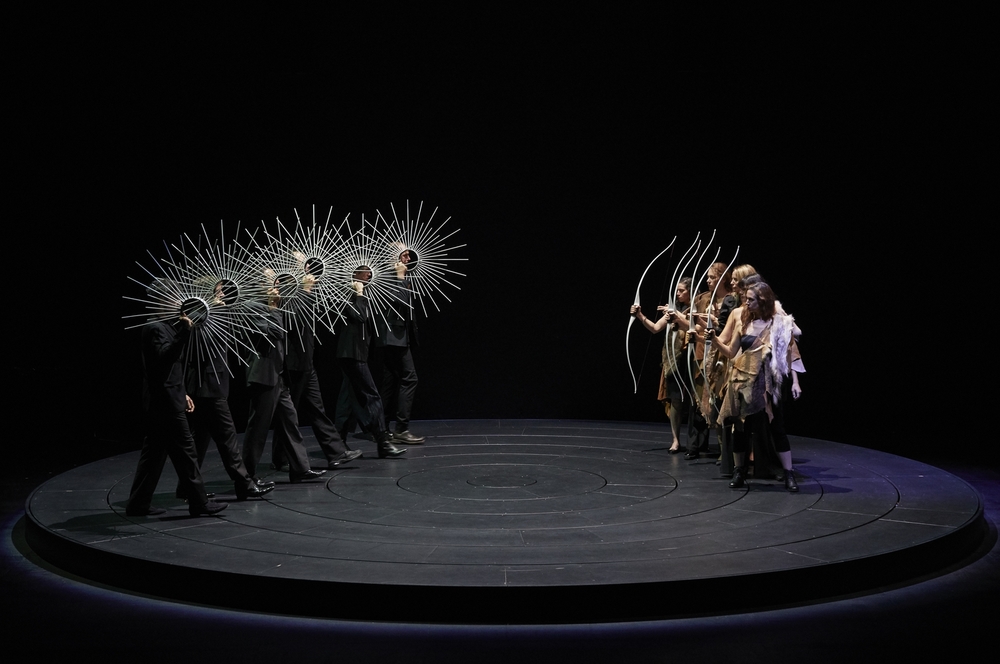
This however only forms a background, the basso continuo to the composer's beautiful writing for the voice. It gives the chorus's telling of legend an otherworldly setting, swirling and haunting, truly lifting it into the mystical realm of the gods. Traditional instruments are used in sections, very much in the style of the period and informed by the music of Heinrich Schütz, those instruments played by several of the singers. Singing and playing as individuals, but also as a chorus, the gods indeed have a multi-voiced form, as if a single voice would not be enough. The conception of this, as well as the blending of ancient and modern in the music, is impressive and striking, giving Dafne a character quite unlike any other opera. It is truly befitting of an opera that seeks to do justice to an important historical work in German opera and through it aspire to represent the idea of immortality.
The staging is an essential element of any opera and Aurélien Bory's presentation has a major part to play here, one that is also commensurate with its ambitions. If it doesn't perhaps bring any allegorical or contemporary reading out of the drama, it at least illustrates its abstraction and otherworldly qualities. The thirteen singers of the Jourdain directed Les Cris de Paris have a complicated choreography to perform on concentric rotating wheels of the stage, itself a reference to the rotating stage devised by Tommaso Francini in the 1617, in the same period of the opera. It brings movement and circularity, chase and distance. Other stage effects, such as the hunting arrows dropped from the sky onto the circular 'target' that are then used to form the crown of Apollo, the appearance of 'Venus' on wires and the transformation of Dafne into a tree are superbly realised all within this circularity. The coherence of concept and execution ensures that there are no slow or dry passages here; everything comes together, flow and movement, music and ambiance, harmony and dissonance, past and present all made one.
When many question the point of contemporary opera, question the abandonment of traditional tonal musical forms in contemporary music and illustrative traditional stage productions, Mitterer, Bory and Jourdain show the importance of keeping music theatre progressive and experimental, while still using the past as a touchstone for reference and for informing the present. The original opera of Dafne, were it even to still exist, would probably remain obscure, of historical curiosity value and rarely performed for a modern audience, incapable even of having the same impact in that form that it would have had on an audience of its time. Here it is given new life, and if the libretto and its subject might feel like they have little to do with contemporary issues, Mitterer's Dafne at least allows us to consider what it tells us about the arts, on the higher universal themes that can be found there, the necessity of carrying their message through to the present day, and in how great art can still speak to and move a modern audience.


