Thursday, 27 May 2021

Alfano - Risurrezione (Florence, 2020)

Franco Alfano - Risurrezione (Florence, 2020)

Maggio Musicale Fiorentino, 2020

Francesco Lanzillotta, Rosetta Cucchi, Anne Sophie Duprels, Matthew Vickers, Leon Kim, Francesca Di Sauro, Romina Tomasoni, Nadia Pirazzini, Ana Victoria Pitts, Barbara Marcacci, Filomena Pericoli, Nadia Sturlese

Dynamic, Blu-ray

Rosetta Cucchi's production of Franco Alfano's Risurrezione was something of a revelation for me when when I first saw it at the Wexford Festival Opera in 2017. Not only did it serve to give much better representation of a composer who is only really known by most for having completed the last Act of Turandot when Puccini died, but it helped illuminate better the idea of opera verismo. More than just being about realism and the misfortunes of ordinary people, it can also be seen in many of its best works (La Bohème, Cavalleria Rusticana) to elevate the lives and suffering of ordinary people to something of a spiritual level.

If you are looking for an author in literature author who is capable of doing precisely that it's Count Leo Tolstoy. To be fair many of the classic Russian writers including Turgenev and particularly Chekhov achieve that in their writing, but no-one else lived their beliefs out quite the same way as Tolstoy. Repudiating even his greatest works and turning his back on the wealthy, dissolute lifestyle of being born into nobility, Tolstoy would choose to dedicate the rest of his life to not only celebrating the spiritual and morally pure existence of a life of hard work and poverty in his writing, but he would live his life according to those values as well.

Tolstoy documented his early life experiences in 'Childhood, Boyhood and Youth', and there's clearly also a semi-autobiographical element to the character of Prince Dmitri and his reckless womanising behaviour in his later work 'Resurrection'. A well-off noble, on a visit to his aunt's country house just before joining the army, Dimitri renews a childhood romance with Katyusha, one of the maids of the household who has now grown into an attractive woman. It's not so much a renewal of an innocent romance as much being aware that he has the power, position and authority to prey on the naivety of the young woman to seduce her.

In Act II we discover that Katyusha is pregnant from that fleeting encounter. Hearing that Dimitri is returning wounded from the front on his way home to St. Petersburg, she goes to the train station to see him and tell him of her predicament. Fearful, hoping he will understand, the bleakness of the conditions don't offer much comfort to Katyusha agonising outside in the cold winter, her fate hanging in the balance. Alfano's opera (not unlike Act III of La Bohème) cleverly interweaves a scene of drinking, gambling and a drunken dispute going on in the station, a scene that also alludes to other vices of the young Tolstoy. 

When Dimitri passes by without seeing her, a beautiful woman on his arm, Katyusha's fate is sealed; vagrancy, destitution, prostitution and a decline that sees her in Act III and IV unjustly condemned to 20 years imprisonment in Siberia. Dimitri however has recognised her, is repentant of his actions, has sought her out and wants to gain forgiveness by trying to save her. Katyusha's feelings about how that can be attained however are quite different and on a different level from Dimitri.

Musically, Alfano's score is wholeheartedly verismo in its range and dynamic, reminding one certainly of Puccini. The situations, the passing of the seasons, the joy of young love and foolishness turning to trials and pain of dealing with the harsh realities of life mirror scenes in La Bohème to an extent. The difference between them is that Puccini's subjects never let him achieve the same kind of of redemptive, soaring spiritual enlightenment that Alfano reaches for in Tolstoy's writing, failing to see - perhaps realistically - any other outcome for his troubled protagonists than death.

Risurrezione strives for a higher purpose, looking beyond death and material concerns towards a spiritual rebirth, and in that respect, Katyusha's journey is perhaps closer to Manon Lescaut in its trajectory and search for redemption for past sins. In the light of Risurrezione I wonder however whether it might be worth looking anew at this lesser and often unsatisfactorily staged Puccini to consider whether he wasn't striving towards a similar transcendental experience in that problematic final act, and whether the opera might be made to work with a staging as sympathetic to it as this one is to Alfano.

In staging Risurrezione it would be enough just to match the emotional content of the music and the drama to the weather conditions of each of the seasons that accompany and heighten the situations and experiences to an almost unbearable level of anguish. The shock of the verismo realism is powerful in its own right, and Rosetta Cucchi's direction doesn't flinch from showing the grim situations to the full. Much more tricky is allowing a sense of hope and meaning for such misery and suffering to take you through to the extraordinary finale of death and rebirth, but the director does that extraordinarily well. Using the image of a young girl seen out of the corner of Katyusha's eye to occasionally wander into each scene, it's a fine way to suggest a sense of the inner woman, the inner child and the necessity to rediscover the innocence of youth.

It's a fantastic idea that works well with the intent of the piece. How much you can hear of that in Alfano's music I'm not so sure, but there is repeated motif reflecting on a photograph of Katyusha taken when she was young in garden of Prince's aunt and the director expands on this to great effect. Conductor Francesco Lanzillotta certainly brings out the fullness of the emotional content of the score, but in order to feel the pain that deeply there must be some sense of human vulnerability there, as well as the human strength to rise out of it. That comes out in all its glory in the finale of the opera and the production's magnificent staging of it.

The human element in opera is of course best expressed through the voice and although Katyusha is evidently a challenging central role to deal with emotionally as well as on a technical level Anne Sophie Duprels reprises her 2017 performance of the role at Wexford here to striking effect. Matthew Vickers is a little bit stiff by comparison, but Dimitri it must be said is a rather more difficult figure to relate to. Vickers nonetheless sings the role well enough to feel some sympathy for this character. Leon Kim sings the baritone role of Simonson, the prisoner who falls in love with Katyusha in Siberia, warmly and with feeling.

This world premiere video recording of Risurrezione, recorded in January 2020 at the Maggio Musicale Fiorentino, is released on DVD and Blu-ray by Dynamic. Image and sound are marvellous on the Blu-ray capturing the tone of the work and its presentation well in Hi-Res Stereo LPCM and surround DTS HD-Master Audio mixes. The enclosed booklet contains a tracklist, a full detailed synopsis and an informative essay on Alfano's and an analysis of the opera. The booklet is in Italian and English. The Blu-ray is region-free, BD50, and offers subtitles in Italian, English, French, German, Korean and Japanese.

Friday, 21 May 2021

Blacher - Romeo und Julia (Duisberg, 2021)


Boris Blacher - Romeo und Julia

Deutsche Oper am Rhein, Duisberg - 2021

Christoph Stöcker, Manuel Schmitt, Florian Simson, Jussi Myllys, Lavinia Dames, Katarzyna Kuncio, Günes Gürle, Andrés Sulbarán, Beniamin Pop, Renée Morloc

OperaVision - 19 March 2021

Adaptations of Shakespeare to opera inevitably involve some level of cutting and reworking, to various extents and to various levels of success. Compromises would have also been made in centuries past - in Verdi, in Thomas and Berlioz - in libretti where the composers were working from less than ideal translations of Shakespeare's text. Some relatively modern adaptations have been much more successful in retaining as much of the poetry of the text and the spirit of the original as possible, notably Aribert Reimann's Lear and Brett Dean's Hamlet, surely two of the most difficult Shakespeare works to imagine being adapted to music.

The narrator at the prologue of Boris Blacher's 1943 chamber opera Romeo und Julia - a German cabaret chansonnier dressed in drag as Queen Elizabeth - suggests that this is not going to be the most faithful of Shakespeare adaptations, and although he promises a two hour telling, the 70 minute running time doesn't really appear to be capable of providing anything more than just a surface retelling of a doomed romance. That's still a lot of Shakespeare to compress down without losing the poetry and essence of the work, so evidently the music is going to have to do some heavy lifting here.

And to some extent, Blacher's opera does so much more successfully than you might imagine - impressively even - particularly since the reduced orchestration consists solely of string quintet, piano, flute, bassoon and trumpet. Secondary characters, including Friar Laurence, are combined in a tightly harmonised eight person chorale singing in oratorio-like fashion. Musically it's surprisingly varied in tone and arrangement, with a Kurt Weill-style cabaret narrator interludes and chamber orchestration that manages to capture the mood of each scene, from the dramatic fight, to the celebratory party, to the famous romantic encounters and the tragic finale.

The abridged and musically reduced version might have been something of a necessity for an opera composed during the war, but Romeo und Julia nonetheless benefits from this kind of compression and condensing, bringing a tighter focus to the love story. If it is less attentive to the detail of the wars between the Capulet and Montague, the real world outside would have provided plenty of context for that. Which in turn makes this an opera not only eminently suitable for staging in the current lockdown conditions, but one where we can understand the difficulties of people trying to carry on relationships under adverse conditions where circumstances and vast forces beyond their control strive to keep them apart.

Inevitably the drama of Romeo und Julia seems a little rushed and overheated if you are familiar with the play, but in truth, even the original play is overheated in how quickly passions and bloods are ignited in both love and in violence, and in how deeply these experiences cut. It's about young people, impetuous, quick to react, dismissive or even contemptuous of the consequences of not following the rules of their elders. The concision of Blacher's opera works then to the benefit of the headlong rush to abandon oneself to the passions of the moment, and the music does it's best to keep up with them.

Even if you're not all that familiar with the play, the tighter focus, the choice of scenes, the music, the handling of the characters and the use of a chorus makes it relatively easy to follow in this opera version. It helps that the poetry of the original is retained in as much as it can be in German translation, the English subtitles in this recorded version for OperaVision even choosing to adhere directly or much more closely to Shakespeare's original text. And when it has such famous lines, well, why wouldn't you?

Manuel Schmitt's directing for the Deutsche Oper am Rhein production is fairly simple but effective in the way that it contributes to highlight Blacher's take on the work and matches its austere chamber arrangements. The costumes are contemporary but there's nothing here trying too hard to be radical, just enough to be suitable and give a sense of the roles of each character. There is little need for over-decoration of the set either, the main action taking place on simple bare stage surrounded by neon-pipe lighting. Romeo and Juliet and the youths occupy centre stage, while fathers, mothers and other authority figures taken up by the chorus remain above on a surrounding platform.

There is however another level hinted at here, the stage rising to reveal a backstage underworld of sorts. Without getting too meta, it's partly an allusion to a narrative level, since the work has the chansonnier walk-on interludes, but it also hints at those external factors that extend the story outwards. All the world is indeed a stage, and each has their role to play. The distinctions and boundaries between our roles as actors, observers or facilitators is not always clear and that's also perhaps hinted at in the work or the production - particularly with many roles being subsumed into a chorus - or something at least that occurred to me while watching this.

Likewise, it's telling that there is a role for musicians on stage here and for "music with her silver sound", a minor scene in Romeo and Juliet (not one I even remembered, but I checked and it is there), but one which Blacher feels duty bound to include in his opera. The music Blacher writes for the work is indeed lyrical and dramatic for all its minimalism, conducted here by Christoph Stöcker to full heightened effect. The writing for the voices is lyrical too and beautifully sung here by Jussi Myllys and Lavinia Dames as Romeo and Juliet, the chorus also contributing to the overall success of this worthy and fascinating work that Deutsche Oper am Rhein have revived for us.

Links: OperaVision

Wednesday, 12 May 2021

Henze - Das verratene Meer (Vienna, 2020)

Hans Werner Henze - Das verratene Meer

Wiener Staatsoper, 2020

Simone Young, Jossi Wieler, Sergio Morabito, Vera-Lotte Böcker, Josh Lovell, Bo Skovhus, Erik Van Heyningen, Kangmin Justin Kim, Stefan Astakhov, Martin Häßler, Jörg Schneider

Wiener Staatsoper Live - 14 December 2020

Yukio Mishima's novella The Sailor Who Fell from Grace with the Sea seems like an unusual work to be adapted to opera, but it's a layered work of unusual psychological complexities that must have been of interest to Hans Werner Henze. Mishima was certainly interested in exploring unusual and taboo behaviours in characters seeking to break out from social restrictions and find an inner sense of order, purpose and meaning. In order to achieve that there is a need for dedication to purity, never showing weakness, seeking to find the spiritual in the physical. That conflict can develop into disillusionment or perhaps even something darker and more dangerous.

Short but densely layered, Henze finds a way in his musical treatment of his 1989 opera Das verratene Meer (The Sea Betrayed) to illustrate and probe those lusts, passions and urges and then attempt to align them with a sense of order that topples over into disorder. There are signs of repression of urges and taboo behaviour in the household of Fusako Kuroda, a widow in the Japanese port of Yokohama, the owner of a clothes shop, who still has sexual urges and seeks out company of sailors. Her 13 year old son Noboru has incestuous thoughts about his mother and spies on her when she undresses at night.

Mrs Kuroda is invited by Ryuji Tsukazaki, the second mate on the freighter Rakuyo Maru which has just come into port, to look around the ship, bringing Noboru with her. Ryuji describes himself as a man of the sea, someone who has a close relationship with the sea that is different from those who live on the land. The sea offered him a sense of excitement exploration and adventures, the sense of something else out there, but it hasn't lived up to its promise. He finds one port very much the same as the other, yet is still drawn towards the sea. When Fusako invites him over to get to know him better however, he sees the possibility of settling down there. 

Noboru isn't sure what to make of this new man in his mother's life. He sees a man conflicted and spies on Ryuji and his mother making love. Lacking a father and fascinated by the sea and adventure he idolises the sailor, wants to ensure that he finds his purpose, a sense of fulfillment, something that proves that there is meaning and order on the world. His friends however are less impressed. Influenced by them Noboru comes to lose faith in the sailor, seeing his infatuation with his mother as a weakness, one that steers him away from his much more important 'pure' relationship with sea.

In some ways the psychology of the work is basic archetypes, a little bit Freudian, but there is definitely an ambiguity to the resulting shock outcome that Mishima and Henze perhaps have different outlooks on. For Mishima its an allegory for the Japanese nation's fall from glory whereas for Hans Werner Henze - without changing a single thing about the work - Das verratene Meer can be seen as something different. Not unlike his version of Der Prinz von Homburg, it undercuts the idealisation of a heroic death, and like Homburg,Henze is undoubtedly drawing on the same personal response to his own country, his father, his experience of the military and his homosexuality.

Henze's music is by no means purely illustrative accompaniment then but seeks to conjoin the drama with the inner forces and the nature of the world. Order is imposed by man and is not only contrary to nature - as the killing of a cat can be said to demonstrate - but it can lead to harmful and dangerous consequences. Inevitably it's tense, driven, dark music that inhabits the same sound world as Benjamin Britten's dark explorations of human conflict and lusts as The Turn of the Screw and Death in Venice, although coming a different musical tradition, that of Alban Berg with a little of the harsh dissonance of Aribert Reimann.

Henze uses a full range of orchestra resources at his disposal to achieve this, with full orchestral blasts as well as reduced instrumentation, punctuated with various percussion sounds. As with the Stuttgart Der Prinz Von Homburg, there is  terrific cast and orchestra here to do justice to the force of Henze's unsettling score, and a sympathetic conductor in Simone Young. The final cymbal claps of the execution of the sailor by the teenage boys coming across not just like killing blows, but like the crashing of waves from the vengeful sea.

Superbly directed by Jossi Wieler and Sergio Morabito for maximum impact of the unsettling qualities of the work, the production sets the opera in the surroundings of a port of bare concrete. That and the presence of railings that signify the presence of the sea through, remain throughout the fourteen scenes that overlap and draw together the mental as well as physical locations of a bunker, a bedroom and the door of the shop. Brutalist ugliness and poetic reverie are in this way combined in the set design as they are in the music. Most impressive - as she was also in the cast for the 2018 Stuttgart Der Prinz von Homburg - is Vera-Lotte Böcker singing the challenging vocal range of Fusako, but there are excellent performances also from Josh Lovell as Noboru and Bo Skovhus as Ryuji.

Links: Wiener Staatsoper, Wiener Staatsoper Live

Thursday, 6 May 2021

Gounod - Faust (Vienna, 2021)


Charles Gounod - Faust

Wiener Staatsoper, 2021

Bertrand de Billy, Frank Castorf, Juan Diego Flórez, Nicole Car, Adam Palka, Étienne Dupuis, Martin Häßler, Kate Lindsey, Monika Bohinec

Wiener Staatsoper Live - 29 April 2021

It doesn't surprise me that some opera lovers would not be too fond of the directorial style of Frank Castorf. He certainly has his own unique approach to opera that is not to everyone's taste. Even if you are open to new ways of presenting opera, there's an awful lot thrown into a Castorf production; some of it obviously related to the work, other elements rather less so. It can be hard work and while you might want to put the effort in for something like Der Ring des Nibelungen, From The House of the Dead or Die Vögel, you might be less inclined to see all the Castorf tricks employed on something as popular as Gounod's Faust.

Opera however is a multi-faceted artform and the best works prove to be adaptable to renovation and reconsideration. Through its very nature Faust should provide not only plenty of entertaining songs, beautiful arias and dramatic situations for singing and dancing, but it should also be able to address other deeper elements in Dr Faustus's search for love, youth and the meaning of life. Entering into a pact with Satan in exchange for such knowledge inevitably brings up questions of morality, religion and war, which means there is plenty for a director like Frank Castorf to get his teeth into.


Castorf's approach is seemingly haphazard and random, a bit of a mess frankly on first viewing, particularly if you are looking for all the familiar situations and signposts. I mean, there are signposts up there pointing to Paris locations, but not the kind that help you find a direction through the drama. Rather than view the opera as a continuous narrative or, in the case of Gounod's opera, a series of separate scenes that build up into an overall work, Castorf goes for the holistic approach and puts everything on the stage all at once. And it's not just the sets all on a revolving platform and even piled on top of one another, but characters and separate incidents, unrelated to the main scene, are all shown simultaneously backstage, projected in live camera shots on screens. It's an awful lot to take in all at once.

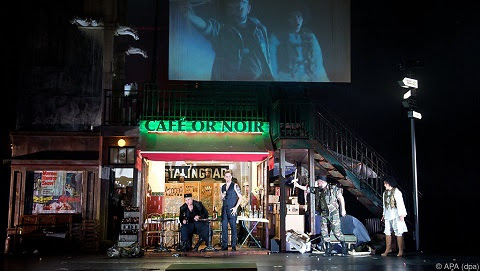
So there on Aleksandar Denić's revolving set, you can see a condensed Paris, past and future all piled on top of one another, front and behind, interiors opening onto exteriors, with a cafe, a church, a butcher shop, the Folies Bergère, and residential apartments. It's dressed in typical Castorf fashion, with obscure movie posters, a telephone booth, a Coke machine. There's even a metro station recreated, the Stalingrad station, where Kate Lindsey's Siébel comes out wearing a desert combat military uniform, his feet bloodied.


With police and foreign legion soldiers in kepis, one of Castorf's targets here is at least clear enough. Valentin emerges out of the metro and paints the words "Algeria is French" on the wall, while additional texts and commentary point to a less idealistic view of Valentin's military exploits, De Gaulle and France's colonialist history and atrocities. The devil is indeed in the detail and there's no doubting the nature of Mephistopheles here. He's not some smooth businessman or smart-dressed nobleman. He comes complete with demonic accoutrements; hairy goat legs, horse tail and hooves. He's a voodoo practitioner, using live snakes, he's menacing and seductive. 

Having thrown all that onto the stage with not a great deal of rationale provided, there's little evidence either of much character development or direction of the singers. Juan Diego Flórez is allowed to stand and sing arias out directly to the audience in an arm waving concert performance delivery. Nicole Car likewise delivers arias outward, but makes up for this by appearing to be much more emotionally attuned to Marguerite and her sad fate. Here Marguerite is not the naive waif we are accustomed to, but since this is the 21st century (or 20th maybe) she is more worldly wise. She puffs on opium and has a good time, but is not fool enough to trust Faust and takes responsibility for her own mistakes.

Frank Castorf appears to be more in his element when he can abandon the limitations of the libretto and "surreptitiously" film Faust and Marguerite behind the scenes with handheld cameras in manufactured situations. This can be a little bit 'random' particularly when filming and developing the other characters Marthe and Siébel. If there is anything that helps guide you through Castorf's production, something compelling that holds like an anchoring point in all the madness, it's Nicole Car's performance that places Marguerite at the heart of Gounod's opera. It's an outstanding performance which could prove to be her defining role.

Juan Diego Flórez can hit the notes all right but his voice is a little too lightweight for Faust, when it needs more of an Alagna or Kaufmann. He doesn't make the same kind of impression that Car does, but aside from the operatic gesturing to the non-existent audience (the production here filmed during lockdown in an empty theatre), it's not a bad performance. Adam Palka is an excellent Mephistopheles, fully entering into the demonic nature of this version of the character and proving to be menacing in tone and performance. Bertrand de Billy conducted the work with a fullness of melody and drama.

I'm not so sure that Castorf really connects with Gounod's Faust or has anything insightful to say about it, but he certainly gives you plenty of opportunity to reconsider the work and see it in a new light. You can question the validity of that approach since for the most part that has less to do with the actual work than the peripheral action, in the additional behind the scenes projections and twists of characterisation. Whether it works or not, whether it's convincing or not isn't the point. You don't have to agree with his choices, but even that allows you to firm up your own convictions about the work. That, as far as I'm concerned, is certainly better than having nothing to contribute.

Links: Vienna State Opera, Wiener Staatsoper Live

Tuesday, 27 April 2021

Wagner - Parsifal (Vienna, 2021)


Richard Wagner - Parsifal

Wiener Staatsoper, 2021

Philippe Jordan, Kirill Serebrennikov, Jonas Kaufmann, Georg Zeppenfeld, Elīna Garanča, Ludovic Tézier, Wolfgang Koch, Stefan Cerny, Ileana Tonca, Anna Nekhames, Aurora Marthens

ARTE Concert  - 18 April 2021

With its blend of philosophy, religion, mythology, spirituality and humanism, Wagner's Parsifal can be a tough prospect to make sense of on a narrative level, particularly in translating that to a modern audience in recognisable human terms. Not that it needs a coherent narrative. Almost every production I've seen of this masterpiece has found original endless (and sometimes baffling) ways of presenting it, while at the same time everything that it is about is all there in the music. And when I say music, it's not just the notes on the page, the singing or even the interpretation of it but the space and time it occupies in performance. The viewer enters into communion with Parsifal in a way that does not happen quite the same way with any other opera.

High-flown words maybe, but there is truth in this. You could write volumes exploring the work, you could write books alone on productions like Herheim's Bayreuth Parsifal, and yet however the work is dressed up, whatever means are used to explore its themes, it rarely fails to make some kind of impact and it's often a profound one. At heart the theme and message of the work can be said to be relatively simple, but in its simplicity it touches on something vast, the essence of an important aspect of what it means to be human, perhaps the most important. Redemption through Compassion, the understanding of which will put us on the path to our soul's salvation.

Even though there are clear religious and ceremonial overtones in the presentation of these themes in Parsifal's Easter Good Friday message, it certainly doesn't need to be seen through a Christian or religious perspective. Indeed such grave solemnity and reverence in a production can get in the way of letting the music express its deep human qualities. Not to make excuses for the sometimes unclear situations and direction in the current Vienna State Opera production by Kirill Serebrennikov, but even the idea of putting that into a coherent dramatic narrative is ridiculous. Anyone expecting or needing a "story" to get it across is missing the point. Richard Wagner utterly and completely puts it all into musical language, which is even more direct and yet complex in how it manages to achieve that with such incredible impact.

It's difficult to describe convincingly how the Vienna 2021 lockdown production manages to get that across - it would take a long time and a lot of pointless analysis - but it unquestionably does. Serebrennikov's setting certainly looks unlike anything else you might associate with Montsalvat. Here's it's a prison, looking more like Janáček's From The House of the Dead. Gurnemanz is the respected veteran lifer who takes young ones under his wing, shows them the ropes and even does tattoos for them. Unlike any other Gurnemanz, this one even collects packages of contraband drugs from bent wardens for them. He knows they need something else to get them through the misery of their situation, and tells them stories that give hope that some kind of redemption may be possible. Even those living in an eternal hell like the seriously ill Amfortas.

It seems unlikely that the new young man on the cell block is going to be any kind of saviour in this production. Young and foolish, he's forgotten his good upbringing and got into a lot of trouble. Not so innocent, in prison he has even killed a man, a "swan", an albino man with tattoo wings who tried to get close to him naked in the showers and paid the price. Someone however sees his potential; Kundry, a visitor who has been granted permission to photograph inside the prison, gathering images of raw masculinity for a fashion magazine, "Schloss". She however lives within a prison of her own and is seeking a way out, seeing something within this young man that might help her overcome her own demons if they don't swallow him up as well.

Aided by projections, the production plays the long first Act out as if it happens over a number of days, and that works well, in its own way bending time and space, encapsulating the inner world and dreams of the prisoners with the harsh reality of their confinement. The idea of being outside of time in any linear narrative is also put across in the use of flashback, Jonas Kaufmann the older wiser Parsifal looking back with regret on his past mistakes and innocence of his younger self, played by actor Nikolay Sidorenko. If you don't quite understand where it is going however that also turns out to be a good thing, as the whole opera is a process, you need to live through it and experience it in its totality to understand it in any kind of way.

Act II however proves to be pivotal here as it should be but far too often fails to adequately achieve. It opens up some of that in the unlikely setting of the offices of Schloss, a fashion magazine run by the tyrannical Klingsor. The Flowermaidens are fashion journalists, office staff and even cleaning staff, all lusting over the new cover model, which really is no less relatable than having mythical female ciphers float around him. What makes Act II striking is by bringing in what is only alluded to in the original and making it central to the purpose of the work, and that's Parsifal's mother Herzeleide.

Many productions have sought to extend the range of Parsifal far beyond the singing characters - Philipp Stölzl even recreating the crucifixion of Christ in a Deutsche Oper production - and with good reason, as much of what is learned as a process doesn't just extend over a lifetime, but over many lifetimes. The production here finds that the best way of expressing what sparks Parsifal's journey to self-realisation is the image that Kundry evokes of his mother. The director brings not just one but three Herzeleide's to the stage. Parsifal's first true feelings for another person are, appropriately and meaningfully, for his mother. Understanding what she has suffered for him only for him to go off the rails, is a profound revelation. Through this he suddenly realises what Amfortas has been going through, and sets out to find a way of bringing healing to his suffering.

And quite what role Kundry plays in this is also difficult to describe but it's vital, the Flowermaidens likewise presenting him with different aspects of what it means to be a woman, deepening his understanding of his own mother's situation. Somehow the director Serebrennikov - mainly though the medium of an astonishing performance from Elīna Garanča - manages to match up the sense of deep sorrow, regret and loss with a sultry undercurrent that runs through the music in this Act. Act II can often feel disjointed and unfathomable, but at its best it is enigmatic and the key to the work, and the new Vienna production makes the most of it, not least in Philippe Jordan's conducting, pacing and navigation of the dynamics of the score.

Trying to analyse and correlate the production with a predetermined idea of what Parsifal should be and even expecting it to deliver a coherent narrative is however besides the point. It's a metaphor, and it makes no more sense than expecting Wagner's mythology of the Knights of the Holy Grail, the suffering of Amfortas, the killing of a swan, the evil of Klingsor and the revelation in a kiss to make sense on any level of reality that is relatable to our lives. The best that a production can do is perhaps illuminate one aspect of the many themes and ideas expressed in the work and put it into terms that are recognisable to a modern audience. And if you can get across an important message - as this one does about imprisonment of the soul and finding a way to freedom - then it's more than enough. Anyone expecting to make narrative sense of the director's production however is only distracting themselves from the beauty of the sentiments expressed and the performances.

And what performances! It's not just a starry cast with a few experienced and distinguished Wagnerians in key roles, but there are some chances and risks taken in a few of the other casting choices that make it much more interesting and bring a little something extra to the production. Jonas Kaufmann sings the role of Parsifal well, if inevitably a little detached by being doubled with an actor. It's sung in the manner that you may be accustomed to, a manner not to everyone's taste, slightly over-pushed. He can do grave and anguished but personally I felt that he lacks sensitivity for Parsifal, and crucially lacks compassion for the role. Elsewhere however there is little to fault.

As we've come to expect from his other Wagner bass roles, Georg Zeppenfeld is just perfect. Hunding, Heinrich der Vogler and King Marke are one thing, but Gurnemanz is a much more extensive role on another level entirely. If the strain sometimes showed over the four hour running time, there was little evidence of it in his singing, which was faultless throughout, warm and compelling. As mentioned earlier, Elīna Garanča also takes her performance to another level. Kundry does present such opportunities for a singer, and even if this production didn't give her as much of a central role or room for interpretation, Garanča takes it to the level required in her singing and acting performance. I've never seen her sing a role so deeply.

Defining Klingsor as a sleazy office manager abuser of his position and power is more relatable than viewing him simplistically as an evil sorcerer, and Wolfgang Koch is suitably sinister in a typically reliable performance. Ludovic Tézier is one of the world's finest Verdi baritones and that doesn't necessarily translate over to a traditional Amfortas role in Wagner, but it certainly makes for an interesting interpretation. He carries some of the mannerisms of Italian opera across, but nonetheless gives a lyrical, sincere and heartfelt performance here. Avoiding the cliches of the spear healing the wound, he nonetheless finds peace as Parsifal's healing message of love, forgiveness and compassion sees the swan reborn and mankind freed from the pain and prison of their everyday existence to possibility of a better world.

Links: Wiener Staatsoper, ARTE Concert

Monday, 29 March 2021

Strauss - Der Rosenkavalier (Munich, 2021)


Richard Strauss - Der Rosenkavalier

Bayerische Staatsoper, Munich - 2021

Vladimir Jurowski, Barrie Kosky, Marlis Petersen, Christof Fischesser, Samantha Hankey, Johannes Martin Kränzle, Katharina Konradi, Daniela Köhler, Wolfgang Ablinger-Sperrhacke, Ursula Hesse von den Steinen, Martin Snell, Manuel Günther, Caspar Singh, Christian Rieger, Galeano Salas

Staatsoper Live - 21 March 2021

It wouldn't be like director Barrie Kosky to miss out on playing up any obvious sexual references, but he shows rather more subtlety than Richard Strauss during the opening exertions of Der Rosenkavalier in this production at the Bavarian State Opera. When it comes to highlighting the obvious however, he doesn't miss pointing out the thematic references to time by having Marschallin and Octavian carry on their business inside a spinning grandfather clock. In the unlikely event that you miss the implications, the boy servant Mohammed here is a Cupid as Old Father Time who sprinkles magic dust on their union, and the chiming of a clock is heard at the start of each of the three Acts.

But then it's not as if Strauss and Hofmannsthal were adverse to a bit of show-off cleverness either. Der Rosenkavalier one of opera's most extravagant works in terms of plotting, layering and referencing, delighting in combining farce with high art, comedy with contemplation. The opera captures the melancholy of being between one age and the next, the incompatibility of the old with the young, the old ways with the new ways, tradition with the modern age. There's a gradual acceptance of time and the pain it causes when the realisation hits of necessity to let go and let the world move on without you having as significant a role in it.

Wrapped up on a farce and aspiring to Mozart, Der Rosenkavalier doesn't miss the mark, even as far as realising that Mozart is of a past age and ideas need to be reconsidered for the modern era. It's a magnificent work, a work of true beauty and accomplishment, and there's a certain irony in the fact that we can look back at this end-of-an-era work with some regret that it belongs to a past age of opera that can never be recaptured, and undoubtedly there's some cleverness or self-awareness on the part of the creators themselves.

The sensible director then will avoid over-complicating the delicate equilibrium that the creators have established, and while few would normally apply that description to Barrie Kosky, he does indeed usually know when to intervene and when to step back in his role as Artistic Director at the Komische in Berlin. Aside from a little bit of highlighting here and there, he appears to slip into the background and let the glory of Der Rosenkavalier speak for itself, providing sumptuous but superficial surroundings and judging the mood perfectly throughout. Despite appearances, that does not come about by accident.


Kosky's touch of vulgarity for example is well-employed in the middle class aspirations of the Faninals, swept away with the notion of a forthcoming marriage into old money and nobility. Octavian as the Rosenkavalier obliges their notions coming not just with a silver rose, but replete with silver carriage and horses. It's unsurprising then that Sophie's head is turned with the romance of it all. It is a quite stunning coup de théâtre. Old age Cupid again sprinkles the magic dust of Strauss's beautiful music on Sophie and Octavian, while the Baron's satyrs chase the Faninal nymphs around the household. With classical paintings of similar scenes decorating the walls, and the old guard sprouting horns of their own, Kosky captures the essential mood and character of the scene perfectly, even with the classical allusions that Strauss and Hoffmansthal reference.

The singing and musical performances are also just about perfect: not just in interpretation of the score, but with performances that enhance the varied tones and intent of the opera. Marlis Petersen is an ideal Marschallin, with the necessary ability and experience (having once also been a Sophie in her time, the work again showing its relevance, meaning and cleverness), and she truly does the role justice. I haven't come across Samantha Hankey before but the US mezzo-soprano only appears to have been on the scene since 2017 and she makes a tremendous impression here as Octavian; nimble and playful also in the dual role as Mariandl. Christof Fischesser is excellent as the boorish Ochs Von Lerchenau, Johannes Martin Kränzle is luxury casting as Faninal and Katharina Konradi is a fine Sophie. With Vladimir Jurowski conducting the glorious sweep of it all, there's no danger of Act II or the concluding Act III failing to hit its targets and it doesn't need any heavy-handed signposting either, or at least no more than the spirit of Strauss and Hofmannsthal dictates.

So when Petersen's Marschallin utters the words "Don't you realise it's all over?", it really hits home. Privilege, class, a whole era is gone or has turned - in the eyes of the young and the modern - into nothing more than a farce. As such Kosky can be forgiven for falling back on the old theatrical trick of turning the audience around and onto the stage, all the more so since there isn't an actual audience present in Munich during the Covid lockdown. Essentially it's what Strauss and Hofmannsthal do, opening up the theatricality of opera and drama as a device, as a trick, as a way of showing the truth. The Viennese farce can reveal something real truths and Der Rosenkavalier cuts to the quick when the Marschallin takes to the stage in Act III. The concluding scenes of this opera are devastating, tying everything up, bringing her curtain down on the old, opening up the way for the new.

There's no better recommendation that you can give for a production than that it brings out everything that is wonderful about an opera, and in Der Rosenkavalier it's even more important to get the tone and the singing right. The Bayerische Staatsoper, Kosky, Jurowski and Petersen at the head of a strong cast do that superbly. The humour feels weighted and balanced with the seriousness, the originality of the composition is perfectly set alongside the references to older works. It's brought out to perfection and to devastating impact here in a wonderfully played performance and deeply felt production that brought a little tear to the eye and a 'Bravo!' from this viewer.

Links: Bayerische Staatsoper, Staatsoper TV

Thursday, 25 March 2021

Zandonai - Francesca da Rimini (Berlin, 2021)


Riccardo Zandonai - Francesca da Rimini

Deutsche Oper, Berlin - 2021

Carlo Rizzi, Christof Loy, Sara Jakubiak, Alexandra Hutton, Samuel Dale Johnson, Ivan Inverardi, Jonathan Tetelman, Charles Workman, Meechot Marrero, Mané Galoyan, Arianna Manganello, Karis Tucker, Amira Elmadfa, Andrew Dickinson, Dean Murphy, Patrick Cook, Thomas Lehman

takt1.com streaming

Other than being associated with a group of post-Verdi Italian composers at the beginning of the twentieth century, opera verismo is hard to define in musical or thematic terms. There's an element of social realism in works like Puccini’s La Bohème and Mascagni's Cavalleria Rusticana, but it’s more in considering how the real people deal with personal hardships and difficulties than in any social commentary or criticism. Other works, like Alfano’s Cyrano de Bergerac, Cilea's Adriana Lecouvreur or Giordano's Fedora that hardly fit the common idea of verismo. In any case with the enhanced emotional range and the artificial construct of singing one’s troubles, opera hardly seems the ideal way to approach any kind of social realism.

On the other hand, the hard-hitting musical style of verismo, pushing and even perhaps over-extending the emotional content even further than Verdi, perhaps hits on a deeper emotional reality for the troubles of its subject, or perhaps more accurately, it communicates the depth of feeling to an audience. For all the (unjustified) criticism of emotional manipulation and accusations of sentimentality that could be levelled against Puccini, there is no question that he does masterfully express the deep personal dilemmas suffered by his protagonists and communicate it through the medium of music in a way that touches the listener.


It might not have the common people touch of Cavalleria Rusticana, dealing instead with two noble families where an arranged marriage has left a woman in a loveless relationship and unable to be with the person she loves, but Riccardo Zandonai's Francesca da Rimini does nonetheless enter into that realm of enhanced emotional turmoil. Musically, it elaborates and elevates to an extraordinary level (aspiring to Wagner's Tristan und Isolde obviously) the romantic aspect, but sets this against and within the bloodthirsty violence and brutality of the family wars. Whether Zandonai’s opera is successful is debatable, but it has potential that could be realised in a strong theatrical setting. Christoph Loy can usually be relied upon for that, but while he certainly makes Francesca da Rimini 'work', I’m not convinced he finds anything deeper in it.

What is indisputable is that Act I of Francesca da Rimini has one of the greatest build-ups in all opera. Perhaps not quite as prolonged and ultimately sublime as Tristan und Isolde, the origin story of which this opera acknowledges as a model, but it's a good one nonetheless. The arrival of the mysterious Giovanni Malatesta is surrounded in gossip and speculation and, on the part of Francesca at least, some amount of trepidation, as she is to be married to this unknown man. When he finally approaches from the wings, she is told that he's slim, tall, handsome and walks like a king. "You're going to be the happiest woman in the world". And bam! just as described her future husband walks onto the stage and Zandonai accompanies this with the most seductive and romantic of music and heavenly choruses. Albeit with a hint of something awry behind it? Menace? Disappointment? For a trick of bait and switch has been played and it's not Giovanni, but his much better looking brother Paolo il Bello who she sees and immediately falls in love with.

Loy isn't going to let that be a premature climax and ensures that Act II of the opera closes on another dramatic finale that has you gripped to your seats and almost blown away. That effect is of course not achieved in isolation and as usual Loy pays close attention to what the music is telling us and looking for the best way of presenting that. Without swords and doublets, he shows the household of Francesca's Polenta family as thugs in suits, conspiring to trick Francesca into a marriage of convenience. With scattered flowers and a Gothic backdrop in the earlier scenes, there's an air of decadence about it as well, and Loy emphasises the almost ecstatic musical explosion at the violent wars of the conclusion of Act II with the intoxicated Francesca almost revelling in the spilled blood of the Malatesta.

That moment of madness turns into confusion and fear that is extended and developed as she becomes torn between all three Malatesta brothers. The music, and particularly the vocal range, is correspondingly pushed further into heightened expression, which Sara Jakubiak sings superbly in Francesca's confrontation with Smaragdi. If she can appear a little detached and not always have the fullness of voice elsewhere, she does bring a sultry character to Francesca, much as she did previously - in parts fully naked - as the queen in Loy's production of Korngold' s Das Wunder der Heliane. She really shows her ability in the varied tones of the opera's third Act.

Although linking thematically and visually with that previous work at the Deutsche Oper, Christoph Loy here adopts more of the style of the similarly themed feuding family wars of his 2015 production of Bellini's I Capuleti e i Montecchi for Zurich or, taking place confined in a wealthy mansion with a window view, it's more simplified like his production of Carl Maria von Weber's Euryanthe at the Theater an der Wien in 2018. If it doesn't measure up to provide any deeper or broader thematic approach, the little details and correspondences with the music do manage to highlight the dramatic qualities of the work, even if it still doesn't seem to hold together as a whole.

Still, Act IV ramps up the drama and the decadence deliciously as Loy insists on showing Francesca flirting dangerously with the third brother, the psychotic Malatestino, fabulously sung and performed with casual menace by the always impressive Charles Workman. The music continues to be filled with ominous motifs building tension and anger that is going to end in tragedy, and it plays out wonderfully under Carlo Rizzi's musical direction. The role of Paolo has a challenging dramatic range to meet and Jonathan Tetelman does it well, all of which adds to a very successful interpretation of Zandonai's opera. The casting is great, the performances convincing, the music compelling, but it's still hard to feel involved in the circumstances or character of D'Annunzio's drama.