Sunday, 2 October 2022

Mitterer - Dafne (Paris, 2022)

Wolfgang Mitterer - Dafne

Opéra-Théâtre de l’Athénée Théâtre Louis-Jouvet, 2022

Aurélien Bory, Geoffroy Jourdain, Clotilde Cantau, Adèle Carlier, Anne-Emmanuelle Davy, Jeanne Dumat, Constantin Goubet, Floriane Hasler, Michiko Takahashi, Amandine Trenc, Virgile Ancely, Safir Behloul, Renaud Brès, Mathieu Dubroca, Alfred Noblet-Rousseau Bory

Athénée Théâtre Louis-Jouvet, Paris - 29th September 2022

Opera can be many things to different people, so it's understandable that not everyone enjoys the idea of contemporary opera. One of the defining characteristics of opera for me however is that, like any essential art work or art form, it needs to be universal and transcend time. Opera is performance art, which means that it lives in the moment and not as notes on music score sheets, or even in a recorded performance. That's why modern opera is important, that's why new approaches are necessary, and that's why it needs to be reinvented, reinvigorated and not remain merely an historical artefact that preserves the past in amber.

That approach is one that Wolfgang Mitterer wholeheartedly embraces in this stunning and beautifully conceived new work Dafne, 'a madrigal-opera after Heinrich Schütz'. Conceived in collaboration with musical director Geoffroy Jourdain and stage director Aurélien Bory, Mitterer's Dafne spans the space between gods and mortals, antiquity and modernity, opera of the past and opera of the present. He takes an old practice, one that is not common nowadays, and resets a 17th century libretto to new music - you don't for example find too many Metastasio-penned libretti being used in contemporary opera. It's not just an academic exercise either, but one that is necessary since the Heinrich Schütz's original music is now lost, destroyed in a fire at a library in Dresden in 1730.

The idea of reconstruction of an opera based on a libretto isn't even a new practice either. Most of the early operas only have basic basso continuo markings and the score largely improvised upon them by the musicians. In the case of reconstructions of several lost Vivaldi's operas, the music is at least derived from other music by the composer, but in the case of Dafne, there is nothing that remains. Wolfgang Mitterer, noted for his experimental electronic music might seem a composer least likely to adhere to fidelity to the source, but in fact he does produce a beautiful work that combines his sound experiments with traditional instruments and a beautiful 12-part polyphony vocal setting of the libretto.

There are actually several reasons why the project would attract a sympathetic and suitable approach from Wolfgang Mitterer. The composer has spoken of performing Monteverdi and Schütz in a vocal quintet in his youth. As 2022 marks the 350th anniversary of the death of Schütz, who is considered as the German Monteverdi, it seems like the right time to revive what is considered to be the first work of German opera. Composed in 1627, based on a libretto by Ottavio Rinuccini adapted into German by Martin Opitz, only the libretto to Schütz's Pastorale survives. That needed to be reworked by the creators for a modern stage performance, but in keeping with the tradition of a madrigal opera from the period, they have chosen to use the idea of a chorus relating the drama, but also using the individual fach of the singers on alternate lines so that each of the gods have a multiplicity of voices.

The libretto doesn't appear to be anything exceptional, it has to be said, or at least with little to distinguish it from other typical Baroque opera or the tragédie lyriques of Lully dealing with mythological subjects and pastorals. Dafne deals with the legend of Daphne from Ovid's Roman retelling by classical Greek mythology in his Metamorphoses. It even has the traditional prologue where the gods are in dispute, although here it's Ovid who provides the prologue, while the dispute between Apollo and Venus takes up the rest of the opera. Full of pride over his defeat of Python, the beast that has been terrifying the island of Delos, Apollo denies that any other gods have power such as his. Despite the warnings of Venus, Apollo mocks Cupid's bow and arrow only to be struck and fall in love with the nymph Daphne.

Like another recent contemporary opera based on Ovid's Metamophoses (Sivan Eldar's Like Flesh), the modern relevance of ancient Roman mythology can be seen in the folly of disrupting the course of Nature. The immortality of Daphne, who turns into a laurel tree to escape the advances of Apollo, can be seen as representing the power of art to transcend time and death, to set oneself outside the power of the gods. Much like Orpheus, the subject of many operas, that can also be testament to the nature of opera itself. As another modern opera Detlef Heusinger's Die Zeitreisemaschine suggests, opera itself is a precious time machine. Even more so here in the case of Dafne, the original opera destroyed, but recreated, reinvented and metamorphosised to survive even beyond its destruction. That alone testifies to the power and relevance of Dafne, not least through the performance and staging choices made here, but there are many other ways that the opera can speak to us.

What struck me as noteworthy about the concept here is that aspect of it returning to the roots of opera, which was conceived as a response to the mistaken belief that it was ancient practice to sing Greek drama verse. Here Mitterer extends that idea, bringing back an ancient tradition, putting an existing surviving ancient text of Greek myth to music and singing. In doing so with the music of our day, he bridges the past and the present. "Not the music of my day" a lot of traditionalists might cry and certainly Mitterer's sonic art approach to music isn't for everyone. The electronic music for Dafne is prerecorded and uses Mitterer's usual mannerisms and techniques, including sampling of orchestral music, with speeded up effects, clicks and electronic juddering, so there was little conducting required on the part of Geoffroy Jourdain for that.
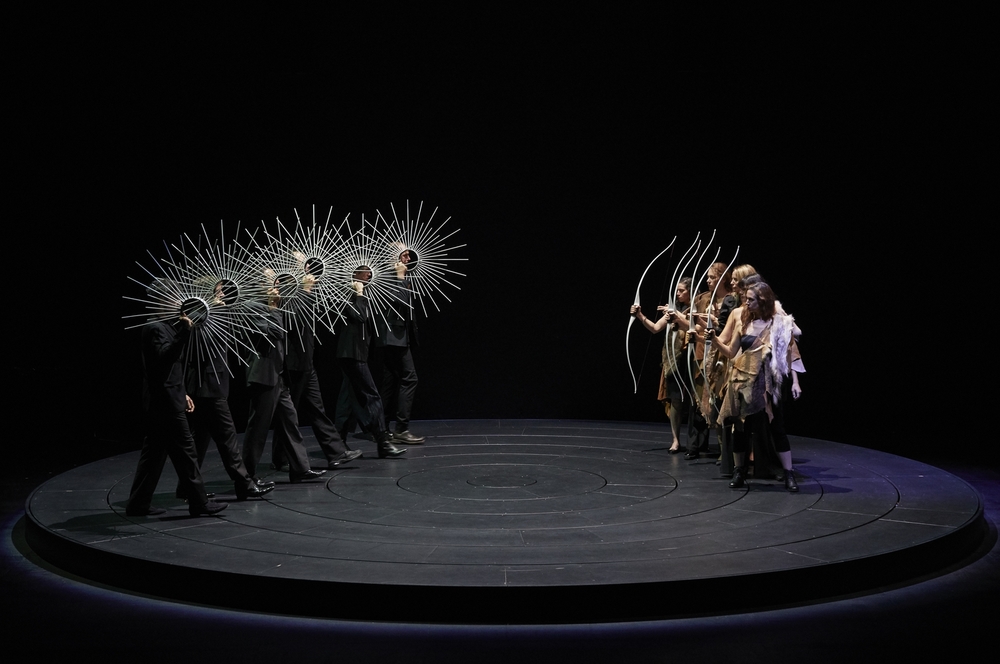
This however only forms a background, the basso continuo to the composer's beautiful writing for the voice. It gives the chorus's telling of legend an otherworldly setting, swirling and haunting, truly lifting it into the mystical realm of the gods. Traditional instruments are used in sections, very much in the style of the period and informed by the music of Heinrich Schütz, those instruments played by several of the singers. Singing and playing as individuals, but also as a chorus, the gods indeed have a multi-voiced form, as if a single voice would not be enough. The conception of this, as well as the blending of ancient and modern in the music, is impressive and striking, giving Dafne a character quite unlike any other opera. It is truly befitting of an opera that seeks to do justice to an important historical work in German opera and through it aspire to represent the idea of immortality.

The staging is an essential element of any opera and Aurélien Bory's presentation has a major part to play here, one that is also commensurate with its ambitions. If it doesn't perhaps bring any allegorical or contemporary reading out of the drama, it at least illustrates its abstraction and otherworldly qualities. The thirteen singers of the Jourdain directed Les Cris de Paris have a complicated choreography to perform on concentric rotating wheels of the stage, itself a reference to the rotating stage devised by Tommaso Francini in the 1617, in the same period of the opera. It brings movement and circularity, chase and distance. Other stage effects, such as the hunting arrows dropped from the sky onto the circular 'target' that are then used to form the crown of Apollo, the appearance of 'Venus' on wires and the transformation of Dafne into a tree are superbly realised all within this circularity. The coherence of concept and execution ensures that there are no slow or dry passages here; everything comes together, flow and movement, music and ambiance, harmony and dissonance, past and present all made one.

When many question the point of contemporary opera, question the abandonment of traditional tonal musical forms in contemporary music and illustrative traditional stage productions, Mitterer, Bory and Jourdain show the importance of keeping music theatre progressive and experimental, while still using the past as a touchstone for reference and for informing the present. The original opera of Dafne, were it even to still exist, would probably remain obscure, of historical curiosity value and rarely performed for a modern audience, incapable even of having the same impact in that form that it would have had on an audience of its time. Here it is given new life, and if the libretto and its subject might feel like they have little to do with contemporary issues, Mitterer's Dafne at least allows us to consider what it tells us about the arts, on the higher universal themes that can be found there, the necessity of carrying their message through to the present day, and in how great art can still speak to and move a modern audience.


Links:
Athénée Théâtre Louis-Jouvet

Sunday, 25 September 2022

Eldar - Like Flesh (Lille, 2022)


Sivan Eldar - Like Flesh

Opéra de Lille, 2022

Maxime Pascal, Silvia Costa, Helena Rasker, William Dazeley, Juliette Allen, Adèle Carlier, Hélène Fauchère, Guilhem Terrail, Sean Clayton, René Ramos Premier, Florent Baffi

OperaVision - January 2022

The subject of ecological disaster seems to be a common theme in many contemporary operas (and in contemporary writing), and it's not a surprise that this is might be one of the pressing issues at the moment for many people. If opera is to be meaningful and relevant it needs to tackle the issues of the day, and if it is to endure it has to be adaptable and universal. Sivan Eldar's Like Flesh makes a very successful attempt to work with ideas that have endured for a long time, drawing influence from Ovid's Metamorphoses, not to mention using a medium that has been around for centuries - opera of course - while at the same time finding a way through the music to remain modern in its expression of the drama.

As a way of approaching the subject in the form of a chamber opera, the librettist Cordelia Lynn comes up with a very concise and meaningful way of expressing the dilemma (much more successfully I feel than Tom Coult's recent Violet) though just three characters. Not a word is wasted as the three characters represent different sides of the equation. The man is a forester concerned with making the most of the catastrophe in a world that is beginning to feel the consequences of climate change, but his idea of making the most is to make money out of it. The woman, his wife, feels a closer bond with nature and sadness at the loss of the richness that was once there. There is also a student, a scientist, who is observing the changes, wanting to find a way if not to reverse the damage - it's too late for that - to at least minimise its impact.

I say that there are three characters, but there is a fourth and that is the first voice we hear in the opera; the trees. The trees have been around a long time and have observed the changes that have occurred ever since man brought an axe into the forest for the first time (recognising the handle as "one of our own"). The voice of the forest is present throughout and in between the scenes, remembering "what the humans did next", but their voice is also seductive to the woman, who begins to show signs of not just becoming closer to nature, but being as one with nature in her transformation into a tree.

You could even say that there is a fifth character in the opera, but then you could say that the music is a distinct character in almost any opera. Here however, it does have a very important role and presence. Searching for a way of creating an approriate and effective sound world for the opera, seeing it as vitally important as a voice for Like Flesh, Sivar turned to the still important technicians of IRCAM for inspiration. The opera was developed using electronic sounds with the assistance of Augustin Muller, but the opera uses both acoustic and electronic playing, creating a voice that in a way represents the uneasy relationship between man and nature, although neither is solely associated solely with one type of sound.

In the hands of Le Balcon and the musical direction of Maxime Pascal, skilled practitioners of contemporary music with electronic effects who are notably also currently presenting a complete cycle of Stockhausen's epic Licht, the complexities and intricacies of Like Flesh are in safe hands. I daresay that the presentation is much more effective in a live environment, as speakers have been placed not just around the theatre in Lille, but also under the seats in order to place the audience entirely within the opera. Considering the intimate nature of the chamber operas arrangements and the sound effects, you can imagine that this would be hugely effective for this particular work in the theatre. For someone listening to a recording of the opera however, it does seem to rely too much on atmospheric drones and is not so musical.

The presentation is just another element and it's the combination and successful deployment of all the other elements that mark this out as a success - the opera notably winning the 202I FEDORA Prize for Opera. Primarily, I however I feel that a large part of why it works so well is down to the strength of the libretto; in its symbolism, its poetry and the concision in how it gets across its ideas. I was particularly impressed as I wasn't keen on Cordelia Lynn's previous libretto for Katie Mitchell's feminist revisionist take on 'The Tempest' with Purcell music as Miranda. Sivan mentions in one of the interviews that the love triangle is not just a metaphor for the destruction of the environment, but the destruction of the environment is also a metaphor for relationships and perhaps even sexual identity. I think this really does come across and contribute to the very human element of the work, rather than it being a preachy environmental catastrophe warning.

The singing puts these ideas across beautifully and with deep feeling. It's a small cast of only three principals and a chorus, and there may be a lot of recitative-like spoken singing in English, but there are fine performances all round from Helena Rasker as the Woman, William Dazeley as her husband, the Forester and Juliette Allen as the Student. The chorus too as the forest, play a huge role, as they should in keeping with the theme of the work, with good solo singing and fine harmonies that indeed present an seductive impression of peace and harmony.

The stage production is another vital component in the overall quality and success of this staging of the opera. It is just beautiful, making stunning use of projections created by Francesco D’Abbraccio, but also effective in the simple transformation scenes and in the movements of the actors and chorus. It all comes together, working with the music and the performances to get across the intent of the opera's important ecological message in a tremendously effective way.


Links: Le Balcon, OperaVision, Opéra de Lille

Sunday, 11 September 2022

Wagner - Götterdämmerung (Bayreuth, 2022)

Richard Wagner - Götterdämmerung

Bayreuther Festspiele, 2022

Valentin Schwarz, Cornelius Meister, Clay Hilley, Michael Kupfer-Radecky, Olafur Sigurdarson, Albert Dohmen, Iréne Theorin, Elisabeth Teige, Christa Mayer

BR-Klassik streaming - 5th August 2022

It's hard to judge a concept for an entire Ring cycle on one standalone part of the tetralogy, but particularly when you are presented - as those are who are unable to make/afford the journey to Bayreuth - with a streamed broadcast of Götterdämmerung alone. And yet, in some ways that makes it more interesting, forcing you to think about past productions of this opera and the Ring and consider where this one is coming from in relation to those, as well if course in relation to Wagner's intentions. There's also the fact that this production met with the usual ignorant boorish heckling from sections of the audience (why do they even go to Bayreuth?) unwilling to put their prejudices and old CD and vinyl recordings aside and see the work in a fresh new interpretation. That's what Bayreuth is about; sometimes it works and sometimes it doesn't but it's essential to keep revitalising and renewing the works of Richard Wagner.

Having said that - and with the caveat that I haven't seen the other three parts - Valentin Schwarz's concept for this production does seem like a bit of a mess that doesn't really hold together. As a basic premise to cover the entire cycle, the general idea here is to present Das Ring des Nibelungen as a Netflix serial, a saga of family ambition, conflict and dysfunction very much in the style of Succession. You can see why traditionalists would hate it. The prelude of Götterdämmerung reveals Brünnhilde and Siegfried in a spacious, modern if modestly furnished abode. In this production, they even have a child here who is assailed by nightmares of his/her unconventional upbringing and background. No doubt fuelled with such horrors in the past, figures of faceless Norns appear here as a nightmare with their threats of dire foreboding. Waking up, the child's parents launch right into their longstanding disputes and differences at the turn their relationship has taken.

The Ring operas are very much about family and power struggles within it, as I'm sure this Bayreuth cycle emphasised this in earlier family disputes between Wotan and Fricke, between Wotan and Brünnhilde, between Sieglinde and Hunding (basically all of Die Walküre) but also between Siegfried and Mime. If the idea of money/gold/power hasn't already been established in Das Rheingold, it is the clear theme that runs through this production and leads to what we know will be a mighty fall of the great and not so good. What Schwarz also intends to introduce here as a further element to highlight the struggles for power is inheritance - one that has relevance through Wotan's line, Alberich's descendants and the Gibichung line. In this production the child is even used as a substitute for the ring, the 'ring' in a way being a cycle of inheritance and succession. 

Or so it seems. The Ring operas however are wide and extensive enough to be able to support not just this, but many other matters that are still relevant and universal. Frank Castorf made much (some might say too much) of this in the last Bayreuth Ring cycle, and in Schwarz's production you can also see the impact this family has not just in destroying themselves, but destroying the world. There's a hint of this in the Norn's warning that we are probably too late to avert the damage that has been done to the ecosystem (world ash tree). And if Castorf's interpretation of the Ring emphasised the damage inflicted upon the world by capitalism, that also seems to be evident in the contrast between the home of Siegfried and Brünnhilde and the clean white luxury mansion being fussily arranged by Gutrune with maids aplenty and a servant with a magnum of champagne.

The hunting photo exhibited on the wall is a nice touch, showing a lightness of touch and humour, but also reflecting something important to the work. The heroism of Gunther is fake and their class bought, vulgar and ostentatious while Siegfried's has been earned through his own hard work. Siegfried is exploited and seduced by the attraction of wealth unaware of the value of his own labour, feeling unrewarded, undervalued, unrecognised. And unseen even. There is another figure in this production - not Wotan surely? Conscience maybe? - a silent figure protecting the child who likely features in other parts, again similar to other silent extra figures in Castorf's cycle. Siegfried is exploited by Gunther for how own prestige, and exploited himself by (putting aside any antisemitic suggestions) the string pulling behind the scenes of the Hagan, son of the Niebelungen.

So there are things that work well in this production, some that don't, others that are worth thinking over and not immediately dismissed by mindless booing of bores who want horned helmets and Wagner served up as nothing but ancient period costume mythology. Siegfried-disguised-as-Gunther's assault on Brünnhilde with a child in the house is every bit as horrific as any home invasion should be. That it's met at the end of Act I with loud boos trying to drown out the applause is a disgrace. Regardless of whether some elements of the stage design and direction might not be appealing, the artists and performers deserve to be listened to and treated with respect. Just don't applaud if you don't like it, or better still, just don't go and spoil it for others. Bayreuth want Wagner and Götterdämmerung remain relevant and are not be some dusty museum works of art, and such is the power of mythology and Wagner's unique insight, perspective and musical genius, that much of what it tells us relates constantly, continuously and ever-changing to meet the challenges we face in the present day. Too bad that some fail to or do not wish to find anything of worth in it.

The naysayers were silenced for a while at the end of Act II. There was nothing spectacular in the staging and showing Hagen meeting Alberich while hitting a punchbag isn't an impressive image, but the staging supported the singing and the singers took flight throughout the intense personal and family drama being enacted through Siegfried's deception of Brünnhilde with the Gibichung. The force of it on the others, combined with age old grievances and jealousies was put across terrifically. Again, not ideal in some places - if the fate of women in such family 'firms' is to be a feature of the production it needs stronger, clearer singing than Iréne Theorin can bring to the vital central role of Brünnhilde - but there is conviction there and a sense of this being a meaningful, painful situation that is going to lead to terrible consequences. The applause for the singers and hopefully for the orchestra under Cornelius Meister is well merited.

Act III was always going to be interesting to those of us who love the underrated Das Rheingold and haven't yet had an opportunity to see how the Rhine Daughters are depicted. Sadly, this element is a letdown, and so unfortunately is much of Act III as the concept, such as we can make of it, doesn't hold up to the conclusion required. The Rhinemaidens, apparently nannies to the child/ring, are in somewhat straitened circumstances here from the loss of the gold, residing in what looks like a sewer with drinks in their hands. It is brightened to reveal a deep drained swimming pool or water container. Either way it's not a terribly romantic image, and again it seems in part to draw on Frank Castorf's ideas and reimagining of the key work of a revolutionary socialist composer as an eternal class struggle and an attack on capitalism.

Unfortunately, Schwarz isn't quite as rigorous in detail as Castorf and Götterdämmerung limps towards an anti-climax. As I've said before, if there is one thing the end of the world and the fall of the Gods must NOT be, it's anticlimatic. Gunther's fate is unclear, he falls to the side while attempting to kidnap Siegfried's son, running away in terror at the approach of Brünnhilde, then climbs down into the 'pool' with a plastic bag that seems to contain the head of the invisible protector tortured in Act II (maybe Wotan indeed). The child drops dead as the Rhinemaidens leave stage. Brünnhilde turns into Salome embracing the head of Jokanaan (well, that's another dysfunctional family all right). Hagan mutters his final line and stumbles off. There is no great conflagration at the end (other than the outrage of inarticulate morons who couldn't wait to boo the production), but an image of twins in a womb. If Gunther's T-shirt is emblazoned with "Who the fuck is Grane?" that's the least of the questions left unanswered in this production.

As ever at Bayreuth the performances are a mixed bag, but overall it delivered on the power and emotional content of the work, which is certainly in keeping with the family concept here. I think the only performance that comes over impressively without any reservations is Albert Dohmen's Hagen. He's the glue that holds this together, a mighty force here, although Cornelius Meister - brought on at short notice as a replacement - does well to keep the music charged on a tough gig. I was similarly impressed however with this production's Siegfried. Another late replacement for Stephen Gould, I have never come across Clay Hilley before, but he filled one of the most challenging roles in opera admirably. As previously noted, you needed a stronger Brünnhilde than Iréne Theorin for the purposes of this production, but I thought she gave a committed performance. Michael Kupfer-Radecky's Gunther was a little too aggressive and forced in his singing, but there is little else to fault there. Elisabeth Teige was excellent as Gutrune in eye-catching array of designer dresses. Christa Mayer's Waltraude in Act II is worthy of praise and an undoubted contributing factor to the success of that Act.

So while the musical and singing performances were engaging enough - and that's a challenge in its own right in this four-and-a-half hour log opera - ultimately Valentin Schwarz's Netflix epic is a bit of a letdown. At its conclusion anyway, but isn't that often the way with Netflix boxset series? I would rather however see someone try and apply new ideas and contemporary relevance to the Ring and partly fail, rather than see it treated 'respectfully' as a stale tribute to a dead albeit great (the greatest) opera composer. Long may Bayreuth keep that legacy alive, challenging and changing with the times, and hopefully the privileged minority Bayreuth audience who find their dull conservative attitudes challenged by creative artists will also change over time. 


Links: Bayreuther Festspiele, BR-Klassik Streaming

Sunday, 28 August 2022

Mozart - Idomeneo (Aix-en-Provence, 2022)


Wolfgang Amadeus Mozart - Idomeneo, Re di Creta

Festival Aix-en-Provence, 2022

Raphaël Pichon, Satoshi Miyagi, Michael Spyres, Sabine Devieilhe, Anna Bonitatibus, Nicole Chevalier, Linard Vrielink, Krešimir Špicer, Alexandros Stavrakakis

ARTE Concert - July 2022

There's no question that Mozart's operas are beautifully expressive of the whole range of human feelings and experience. Even at the age of 24 in his earliest masterpiece Idomeneo, Re di Creta he defies the often dry conventions and expectations of the opera seria format to create a work that imbues ancient Greek mythology with a rare humanity and authenticity. A stage director can choose to work to bring those human elements out, to interpret or reinterpret them, or they can quite reasonably rely on the music to speak for itself. That appears to be the intention of the director Satoshi Miyagi at this production for Aix-en-Provence 2022, but whether it supports Mozart's music or works against it is less certain.

There is certainly nothing wrong with updating the setting of Idomeneo or using it to express the original ideas and themes in a different context. I must admit I had my doubts about it being a neat fit for the director's proposed intention of using the Japanese wartime emperor Hirohito as a substitute for Idomeneus the King of Crete, or whether this would be in any other way meaningful or revelatory, but it has to be said that this notion never really asserts influence over the performance of the work here. What is far more significant to how the opera plays out in this production is decision to present it in a Noh drama fashion, with minimal but highly stylised sets and movements.

It certainly looks impressive, achieving the same kind of glacial quality that Robert Wilson employs in his opera and stage productions, and they are - usually but not always - none the worse off for it. Consequently, the principal performers here, dressed in stylised Japanese costumes, remain expressionless with minimal movement, often raised on their own platforms at a distance from one another. The chorus meanwhile, wearing more familiar military uniforms, merge with the sets, becoming part of them, part of the while fabric of the opera.

As far as that goes it's fine, the sets remain fluid and slowly moving and changing, ensuring that everything doesn't remain too static. If Idomeneo were a typical opera seria, it might not be enough to enliven the work and make the drama come to life, but despite the qualities of the music and the fact that it does indeed speak for itself, it seemed to me that it didn't do Mozart any favours. Not only does the intention to relate this to Hirohito and the Japanese people fail to make any impression - the opera has been staged as a modern post-war conflict much more successfully elsewhere in numerous updated productions - but it even seems to almost work against and neutralise the music, and that is not a good thing.

Fortunately it doesn't quite do that thanks to conductor Raphaël Pichon. If there are any doubts that remain about the quality of this early Mozart opera and how it stacks up against his mature works, this was certainly dispelled by the musical direction. Sure, the composition of Idomeneo can't compare to the great Mozart operas with Da Ponte, but much of what is great about those later works can already be heard developing here in a truly exciting way. It's a strong enough work on its own terms - more than strong and certainly if compared to what preceded it in opera seria, it's hugely progressive, devoid of the mannerisms and much more relatable, the characters really seeming to engage with one another and not just wrapped in their own worlds. Which, when you get right down to it, might just be what Mozart's operas are all about and what makes them great.

Unfortunately the production's stylised Noh influenced staging pushes the opera back onto those mannerisms, removing emotional connections, putting physical distance between the characters. I personally found Satoshi Miyagi's direction cold and distracting, at odds with Mozart's warm sympathetic and deeply expressive music. Worse, it simply offered no way in to relate to the plot and the drama to find a reason to care about each of the characters, much less offer an interpretation as to their motivations and behaviours as others have done, particularly into the complex nature and behaviours of Elettra and the king himself. There is no denying however that the set designs and the lighting were terrific and this was beautiful to look at, and it did suit the elegant formality of Mozart's music, if not bring out anything deeper from it.

Up until the conclusion, that is. A blood red backdrop is projected against the characters, showing them set against the horror and devastation that their decisions have caused. While mainly abstract in its human shapes and shadows cast against the horror of war, the suffering, the trauma, the eventual release and the recognition of the folly of its leaders acting like gods, it did hit home effectively, particularly with Mozart's music and with the soaring singing of the principals and chorus. It's here that Hirohito is most effectively evoked through the voice of the god Neptune, his broadcast voice coming from a record player that appears on its own raised platform. The slow and detached build-up might have been testing, but by the time the conclusion was reached, you were left in no doubt that this production did justice to Mozart, if perhaps not exactly find anything new in it.

Despite the impositions placed on the singers to remain mainly impassive and inexpressive, there was also much to enjoy in the singing. These are already challenging roles - Mozart composing this in 1781 for the best singers in Munich at the time - and the casting of the right kind of Mozartian voices is ideal for this production at Aix-en-Provence's Théâtre de l’Archevêché. If the director had little in the way of showing any nuance in the character of Idomeneo, who can be played sympathetically or as a misguided relic of the past who gets his just desserts, Michael Spyres's soft timbre brought warmth and humanity to the role. Soprano Sabine Devieilhe's singing brought more feeling and drama to the role of Ilia than the minimal direction allowed. Anna Bonitatibus as Idamante and Nicole Chevalier as Elettra were more constricted by their roles having little room for interpretation, but both sang superbly. With a cast like that and Mozart's music beautifully interpreted by Pinchon and the Pygmalion orchestra and chorus, the greatness of Idomeneo remains indisputable. 


Links: ARTE Concert, Festival Aix-en-Provence

Wednesday, 24 August 2022

Mahler - Resurrection (Aix-en-Provence, 2022)

Gustav Mahler - Resurrection

Festival Aix-en-Provence, 2022

Esa-Pekka Salonen, Romeo Castellucci, Golda Schultz, Marianne Crebassa, Maïlys Castets, Simone Gatti, Michelle Salvatore, Raphaël Sawadogo-Mas

ARTE Concert - 13th July 2022

I don't think we need to get into a debate about what is an opera and what isn't. The definition is so wide now that there are works with less singing and drama and indeed music than Mahler's Second Symphony. There can be little argument however about the fact that Auferstehung, Resurrection, was conceived as a symphony, but symphonies have a narrative of their own and Mahler's symphonies are by no means conventional. The composer might have had his own intentions for the work but the listener is free to let the music speak directly to each of us as individuals and interpret in their own way. Romeo Castellucci, much as many begrudge him even directing an opera in his own way, is likewise free to do so, and comes up with a bold visual narrative for this performance of Mahler's great work (they are all great as far as I'm concerned) for the Aix-en-Provence festival.

Knowing Castellucci, and knowing indeed what he made of Mozart's Requiem for the 2019 Aix-en-Provence Festival, his vision for what we think of as a resurrection is certainly far from what either you or indeed Mahler might have imagined. Almost as a companion piece to the Requiem, this time there is little in the way of a set for Resurrection. The location of the abandoned and graffiti vandalised sports stadium in Vitrolles is in a way 'resurrected' for this production and performance of Mahler's Symphony No. 2. The audience however are greeted with the site of an empty mud covered floor to look down on, as a white horse wanders onto the muddy expanse that constitutes a "stage". His owner comes looking for the horse and finds nearby what looks like the remains of a body. After a panicked phone call a UNCHR team in white overalls begin digging up not just one buried body but discover that they have begun excavating a mass grave.

By any standards, it's a grim notion of a resurrection. In a way though it is a true modern secular idea of a resurrection, one that nonetheless has a meaningful role to play for many families who have lost family in such horrendous circumstances that constitute war crimes all over the world. Buried in mass graves, their recovery, identification and re-burial is a resurrection of sorts, one that allows the dead to be accorded after death and burial with a dignified and proper interment, as well as giving grieving families the release of knowing what has happened to their loved ones and the opportunity to pay respects. So yes, a resurrection of sorts, a necessary disinterment, even if it is quite a grim process.

Castellucci's production spares the viewer little of the grim reality of such a find. It is a frighteningly realistic depiction of just how such a process would take place. Emaciated semi-decomposed bodies, including a number of children and newborn babies, are unearthed by hand and delicately lifted over to be placed in rows on white sheets. Vehicles for heavy digging are brought in as the scale of the horror becomes evident, vans arrive for the collection and the forensic examination of the bodies. There is little of the familiar Castellucci abstraction or symbolism here, this is as direct as it gets. If the audience were unaware of what would take place, this would certainly come as something of a shock.

That sense of shock, or deep emotional impact is undoubtedly provoked just as much by the scene being set against Mahler's powerful, expressive and deeply emotional music, conducted here by Esa-Pekka Salonen. I've questioned before (in Calixto Bieito's Turandot) how far it is necessary and permissible to stage indescribable horrors, and whether the opera stage is really a suitable vehicle for such statements. There of course should be no limits to artistic expression, even if it feels like there is a subversion where the intentions of an original work of art are used to express something other than they are intended. That's down to the individual to react or take what they wish, but it's certainly is important that an artist is free to interpret as they see fit.

What is essential for any work of art - particularly performance art - is that it remains vital and meaningful. Musical fashions change and even Mahler might not withstand the reality of philistinism from deeply conservative and right-wing culture war attacks on multiculturalism and freedom of expression as a means of stirring up fear and division. (Bieto's Turandot more or less addresses this). As far as Resurrection goes, Castellucci piles horror upon horror that no viewer could remain unmoved by what is shown, and there is evidently justification for showing it this way. This however is only a stage representation. Imagine how utterly devastating it must be to know that such situation are not uncommon in real-life.

You don't need examples to confirm that such scenes have taken place and many times even in living memory. It's not even really a surprise that even as this production was being conceived and developed, that similar gruesome discoveries were being made in Mariupol in Ukraine. Dealing with such a subject in this day and age, there is no place for Castellucci provocation in the staging or for sentimentality in the musical performance, and both were resolutely direct and had real impact. The text of Des Knaben Wunderhorn in the fourth movement, sung by Marianne Crenbassa certainly hit home, as did Golda Schultz as the soprano in this performance. With superb choral work, the production unearthed and laid bare the underlying humanism and spirituality of the various stages of the process of death, mourning and rebirth in this remarkable work.


Links: Festival Aix-en-Provence, ARTE Concert

Sunday, 24 July 2022

Donizetti - Viva la Diva (Buxton, 2022)


Gaetano Donizetti - Viva la Diva

Buxton International Festival, 2022

Iwan Davies, Stephen Medcalf, George Humphreys, Jenny Stafford, Richard Burkhard, Elliot Carlton Hines, Raimundas Juzuitis, Joseph Doody, Olivia Carrell, Quentin Hayes, Lauren Young

Buxton Opera House - 18th July 2022

Buxton is known for reviving rare and little-known operas in their annual festival, but there is also always a tremendous variety to the musical offerings. This year was no exception. There was a rare Rossini, a new contemporary opera by Tom Coult, a Sondheim musical Gypsy, Jonathan Dove's Mansfield Park, a baroque opera in Johann Hasse's Antonio e Cleopatra and a comic opera by Donizetti that, for me at least, is known only by reputation. Another thing Buxton do well is farce, whether it's Mozart (La Finta Giardiniera) or Britten (Albert Herring), they recognise that humour is an essential part of opera, that there are times when it shouldn't be taken so seriously, but at the same time, comedy has a way of revealing truths that may be difficult to broach in any other way. 

How else for example, can you look upon the complicated business writing an opera to satirise the process of putting on an opera? That's what Viva la Diva (alternatively known as Viva la Mamma, based on Donizetti's Le convenienze ed inconvenienze teatrali) is all about, and typically Buxton - recognising that they aren't exactly Glyndebourne, Salzburg or one of the very important opera festivals - do it very much their own inimitable and self-effacing way (while also making fun of Glyndebourne and Salzburg). The temptation of what you can do with an opera about the problems that can arise trying to put on an opera are too much to resist and the BIF go out of their way to make it feel 'at home', recognisable not just to the opera world trapped in its own little hermetic bubble, but as something that exists very much in the world of culture and arts funding, business dealing and political favours.

Not only does director Stephen Medcalf not resist but he takes it much further, and before we even get to the rehearsal room in Act I there are an extra highly entertaining 20 minutes of a prologue added to cover the auditions for a production of the opera seria Romolo ed Ersilia for the 2022 High Peak Opera Festival. Donizetti's original work, adapted from plays by Simeone Antonio Sografi on the theatrical world, are consequently greatly reworked in a new English version by Kit Hesketh-Harvey. This brings it right up to date and introduces several more levels of humour to the proceedings, where even the person doing the surtitles has a few observations of his own to impart about his role in the whole process of putting on an opera. It's a very clever idea that introduces the characters and warms the audience up for what will follow.

It's a wonderfully witty colloquial and contemporary translation/resetting/rewriting of the opera, right down to renaming the characters, including Vanamaka Zonnendanz as a Czech mezzo, a Mr B.S. Merchant as the director, Conn Chetham as the dodgy impresario, and Huw Watt as the conductor. The rehearsal room also has local resonances and references, there are a few in-jokes thrown in and extemporised for the current high temperatures (it was 37°C outside). It's a laugh a minute if you can keep up with the pace as the jokes are flying out. Donizetti's opera evidently provides the basis for this, providing an insight into the whole creative and performance process as well as the personalities involved, and the director Stephen Medcalf swears that nothing in the Buxton production is entirely made up, but has a basis in the reality that he has experienced in his career.

Viva la Diva may not be anything more than an amusing satire that pokes fun at the personalities involved and their mannerisms, but it's just as clever and layered as Ariadne auf Naxos - if clearly not as musically sophisticated as Richard Strauss - predating it by almost a century. If you are going to play a comedy like this as a farce, the success rests just as heavily on the performers being willing to put everything into it, and that was very much the case here. That goes right down to the conductor Iwan Davies taking part, demonstrating a comic temperamental impatience with his singers, and by extension this involvement undoubtedly fed into the bright, lovely music performance by the Northern Chamber Orchestra.

It would be indelicate to name any of the personalities being satirised - they were broad enough that everyone could make their own mind up about who the acting-up Prima Donna most resembles (and I'm sure insiders will know a few of their own), but Jenny Stafford was marvellous, darling. We got a spot on performance from Lithuanian bass baritone Raimundas Juzuitis as Haakan Czestikov. Although his exaggerated thick Russian accent dialogue wasn't always easy to make out, his threatening presence and singing were excellent. We didn't get enough of Joseph Doody as the temperamental Italian tenor or Lauren Young as the Czech mezzo, but both were excellent. Quentin Hayes as Ray, Olivia Carrell as Alexa and Richard Burkhard as the impresario also lived up to their roles very well, but evidently George Humphreys, done up like a pantomime dame as Agatha, la Mamma, dominated proceedings. As usual the singers and 'singers' here get all the credit, but you have to acknowledge the contributions by the chorus, actors and other creatives so important in a team effort like this, even though as usual they don't even get a name check in a review.

Having said that it would be remiss not to mention the superb set design by Yannis Thavoris which added another element of satire at extravagant Regietheater productions. I actually thought it was a very convincing and workable concept for 'Romolo ed Ersilia'. Maybe not so much the Schmirnoff rocket, but I could see this working for Bregenz. I can't imagine where they got the funding for such an extravagant set at a festival in a little spa town on the edge of the Peak District, or rather I have a better idea now of the kind of business arrangements and deals that are made to get a show like this on the road. I just hope the cast and musicians got paid for this one.


Links: Buxton International Festival

Saturday, 23 July 2022

Coult - Violet (Buxton, 2022)


Tom Coult - Violet

Buxton International Festival, 2022

Andrew Gourlay, Jude Christian, Anna Dennis, Richard Burkhard, Frances Gregory, Andrew Mackenzie

Buxton Opera House - 18th July 2022

The idea of the world coming to an end in Tom Coult's new and first opera Violet may have had a little extra edge due to the fact that it took place in Buxton on the hottest day of the year in a summer that was hitting the highest temperatures the UK has ever seen. It was 33°C at 7:15 pm when the opera started (and it reached 37°C the following day), so you felt like you had indeed been out through the wringer by the time you got out. As far as Violet is concerned, I'm undecided whether that's a good thing or not.

Time and awareness of the passing of time is significant as far as Violet goes and playwright Alice Birch has built a relatively simple idea around this for her libretto. A woman in a village, Violet, notices that an hour has disappeared from the day, a swift adjustment from midnight to 1:00am in the blink of an eye that even affects the clocks. Her husband Felix doesn't believe it, but as subsequent days each lose another hour every day, the evidence is clear and the implications worrying as we come to day 23, a day lasts only one hour.

I had been looking forward to hearing this since 2020 when it was originally scheduled and then cancelled because of the Covid pandemic, so I based my annual visit to the Buxton International Festival around its single performance here. The critical acclaim from its likewise readjusted world premiere performance at Aldeburgh to June this year was also promising, but despite its acclaim Violet didn't live up to the billing for me. It may be a simple idea that invites profound thoughts, but you're going to have to bring those yourself, because Violet and the production don't provide them.

What the opera seeks to explore is evidently how people react to what looks like impending doom, and the responses from the characters here varies. Violet, who has been suffering from depression and is the first person to understand what is happening, finds it easiest to embrace the idea, having presumably been expecting or longing for her own personal world to shut down for years. The other people and the inhabitants of the village used to a sense of order in their lives, are less sanguine about the turn of events and unexpectedly this turns to fear, anger and violence.

Not that we really see any of this in the Music Theatre Wales production (or hear it in the music really) other than through reports in the exchanges between the four characters who remain confined to a room around a table, curiously preoccupied with meals. The room is more of an abstraction, with ominous computer visuals projected behind of skies and perhaps time itself being consumed by strange singularities. The table is eventually overturned and Violet for some reason builds a boat, but under the direction of Jude Christian there is very little meaningful activity on the stage. The intent however is to present Violet as an idea or something to provoke ideas, but there is very little in the mundane exchanges of growing concern that really invite any deeper consideration.

As I suggested at the start, you could take what happens as a metaphor for global warming, with its small incremental and irreversible changes that creep up with the potential to have serious consequences down the line. You can also take it on an individual level of someone feeling their world closing in on them and accepting that there is no way out. The breakdown of the old social order presents Violet with a freedom, an inner freeing that she was unable to attain under the established patriarchal system. There are lots of other ways you can read this, even the idea of accepting the inevitably of time and change, but there is nothing too deep provided here.

Musically with its metronomes and bells, the score is quite effective at sustaining the mood of impending doom. Coult cites Ravel as a model (and evidently L'Heure espagnole with its clockmaker comes to mind), as well as several movie influences, mainly Lars Von Trier and there is certainly an element of Melancholia here (but nothing Wagnerian in Coult's score as with that film's apocalyptic use of Tristan und Isolde). Musically I can think of several antecedents that have worked to abstract ideas of time more successfully. I was reminded of Georg Friedrich Haas's microtonal shifts in Morgen und Abend and evidently of the musical techniques employed by Britten for The Turn of the Screw. I expected at least that each scene or segment of Violet would shorten in length as the opera progressed, but they all seemed more or less equal.

Nevertheless, conducted by Andrew Gourlay the chamber orchestration and the fascinating use of instruments managed to keep the opera engaging on a musical level, becoming sparser and more abstract as time progressed and disappeared. The countdown of hours left each day also provided structure and inevitably apprehension and Anna Dennis gave a terrific performance as Violet. The closing section of the final moments of existence using computer graphics of family in a room with a macabre game show in the background was perhaps intended to be satirical, but felt misjudged and really failed to make the impact. Not with a bang but a whimper indeed. Sadly, I felt much the same about Violet.


Links: Buxton International Festival