Monday, 7 November 2022

Caruso - The Master (Wexford, 2022)

Alberto Caruso - The Master

Wexford Festival Opera, 2022

Alberto Caruso, Conor Hanratty, Thomas Birch, James Wafer, Annabella-Vesela Ellis, Lawrence Gillians, Andrii Kharlamov, Dan D'Souza, Isabel Araujo, Anna Gregg, Zita Syme, Emma Walsh, Arlene Belli, Dominica Williams, Gabriel Seawright, Stephen Walker, Chris Mosz, Emma Jüngling, Deirdre Higgins

Jerome Hynes Theatre, National Opera House, Wexford - 3rd November 2022

I can't say I had any prior expectations of The Master before attending one of the first performances of the new work at the 71st Wexford Festival Opera. I'm not familiar with Alberto Caruso (despite later discovering that I was sitting beside him at the performance of The Spirit Knight the day before) and I haven't read Colm Tóibín's book - or indeed any of his work - although I have read a lot of Henry James, the subject of his award-winning book of the same name. I had previously read several articles by Tóibín talking about his appreciation of opera and, being a native of this part of the world (just up the road in Enniscorthy), his early visits to this opera festival. Collaborating with Caruso on an adaptation of The Master as a chamber opera, not even a main stage opera at the festival but as one of their 'pocket opera' programme, it was nonetheless something to look forward to, and I was at least assured of the highest quality of performance. We got that, but also a whole lot more than I expected.

Still, I had my doubts that composer and librettist could sustain interest or indeed compress the span of the undoubtedly complex nature of the life of Henry James over a two hour long opera with no intermission. The opening didn't seem promising as the author is visited in Venice in 1899 by the ghost of an old friend Constance Fenimore Woolson. James is still smarting from the abject failure of his misguided attempt at theatre, his play Guy Domville greeted with derision from the London public in 1895, his bitterness intensified by Oscar Wilde enjoying success with what he feels is an inferior comedy An Ideal Husband just around the corner. Grudges and hard feelings between Victorian writers (even as great as James and Wilde) hardly seem to be a hot subject to bring up in a new opera, but in a sense that is what the ghost tells James and goes on to show him; that greater art will endure.

That's still a tricky thing to put into an opera, particularly since James, his private life and his sexuality were for obvious reasons kept hidden and private, with only hints and suspicions that reveal more of the man in his letters. Tóibín points out likely reasons for this, taking up the suggestion of James' supposed homosexual inclinations and taking into consideration what happened to Oscar Wilde around this time. As many writers considered exile to France in the wake of Wilde's trials and imprisonment, with talk circulating of a supposed list of figures being drawn up for investigation for similar crimes against Victorian morality, James felt secure in his celibacy that he had no indiscretions to be found out. As a European at heart, constantly travelling, James needed no further incentive following the failure of his play to continue his travels on the continent.

It's only then that you see the opportunities that open up for the opera, just as they did for a naturalised Englishman of American origin who writes about tragic figures bound by society's manners and rules whose lives are enriched, romantically, culturally and sometimes fatally by the history and diversity of Venice, Rome and Florence. The Master takes those locations in, and the diversity and the impact they have on James is put across beautifully in concise, relevant scenes taken from his life, set against the background of his great works, all set to a rich variety of musical themes by Alberto Caruso.

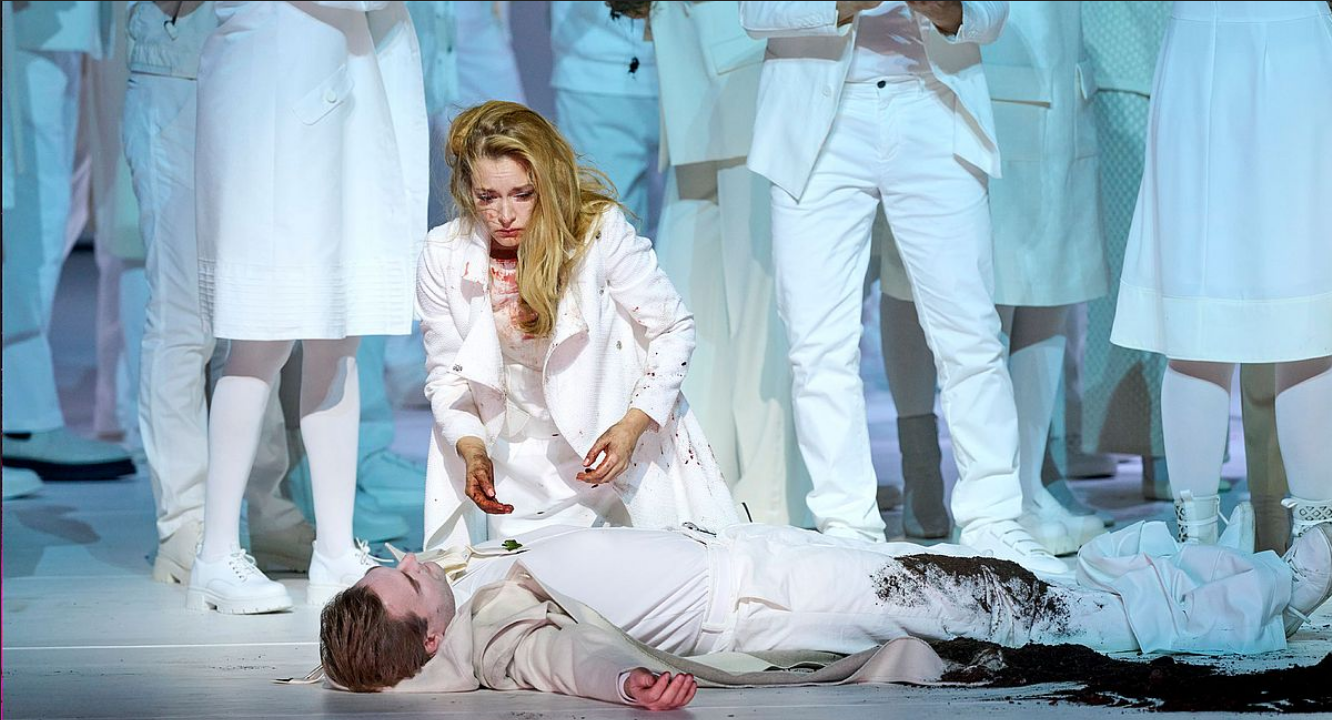
For a chamber opera, there are a surprising number of diverse scenes, which means that there are also a larger than usual number of principal singing roles. Among them is James' awkward bedroom encounter with Oliver Wendell Holmes, the death of his sister Alice and his meeting with the sculptor Hendrik Andersen. Despite being presented a chamber opera and featuring in the Wexford festival's side programme of 'pocket operas' and despite being performed with piano accompaniment music only (played by the composer), it seemed to me that this had the range and ambition of a full scale opera in conception and in execution. All the ensemble characters and the social situations with chorus who come into contact with James have an important part to play in defining who he is and who he is not, in as far as can be speculated upon. Taking on the difficult challenge of writing a libretto from his own novel, Colm Tóibín makes a convincing case not just for which scenes to include, but in how to make them work in isolation and in terms of the work as a whole.

While I think those choices are superb - every scene having something of interest to impart on James, on art, on love, on friendship, on life in general - Caruso's score, even in piano reduction, brings it all together, making it feel less a series of isolated scenes than something that has that bigger picture in mind. Between them Caruso and Tóibín's familiarity with opera conventions, there is clearly the ambition to use and enrich the work with its distinctive qualities, the creators being consistently creative in overlapping exchanges, quartets, choral arrangements. And they are not used lightly, but in the service of getting to the heart of what is important in each scene and how it contributes to the whole.

Away from the stage, it's hard to convey with words alone how the creators have managed to turn such a story into a compelling opera - and a modern opera that runs to almost two hours - but there is not a dull moment anywhere. Of course, a lot of the success of the work and its performance here is down to the cast and they are superb, not just Thomas Birch as Henry James and Annabella-Vesela Ellis as Constance Fenimore Woolson - whose challenges are considerable considering they are on stage singing for most of the running time - but all the supporting roles were undertaken with great character and thrilling singing. Caruso brought the full character of the score to light in his piano playing. Mostly however, the success is down to how well the creators and performers make use of the unique ability of opera to conjure scenes and bring them to life. Magic & Music is the main theme of this year's Wexford Festival Opera, and The Master created its own kind of magic.

The intimacy of the smaller Jerome Hynes Theatre at the National Opera House undoubtedly helped. There was little required in the way of sets or props, but everything that was needed to draw you in was there in the singing, in the beautiful period costume design, in the excellent choreography and direction by Conor Hanratty that ensured that this flowed through without any need for an interval. I'm sure however that the quality of this work is enough to expand equally successfully to a larger stage and orchestration without losing anything of its heart and intimacy.

Links: Wexford Festival Opera

Sunday, 6 November 2022

Dvořák - Armida (Wexford, 2022)

Antonín Dvořák - Armida

Wexford Festival Opera, 2022

Norbert Baxa, Hartmut Schörghofer, Jozef Benci, Jennifer Davis, Stanislav Kuflyuk, Jan Hynk, Rory Dunne, Gerard Schneider, Josef Moravec, Thomas Birch, Andrii Kharlamov, Libuse Santorisova, Chris Mosz, Josef Kovačič

O'Reilly Theatre, National Opera House, Wexford - 2nd November 2022

Harking back to the standard 19th century operatic tensions involving war and love, based on Torquato Tasso’s La Gerusalemme liberata during the time of the crusades, you would think that it shouldn't be too difficult to make a version of Armida exciting and dramatic. Dvořák's dynamic music in his final opera certainly lives up to the drama, expressing high passions of love and betrayal where the stakes are high between the opposing forces of Christian and Saracen armies. Add in some magic, sorcery and an Act II finale that includes a swooping dragon to stage a dramatic escape at a critical point and this seems tailor-made for the 71st Wexford Festival Opera's Magic & Music theme. And yet, something is lacking in this production.

It's definitely not Dvořák's music. There is no fake Eastern exoticism here, there are no romantic light arias; it's straight ahead drama and high passion on a war footing. Ismen, ruler of Syria and sorcerer, is however under no illusions as to the limits of his powers to make Princess Armida love him. He knows she loves another, but he and King Hidraot, the father of Armida, believe that she is better placed to infiltrate the enemy camp and use her magic powers against the mighty forces that have already gathered to take the city of Jerusalem. Armida however has other ideas having been bewitched herself by the appearance of the knight Rinald out hunting. There is powerful vocal writing to match these emotions, not least of which is the inexplicable passion that grips Armida and leads her to side with the enemy.

And yet, much of what passes for drama in the first two acts feels detached from the characters and more like symphonic colouring and scene setting as characters define their position and plan their course of action. Director Hartmut Schörghofer doesn't have any great ideas to make it visually more engaging as a human drama, keeping it in a First Crusade (1096 - 1099) setting, using the backdrops for projections of locations with the principals and choruses filling a mainly bare stage, often singing outward. Norbert Baxa's rousing conducting makes this sound terrific and the singing is outstanding, and that proves to be more than enough for a satisfactory presentation of this rarely performed work, but you are left feeling that it could do with a little more action or activity. And contemporary relevance, possibly.

There really isn't much to help the audience engage with the predicament at hand, the festival theme of Magic & Music taken a little too literally here and not enough attention given to the human side, or to the reality and scale of the war being played out. You can hear it ok, not least in the fine singing of Jennifer Davis as Armida and Stanislav Kuflyuk as Ismen, and the impressive choral work certainly suggests the might of the Christian forces on one side and the women of the court of King Hidraot on the other. The set relies on a mirrored background cutting the stage diagonally to visualise the divisions, with screens that open up and supply depth on one side, and computer generated projections of the army camp on the other. A huge dragon on the screen swoops down and explosions of magic do a little to match the content, but it still feels distanced and stage operatic.

You might expect the opera to pick up after this pre-interval magical intervention by Ismen, but the sorcerer for some reason leaves Armida and Rinald to wander and wonder in an enchanted garden in the third act. It doesn't really work musically or dramatically in any sense of taking the opera forward - feeling more like an operatic convention to have a romantic interlude - and here the director also fails to find a way of making this engaging or even capitalise on the visual splendour and magic that such a scene offers. Projected computer graphics are used and, like the movies when they are overused (Avatar came to mind in this scene), it lacks a sense of real substance, a sense of reality. Perhaps if you are seated lower and at a better angle it might have looked more enveloping (the accompanying images seem to testify to that), but from the left of the stage and above, the mirrored effect wasn't visible.

The final act should bring about action and passion, and musically it really did. Down in the orchestra pit Baxa and the Wexford Festival orchestra delivered the rolling punches, the fearsome chorus of Crusaders - superbly managed by Andrew Synnott - even though only a representative handful, completely gave the impression they could overrun Jerusalem themselves. The principal singers raised their game also, striking blow after blow. Partly however because there was little conviction behind the buildup of the previous acts to merit it - in the dramatic content of the opera as much as in the stage direction - it still appeared to fall short of what was needed to make this opera work.

Still, any opportunity to see a rare Dvořák opera performed live is an occasion to relish, and although it is imperfect in conception and with the death of composer in 1904 there was no opportunity for revision, it didn't disappoint in a fully orchestrated live performance. The timing was a little bit off between orchestra and chorus in the opening scenes, but there were no issues elsewhere. I was concerned that conductor might be a little heavy-handed and sacrifice melody for overstatement, but it was wholly appropriate for a staged version of Armida, attempting to make those high emotions, passions, conflict and heightened magical content all blend with the intent of the drama, and it sounded terrific in the O'Reilly Theatre of the National Opera House.

The performance certainly revealed some excellent singing. Looking like she hadn't been given a great deal of direction, Armida spent much of it almost looking like she was in a state of trance, but Jennifer Davis sung out those passions impressively. Ismen is a choice role, a rather more interesting figure than Rinald, and it was taken superbly by Stanislav Kuflyuk. Gerard Schneider did what he could with Rinald, but the character is not greatly defined in either the music or the direction. As already noted, but it's worth saying again, the male and female choruses were outstanding, giving the work that extra edge of lyricism and dramatic dynamic where needed.


Links: Wexford Festival Opera

Cellier - The Spectre Knight (Wexford, 2022)

Alfred Cellier - The Spectre Knight

Wexford Festival Opera, 2022

Gioele Muglialdo, Sinéad O'Neill, Thomas Bennett, Monwabisi Lindi, Grace Maria Wain, Erin Fflur, Jennifer Lee, Matthew Nuttall

Wexford Arts Centre - 2nd November 2022

Alfred Cellier's The Spectre Knight proved to be an ideal way for me to start this year's Wexford Festival Opera, the essential place to go every year if you are an opera lover. There you will be guaranteed to see and hear rare works that often haven't been performed in over a century, and almost invariably find that these works are more than worthy of being staged again. Aside from the larger scale works on the main stage, you will find much of interest - and rarity - in the 'pocket opera' performances. And as such we got the opportunity to see Cellier's The Spectre Knight, a 'Fanciful Operetta in One Act', of which no recordings exist, a light and entertaining one-hour piece staged here with much love, care and attention, brightly directed and performed.

Cellier was a contemporary of Gilbert and Sullivan, conducting many of their works and even collaborating later with W.S. Gilbert on The Mountebanks. The Spectre Knight indeed was even first performed as a 'curtain raiser' for Gilbert & Sullivan's Sorceror in 1878, and it plays that part very well. It's not a work that is going to upstage any main act, but within its modest runtime and ambition, it is not unexpectedly filled with bright little melodies and light humorous situations, and even one or two surprising elements, references and allusions that give it a little more character.

The plot of the operetta owes much to Shakespeare, establishing a situation similar to The Tempest, where a Duke banished from his kingdom is living with his daughter in exile, in an enchanted glen supposedly haunted by the Spirit Knight. They aren't entirely alone, the Lord Chamberlain also residing with them and two servants who tend to drink a lot. There are however no young men, much to the disappointment of the Duke's daughter Viola, who has never even seen a young man. Just for added realism, there were no young men in the audience at the Wexford Arts Theatre either. 

It all seems a little bit dubious however when Viola's cousin Otho appears (a 'distant cousin' he hastens to remind us), looking to deceive and take advantage of an innocent young woman who has never met a young man, let alone a handsome one like Otho. He disguises himself first as a friar to put some ideas into her head, grooming the suggestive Viola. Then he disguises himself as the Spectre Knight and, through the telling of his sad fate, manages to win the approval and admiration of all. Viola however is not entirely convinced, even when Otho admits who he is. In truth, Otho has loved Viola for a long time and has come to tell the Duke that his kingdom has been restored. Happy news for everyone.

The Spectre Knight is delightfully played with some updated dialogue and contemporary references by director Sinéad O'Neill, keeping it very much in the spirit of Shakespeare's comedies. There is maybe not a lot that stands out musically in the piano score reduction played here by Gioele Muglialdo, but are certainly plenty of bright tunes that keep everything moving along. A few other melodies from Verdi (Brindisi from La Traviata), and Mozart ('La ci darem la mano' from Don Giovanni) are inserted, although it's not clear if those were there in original or included here for fun, but it's telling that they don't feel out of place. The set was colourfully dressed and creatively directed to make use of the limited space, making this feel fully staged.

Brightly played and brightly sung, played for laughs and played for fun it's hard to fault this on any level. Not only do we get the chance to see and hear some pleasant musical theatre, well-staged and performed, filling in forgotten gaps in musical history, these 'pocket operas' also provide an opportunity for many of the excellent ensemble of young singers who contribute elsewhere to the chorus and supporting roles in the main stage opera to show their singing and performing talent in small principal roles. Jennifer Lee was a charming Viola to Thomas Bennett's Grand Duke and Matthew Nuttall's not at all creepy Otho/Friar/Spectre. Even in the smaller role of the Lord Chamberlan, Monwabisi Lindia managed to confidently deliver Verdi's Brindisi and Grace Maria Wain and Erin Fflur were hugely entertaining as servants/ladies of the court.

Links: Wexford Festival Opera

Saturday, 29 October 2022

Cherubini - Medea (New York, 2022)


Luigi Cherubini - Medea

Metropolitan Opera, 2022

Carlo Rizzi, David McVicar, Sondra Radvanovsky, Ekaterina Gubanova, Matthew Polenzani, Janai Brugger, Michele Pertusi, Christopher Job, Brittany Renee, Sarah Larsen, Axel Newville, Magnus Newville

Met Live in HD - 22nd October 2022

Livestreamed opera and opera on DVD are obviously something quite distinct from live opera but the Met live broadcasts with their presenters and backstage interviews during the intervals are something else again. The Metropolitan Opera have of course long been innovators in presenting their opera to the world in live radio and then livestream broadcasts to the cinema, so they're obviously very good at it. They have it down to such a fine art now - with flawless uninterrupted High Definition image and sound - that you do however wonder where the priorities lie; whether the image, presentation and star attractions of big productions take precedence over the actual musical content.

That's maybe just an idle thought, as I have rarely had any doubt about the quality of the performances I have seen streamed from the Met, but the format certainly makes me think differently about how I review such a production. It's not like live opera, or even opera on DVD. I'm sure the primary consideration is a striving for excellence for the audience in the theatre - whether you think they achieve it or nor - but I get the impression that for some productions they do seem to have an eye to how it will look in its cinema broadcast. Those considerations are largely on the camera placements and shots, and Gary Halvarson ensures that the Met Live in HD broadcasts have a very distinctive and impressive look.

Which brings us to the Met production of Luigi Cherubini's Medea. If it merely looked impressive however and didn't also live up to that in performance, you'd have more reason to be critical, but there are few concerns on that front. Throughout the broadcast we were reminded by Joyce DiDonato and Peter Gelb that this was the first time Medea has been performed at the Met, which is incredible, but also welcoming as a sign of the Met striving to expand their range. It's not a minor work by any means, made famous by Maria Callas, but as one of those works belonging to that in-between period between classicism and romanticism, it has perhaps been somewhat left in the shadow of the twin titans of Mozart and Verdi.

Mainly however the stated reason for not performing Medea before now, is that - as a showpiece of Maria Callas demonstrates - it indisputably requires a soprano of tremendous force to deliver it and do justice to the role of Medea. It wasn't until Sondra Radvanovsky suggested that she would love to sing the role that the Met felt it would be worth exploring.

Whether Radvanovsky is good enough to sing it, I have some reservations, but by and large it was a successful account that certainly emphasised and made obvious the attractions of the work. There's no doubting Radvanovsky's comittment to a challenging role, but she didn't totally win me over. There were some weaknesses in her delivery and the strain showed in the demanding third act, but in the moments where it counted, especially in the delivery of the extraordinarily powerful and demanding finale, it was genuinely spine-tingling.

If Sondra Radvanovsky wasn't totally convincing it seemed to me that she was maybe trying too hard. The blame for that falls on director David McVicar who forced her into all kinds of gymnastic writhing on the stage, pacing, ducking, diving, rolling, crawling, stretching. Most of this is completely unnecessary since all the force of the role of Medea is there in the libretto, in the music and in the terrific writing for the voice by Cherubini. All this movement undoubtedly tired Radvanovsky much more than was necessary and clearly affected what is already a challenging vocal performance. That should not happen. It is simply bad direction, and that's the kind of thing that makes me wonder where the priorities in presentation lie.

McVicar's production has its obvious attractions - primarily aesthetic - but it didn't entirely convince on a human emotional level. It looked stunning but was way over the top, going for shock and awe. It didn't adhere to any historical period other than generic operatic past, which works well enough. Classical stone steps lead up to huge tarnished steel doors that resemble stone walls, emphasising just how much Medea is cut off and excluded from the world of Colchis. To make sure you didn't miss a thing in the huge expanse of the Met stage, a huge tilted mirror at the back reflects and expands the area for the drama, permitting the viewer to see the full grandeur of Giasone's wedding to Glaucis' while Medea writhed around in anger, jealousy and rage outside of it.

Halvarson's cinematography captured all this superbly with low angles foregrounding Medea against the beautifully lit backgrounds. Aesthetically it was striking but emotionally it was utterly redundant. With McVicar's stylistic mannerisms and Medea's eye-rolling and writhing around the stage, all amplified by the dramatic camera angles, it overwhelmed the true heart of the musical drama. Act III was the worst offender. Flames flickered earlier than expected, flames of fury presumably since Medea has not yet started to enact her fiery revenge. The gory death of Glauce doesn't need to be shown, nor do the deaths of the children, at least not in the cinematic gore fashion shown here (we had the same problem with Met's Tarantino-meets-Werther). The raging thunderstorms and circles of flame that accompany Medea's final descent into insanity are spectacular, but overly emphatic when you have that vocal finale, which Sondra Radvanovsky delivered superbly.

Musically Carlo Rizzi matched the fireworks on the stage, but I found the busy stage and overacting too much of a distraction, so I can't say say for sure if it really got to grips with Cherubini or whether this was also smothered by McVicar's indulgent production. Matthew Polenzani brought a more sympathetic side to Giasone in a lower tessitura than he is accustomed to. He sang well but didn't make a great overall impression, overshadowed as his character is by the dominance of Medea and by the production. The other roles were well-handled; Ekaterina Gubanova an excellent Neris and Janai Brugger giving a good account of Glauce.

There was a lot to enjoy here, but how much of it was genuine opera and how much was pure stage spectacle is debatable. Even that might not really matter, as spectacle has its place in opera and it was certainly a feature of the opera's original French production in 1797. I enjoy high production values in opera as much as anyone and am certainly in favour of new technology and theatrical techniques being employed, but I was left with the feeling here that as impressive as this was, as much money and effort has been put into impressing you, it just didn't connect on an emotional level. Worse, the production actively hampered the qualities that are there in the opera itself and was detrimental to the delivery of the singing, and that should never happen. 

Tuesday, 18 October 2022

Mitchell - Propaganda (Belfast, 2022)

Conor Mitchell - Propaganda

The Belfast Ensemble, 2022

Bob Broad, Conor Mitchell, Joanna O'Hare, Darren Franklin, Rebecca Caine, Matthew Cavan, Oliver Lidert, Celia Graham, Sean Kearns

Lyric Theatre - 15th October 2022

Musicals are not something usually covered in OperaJournal as a rule, but there are exceptions to every rule, and I will certainly make an exception when it comes to Conor Mitchell and The Belfast Ensemble. In fact, there are apparently no rules as far as Conor Mitchell is concerned. Whether it's a symphonic mass, musical theatre, operetta, opera, or some undefinable cross between music, video and texts, Mitchell will use whatever means is best suited to the subject he is dealing with, permitting no distinction between what is high art and what is popular entertainment; all of them vehicles capable of putting across serious messages about social, personal and political issues.

I mean, for a start, when was the last time a Belfast composer wrote a musical? Has there ever even been a musical written by a Belfast composer? New opera is not unheard of here - NI Opera Shorts in 2012 provided a platform for several local composers, and Brian Irvine has had several successful new works produced (Least Like The Other). Mitchell, who also contributed Our Day to NI Opera Shorts, has also made a major impact and stirred up some controversy with the brilliant Abomination: A DUP Opera, but I don't think anyone has had the nerve to imagine that a musical would be the best way to present views on local topical issues.

Not that Propaganda 'A New Musical' deals directly with local issues. Set during the Berlin Blockade and Airlift in 1946/47, it hardly seems in any way connected with contemporary or recent Belfast, but indirectly it very much relates to local and more universal issues. It's not that difficult to see some parallels between Belfast and a city that will have its people divided by a wall as a consequence of the events that take place during this period, so that is at least a starting point for recognition, even though any such reference is not laboured or even made explicit, other than hinted at perhaps in one or two scenes and in the spoken accents.

The reason why it's understated - although understated is perhaps not quite the mot juste for describing any aspect of this production - is that the libretto or storyline keeps things simple and largely on a human level. The plot really involves little more than the difficulties for one family doing whatever is necessary while struggling to survive and keep on the right side of the authorities in a Berlin almost utterly destroyed after the war, living in the Russian sector of the city that is already in a precarious position. For Hanna, that involves being a model for some provocative pictures, although her photographer husband Stanislav/Slavi, has more artistic aspirations.

Even in that there is clearly some personal commentary on questions of popular entertainment and art, and that is reflected in the music, which bounds along with big melodies that would grace any great American musical. It is however actually also subtly layered, so you will hear Russian composers referenced and even Irish lilts that suggest other connections. There is something perhaps ironic with the opening 'New York, New York'-like swing of 'Like What You See, Boys?' being applied to war-torn Berlin (if you can make it there, you can definitely make it anywhere), but that opening song already reveals layers in the human struggle and freedom of sexual expression against repressive laws that is teased out in Hanna and Slavi's relationship problems and elsewhere.

There's definitely nothing romaticised about dressing up these personal, social and political differences in catchy memorable melodies. The central love story was born out of difficult circumstances, it lives through difficult circumstances and it ends in difficult circumstances. But change does occur over the course of the drama in the central figure of Hanna, who asserts the determination of the individual to refuse to submit to power of social, political and gender expectations and accept that the circumstances of her position should involve any compromise of her integrity. It's more than that even, Hanna in a way refusing to live the lie that she is the photographer to save Slavi, but becoming confident enough to choose her own way forward.

What is particularly brilliant about Propaganda is the way that Mitchell uses the format of the musical - as a popular entertainment with wonderful songs - as an almost subversive undercurrent to draw out these other underlying layers and issues. You could just enjoy this as a historical entertainment and it works brilliantly on that level, or you can dig deeper if you want. And as ever, Conor Mitchell fearlessly provides plenty of provocative material and is not afraid of courting controversy to make serious, relevant and meaningful social and political points. One scene even relates the struggle for Irish independence with the socialist struggle of Soviet Russia, with huge Soviet banners, the singing of the Russian national anthem, and large projections of Uncle Joe Stalin dominating the stage.

The production and stage design is critical in getting across both these elements, presenting the human story taking place against the backdrop of huge adversarial forces. The production design is simply just stunning. The central home of Slavi, Hanna and her mother is on a raised stage on a framework of scaffolding, representing very much that they are an island in the ruin of Berlin, while all around is the might and threat of Russia. Despite the adherence to period costumes and some projected footage and announcements, it still feels very relatable and applicable to anyone from Belfast who has struggled to assert their own identity within an intolerant society.

The writing, the music and the stage production are all top notch, and with Bob Broad conducting the impressive Belfast Ensemble orchestra everything flows beautifully between the music and drama. The singing and delivery is the other critical element that contributes to the success of Propaganda in its opening run at the Lyric Theatre in Belfast. Everyone gives an outstanding and fully committed performance, with Joanna O'Hare evidently carrying much of the duties in the central role of Hanna. It's very much an ensemble piece without a single weak element, but I was also impressed with Rebecca Caine as Hanna's mother, Magdalene von Furstenberg, who was perhaps the one true operatic voice on the stage. Just to show that this is by no means essential, actor and drag artist Matthew Cavan - who despite appearing in many Belfast Ensemble productions is not usually noted as a singer - was just superb here, singing with conviction and bringing personality and personal character to the role of Gerhardt.

As primarily an opera review site, I have nonetheless previously praised the Belfast Ensemble for being the true progressive musical force in Belfast, willing to push boundaries that NI Opera was failing to do in the post-Oliver Mears years, as they turned away from opera in favour of musicals at the Lyric Theatre like Sweeney Todd and Kiss Me Kate. Ironically, while opera is back on the NI Opera agenda, the scheduling of one opera a year - La Bohème in 2021 and La Traviata in 2022 - even with high production values (and equally high ticket prices) are by no means signs of a superior art form pushing a progressive musical direction. It's again the Belfast Ensemble and a musical at the Lyric Theatre this time that shows real artistic creativity and imagination.

Links: Lyric Theatre, The Belfast Ensemble

Wednesday, 12 October 2022

Mahler - Von der Liebe Tod (Vienna, 2022)


Gustav Mahler - Von der Liebe Tod

Wiener Staatsoper, 2022

Lorenzo Viotti, Calixto Bieito, Vera-Lotte Boecker, Monika Bohinec, Daniel Jenz, Florian Boesch, Johannes Pietsch, Gabriel Hoeller

Wiener Staatsoper Live Streaming - 7th October 2022

To somewhat stretch a metaphor, the idea of a Mahler opera is a bit like waiting for a bus around these parts. It can feel like you are waiting for a hundred and fifty years and then suddenly two of them come along together. Since of course there is no such thing as a Mahler opera that's even more unexpected, and it's perhaps no surprise that the directors daring to stage Mahler's symphonic and lieder works as opera are two of the most ambitious and controversial of contemporary directors; Romeo Castellucci and Calixto Bieito. As strange as it might be to imagine Mahler staged, it's even stranger that such an idea in these times is deemed controversial enough to upset a few sensitive souls who don't even have to watch it or let it impinge upon their favourite Mahler recordings on CD.

While that might not exactly be the primary intention of these directors to upset anyone, there is certainly something of a desire to stir things up - but in a good way, or perhaps a necessary way. Because these are indeed the times we are living in; a time of war in Europe, a time of global pandemic killing millions, a time of looming environmental crisis and climate change that does indeed affect everyone. It's not enough in these times for an artist to remain detached from that, but there should be some recognition that great art is drawn from such dark times and experiences, and it should reflect them and not gloss over them.

In the case of Castellucci's production of Resurrection, for example, it's not enough to just put on a work of such sublime creativity and feeling as Mahler's Sixth Symphony as a concert performance for a wealthy audience at the Aix-en Provence festival. It would almost be an injustice to Mahler to present such a work as a rich indulgence. It's a profound work that has deeper meaning and if it can move an audience - whether to applause or booing - then it ought to provoke such a reaction. Anyone however who boos the imagery of the digging up of a mass war grave while such atrocities are happening for real at that moment not so far away should really think twice about their understanding and purpose of the arts.

The same goes for anyone who manages to work themselves into a state about a creative artist taking a similar approach to this Vienna State Opera stage production of another Mahler's work. Von der Liebe Tod actually consists of two Mahler works brought together, Das Klagende Lied, a cantata from 1879/80 based on the Brothers Grimm fairy tale, and Kindertotenlieder from 1901/04, based on a poem by Friedrich Rückert. Calixto Bieito employs similar techniques to Romeo Castellucci, the two directors almost crossing over as they progress from what were not ever exactly conventional opera stagings in the first place to rather more abstract presentations of works that were never intended to be fully staged.

I say never meant to be fully staged, but the question that arises immediately when watching the first part of this production, the cantata Das Klagende Lied, is why not? It has a clear fairy tale narrative and powerful accompanying music and singing that is dramatically attuned to the developments and deeper sentiments of the story. It's mostly narrative based admittedly, and doesn't even have clear individual roles that you might find in an oratorio, but it is filled with imagery that deserves to exist more than in the mind of the individual listener. In fact it is the role of a director - much as some would seek to not credit him or her with any importance - to explore a work closely and relate it to universal concerns that any listener will recognise and identify with.

Calixto Bieito then evidently doesn't go in for straightforward naturalism or literal illustration of the story in the way of Otto Schenk's The Cunning Little Vixen at the same opera house, for example. The imagery Bieito devises for this fairy tale opera/cantata however is exactly what a director should do when confronted with a work of great art and that is to dig deeper into the underlying meaning of the fairy tale and relate it to more universal concerns. Using the red flower of the fairy tale, the imagery of the willow and the nightingale, all of them witnessing the killing of one brother by another, the overriding idea - for me at least - appears to be the impact violence has on individuals, on society, on nature. And yes, that is something we can see in many aspects of the times we are living in.

As he is wont to do, Bieto simultaneously makes this beautiful to look at but harrowing at the same time, refusing to prettify the underlying horror at the heart of the tale (see also his response to the not dissimilar fairy tale story of men dying for a cold hearted queen in his version of Turandot). In the story, the minstrel comes across a gleaming bone in the woods that he carves into a flute, but here he hacks off an arm, cuts out a bone from within the flesh and plays on a blood spattered bone. It's not the 'flute' that sings either, but the grim spectacle of the dead boy with a bloody hacked off arm singing of his fate. Evidently, this will not be to everyone's taste, but it is necessary.

The dead boy slayed by his brother over a flower leads beautifully into the second part of Von der Liebe Tod, the ruins of the wedding feast turning into an abandoned playroom for dead children in Kindertotenlieder. Conceptually this is marvellous, the earliest of Mahler works - Das Klagende Lied his Opus 1 composed when he was 19 - brought together with the later, final work of a composer capable of committing all his lived experience in the meantime into it; a fairy tale turned into reality and that reality and horror concentrated and transformed into something beautiful through art. That is the purpose of art, or one of its many purposes. It's that same art in musical performance and interpretation that ensures that such work lives on, remains vital and alive and connected not to past events, but to what people are experiencing today. Sometimes life mirrors art in shocking and unexpected ways. One need only think of another recent tragedy in Thailand to see how deep feelings run in Kindertotenlieder. The idea that anyone could even think of mindlessly heckling artists on a stage after viewing this is unconscionable.

It helps that musically this is a glorious affair. The influence of Wagner on the youthful Mahler is most pronounced in the considerable orchestral forces and choral arrangements employed in the service of emotional and dramatic content of Das Klagende Lied. The conducting of the works by Lorenzo Viotti also comes to the fore in Kindertotenlieder, with intense, heartfelt singing from Florian Boesch and Monika Bohinec. How much more alive does this become when such performances are aligned with visual imagery and artistic direction that meaningfully connects the work with reality, that doesn't sugarcoat it or diminish its sentiments, as some might be tempted to do with these two particular works. Welcome to the opera stage of the 21st century, Gustav Mahler.

Sunday, 2 October 2022

Mitterer - Dafne (Paris, 2022)

Wolfgang Mitterer - Dafne

Opéra-Théâtre de l’Athénée Théâtre Louis-Jouvet, 2022

Aurélien Bory, Geoffroy Jourdain, Clotilde Cantau, Adèle Carlier, Anne-Emmanuelle Davy, Jeanne Dumat, Constantin Goubet, Floriane Hasler, Michiko Takahashi, Amandine Trenc, Virgile Ancely, Safir Behloul, Renaud Brès, Mathieu Dubroca, Alfred Noblet-Rousseau Bory

Athénée Théâtre Louis-Jouvet, Paris - 29th September 2022

Opera can be many things to different people, so it's understandable that not everyone enjoys the idea of contemporary opera. One of the defining characteristics of opera for me however is that, like any essential art work or art form, it needs to be universal and transcend time. Opera is performance art, which means that it lives in the moment and not as notes on music score sheets, or even in a recorded performance. That's why modern opera is important, that's why new approaches are necessary, and that's why it needs to be reinvented, reinvigorated and not remain merely an historical artefact that preserves the past in amber.

That approach is one that Wolfgang Mitterer wholeheartedly embraces in this stunning and beautifully conceived new work Dafne, 'a madrigal-opera after Heinrich Schütz'. Conceived in collaboration with musical director Geoffroy Jourdain and stage director Aurélien Bory, Mitterer's Dafne spans the space between gods and mortals, antiquity and modernity, opera of the past and opera of the present. He takes an old practice, one that is not common nowadays, and resets a 17th century libretto to new music - you don't for example find too many Metastasio-penned libretti being used in contemporary opera. It's not just an academic exercise either, but one that is necessary since the Heinrich Schütz's original music is now lost, destroyed in a fire at a library in Dresden in 1730.

The idea of reconstruction of an opera based on a libretto isn't even a new practice either. Most of the early operas only have basic basso continuo markings and the score largely improvised upon them by the musicians. In the case of reconstructions of several lost Vivaldi's operas, the music is at least derived from other music by the composer, but in the case of Dafne, there is nothing that remains. Wolfgang Mitterer, noted for his experimental electronic music might seem a composer least likely to adhere to fidelity to the source, but in fact he does produce a beautiful work that combines his sound experiments with traditional instruments and a beautiful 12-part polyphony vocal setting of the libretto.

There are actually several reasons why the project would attract a sympathetic and suitable approach from Wolfgang Mitterer. The composer has spoken of performing Monteverdi and Schütz in a vocal quintet in his youth. As 2022 marks the 350th anniversary of the death of Schütz, who is considered as the German Monteverdi, it seems like the right time to revive what is considered to be the first work of German opera. Composed in 1627, based on a libretto by Ottavio Rinuccini adapted into German by Martin Opitz, only the libretto to Schütz's Pastorale survives. That needed to be reworked by the creators for a modern stage performance, but in keeping with the tradition of a madrigal opera from the period, they have chosen to use the idea of a chorus relating the drama, but also using the individual fach of the singers on alternate lines so that each of the gods have a multiplicity of voices.

The libretto doesn't appear to be anything exceptional, it has to be said, or at least with little to distinguish it from other typical Baroque opera or the tragédie lyriques of Lully dealing with mythological subjects and pastorals. Dafne deals with the legend of Daphne from Ovid's Roman retelling by classical Greek mythology in his Metamorphoses. It even has the traditional prologue where the gods are in dispute, although here it's Ovid who provides the prologue, while the dispute between Apollo and Venus takes up the rest of the opera. Full of pride over his defeat of Python, the beast that has been terrifying the island of Delos, Apollo denies that any other gods have power such as his. Despite the warnings of Venus, Apollo mocks Cupid's bow and arrow only to be struck and fall in love with the nymph Daphne.

Like another recent contemporary opera based on Ovid's Metamophoses (Sivan Eldar's Like Flesh), the modern relevance of ancient Roman mythology can be seen in the folly of disrupting the course of Nature. The immortality of Daphne, who turns into a laurel tree to escape the advances of Apollo, can be seen as representing the power of art to transcend time and death, to set oneself outside the power of the gods. Much like Orpheus, the subject of many operas, that can also be testament to the nature of opera itself. As another modern opera Detlef Heusinger's Die Zeitreisemaschine suggests, opera itself is a precious time machine. Even more so here in the case of Dafne, the original opera destroyed, but recreated, reinvented and metamorphosised to survive even beyond its destruction. That alone testifies to the power and relevance of Dafne, not least through the performance and staging choices made here, but there are many other ways that the opera can speak to us.

What struck me as noteworthy about the concept here is that aspect of it returning to the roots of opera, which was conceived as a response to the mistaken belief that it was ancient practice to sing Greek drama verse. Here Mitterer extends that idea, bringing back an ancient tradition, putting an existing surviving ancient text of Greek myth to music and singing. In doing so with the music of our day, he bridges the past and the present. "Not the music of my day" a lot of traditionalists might cry and certainly Mitterer's sonic art approach to music isn't for everyone. The electronic music for Dafne is prerecorded and uses Mitterer's usual mannerisms and techniques, including sampling of orchestral music, with speeded up effects, clicks and electronic juddering, so there was little conducting required on the part of Geoffroy Jourdain for that.

This however only forms a background, the basso continuo to the composer's beautiful writing for the voice. It gives the chorus's telling of legend an otherworldly setting, swirling and haunting, truly lifting it into the mystical realm of the gods. Traditional instruments are used in sections, very much in the style of the period and informed by the music of Heinrich Schütz, those instruments played by several of the singers. Singing and playing as individuals, but also as a chorus, the gods indeed have a multi-voiced form, as if a single voice would not be enough. The conception of this, as well as the blending of ancient and modern in the music, is impressive and striking, giving Dafne a character quite unlike any other opera. It is truly befitting of an opera that seeks to do justice to an important historical work in German opera and through it aspire to represent the idea of immortality.

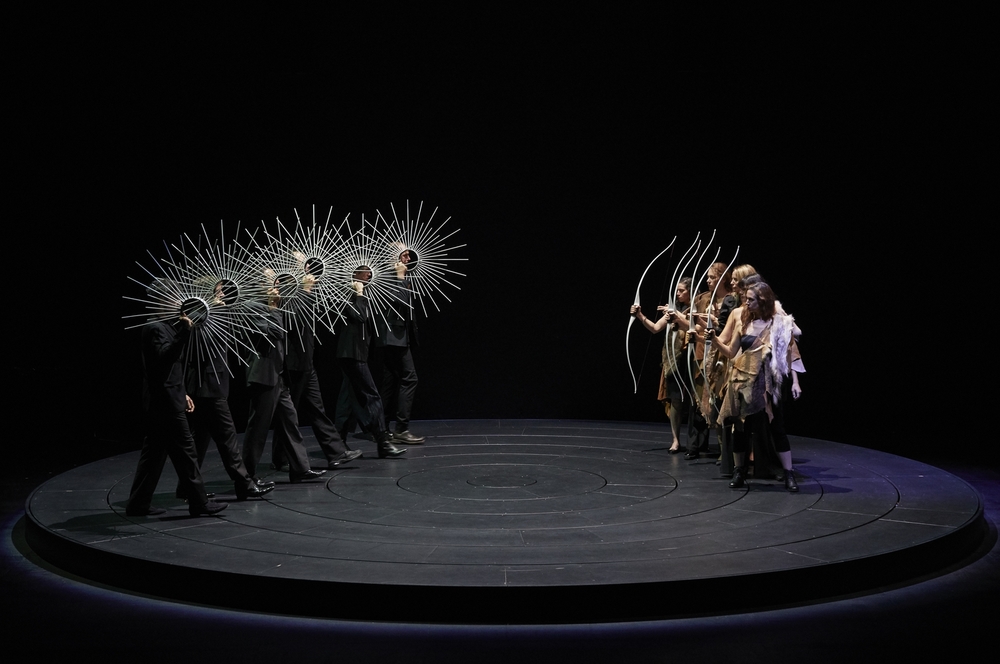
The staging is an essential element of any opera and Aurélien Bory's presentation has a major part to play here, one that is also commensurate with its ambitions. If it doesn't perhaps bring any allegorical or contemporary reading out of the drama, it at least illustrates its abstraction and otherworldly qualities. The thirteen singers of the Jourdain directed Les Cris de Paris have a complicated choreography to perform on concentric rotating wheels of the stage, itself a reference to the rotating stage devised by Tommaso Francini in the 1617, in the same period of the opera. It brings movement and circularity, chase and distance. Other stage effects, such as the hunting arrows dropped from the sky onto the circular 'target' that are then used to form the crown of Apollo, the appearance of 'Venus' on wires and the transformation of Dafne into a tree are superbly realised all within this circularity. The coherence of concept and execution ensures that there are no slow or dry passages here; everything comes together, flow and movement, music and ambiance, harmony and dissonance, past and present all made one.

When many question the point of contemporary opera, question the abandonment of traditional tonal musical forms in contemporary music and illustrative traditional stage productions, Mitterer, Bory and Jourdain show the importance of keeping music theatre progressive and experimental, while still using the past as a touchstone for reference and for informing the present. The original opera of Dafne, were it even to still exist, would probably remain obscure, of historical curiosity value and rarely performed for a modern audience, incapable even of having the same impact in that form that it would have had on an audience of its time. Here it is given new life, and if the libretto and its subject might feel like they have little to do with contemporary issues, Mitterer's Dafne at least allows us to consider what it tells us about the arts, on the higher universal themes that can be found there, the necessity of carrying their message through to the present day, and in how great art can still speak to and move a modern audience.


Links:
Athénée Théâtre Louis-Jouvet