Saturday, 9 September 2023

Prokofiev - War and Peace (Munich, 2023)


Sergei Prokofiev - War and Peace

Bayerische Staatsoper, 2023

Andrei Zhilikhovsky, Olga Kulchynska, Alexandra Yangel, Kevin Conners, Alexander Fedin, Violeta Urmana, Olga Guryakova, Mischa Schelomianski, Arsen Soghomonyan, Victoria Karkacheva, Bekhzod Davronov, Alexei Botnarciuc, Christian Rieger, Emily Sierra, Martin Snell, Christina Bock, Sergei Leiferkus, Alexander Roslavets, Oksana Volkova, Elmira Karakhanova, Roman Chabaranok, Stanislav Kuflyuk, Maxim Paster, Dmitry Cheblykov, Nikita Volkov, Alexander Fedorov, Xenia Vyaznikova

ARTE Concert - March 2023

Neither the Bavarian State Opera nor director Dmitri Tcherniakov really knew what they were letting themselves in for when they chose to present Prokofiev's War and Peace on the 5th March 2023, on the 70th anniversary of the death of Prokofiev (not to mention the 70th anniversary of the death of Stalin). They evidently knew about the challenges of putting on a complex Russian opera with huge orchestral and choral forces and a large number of principal roles, but at the time it was planned they hadn't really counted on the Russian invasion of Ukraine on the 24th February 2022. By the time it came to put stage the opera in 2023, it was even more of a challenge in a climate where some Russian artists were being cancelled and there were second thoughts about programming works by Russian composers. Serge Dorny however believed that the production they had envisioned for this epic work could stand on its own merits and make its own points. The reception it received justified that decision, but looking at it more critically now away from the heat of March 2023, while it's still a powerful piece, it's just a little less impressive.

Lately there have been two sides to the operas directed by Dmitri Tchernaikov, or maybe just two sides of the same coin. On one side is the psychoanalytical, taking a distanced perspective and exploring the undercurrents to familiar stories from a kind of laboratory experiment (Les Troyens, Pelléas et Mélisande, Carmen, Das Rheingold) and on the other a kind of deflating of grand myths and legends (Der Freischütz, Parsifal, most of his Wagner actually) reducing them down into human terms. You could see them both as the same approach, finding the human element within grand sweeps of history and legend. His approach to Russian giants of Rimsky-Korsakov, Tchaikovsky, Shostakovich, Borodin and Prokofiev has been a little different, seeing in them something of the history, character and nature of ordinary Russian people, something that perhaps comes more from the original literary sources. There is no greater Russian literary source than Tolstoy's 'War and Peace', but how is a director of Russian origin supposed to approach a Russian opera when there is war in Ukraine?

Well, as it happens, almost exactly the same way as Tcherniakov has done before. If 'War and Peace' tells us anything, it's how ordinary lives are disrupted by war, how our stories and loves are coloured by war, how our view on life and history is irrevocably transformed by war. That goes for the lives of the high society aristocracy that Tolstoy grew up in and primarily writes about in the novel, and it perhaps brings them down to the same level as everyone else and reminds them of their essential humanity. So, it's a given that there is going to be no glamour in Tchernikov's production of Prokofiev's opera version of War and Peace, but a reminder, as if anyone needed it at the moment, of the nature of life in a time of war.

The director chooses to set the opera not in the grand mansions an ballrooms of Russian high society, nor on the battlefields of Ostrovno or Berezina (and indeed avoids the burning down of Moscow altogether), but instead locates the whole opera in the Hall of Unions in Moscow (which actually survived the burning), where in the past Lenin, Stalin and Brezhnev have all lain in state. Here it's become something of a refugee centre, even before the war has started in the opera timeline. The room is filled with camp beds, mattresses, where masses of civilians are dressed in everyday clothes that they have presumably been wearing for days. The whole scope of the high society engagement of Natasha Rostova and Prince Andrei Bolkonsky takes place among this mess of humanity in peacetime, but even as that relationship is thrown into turmoil by the playboy Khuragin's attempt to elope with Natasha, the very real threat of war looms nonetheless.

The love lives of the aristocracy may seems trivial however when compared to the upheaval that is to take place when Napoleon Bonaparte invades, but it's far from trivial in Tolstoy's eyes. He, like Pierre, who although married loves Natasha deeply himself, comes to despise the trappings of wealth and privilege, society, but nonetheless in his search for meaning and value in life, finds the essence of humanity lies at the heart of it. It may be torn apart by war, but love and family are the essence of society or a nation and it is what keeps people going and enduring the hardships they face. Tcherniakov, while not quite going as far as Graham Vick in explicitly reversing the idea of 'War' and 'Peace' in his Mariinsky production, nonetheless similarly opens his production with Prince Andrei Bolkonsky contemplating suicide, and gives more or less equal weight to both sides of the equation.

The second half when war breaks out is however more of a challenge to accept within the limitations of the House of Unions setting that the director has set for himself and the progress of the opera. It's understandable that you would want to downplay any sense of wartime heroics - not that there is much of that in Tolstoy's vision of the horror of Napoleon's 1812 invasion - but it's harder to work it into the context of a room of refugees who indulge in a "Military-patriotic game ‘Battle of Boprodino' ". It risks downplaying the horror of the reality of the war - and by extension the unavoidable comparison to Ukraine. It's a tough balance to strike, but I would like to think he could have done more with this. Even Les Troyens, while succumbing to it being a play-acting of traumatised victims of war, was able to find a way around the traditional and humanise it without trivialising it. It might have had impact in the theatre, but looking at it now, it seems faintly ridiculous and ill-judged alongside a Russia currently at war in Ukraine.

There's certainly a case for ridiculing the world leaders and warmongers, but the scene of Napoleon played out like a comedy act for the entertainment of the assembled, prancing around throwing wine and food around, chewing his tie to hoots and howls of laughter, doesn't really get across the greater loss of life his ambitions and actions cause for ordinary soldiers and citizens. For all those irritating tropes of it looking like a madhouse, there is however more to direction than scene setting, and the fact that it takes place entirely within Moscow does allude to the fact that the war is within and that figures arise out of this mass and horror begins. This is at least borne out fully in the stage directions and acting performances, which do delve into those deep emotional and life upheavals, particularly on the part of Pierre who is central to the whole work. Its also there evidently in the music, which depicts all the inhumanity that war visits on the ordinary people. 

Given Tcherniakov's previous explorations of the nature of the Russian people through their legends, their literature and their composers, his take on Prokofiev's War and Peace could be seen a lament for the state of Russia perhaps, or the Russian people, or their victims. Which is another way to look at war, but hardly insightful either in the light of war in Ukraine or indeed in the depth to which Tolstoy explores the subject. Bearing in mind the challenges that had to be faced at the time of the production however, and the delicate balance that had to be maintained, it's about as much as you could expect, and it certainly hit the mark with the audience in Munich. Tcherniakov, who is more accustomed to facing boos and howls of derision at a curtain-call, is met here with roars of approval from an audience who clearly have been deeply emotionally engaged with what has been shown on the stage.

That may have been partly due to the highly charged atmosphere in a time of war - opera should be 'of the moment' and meaningful to a modern audience and Tcherniakov undoubtedly succeeded in striking a chord with his audience - but the director also did it on his own terms, finding the essential human quality within the work and also finding a way to explore the essential idea of Russian character and nature facing the upheaval of life that lies at the heart of the work ('Russian' in spite of the fact that many of singers are also from former soviet states), taking nothing away from the challenge of striking a balance and finding a universal character to the work. The highest praise in that regard however has to be reserved for the central singing performances: Moldovan Andrei Zhilikhovsky as Prince Andrei Bolkonsky, Ukrainian Olga Kulchynska as Natasha Rostova as Armenian Arsen Soghomonyan as Count Pierre Besukhov all never anything less than impressive.

The success of how that is put across is also testament to the power of Prokofiev's musical "reduction" of War and Peace, but reduction is hardly the appropriate term for this opera. With its huge cast required for the principal roles, its huge chorus and huge orchestral forces required to play Prokofiev's complex score, no undertaking of War and Peace is taken lightly. Vladimir Jurowski took a measured approach to the score, including some significant cuts, but only in terms of managing sensitivities which could not be ignored or taken lightly in the present climate. It's clear however that he takes on such challenges without losing any of the impact or intent of the score. The decision to go ahead with some judicious cuts was clearly the right one, Tcherniakov's production might not look now like it really addresses the complexities of the work, but it was the right one for the time, the power of the work and its importance enhanced by the reality of current events.


External Links: Bayerische Staatsoper, ARTE Concert

Sunday, 27 August 2023

Benjamin - Picture A Day Like This (Aix-en-Provence, 2023)


George Benjamin - Picture A Day Like This

Festival d’Aix-en-Provence, 2023

George Benjamin, Daniel Jeanneteau, Marie-Christine Soma, Marianne Crebassa, Anna Prohaska, Beate Mordal, Cameron Shahbazi, John Brancy, Lisa Grandmottet, Eulalie Rambaud, Matthieu Baquey

ARTE Concert - 14 July 2023

I have to say that my first impression of the new opera from George Benjamin and Martin Crimp premiered at the 2023 Aix-en-Provence Festival was that it appeared to be a slight work; a simple story, a fable, a fairy tale with a fairly obvious moral and meaning. Such thoughts were also there to an extent while viewing the previous two operas, Written on Skin and Lessons in Love and Violence, at least in as far as they seemed overly studied and mannered, removed from the everyday. Both those operas however nonetheless left a great impression and have rewarded further listening for detail and substance, and I have little doubt that Picture A Day Like This will be the same.

Running to around 65 minutes Picture A Day Like This is certainly shorter and perhaps even slighter than the previous two operas by Benjamin and Crimp, but it is by no means a lesser work, since it deals with deep emotional reaction to difficult human experiences and situations. It doesn't employ a full orchestra, nor does it appear to take in the wide range of emotions and dramatic action as the previous two works. Rather it's a chamber opera with a smaller cast and orchestra, although it does have at least as few principal roles as Written on Skin. Like that work, it's equally as intense and bristling with underlying menace and unease, only here it does so in an appropriately more concentrated form. Such is the impact that it's only when you come out of it that you realise how successfully the composer and librettist have gripped you in their world.

The plot is related in the simplistic manner of a fairy-tale, but also similarly touching on deep human emotions and universal experiences the way a fairy-tale can do. And, in the opera form, that means that it has the benefit of music to delve even further, and we know that Benjamin's music is highly capable of doing that. The story relates the loss of a child by the Woman (the creators like to operate on the idea of general human rather than specific), who is so distraught she searches for a means to bring him back to life. She is told that if by the end of the day she can find a single person who is happy with their life and cut a button from their sleeve, her child will be returned to her, and she is given a list of a number of people who all seem to be living a life of perfect bliss. Evidently, their lives are not as filled with contentment as they appear to be.

The implication or moral is clearly evident. Everyone carries their own burdens, and if they appear to be happy, it's only because they have had to learn live with their fears and trauma - some more successfully than others. Ultimately, many of those strategies have failed and there is no real pleasure to be found in material possessions, in fame or success, even love has its limitations. None of these situations is comparable to living with the death of your young child, nor is it that the intention when it comes to the Woman's final encounter with Zabelle and the beautiful garden she has created to suggest that it's in any way similar to a composer's struggle with their art, but the latter suggests that is important is finding a way of living with your unhappiness, making it a part of you, not denying it.

It's a simple moral or message then, one that shouldn't need dressed up in a fairy-tale situation with intense music, but here is no question that bereavement - particularly of a child - is a challenging and multi-faceted subject to explore. The coming to any realisation is a journey that the Woman has to make and be experienced, and - to a much lesser extent obviously - the listener has to make that same journey over the course of the opera. And to be honest, that would be hard to endure over anything longer than the running time of just over an hour. Nonetheless, George Benjamin uses every minute of that to find the right note, taking care not to overload it, using space and silence as important elements to give room for the music, the situation and the content to breathe and express itself to the fullest extent. There are few if any dramatic flourishes, and nothing seems superfluous. At times the score feels like 'mood music' or soundtrack backing in the way that it rarely draws attention to itself, but it nonetheless weaves a complex way through the emotional and dramatic content.

The impression that this is slight and lacking in dramatic action is probably also due to the mostly dark, minimalist stage direction, but this is also deceptive. Carefully directed by Daniel Jeanneteau and Marie-Christine Soma, as well has handling the set design, dramaturgy and lighting design, it's actually appropriate and essential that the attention isn't drawn away from the emotional impact of the primary expression of the music and the singers. As such it's highly effective, using glass and mirrors so that figures seem to appear from nowhere and vanish like in a dream. When it comes then to stressing the vital importance of the impact of Zabelle's garden then, the effects are extraordinary and almost magical. All of it contributes to enveloping you in this otherworldly place, the otherworldly place where grief takes you.

Since all the singers were hand-picked by the composer, who worked with them to play to their strengths, it's no wonder that the singing is so effective in the part it plays in this. The performances are as carefully calibrated as the music, with Marianne Crebassa creating the vital central role of the Woman. Crebassa's ability is well known on these pages, but here in such a role where a huge journey has to be undertaken over the running time of little more than an hour, it goes beyond technical ability and into timing, delivery, expression, feeling and being. Similarly, you might regret that Anna Prohaska doesn't have a larger and more showy role, but again it's a case of providing only what is essential to the work. The other singing roles of the happy but not happy people the Woman encounters - Beate Mordal, Cameron Shahbazi and John Brancy - are likewise impressive in their ability to tap into the essence of the situation and what lies behind in the music.

Benjamin, as is customary for this composer, conducts the score himself, leading the Mahler Chamber Orchestra through the dark intricacies of the score. It's a short work with few characters, few situations and minimal orchestration, but when Marianne Crebassa gazes out as the dying notes remain suspended in the air and the listener emerges out of this dream-like state, any suggestion or impression that this is a minor work is immediately erased. I've no doubt that not only does it reach as deep as Benjamin and Crimp's previous collaborations. but as well as standing on its own terms, Picture A Day Like This actually contributes another level to their body of work as a whole.


External links: Festival d’Aix-en-Provence, ARTE Concert

Monday, 21 August 2023

Verdi - Macbeth (Salzburg, 2023)


Giuseppe Verdi - Macbeth

Salzburger Festspiele, 2023

Philippe Jordan, Krzysztof Warlikowski, Vladislav Sulimsky, Tareq Nazmi, Asmik Grigorian, Caterina Piva, Jonathan Tetelman, Evan LeRoy Johnson, Aleksei Kulagin, Grisha Martirosyan, Hovhannes Karapetyan

ARTE Concert - 29th July 2023

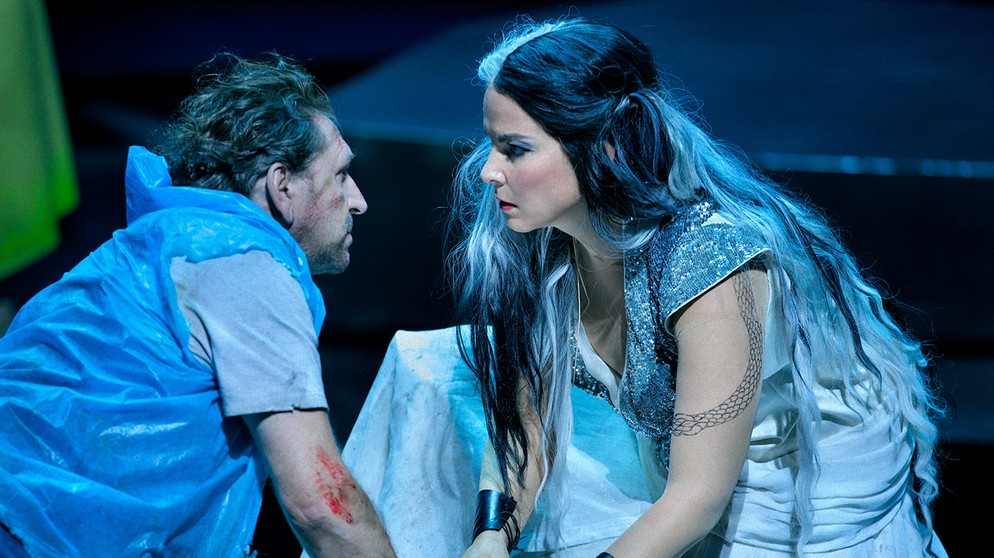
By now, we are probably all familiar enough with Krzysztof Warlikowski's bag of tricks to have some idea of how his opera productions are likely to play out. They are almost always willfully subversive of the stage directions, imposing a period updating on them, usually relating to whatever movie is currently popular or indeed willfully subversive, such as David Lynch or Nicolas Winding Refn. Pasolini's Salò too is often a favourite for opera directors, not just Warlikowski. The question is whether his approach is ideally suited to the tone and themes of the opera or whether it brings anything new out of them, but often it can be surprisingly effective. I'm not convinced that the directness of Verdi works from this kind of overly elaborate approach, even in a work as emotionally complex as Don Carlos, where I felt Warlikowski was lost for ideas. In the case of his Macbeth for Salzburg, it has the disappointing and for this opera the somewhat unfortunate effect of rendering it essentially bloodless.

Ordinarily, failing to live up to Verdi's dark tone for Macbeth would be almost fatal, but there are some compensations here. Up until relatively recently it was a largely neglected Verdi opera, particularly in the UK where it was considered lacking the depth and poetry of Shakespeare, too condensed into little more than the sound and fury of the play. Now it can be recognised for the magnificence of its set pieces and the musical attunement to the work's dramatic power. It's the consummate blood and thunder Verdi opera, one that also provides great roles and arias, notably for Lady Macbeth, and a famous chorus in 'Patria oppressa'. If nothing else, the greatness of those elements remains apparent in the Salzburg production, although muted slightly by the musical and stage direction.

Warlikowski chooses to align this production of Macbeth with Pasolini's film Edipo Re (Oedipus Rex), both in term of its visual look and period inconsistency, as well as using it as a way to delve into the underlying psychology for the murderous couple deriving from their inability to have children. This is hinted at in Shakespeare's drama but never made explicit (although many productions have similarly explored this angle). Lady Macbeth is shown visiting a gynaecologist in similar period costume to the framing 1920's Italy of Pasolini's Oedipus Rex, and being told she will never have children. That film is also referenced explicitly in a clip of a mother breastfeeding her baby. This presumably is the suggestion for Macbeth's murderous campaign against any successor, incited by jealousy and fear of being supplanted at the breast by his or indeed any child. It's an idea certainly, but whether it holds up in terms of Shakespeare or even Verdi's version of Shakespeare is debatable/doubtful.

Krzysztof Warlikowski retains the 1920s imagery for the main part of the production design, giving it also something of the feel of the Godfather or a 1930s' Hollywood gangster movie. Mixing periods, a widescreen television is used for Macbeth's viewing of Edipo Re (setting off his fear of a successor), which could stand in for a projector, although no effort made to make it look so. Live projections and filmed segments are of course used (a still photo from the production shows Pasolini's The Gospel According to St. Matthew is also referenced, but I didn't see this while viewing the production from the online steaming) and this is effective not just for showing behind-the-scenes views like the killing of Duncan, but helping lay the psychological groundwork and set mood. It's a dark mood certainly, but all of the suggestion and explicit explaining avoids a more direct and dangerous bloodletting drama, and the murder scenes of Duncan and Banquo consequently fall rather flat.

I'm not sure what to make of the weird sisters chorus in this production either. A mix of women in dark sunglasses and children wearing sinister masks, they seem to hint at a more radioactive doom for no apparent reason. The banquet scene for the appearance of the ghost of Banquo is more effective, the period used to establish Lady Macbeth like a vampish singer in Hollywood movie night club. Macbeth's breakdown is effective as he reacts to a balloon where he has unconsciously drawn Banquo's face, although its impact on his high society guests less apparent. Serving up a dead child at the climax of breakdown hits the mark however, and this becomes a running theme, with children in masks continually haunting Macbeth.

This leads to an unconventional approach to 'Patria oppressa', which becomes less about a downtrodden and despairing people rising up against the horror that Macbeth has inflicted upon a nation but is tied nonetheless into the obsessive idea of total genocidal destruction through its connection to the murder of Macduff's family. The chorus remaining offstage, replaced by about 20 children of Macduff dressed all in white underwear, who all partake of a drugged drink passed around by their mother to end their lives. Macduff's despair is somewhat heightened then - 'Ah, la paterna mano' suitably heartfelt and expressive in Jonathan Tetelman's delivery - as the bodies of the innocents are laid out. It's certainly effective as such, but some might think this traditional highlight of the opera has been underplayed.

A lot of the impact being dissipated is I feel partly due to the large size of the Grosses Festspielhaus stage. Warlikowski is partly forced to fill the large space with projections and supernumeraries, but Macbeth is an intense intimate drama that doesn't scale up effectively. Or not here in any case. Verdi's music often makes up for such failings, but filling in for an unwell Franz Welser-Möst, Phillippe Jordan's conducting felt a little too slick in places. Although the drive and impact was effective in the key scenes, there was perhaps not enough unbridled passion in it for me, which I think is also the main failing of the direction also. 

One place where there were few such qualms was in the singing. The huge choral forces certainly filled the space in vocal presence and the principals similarly all had the personality and singing ability to make an impression. Asmik Grigorian is superb as Lady Macbeth. Along with recent performances over the last few years, particularly at Salzburg, where she has worked with Warlikowski before on Elektra she is proving to be one of the best dramatic sopranos in the world. She doesn't quite bring the full fireworks you would like for a Lady Macbeth, but I would fault the direction on that point, as her acting and singing delivery can scarcely be faulted. The same could apply to Vladislav Sulimsky's Macbeth. It's a solid performance, the passion and fear are evident when the direction is effective (the banquet scene), less so in others (the assassination of Duncan). Bass Tareq Nazmi's Banco was astonishing in his depth and lyricism. It's unfortunate that Banco is not given a greater role and is killed off too soon, but we at least were able to enjoy an excellent 'Studia il passo, o mio figlio'.

If it was a bit of struggle to connect Warlikowski's ideas, direction and production design to Verdi's opera and at the same time make it fully inhabit the stage, the production gained force as the opera progressed. The downward spiral of Macbeth and Lady Macbeth was well depicted, the murder of Macduff's family during ''Patria oppressa' hit home, as the opera made its way towards its suitably dramatic conclusion. I can't help feel that a little less over-thinking in the direction and the conducting, a smaller scale production and a little more trusting in Verdi's score would have been much more effective.


External linke: Salzburg Festival, ARTE Concert, Photographs - © SF/Bernd Uhlig

Saturday, 12 August 2023

Wagner - Parsifal (Bayreuth, 2023)

Richard Wagner - Parsifal

Bayreuther Festspiele, 2023

Pablo Heras-Casado, Jay Scheib, Andreas Schager, Derek Welton, Georg Zeppenfeld, Elīna Garanča, Jordan Shanahan, Tobias Kehrer, Siyabonga Maqungo, Jens-Erik Aasbø, Betsy Horne, Margaret Plummer, Jorge Rodríguez-Norton, Garrie Davislim, Evelin Novak, Camille Schnoor, Julia Grüter, Marie Henriette Reinhold

BR-Klassik livestream - 25th July 2023

There is obviously more than one way to view an opera, particularly so in a work as rich, abstract and enigmatic as Parsifal, but this year's new production by American director Jay Scheib for the 2023 Bayreuther Festspiele actually went as far as delivering a production where the audience watching it could see two different productions playing out at the same time. The was achieved by 'augmented reality', allowing a small proportion of the audience (330 of the almost 2,000 capacity) to see enhanced elements while the majority got the plain vanilla version. As if there could be anything 'vanilla' about Parsifal. While I can't say much about the enhanced version - having watched the non-augmented reality version (or simply 'reality' as most people know it) via a livestream, I have doubts that it could offer anything more than the regular version. And even if that wasn't particularly revelatory, this Parsifal had a few interesting ideas and some fine musical and singing performances.

It's just my opinion of course, but no Wagner opera should be exempt from the kind of restless experimentation, updating, reworking, rethinking, modernisation, whatever you want to call it that Bayreuth often exercises in their stage productions of his works. Some works appear to be more suited to this than others, some are just incoherently thought out, but often they do succeed in inspiring new ways of considering some of the greatest works of opera. Parsifal has less surface narrative than most and is often interpreted in a wide variety of ways, but there are nonetheless deep important spiritual intentions in the work that should not be neglected. But if you can find other ways to tap into this, why not try?

Wagner's music score is more than capable of withstanding any conceptual conceit a stage director throws at it, and it can be just as intriguing hearing what the individual interpretation a conductor can bring to the pace, delivery and detail of the score. If you have that and when you have a good cast, you know the work has everything it needs, and anything else that the stage director decides to focus on is a bonus that you can choose to consider or not. As far as the new Bayreuth production is concerned, the musical under Pablo Heras-Casado is. I've liked others better, but that's just personal preference and as long as the purpose of the music and its relation to the underlying sentiments, philosophy, mood and drama is maintained - which it is here - then that's the basic minimum you can expect. The singing is essential also - you simply can't do Parsifal without strong experienced voices - and looking at the cast here for the roles of Gurnemanz, Parsifal and the Kundry here, there are no worries on that account, but it's supported also by fine performances in the roles of Amfortas, Klingsor, and Titurel. There can be few complaints, if any, on that score.

The deeper message of Parsifal lies in the musical expression, and perhaps even more in the responsiveness of the listener, all of which are more expressive than the relative and deceptive simplicity of the plot outline, which you would think would not allow for any great variance - although many directors have managed to successfully find other creative ways to relate to the underlying tone of the work. One can glance through past reviews here just to see how varied interpretations can be. This long preamble might suggest that I don't have a lot to say about this specific production that I haven't said before and which hasn't been expressed better in other productions - including of course Stefan Herheim's Parsifal at Bayreuth, which I have yet to say anything about - and to some extent it's true that there is not a lot that was inspired about this new version (non-augmented reality version anyway), but it was still good enough to impress.

Leaving aside the augmented reality aspect, one way a director can choose to impose or highlight a certain crucial aspect of Parsifal or any opera work, is by the use of additional silent actors. While most of us don't see the visual overlays, we do see at least one 'invisible' figure, a kind of mirror image of Kundry, or simply 'woman'. Gurnemanz upon waking, or in his waking moments, is seen grappling in the embrace of an unknown woman during the prelude. She appears to be a holy woman, judging from the image of a saint or holy figure on the back of her shirt, or perhaps just appears that way to the devout Gurnemanz. She remains in the background in Act I, tending to the unhealing wound of Amfortas and appears elsewhere throughout the work. Is she a mirror image or expansion of Kundry? In a work where the presence of woman outside of Kundry barely makes an impression other than to lead good righteous men into ruin, Kundry's expansive presence can be extended in a work where compassion is important.

And yet, although many other productions make a powerful Kundry central to the whole ethos and philosophy of the work, that aspect is not emphasised as much, or seemingly as central to the other significant spin that the director places on the work, which is in how the Grail and the worship of the Grail is depicted here. The Grail is shown as a large purple-blue crystal, but more than its physical presence, what it important is how it is depicted as something painful, an adherence to old traditions (and religions?), that need to be cast off for mankind to be free from the weight of the past in order to achieve transcendence. This is hinted at in the second Act, where there is a connection established between the Grail and the cavern where Klingsor resides, which is the same shape and colour as the crystal in Act I. This is taken through to Act III which goes as far as Parsifal destroying the 'grail', the crystal thrown to the ground and shattering into pieces.

Although pain and suffering has always been an essential part of Parsifal, the path to enlightenment being essentially a painful journey, it's a significant departure nonetheless to actually destroy the Grail at the conclusion. Yet somehow this doesn't really achieve the redemptive quality of the work that you expect, but there is clearly an effort made to tie it in with the transformative impact that all the principal figures - and even secondary ones - undergo. Personally, while the set design is at least wholly sympathetic to the work, I think the fine singing is key to bringing this together as successfully as it does. Act I at least has all the beauty, agony and magnificence you could hope for and expect, laying the seeds for what it proposed in the subsequent acts. The set is open and spacious, simple and abstract - a pool, a platform/bed/coffin, a high steel pillar and a circle of light that rises to fill the stage with light during the transubstantiation offering (this one very reminiscent of a Catholic mass communion processional), but it's Amfortas's pain and the performance of it from Derek Welton that hits the mark.

Act II is much more exotically coloured and lit than is usual for the garden of the flower-maidens, appearing genuinely enchanted (and I imagine even more so in the AR version) but again, what really brings it to life is the singing. The struggle between Klingsor and Kundry as he exerts his power over her is excellent, mainly on account of the performances and singing of Jordan Shanahan as Klingsor and Elīna Garanča as Kundry. Andreas Schager has a key role to play as Parsifal of course, and does so with characeristic intensity in this act. Building on the view of the Grail that this production takes, poor Sir Ferris exists as here as a blood splattered dummy in the background while Kundry attempts her seduction of Parsifal. Parsifal is moved to rip out his heart out and compare it to a stone, as he reflects on his failing to recognise what has prevented him from understanding Amfortas/The Saviour's suffering for our sins and begin the search for redemption. Schager makes it feel real and is matched by Garanca's expression of Kundry's torment. It's hard not to be won over, even if there is little that is new expressed here.

I can't say I've ever seen a production of Parsifal that matches the description stage directions for Act III as "A pleasant, open spring landscape with a background of gently rising flowery meadows". More often it looks more like a post-apocalyptic landscape. Here indeed the stage is dominated by some monstrous looking rock crushing truck that houses Gurnemanz, and by a crater in the centre of the stage that doesn't look much like a holy spring. The rock crushing extends then to Parsifal's destruction of crystal, ending the worship of the Grail and the ways of the past. This is also the idea emblazoned on the back of the shirts of Kundry and Parsifal, the former saying 'Forget Me', the latter 'Remember Me', the two of them united in the holy spring. Even Gurnemanz embraces his shadow Kundry. It would seem to have little to do with Wagner's idea of redemption, but it is impossible nonetheless not to be moved by the extraordinary beauty and majesty of this work and what it achieves across four hours.

That at least is supported by truly impressive singing performances and an outstanding chorus. Georg Zeppenfeld is his usual solid impressive Gurnemanz, with grave, clear intonation and authority. Andreas Schager sings with such intensity that he inevitably show a little bit of strain. Elīna Garanča makes her debut appearance at Bayreuth, but I've seen her sing the role of Kundry in an ambitious production of Parsifal at Vienna in 2021 (which interestingly doubled the role of Parsifal as they do with Kundry here). She is even more impressive here and takes the curtain call at the premiere of this new production to deservedly thunderous applause. Pablo Heras-Casado is warmly received for a consistent measured performance dramatically attuned to the stage, that nonetheless (although limited to the sound mix on the livestream) I thought sounded a little lacking in detail in places. There was inevitably a mixed reception for the production team, the louder boos trying to drown out what sounded in the main like welcome applause.

This was not a great production though. Depending on your view it fails to make the essential point of the work or you could think that it finds its own roundabout way around to it, but it has moments that are successful and it looks suitably impressive. Like many of the recent Bayreuth productions however it feels like a kind of halfway house between the extreme much-maligned but fascinating excesses of the last decade and a more traditional production that at least touches base with the original stage directions. The new developments like the use of AR here - which I've read about subsequently and it seems genuinely interesting if a little overdone (reminding me of an initial misguided and eventually rejected idea to do something similar in Robert Dornhelm's greenscreen experiments for his film version of La Bohème way back in 2006) - are welcome, showing a willingness to still trying to extend the word, the music, the significance and the legacy of Wagner into the future while at the same time trying not to lose the traditional unadventurous audience who expect something more respectful or reverential.


External links: Bayreuther Festspiele, BR-Klassik

Tuesday, 8 August 2023

Josipović - Lennon (Zagreb, 2023)

Ivo Josipović - Lennon (Zagreb, 2023)

Croatian National Theatre in Zagreb, 2023

Ivan Josip Skender, Marina Pejnović, Domagoj Dorotić, Dubravka Šeparović Mušović, Marija Kuhar Šoša, Ozren Bilušić, Kristina Anđelka Đopar, Sofia Ameli Gojić, Helena Lucić Šego, Siniša Galović, Dario Ćurić, Davor Radić, Siniša Hapač, Alen Ruško, Siniša Štork, Borko Bajutti, Noa Vlčev

OperaVision - 24th April 2023

In principle, I can see nothing wrong with the idea of writing a contemporary opera about someone like John Lennon. He was a major public figure, he made a huge impact on a generation of youth and left an indisputable musical legacy with the Beatles and as a solo artist that is still important and influential today. Or perhaps he really was a fake, as his assassin Mark Chapman believed when he shot him on the 8th December 1980, not that that is any reason for killing him. Either way, there is an interesting subject with several aspects of John Lennon's life and his relationship to music and social change that could be explored here through the inherently dramatic form of music theatre.

Composed by former Croatian President Ivo Josipović and premiered in 2023 at the Croatian National Theatre in Zagreb, the early signs unfortunately are not a good indication that Marina Biti's libretto is going to delve too deeply into those contradictory viewpoints of a man who certain divides opinion. The opening scene for example goes straight to Chapman's shooting of Lennon on a New York street, where Lennon and Yoko Ono are here seen walking around among the people singing "Sky, swimming in the sky, swimming in the sky, Sky…". They are distracted by a shout of "John! John!" by a baseball hatted figure carrying a gun and a copy of The Catcher in the Rye. The music similarly follows predictable, repetitive patterns, suggesting that it's going to find it difficult to break out and show some new ideas from here on.

So where does the opera go after killing its lead character in the opening scene? Not in flashback, as you might think, or at least not in any conventional way, but in the feverish rush of the impressions of the past life of a dying man. Which you think should at least be an interesting way of exploring those contradictions of a life lived looking back with regret for opportunities missed or mistakes made. If only the libretto was capable of expressing this in a thoughtful way rather. The second scene however has a ghostly John in confusion about what has happened, uttering banalities, ("Am I in the sky?, Unthinkably high?, Or in the deepest deep of the sea? Am I awake or asleep? Am I a captive? Can I break free?") while Chapman (in Lennon's dream?) similarly barks out broad declarative justifications against "this self proclaimed Christ" "the fakest of kings on the fakest of thrones", "I killed you, I killed you, John I did, I did, I killed you, l killed you. I'm not sad... John is gone."

The remaining scenes take in what led up to John death in a rather random fashion, revealing little about the man or any motives Chapman might have had for killing him other than trot out the old cliché of "we are not all that different, me and you". Throughout, he remains haunted by visions of Chapman wanting to ensure his reputation is destroyed, dragged down underground, preventing him presumably from swimming in the sky? It is more of a post-death or pre-death (double) fantasy or musical fantasia. In principle, this could be a more interesting area to explore than trying to merely present a literal retelling of events, instead becoming a meditation on John Lennon's death and "afterlife" as a martyred musician. In practice - a preceding scenes have shown - the libretto isn't strong enough to delve that deeply.

It does at least manage to keep an effective flow as significant figures from Lennon's life arise to sympathise or berate him. He meets Stu Sutcliffe on the other side, in the house of light, the two of them mediating on how much they suffered. May Pang and Yoko have a tango a tre while John suggests giving peace a chance. "He liked the idea of revolution. He wanted peace but also change. Though sometimes such things can be hard to arrange". Mimi, the aunt who brings him up after death of mother appears, regressing Lennon to "want to be a child again" and state "Can my mummy not be dead?". Paul McCartney appears, offering to be a friend, Julian on the other hand begrudging of his father's lack of attention to him.

As unrevealing and uninspired as this approach to exploring the life of John Lennon is, it is also weirdly hypnotic in the music and in the stage production that plays up the otherworldly aspect of this death masque. Lennon, the principal singer and various multiple incarnations of him, is dressed in white, as are most of the other haunted chorus who guide him through these last moments of his life. The chamber orchestra conducted by Ivan Josip Skender is driven by piano and percussion, but capable of delivering otherworldly shimmering strings that build tension despite the failings of the libretto. 

The set designs by Ivan Lušičić Liik are impressive, with moving blocks and scaffolding framework shifting according to the flow of Lennon's wandering mind and the needs of the scene. The costume design is also effective even if older men look ridiculous in mop top wigs and collarless Beatles suits and the stage action, populated by a large chorus and numerous walk on figures well choreographed. The director Marina Pejnović does as well as can be done within the limitations of the drama and weak characterisation she has to work with in the libretto.

And unfortunately all efforts of the principal cast including Domagoj Dorotić as Lennon and Ozren Bilušić as Chapman to make something more of Lennon - and get to grips with some mangled English enunciation - prove futile while the intentions and purpose of the opera remain rather opaque. It gets rather meta when John decides to get everyone together and make an opera of it all, only for it to get taken over by Yoko Ono (an excellent Marija Kuhar Šoša) proclaiming that she is the star soprano. The injection of a little bit of self-referential humour in the production helps, but fails to redeem it.

Lennon remains an interesting idea with a novel approach to its subject - although not all that novel really since the meta-opera post-death reflection is also attempted in Fafchamps Is This The End? as well as Georg Friedrich Haas's Morgen und Abend - and there is surely something more Orphic that could have been done here with a musician in land of the dead situation. Lennon however seems to have similar failings to Is This The End? through a weak English libretto written by a presumably non-native speaker of the language. Stefan Herheim also showed in his astonishing reconstruction of La Bohème what can be done when you have a work strong enough to support such conceits, but Lennon unfortunately is devoid of any such poetry, insight, character or meaning.

Saturday, 15 July 2023

Handel - Orlando (Buxton, 2023)


George Frideric Handel - Orlando (Buxton, 2023)

Liberata Collective, Buxton International Festival, 2023

Adrian Butterfield, Christian Joel, Joanna Harries, Olivia Doutney, Susanna MacRae, Jolyon Loy

Pavilion Arts Centre, Buxton - 10th July 2023

Although I'm very much in favour of modernising and keeping opera productions relevant and meaningful to a contemporary audience, I'm not opposed in principle to historically informed productions. Like any production, it's how well it's done and how much it is in service to the work that counts, and if either approach means that you just get to hear more from Handel and other baroque opera composers - particularly with period instruments - then I'm all for it. The Liberata Collective certainly put an interesting spin on their production of Orlando for the 2023 Buxton International Festival by staging it in the authentic Baroque Gesture style.

I've never seen a Baroque opera performed in the style of the period, other than Pierre Audi's rather dull historical versions of Tamerlano and Alcina, so it was hard to know what to expect. With Baroque Gesture, there are strict guidelines on posture and stage position that might not even really be evident to a modern audience, but the acting and exaggerated signifying hand gestures risk being appearing mannered to a bemused audience rather than informative. Or silly even if it turned out to be anything like the odd period style acting I witnessed at the Opéra Royal de Wallonie, Liège's 2013 production of Grétry's Guillaume Tell, which was something of an acquired taste to say the least. On the other hand, if the period acting turned out to be as revelatory as hearing such early opera works performed using period instruments, this Orlando would be of great interest to anyone looking for as authentic a performance of Handel as possible.

And in some ways it was, although perhaps more for academic interest than for bringing out any other newly rediscovered dimension out of Handel's Orlando. The Liberata Collective helpfully provided a booklet with the kind of gestures to expect to see on the stage as well as and what they mean, and also gave some historical background on the practice. Since this opera would have been performed in the original Italian on its original performance at the King’s Theatre in London on 27 January 1722, surtitles would obviously not have been provided, but a translated libretto would have been handed out. The audience would also be familiar with the gestures operating like signifiers or pointers to what is being described on the text. So lots of swooning and pointing to the heavens, but the mannerisms are there just as much to serve the function of dramatic style and expression.

And, if this Orlando is anything to go by, they do hold the attention in a 'look at me, look at me!' kind of way, although translations displayed to the screens at the sides of the stage may have distracted from a focus on the performers and the gestures now and again. You could look at this as the best of both worlds, as there were moments to enjoy in the gestures and the performances as well as in the English translation without too much being compromised.

Orlando however is not the most exciting episode in Ludovico Ariosto’s epic poem Orlando Furioso, nor indeed the most interesting of the three Handel operas based on the work. To compete with the magic enchanted isles of Alcina and the romantic medieval melodrama of Ariodante, Handel even introduced the characters of Dorinda and Zoroastro, neither of whom appear in the original work and, unlike many of the works he created when he moved to England which reused elements from earlier works, composed entirely new music for Orlando. Nonetheless, it's still a challenge not just to hold attention as really invite you to care about the romantic drama going on on the stage. 

The premise in Orlando is laid out at the start. Zoroastro, unhappy about the complicated and unresolved love drama going between the Orlando, Angelica the Princess of Cathay, the prince Medoro and the shepherdess Dorinda, casts a spell on the knight to turn him away from effeminate love and get back to doing what he is best, which seems to be being prone to fits of madness and violence, taking up a sword and slaughtering Saracens in the Crusades. Thereafter, both women and Medoro are left rather confused about Orlando's attentions and quite keen to get away from him, until Zoroastro relents and brings him back to his senses.

The focus may be on gestural expression, but the production doesn't fail to recognise that nature also features in the libretto and suggests another dimension to the work. Two laurel trees decorate the stage indicating the bucolic setting, but the focus on nature and what it says about the nature of man is not emphasised or explored quite as successfully as it was in the direction of Mozart's Il re pastore which ventured deeper into that territory the previous evening at the Buxton International Festival. There's an interesting comparison to be made on the respective approaches to this kind of Baroque opera, and one wonders whether the Mozart would have gained anything from a Baroque Gesture style performance. As it is, each opera worked in its own terms, but it shows that for all their superficial simplicity there are many ways to bring out deeper aspects from such works.

Here of course, with Adrian Butterfield directing the Ensemble Hesperi from the violin and with the use of period instruments, the emphasis was on the quality of the music of Orlando and its ability to carry the dramatic intent of the opera. And being Handel of course, it's absolutely beautiful. With the small ensemble to the right of the stage, it was more than enough to spring this work into life. There was some fine singing as well from Christian Joel singing countertenor as Orlando, and Jolyon Loy's drop-in appearances as Zoroastro had the necessary impact. Despite the gestured mannerisms and the sometimes playful bemused response to Orlando's conflicted emotions, the quality of the performances of Joanna Harries as Medoro, Olivia Doutney as Angelica and Susanna MacRae as Dorinda all commanded attention. 

Attention is vital in Orlando, to feel involved in the drama and what the music brings to it. If there is one aspect that Baroque Gesture brought to this, it's some indefinable sense of balance and movement. The entrances and exits felt natural and timely, adding a sense of order and structure that suggests that this lost art is an essential element of Baroque opera. Everything felt in its right place to the extent that when Zoroastro steps in and repairs the harm that Orlando has done, it doesn't feel quite as much the deus ex machina that Baroque opera can often provide. That is something that Il re pastore could possibly have benefitted from, but each had their own merits in an excellent Buxton programme. I would have loved to have seen their production of La Sonnambula as well, but sadly missed that due to a very long flight delay on the way over to the festival.


Links: Buxton International Festival

Thursday, 13 July 2023

Mozart - Il re pastore (Buxton, 2023)


Wolfgang Amadeus Mozart - Il re pastore

Buxton International Festival, 2023

Adrian Kelly, Jack Furness, Katie Coventry, Ellie Neate, Olivia Carrell, George Curnow, Joseph Doody

Buxton Opera House - 9th July 2023

There is no good or bad when it comes to Mozart's opera works - or any Mozart really - just compositions that you can characterise as youthful work and mature work. Idomeneo and Die Entführung aus dem Serail maybe blur those lines a little, but the works on either side are certainly distinct. Not better or worse, just the work of a composer who consistently developed and found his own voice and expression with each piece. But even Lucio Silla, La Finta Giardiniera and Mitridate, Re di Ponto (written at the age of 14) are accomplished works that have proven their worth in intelligent sympathetic productions. So even though Il re pastore, is somewhat of an unknown quantity for me, there was the assurance that since its Mozart and in the hands of the Buxton International Festival, it was still going to be worthwhile.

And sure enough the 2023 BIF production confirms that this is no lesser work, and in fact might be all the more impressive for having been composed when Mozart was only 19 years of age. It's impressive also for making light work of a Metastasio libretto, which can often be quite tortuous in their plotting and rather obvious in their progression to a conclusion of conventional sentiments and moral messaging. Even the title of the opera (The Shepherd King) almost tells you everything you need to know about this opera; that it's about a king or ruler who makes mistakes - mainly in terms of who he chooses to form romantic couples (not least because not everyone is who they appear to be) - but eventually comes to see sense and rule with clemency, forgiveness and understanding. There is however a little more to Il re pastore, mainly due to how the youthful Mozart delves a little deeper into this idea and brings its characters to life.

The actual detail of the plot is very much along typical Metastasian lines, although perhaps a little less convoluted than usual. Alexander the Great/Alessandro, has just conquered Sidon which has been ruled by a tyrant, and wishes to restore its rightful ruler to the throne. He discovers that a humble shepherd Aminta, who has ambitions to marry Elisa, a woman he believes is above his station, is in fact the heir to the throne and unaware of his heritage. Despite being reluctant to leave the happy life of a shepherd, Agenore convinces him of the importance of duty taking precedence over love. Rather than depose the current queen Tamiri, Alessandro however decides that Aminta should marry her, unaware of her love for Agenore. Oh, what a foolhardy judgement! This causes a lot of anguish and recrimination in the third quarter of the opera, the second having been filled with sentiments of love and devotion for each other. Hopefully someone with sense and wisdom will resolve all this by the conclusion…

Admittedly it's not the most inspiring of tales. As predictable and as conventional as the plot is, a carbon copy of many other operatic situations dealing with rulers and the exercise of power wrapped up in a romantic melodrama, there is a little more to Il re pastore, or at least more that Mozart manages to bring to it. There are elements in the libretto relating to nature that are enhanced by Mozart's music, that elevate the work considerably. Those qualities might still go unnoticed here other than for the sympathetic production direction of Jack Furness. The set design consists almost solely of bucolic background video projections of gently flowing streams, green fields, hills with sheep and horses and vistas of skies. Nature is brought very much to the fore, so that when Agenore tells Aminta that you can't rule over others if you can rule yourself, it associates that necessity for a ruler to exercise wisdom and clemency with the importance of understanding of one's own true better nature.

That is a subject that Mozart is inclined to explore in almost all of his operas, with the exception perhaps of Don Giovanni, although there is a similar case that can be made for that. While it is fascinating to hear a youthful early work by Mozart begin to explore those ideas and find musical expression for them - albeit owing more to Haydn here than the sophistication of later works - the work has its own charm and the skill is evident in how the music is employed in service of this underlying idea of nature. Even on the level of simple arrangements and structure, the music flows beautifully, the recitative passages and da capo are kept to a minimum - at least in this production - allowing the opera to lead from one beautifully melodic aria into the next, where each character is given the time to explore and express their true nature.

That is brought out also in the minimalist and deceptively hands-off nature of the production. The director, Jack Furness takes time to ensure that each of the characters have the opportunity to express themselves, the women in particular being rather fiery in nature, creating some entertaining exchanges that play to the dynamic of the central part of the work. He also stages the moment when each of the protagonists become aware of Alessandro's misguided intentions for their marriages by having them appear on the stage reading a missive and reacting in horror and despair. At every stage the sentiments are attuned to the music, sometimes playful, sometimes darker - but never too dark - and despite the overwrought nature of some of the scenes, never employing farce or stooping to make light of it.

Mainly however, it's left to the projections behind a bare stage to play out in accordance with the music and those underlying sentiments. There's multiple-angle footage of a gently flowing stream while words of love and commitment are expressed, a battered stone tower looms over a vista of hills and lakes for Alessandro, each of the chosen screens subtly alerting the audience not so much to the nature of the wider world surrounding the characters but more an insight into their inner world. It serves also to bring out that essence of nature that is suggested in the libretto and title, that a Shepherd King is needed to look after his flock. And even in a world where we are no longer ruled by kings, the underlying idea in Il re pastore of the danger of rulers out of touch with ordinary people and detached from their own true nature is one that is still relevant.

And one that is very much in evidence in the music. The musical performance of this early Mozart opera was an absolute delight, as it always is when you hear Mozart played with a lightness of touch by a smaller chamber ensemble. Adrian Kelly, conducting and providing accompaniment for the recitative on fortepiano, navigated the Northern Chamber Orchestra through the work, alert to the subtle changes of expression, creating an authentic period-like sound. Bright, youthful voices are essential for this kind of Mozart work and, sung in the original Italian, the singing performances were uniformly excellent in their handling of some challenging arias. The most entertaining performances came from Ellie Neate's Elisa and Olivia Carrell's Tamiri, both playing up the betrayed women roles that Mozart would specialise in with Don Giovanni. Katie Coventry's trouser role of Aminta was perfectly judged, Joseph Doody commanding as Allesandro and George Curnow brought great character to Agenore.

No one is going to reclaim Il re pastore as a neglected work, but even the earliest of Mozart's operas have a certain charm and beauty that deserves revisiting and exploring. Thankfully that's what the Buxton International Festival is rightly renowned for, and Adrian Kelly and Jack Furness take that opportunity in this production to show that this is a work that has more than just curiosity value.


Links: Buxton International Festival