Showing posts with label Franz Welser-Möst. Show all posts

Thursday, 13 August 2020

Strauss - Elektra (Salzburg, 2020)

Richard Strauss - Elektra

Salzburger Festspiele, 2020

Franz Welser-Möst, Krzysztof Warlikowski, Aušrinė Stundytė, Tanja Ariane Baumgartner, Asmik Grigorian, Derek Welton, Michael Laurenz, Tilmann Rönnebeck, Matthäus Schmidlechner, Sonja Sarić, Bonita Hyman, Katie Coventry, Deniz Uzun, Sinead Campbell-Wallace, Natalia Tanasii, Valeriia Savinskaia, Verity Wingate

ARTE Concert - 1 August 2020


Back in 2013, Krzysztof Warlikowski set the Munich production of Richard Strauss's Die Frau ohne Schatten in an asylum. That's not a particularly original way to deal with such a wonderfully colourful and rich fairy-tale, but it remained largely effective through the power of Strauss and Hofmannsthal's extraordinary vision, with its psychoanalytical undercurrents that Warlikowski was careful not to dilute with too many distractions or modernisms. If there's ever a Strauss opera that deserves to be set in a mental institution though it's Elektra, where the mental disintegration of its lead figure as scored by Strauss is even more extreme than that of the preceding Salome (also recently reworked by this director). Warlikowski doesn't explicitly set this 2020 Salzburg production of Elektra in an asylum, but for all the aberrant behaviour on display in the House of Atreus, it might as well be.

As is often the case it's difficult and usually not particularly instructive to deconstruct Warlikowski's intentions or examine too closely how they align with the themes of the work in question, particularly when he goes overboard in cinematic references such as in the recent production of The Tales of Hoffmann. Some of the director's familiar mannerisms are there in the Salzburg Elektra, but mainly evident only in the set design of his partner and regular collaborator Małgorzata Szczęśniak. They take full measure and width of the Felsenreitschule venue in Salzburg to create a huge (socially distanced) space for the work, much wider than the usual claustrophobic set usually reserved for this intense work. If there's a method to this, it can only be to rise to the scale of the orchestration itself, and in terms of that and Franz Welser-Möst's conducting of the Vienna Philharmonic, it certainly gives full expression to the opera's immense forces.

One side of the stage does indeed have the look of a rundown asylum, with a long narrow communal bath and row of showers with rust stained steel walls on Elektra's side of the House. The water from the shallow pool causes flickering reflections that highlight and suggest the constant uncontrolled agitation of Elekra's mind over the murder of her father Agamemnon and her desire for vengeance upon her mother Clytemnestra. The other side of the stage holds a glass panelled interior room of the palace where Clytemnestra and her maids are bathed in blood red lighting, Warlikowski using video cameras to project what goes on inside. In its totality the set effectively creates an environment that simultaneously reflects the internalised emotions barely controlled by external appearances.

Other than that Warlikowski sticks fairly closely to the ample expression that is already there in the music with few of the distractions or diversions that you usually find with this director. There is an autopsy, a few stray figures who wander dazed onto the stage, some dummies of children, but there are no dancer interludes and no short film introduction, although the scene is set with a recital of backgrounding text before the opera starts. With the spirit of Agamemnon made present, it's clear then that the director wants to bring motivation and characterisation to the fore and, aligned with the score, it's impossible not to feel Elektra's pain on a deep and visceral level which, without taking away from the quality of the poetry and the psychological depths explored, is surely where opera is most successful and notable.

Crucially, you can't really achieve that level of dramatic intensity without an Elekra to match it and, well, there was little doubt that on her recent performances of growing power and intensity, Aušrinė Stundytė would be capable of measuring up to it. It's an outstanding performance, the Lithuanian soprano as ever almost completely immersed in character (to be completely immersed would surely be next to madness). But a damaged Elektra can't work in isolation. Warlikowski takes care not to present Clytemnestra as a domineering caricature and sung by Tanja Ariane Baumgartner, we see a more troubled and not unsympathetic figure who has been a victim of circumstances, but still very dangerous. Asmik Grigorian also permits you to have some sympathy for the usually wet Chrysothemis, the force of her delivery undoubtedly contributing to the success of that characterisation.

Make no mistake however, violence, madness and death are the inevitable outcome, deliriously unravelled in Strauss's extraordinary score and put into words in Hugo von Hofmannsthal's very distinctive and poetically rich spin on Sophocles' version of the Greek tragedy. For all the beauty of the language, it distills the essence of the drama down into the big questions and conflicts of life and death, hatred and love, family bonds and debts of honour, irreconcilable extremes that descend into madness and death. Krzysztof Warlikowski effectively visualises that violent climax with large scale projections of splattered blood and masses of flies. Whether you follow it or just feel it, the Salzburg production as a whole certainly succeeds in doing justice to one of the greatest opera works of the 20th century, still capable of leaving you almost breathless and in shock.

Links: Salzburg Festival, ARTE Concert

Friday, 3 August 2018

Strauss - Salome (Salzburg, 2018)

Richard Strauss - Salome

Salzburg Festival, 2018

Franz Welser-Möst, Romeo Castellucci, John Daszak, Anna Maria Chiuri, Asmik Grigorian, Gábor Bretz, Julian Prégardien, Avery Amereau

Medici.TV


There comes a point in a Romeo Castellucci production when you wonder if it's worth the effort trying to make sense of it. It's not that they don't have meaning and value, Castellucci's productions are original, striking and do often find a new way of looking at a familiar work, but there are strange elements within that defy any attempt to pin them down or directly relate them to the works in question. Even when the director provides you with some pointers of where he is coming from, you can't always follow where he is takes it. Ultimately however, it fits or it doesn't, it will work for some and not for others. His Salzburg Festival production of Salome presents the same issues and is likely to similarly split audiences.

Salome for Salzburg is typical Castellucci in that respect at least. Some of the director's familiar techniques and obscure images are in there, but the production is not just a rehash of familiar tricks and tics, and - unlike a director with a singular vision like Robert Wilson for example - he doesn't try to force each opera to fit into their distinct worldview, but rather approaches it on it own terms, even if there is sometimes a similar visual aesthetic. This production is very much a response to Salome, even if inevitably it doesn't entirely match the familiar imagery and stage directions that we are accustomed to expect on some level with this opera, and even if it can appear somewhat obscure and occasionally even baffling.

In fact, rather more than most directors who take a work on its own terms, Castellucci is also known for taking the location into consideration and making it part of the production. Not that you really have much choice when it comes to the Felsenreitschule venue in Salzburg, an open air riding school carved into the very rock of the city. There's a reference here then to a Latin inscription carved above the nearby Sigmundstor or Neutor Tunnel 'Te Saxa Loquuntor' ('The Stones are talking of you') that Castellucci employs as a distinctive way to consider the work in terms of its Salzburg production, but what it means is anyone's guess, and easier to describe than interpret.


The location itself is of course spectacular in its own right, even if it's just for scale and atmosphere. The arcades are actually blocked off here to form a more solid surrounding wall, with openings used occasionally for entrances, exits and props. If nothing else it gives 'presence' to the flow and decadence of Oscar Wilde's original text and the taboo-breaking nature of the content that is in line with the employment of Strauss's musical forces. The detail of the composer's attempts to account for the line-by-line control of mood and subtext is where Castellucci perhaps has more of his own personal views and ways of presenting it.

You expect eccentric touches and they are most obviously there with the lower half of everyone face painted red. Everyone that is except Herodias, who is painted green for some reason and Salome, whose face is not painted, but who is marked out in contrast to everyone else by her virginal white appearance. Virginal is very much suggested by the opening scene before the music starts, showing her as little more than a child - whether it's a flashback or a suggestion of her real age is unknown - who cuts through the veil that presents the Sigmundstor Latin inscription. The back of Salome's dress when she appears in the opera appears to be stained with menstrual blood. If it was any other kind of blood, I think we'd know about it from the production and her protective and vocal mother Herodias might have had something to say about it.

The other significant person in the work of course is Jokanaan, or the prophet John the Baptist, whose voice does indeed appear to talk of you from the stones (Te saxa loquuntor), imprisoned below the floor in a cistern. His face is painted black, making his first encounter with Salome very effective indeed; she slight and delicate in white, eclipsed by the dark, wild, primitive and almost bear-like mass of Jokanaan, a man who had lived in the wilderness. Indeed there is an eclipse of sorts, with a huge black circle that overwhelms and enfolds their first encounter. Reinforcing his wild erotic presence, a live horse can be seen rearing out of the circular pit that holds him. So far so much is mostly just giving emphasis to the forces at work in the opera, forces that are most definitely there in the sinister, sinuous, beautiful and violent music, the Vienna Philharmonica well conducted through that variety of moods and colours by Franz Welser-Möst.


The other strange and confusing touches in the production relate to and contrast with how we expect to see the more iconic scenes of the work. During the Dance of the Seven Veils, Salome doesn't actually dance (heaven forbid that Castellucci should be so literal), but instead she kneels head down semi-naked on a plinth with the word SAXA written on it, while a block of stone is lowered 'crushing' her beneath it. Feel free to interpret that how you like. Instead of Jokanaan's head being presented on a silver charger, we have Jokanaan's naked decapitated full torso, with the head of a horse (presented as a first appeal to Salome to change her mind) left beside it in a shallow pool of white liquid. As far as taboo-breaking goes, you would expect an animal head to have additional shock impact and hint at illicit desires - which you should really be aiming for at the conclusion of this opera - but neither the thunderous cacophony of the closing notes nor the staging really make the necessary impact here.

That perhaps doesn't matter as much when the performances have been intense elsewhere throughout (although I do think that the impact of the conclusion should be viscerally felt). Asmik Grigorian certainly carries the kind of soaring intensity that the opera's Salome ought to have, reaching the luxurious heights and the depraved depths of the work. Herod and Herodias can sometimes be given to older singers just past their prime, but that's not the case here with John Daszak and Anna Maria Chiuri. Daszak isn't ideal but does carry a suitable haunted quality. Chiuri is spectacular, giving this Herodias a lot more input than usual. Gábor Bretz is not the most sonorous Jokanaan, but again his presence is felt. I'm not sure that Castellucci has any great vision for the work or the characters, but he certainly gets to the heart of their natures, working with the opera and the location to bring his usual unique qualities and intensity to this Salzburg production.

Links: Salzburg Festival, Medici.TV

Sunday, 19 February 2017

Strauss - Die Liebe der Danae (Salzburg, 2016)

Richard Strauss - Die Liebe der Danae

Salzburger Festspiele - 2016

Franz Welser-Möst, Alvis Hermanis, Krassimira Stoyanova, Tomasz Konieczny, Norbert Ernst, Wolfgang Ablinger-Sperrhacke, Regine Hangler, Gerhard Siegel, Pavel Kolgatin, Andi Früh, Ryan Speedo Green, Jongmin Park, Maria Celeng, Olga Bezsmertna, Michaela Selinger, Jennifer Johnston

ORF2 - August 2016

"All that glisters is not gold", Shakespeare tells us in 'The Merchant of Venice', and the distinction is a relevant one in the case of Strauss's treatment of the King Midas myth in his late opera Die Liebe der Danae. Even though the opera was developed from an idea by Hugo von Hofmannsthal and is scored to some of Richard Strauss's most gorgeous and extravagant musical arrangements, the resulting work lacks the depth of their earlier collaborations, lacks an edge and does feel a little out of touch with the realities of the changing times in which it was composed. And yet, like the similarly compromised Arabella, it is not without merit, particularly if a director is able to bring something to it.

There is plenty of glitz and glister in Alvis Hermanis's production of the work for Salzburg, but not much that really taps into a seam of gold. It's all decorative, aiming for a generic fairytale look and feel with little care about whether it makes sense, and certainly not caring to look any deeper into the work for social commentary or contemporary relevance. Whether there is much to be gleaned on those levels from Josef Gregor's libretto is doubtful, but at least the Deutsche Oper production from 2011 attempted to relate the curse of Midas's gift to that of the "golden touch" of the composer, and also see the aging Strauss in terms of Jupiter's failing powers and influence in the new world. This however just feels like empty spectacle.

That in itself could be seen as a valid reaction to the piece as Der Liebe der Danae is certainly all glittery show, its lush post-Wagnerian Romantic melodic sweep as easy on the ear as the set designs are on the eye in this Salzburg production. Hermanis arranges the first two Acts as a decorative display of constant motion and changing colour, which at least reflects the musical flow of the work. That's the same principle that the director applied to the metronomic rhythms of Janáček's Jenůfa at La Monnaie, and here another parade of dancers in gold skin-tight suits are frequently present, dancing and writhing at the back of the stage.


It's not totally gratuitous then as it does relate to the dream-like quality of the music, which is itself an expression of the hopes of the bankrupt King Pollux to find a wealthy suitor to marry his daughter Danae and save him from his debtors. Her portrait has gone out to King Midas, so he has high hopes for the best possible match. Danae is also in the thrall of a dream, seeing her lover bring her gifts of gold, but it seems that those dreams might be frustrated when it is not Midas who arrives bearing gifts, but his messenger Chrysopher. Or so it seems. In reality, Jupiter is up to his old tricks, posing as Midas in order to seduce yet another mortal woman, and his messenger is indeed the real Midas.

The Salzburg production certainly gives a bold, colourful setting for this dream fairytale, its golden-red glows and exotic costumes all contributing to this effect, but it's all very random and free-associative. It's like, what's the first thing you think of when you hear this opera? Fairy tales and the Arabian Nights? Well, that's good enough, no-one is going to think too deeply about Der Liebe der Danae. This could account for the undue emphasis placed on Midas's past as a donkey driver in Syria dominating the tone and locations for Act III, the setting clearly evoking some kind of contemporary allusions for the director.

Hermanis is controversially on record for voicing his objections to Germany's refugee policy, quitting a theatre where he was contracted to work in Hamburg. Although those objections were supposedly based on fears of importing terrorism, there was a unpleasant racist tone to them that could be seen to be reflected in the caricatures of middle-eastern men in over-sized turbans and women with exaggerated breasts grasping for riches. The bottom line however is that the production is not terribly imaginative, it doesn't appear to have any consistency or purpose, and is merely static and decorative. It's certainly lovely to look at, but it doesn't really do justice to the characterisation or the treatment of mythology in the opera, nor does it manage to apply it meaningfully to any contemporary reality.

As with much Strauss, particularly those that are more Wagnerian in scope (and there are many correspondences here with the Ring), the voices and the ability to meet the singing challenges count for a lot here. The individual members of the principal cast in the Salzburg production are all exceptionally good, but there is some terrific ensemble work from the other character roles of the four kings and Jupiter's old flames Semele, Europa, Alkmene and Leda. Krassimira Stoyanova yet again demonstrates for me that she is one of most impressive singers of Strauss around today. Her interpretation and acting aren't particularly exciting - not that she is given much character to work with here - but her range, technique and the timbre of her voice are all just wonderful.


Much the same could be said about Tomasz Konieczny. I was unimpressed by his Wotan for the Vienna Ring Cycle two years ago where he had the vocal ability but a rather grating tone. Here however in the Wotan-like role of Jupiter, he combines power with superb vocal colouring. The all-important closing scenes of Die Liebe der Danae between Danae and Jupiter consequently are vividly expressed. Gerhard Siegel is certainly more lyrical in the human role of Midas, if not really a convincing rival in the romantic stakes. Norbert Ernst's cuts an appropriately bright and sparkling figure as the Loge-like Merkur, and Wolfgang Ablinger-Sperrhacke is excellent in the role of King Pollux. With a cast like this and Franz Welser-Möst conducting an unrestrained (a little too unrestrained?) account of Strauss's extravagant arrangements and melodies, it's disappointing that Alvis Hermanis is unable to rise to the heights that Strauss was aspiring to, but of course never quite reaching himself.

Links: Salzburger Festspiele, ORF2

Thursday, 3 December 2015

Beethoven - Fidelio (Salzburg, 2015 - Webcast)


Ludwig van Beethoven - Fidelio

Salzburger Festspiele, 2015

Franz Welser-Möst, Claus Guth, Jonas Kaufmann, Adrianne Pieczonka, Sebastian Holecek, Tomasz Konieczny, Hans-Peter König, Olga Bezsmertna, Norbert Ernst, Paul Lorenger, Nadia Kichler

Medici.tv - August 2015 

The 2015 Salzburg Festival production of Fidelio finds a way to bring out and emphasise the beauty of Beethoven's musical compositions for the opera, but it does so rather drastically by cutting all the spoken dialogue sections. This is a risky strategy since the work has a very important message on life, liberty and love that is contained within its drama just as much as in the music. Or does it? Is it not Beethoven's music that really carries the depths of the sentiments far above the rescue opera nature of the drama? The Salzburg production seems to confirm the impression that it's the music that takes precedence over the drama, but evidently the music and drama are intertwined and to such an extent in Fidelio that deconstruction of its elements might not really serve any valuable purpose.

Salzburg have a bit of a history with reworking familiar operas to see if a fresh approach can reveal new facets of the work. And not just in the expected manner of bringing in a director who can radically reinterpret the work. Salzburg aren't afraid to take an adventurous approach with the music and the structure of familiar works as well, such as Christian Thielemann's revelatory pared-down arrangement of Parsifal and the less successful attempt to reinstate a version of Molière's 'Le Bourgeois Gentilhomme' alongside Strauss's abandoned first version of Ariadne auf Naxos. In the case of Salzburg's Fidelio, the right director is also needed to compensate for the stripping away of the spoken dialogue, and the feeling seems to be that along with Beethoven's music, Claus Guth's probing psychological dissection of the work can be enough to get the essence of the work across, and perhaps even bring something more out of it. That's a bit of a gamble...

Musically at least, Fidelio appears to be in safe hands with Franz Welser-Möst and the Vienna Philharmonic. More than safe, the work seems to just glow with all the splendour of one of the finest works of the Classical period played by one of the best orchestras in the world. The sweep of the drama is all there, along with sensitivity for the sentiments and attention to the sophistication of the human message in the arrangements - one of the strongest expressions of the beauty and resilience of humanity outside of Mozart. Mozart's influence indeed can be heard much more clearly when presented in this purely musical fashion without the awkwardness of some of the domestic elements and dramatic implausibilities intruding. Even those however are given new life here, with even Marzelline and Jaquino's opening duet sparkling and fresh.


Viewed purely in terms of the impact of cutting all the spoken text just so that the arias, duets and quartets can be better highlighted, Salzburg's Fidelio succeeds impressively. In no small part, the quality of the exceptional casting and singing has much to contribute to that. Jonas Kaufmann sings Florestan with all the intensity combined with sensitivity you would expect, possibly a little over-projected, but clearly in anguish for his unjust imprisonment, sustained only by the love of his wife and his belief that what is right will eventually overcome evil in the world. Adrianne Pieczonka is also about as good as you can get in this role nowadays. Hans-Peter König as ever phrases beautifully with rounded depth and resonance as Rocco. Olga Bezsmertna is a bright, lyrical and passionate Marzelline, well matched with Norbert Ernst's Jacopo. I found Tomasz Konieczny's baritone lacking in colour and dynamic when he sang Wotan in the 2015 Vienna Ring Cycle, but he is a little better here as Pizarro.

If the reconstruction, interpretation and performance allow the opera to flow more beautifully on a purely musical level, it does risk making a nonsense of the dramatic content. Christian Schmidt's sets for Claus Guth's production don't even bother with a jail or even any familiar sense of captivity. The action is set in what looks like a large undecorated ballroom or anteroom which is dominated by a huge black monolith that rotates to obscure and block the way between the characters, serving also to permit entrances and exits. Light and darkness are important symbols in this work, and this is emphasised by the black dress of Pizarro and his men contrasted with the immaculate white of the prisoners who troop out for "O welche Lust". No dressing in rags here. Shadows are also significant, reflected boldly on the walls, shifting in size and solidity.

The representation of a 'shadow side' is a common psychological device used by Claus Guth, and it's extended here - also not uncommonly - to a number of doubles. The most obvious candidate for such a division is of course Fidelio/Leonora, but at least Guth doesn't or seems not to make too much of the male/female persona of Leonora's disguise. Quite how he wants to mark that division however is anyone's guess, as the silent shadow double for Leonora here seems rather to be the underlying expression of the fear and confusion (over Marzelline's interest in Fidelio) that Leonora cannot show on the surface. Quite why the shadow Leonora frantically expresses herself using exaggerated sign-language gestures isn't obvious. Nor is it clear why the fairly one-dimensional Pizarro is the only other figure with a shadow-self, and indeed he doesn't seem to offer any more insight on the nature of the evil that is already there in the character's expressions and actions.


If the purpose of Guth's concept is difficult to determine, and can't exactly be said to fill in the gaps left by the cuts to the spoken dialogue (Guth in fact introducing industrial noise sounds and amplified breathing in their place), the setting looks good and works dramatically with the characterisation. Up to a point. I daresay prior familiarity with Fidelio aids understanding of what is happening and there are a few other concessions. The duets are still there, and a lot of the conflicts of light and dark occurs there. These are also superbly played and sung for all the necessary impact. It also helps to have a projected image of Florestan during the overture as a hint of the object of Leonora's mission. It's not a bad idea either even if it's just to remind the audience who have come to see him that Jonas Kaufmann will appear, since it's a good hour and a half and into Act II before we see or hear Florestan.

It's only when we see Florestan and the state that he is in that the nature of the opera and Guth's directorial touches hits home with more of an impact. As far as the opera goes this ought to be a big deal, and Franz Welser-Möst and the Vienna Philharmonic certainly set that up the drama of the outcome in the Leonore No. 3 introduction to the finale. Quite whether Guth's direction works to the same extent or even follows the same direction is less certain. By the time we get to the Finale where the black monolith has disappeared leaving behind only a pit in the floor of the ballroom and a huge chandelier refracts light everywhere, the set starts to look more like an emotional space rather than a physical one.

If it were not already obvious, particularly with the in-between breathing and the noise, Florestan's confused, exaggerated, horrified reaction to Leonora and his 'freedom' suggests that the whole idea of the rescue - with all the implausibilities that lie within the rescue opera itself - is just a feverish fantasy of the prisoner's mind. While psychologically this is likely to be more realistically the state of mind of a tortured man left to starve and die in isolation, it is not, I imagine, exactly what Beethoven had in mind. Leonora's shock at Florestan expiring on the final note of the opera suggests a mix of subjective and objective realities, so it could be that the rescue is just too much for Florestan's weakened body and spirit to take. That ending certainly has a big impact, but the confusion of the final scene does tend to detract from the spirit of what is truly great about the work.

Links: Salzburger Festspiele, Medici

Friday, 26 September 2014

Strauss - Der Rosenkavalier (Salzburg 2014 - Webcast)

Richard Strauss - Der Rosenkavalier

Salzburg 2014

Franz Welser-Möst, Harry Kupfer, Krassimira Stoyanova, Sophie Koch, Günther Groissböck, Mojca Erdmann, Adrian Eröd, Silvana Dussmann, Wiebke Lehmkuhl, Rudolf Schasching, Stefan Pop, Tobias Kehrer, Martin Piskorski, Franz Supper, Dirk Aleschus, Roman Sadnik, Rupert Grössinger

Medici.tv - August 2014

It's probably a self-evident truth and practically a definition of opera, but perhaps more so than any other work, there needs to be a perfect coming together of all the various elements in Der Rosenkavalier. Each of its elements - not just the music, the singing and the staging, but all the other areas that are considered less important - all have their part to play in making this difficult opera work. Truly work as it's meant to. As Salzburg productions go, their 2014 Der Rosenkavalier isn't one of their most adventurous, but in almost every area it serves the intentions of the work, showing in the process just how perfect Der Rosenkavalier can be, and consequently just how miraculous the nature of opera itself can be.

Strauss and Hofmannsthal's first fully-fledged collaboration (after adapting Hofmannsthals' dramatic version of Elektra), Der Rosenkavalier is an immense but delicately poised work that presents considerable challenges in its huge orchestration, the intricacy of interplay and interaction and the demands that it places on the singing voices. Attention to these demands is necessary to achieve a very specific tone and mood, and a production can't really stray too far away from these intentions without undermining the entire purpose of the work. As it says itself, it's a Viennese farce and nothing more, but like the Mozart comedies that it is styled on, Der Rosenkavalier opens up deeper meditations on life, love, time, on the necessary but beautiful pain that comes with the passing of the old and the birth of the new. Der Rosenkavalier in itself, reverential and referential of older opera works, indulges this nostalgia for the past at the same time as it points a way towards the future.


The person best placed to draw out those qualities in a production of Der Rosenkavalier and bring the necessary balance of warm nostalgia and reflective meditation on the meaning of it all, is traditionally the conductor. It's always the conductor who is in charge of Der Rosenkavalier. Leading the ever impressive Vienna Philharmonic, Franz Welser-Möst's control and management of the score is absolutely stunning, weaving Strauss' complex lines through the singing voices, matching the melodies, the tempo and the sheer majesty of a score whose lyricism and evocation of resonances belies any notion of the work being merely "a Viennese farce and nothing more". More than anything else, it's Strauss's writing that fleshes out the broad strokes of the stock characters, imbuing them with considerably more personality and humanity and making their concerns and behaviour universally recognisable.

It's immediately apparent that the Salzburg production has a handle on all these essential ingredients. From the overture to the impression that is created by the elegant set for the Marschallin's bedroom in Act I, everything feels right and sounds right. All the more so on account of the singers we have in the roles of Marschallin and Octavian. Sophie Koch is maybe not so sure of voice on the top notes as she once was singing Octavian, but her experience counts. She knows the role well and is better fitted than most to handle the intricacies of this difficult trouser role (ahem, Glyndebourne!). Krassimira Stoyanova is a glorious Marschallin and gives a great performance here. She has an amazing voice that is perfect for big roles like this, and she is simply just one of the best Marschallins in the world at the moment. I don't think there's any particular chemistry between Stoyanova and Koch, but they work together well and bring their own character successfully to the roles.


I was disappointed however by Günther Groissböck's Ochs von Lerchenau. Not with his singing, which I thought might have been challenged by such a role. True, he doesn't have the commanding boom that is required and is probably a little too young and handsome for the role, but he navigates his way perfectly through the long and challenging sing-speech rhythms of the part. His timbre is lovely and his delivery is perfectly good, but I just couldn't take to him as the baron. He never looked terribly comfortable with the part either, his gestures limited to an arrogant sneer and swagger, adopting a teapot stance and flicking his hand dismissively now and again. His concentration on the delivery means that he sings the role almost entirely without looking at any of the other characters he is interacting with. It's possible I suppose that this is how the role has been directed, Ochs always dominating, the other characters always behind him, subservient to his sense of self-importance.

Whether it was an issue with casting or direction, Baron Ochs consequently failed to come to life for me or really make the necessary stamp on the significance of his role in Der Rosenkavalier. Other than that however, Harry Kupfer's direction is hard to fault. The stage design is classy and elegant, the silver-grey colour scheme giving a sense of a cool nostalgic detachment for an idealised past. Hans Schavernoch's set is made up of large panels and props that glide into position, while large projected photographs of classical Vienna scenes, rooftops and parks place the work perfectly into the essential context of the wider world that the opera is set in.


The stylised version of this cold idealised Vienna contrasted perfectly with the warm richness of the lives and sentiments of the characters within it. Act I and II contrasted noble elegance with vulgar extravagance of marbled ostentation, while Act III didn't just reveal the darker underside of the comic playing, it practically built the set around the performers in the location of a misty Prater park, making it feel wholly a part of the wider world. Everything slips into place the way it ought to, as elegantly as Strauss's score, and the finale consequently was simply gorgeous. Och ungraciously fades back into the mist, the Marschallin glides off in her Rolls Royce, leaving Koch's Octavian and Mojca Erdmann's delicately sweet-toned Sophie to look ahead to the future.

Wednesday, 9 July 2014

Janáček - The Cunning Little Vixen (Vienna 2014 - Webcast)


Leos Janáček - The Cunning Little Vixen

Wiener Staatsoper, Vienna - 2014

Franz Welser-Möst, Otto Schenk, Chen Reiss, Hyuna Ko, Gerald Finley, Donna Ellen, Andreas Hörl, James Kryshak, Donna Ellen, Wolfgang Bankl, Ilseyar Khayrullova, Lydia Rathkolb, Heinz Zednik, Wolfram Igor Dentl, Sabine Kogler 

Vienna State Opera Live Web streaming - 30 June 2014

Janáček's The Cunning Little Vixen is proving to be one of the most popular works of 20th century opera, and it's not hard to see why. The music is beautiful, some of the most ravishing melodies ever composed that are instantly memorable as well as being sophisticated and idiomatic. Like the music, the subject is immediate and accessible, looking at the question of existence in a way that makes it meaningful to adults and children alike. It can be heartbreakingly sad, as well as uproariously funny.  It's above all a life-affirming work.

Dealing with as much as it does - all life, nature, the seasons, the passing of time, the idea of being a solitary entity making little connections with others, the loneliness of existence and the realisation that it will end, the necessity of confronting the fact that the world just moves on - The Cunning Little Vixen is also a difficult work to strike an effective balance between the large scale and the small, between the profound and the intimate. Otto Schenk's production for the Vienna State Opera is one of the best balanced versions I've seen.


Balance however isn't everything. It certainly makes the work appealing to the largest, most conservative part of the audience who don't want their preconceptions of the opera challenged. For every choice the director makes however - and here it must be said the choices are mostly safe ones - he necessarily must abandon other ways of presenting the work that can be a little more exciting and enlightening. The primary choice any director has to make with The Cunning Little Vixen is whether to play the animal world as cute and cuddly in a way that won't frighten the children and upset the delicate sensibilities of the audience, or show nature as a more violent and uncontrollable force.

Amra Buchbinder's stage and costume design is lovingly and elaborately detailed. Set almost entirely in a wood that dissolves into a starry night, it means that the beauty of nature is ever-present, even in the scenes at the Forester's lodge and the tavern. All the animals are recognisable and realistic in their costumes, movements and actions without being cute or over-stylised. As important as the beauty of nature is in the work however, the fact that animals behave as animals and not like humans should not be overlooked. Vixen however is fairly harmless here. She doesn't massacre the hens in a frenzied animal bloodlust, for example, even if she sorts the rooster out all right.


While there is a case for making Vixen a little more feral, such an approach can over-dominate as much as making her too cute and cuddly. The human connection to vixen's nature is also vital, and in order to establish that it's not so much a case of making the animals seem more human as much as giving the humans in the work due consideration. The Forester, his reflections on his life, his sense of his relationship with other people and the world around him are a vital part of The Cunning Little Vixen, and surely the aspect that Janáček would most have identified with. There's a sense of disconnect and dissatisfaction in the Forester. He observes and loves nature and his place in the world, but there's something about it that remains beyond his grasp.

He sees what is missing in the vixen, or at least he eventually comes to a better understanding of life through his connection with Vixen. Initially, he just grabs her and tries to own this wild animal, as if he can tame her nature to a condition where it can fit into his vision of order in the world. That of course proves impossible, but in Vixen's escape - although it infuriates him - in her death and her "rebirth", the Forester gains a sense of hope or comes to peace with the idea of progress and renewal, that the world will move on, that nature will look after its own, regardless of our efforts to impose a presence and a will upon it.


Director Otto Schenk brings the kinship of these two incompatible creatures of nature in a very simple way. He brings the Forester and Vixen closer together and even has them embrace at one point. There's consequently a warmth or at least a respect that exists between one for the other, or at least a connection is established showing that they can at least co-exist, even if it's never on common ground. It's not a particularly clever idea but the director at least recognises how important and true it is to the intent of the opera and how critical it is in getting the principal message of the work across in a balanced and meaningful way.

Or at least it's one part of what is needed. What proves to be just as critical to the success of this production - as it often does in this opera - is not so much the casting and performance of Vixen, as the attention given over to the characterisation of the Forester. Gerald Finley's beautiful smooth baritone isn't a perfect fit for every role - he's a little lacking in sufficient character for as complex a personality as Don Giovanni, for example - but the warmth of his timbre and his presence fills the Forester with life and a zest for life. The fact that he can handle the rhythms and expression of the Czech libretto is also impressive. No less impressive is Chen Reiss' bright vixen, and her scenes with Hyuna Ko's adoring and adorable Fox are just delightful. Franz Welser-Möst's delicate reading of Janáček's rhythmic pulse is also sensitive to the varying tones in the work as well as the balance that is achieved on the stage.

Links: Wiener Staatsoper live streaming

Tuesday, 11 December 2012

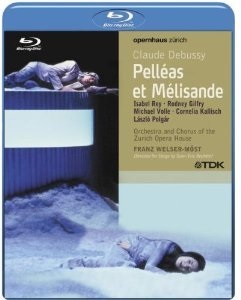
Debussy - Pelléas et Mélisande


Claude Debussy - Pelléas et Mélisande

Opernhaus Zürich, 2004

Franz Welser-Möst, Sven-Eric Bechtolf, Rodney Gilfry, Isabel Rey, Michael Volle, László Polgár, Cornelia Kallisch, Eva Liebau, Guido Götzen

Arthaus Musik

The 2004 Zurich production of Pelléas et Mélisande is a curious one, but then Debussy's only complete opera is a strange and enigmatic work.  It's a work that is founded on ambience and ambiguity, as much in the libretto - Maurice Maeterlinck's symbolist drama brought over almost intact - as in the haunting qualities of Debussy's music, which do not underscore or emphasise specific emotions in the traditional manner as much as suggest otherworldly mood and mystery in the hidden depths that lie within it.  The production design consequently also goes for a non-specific, otherworldly location within a snow-bound world that seems to work well with Debussy's floating lines, the coldness and detachment of the expressions, as well as the enclosed intimacy and oppressiveness of the subconscious passions that underlie them.

By far the strangest element of Sven-Eric Bechtolf's production however is the use of life-size dummies, looking uncannily like the characters themselves, which are carried around by them or maintain a presence throughout the performance.  Not only are these dummies carried around, sometimes propelled around the stage in wheelchairs, but the characters interact more with the dummies than the actual people they represent.  The key to this, of course, is that they are indeed representational and symbolic - the word symbolism deriving from a separation into halves between the real and the representational - and this feels entirely appropriate within an opera that, derived from a symbolist drama, is about much more than the surface interaction between the characters.  The idea emphasises not only a failure to connect meaningfully with the other characters, but that they even suffer from a sense of detachment from their own sentiments and feelings.


This is expressed wonderfully within the drama itself in a number of enigmatic scenes that rely on creating resonances and sensations, and Debussy adds to the growing sense of unease through his unsettling scoring and linking musical interludes.  Rolf Glittenberg's set designs for the Zurich production, although strange, create an equally unsettling and ambiguous atmosphere that works well with the nature of the work, while even the strange marbled stone suits worn by the inhabitants of the royal castle (but not Mélisande) raise questions or create impressions about their inner nature.

The minimalism, the symbolism and the obsessive repetition, all emphasised in this production through the division between the disembodied figures and their mannequins, seems to reflect a similar haunted quality to the one in Robert Wilson's distinctive production of this opera, where the characters seem to be ghostly figures acting out roles and gestures that have been played out many times before, perhaps at the instigation of Golaud - or even obsessively inside his own head - though his inability to discover, or recognise "the truth".  There's a fatalistic quality in the work that bears out this idea, Arkel in particular for example mentioning, at the news of Golaud's marriage to Mélisande - the woman with no past - that "we only ever see the reverse side of destiny, the reverse even of our own", that Golaud "knows his future better than I", and that "perhaps nothing that happens is meaningless".  These figures all seem to be searching for meaning and significance in objects, in rings, in towers (a Citroen car here), in a golden ball, and even in the indecipherable blank expressions of dummies.  By the end they seem to be no nearer to an answer and the eternal mystery of Pelléas et Mélisande persists.


The production design won't be to everyone's taste, but this is a good all-round performance of the opera.  Franz Welser-Möst conducts the Zurich orchestra marvellously through the beautiful floating score with a mood and tempo that matches the ambience of the snow-smothered production and the fluid revolutions of the set.  The singing and the performances are excellent, particularly Rodney Gilfry, who seems to delve deeply into the character as Pelléas, but Isabel Rey is also a fine Mélisande, Michael Volle a particularly tormented Golaud, bringing a remarkable intensity and much needed dynamic to the work, and László Polgár brings deep beautiful tones, to a dignified but somewhat opaque Arkel.

The Blu-ray release from Arthaus is a repackage of the previous TDK release, retaining even the label on the disc itself and the original TDK menus.  The HD picture quality is very good, the sound well distributed with a cool tone on the PCM Stereo and DTS HD-Master Audio 7.1 mixes.  There are no extra features on the disc itself, which is region-free.  Subtitles are in English, German, French, Spanish and Italian.

Thursday, 21 April 2011

Debussy - Pelléas et Mélisande

Claude Debussy - Pelléas et Mélisande

Opernhaus Zürich, 2004

Franz Welser-Möst, Sven-Eric Bechtolf, Rodney Gilfry, Isabel Rey, Michael Volle, Lázló Polgár, Cornelia Kallisch, Eva Liebau, Guido Götzen

TDK

Debussy’s only full-length opera, composed in 1902, could be considered somewhat difficult, and indeed part of the reason for its difficulty could lie in the composer consciously striving not to imitate Wagner. If the Wagner influence is still evident in Pelléas et Mélisande however, Debussy takes the idea of music-drama a little bit further, making it difficult to find conventional melodies, leitmotifs or even a clearly definable plot, the almost mythological storyline flowing rather to its own pace, rhythm and purpose. In reality, it’s not a difficult opera at all, unless you bring such expectations to it, but rather, left to work to its own unique operatic language, allowing yourself to go with the flow, it’s actually easy to become caught up in the strange world that Debussy creates.

The strange nature of the opera and the musical arrangement that it consequently adopts undoubtedly have more to do with the nature of the source work for the opera, a symbolist play by Maurice Maeterlinck that relates less to the conventions of narrative cause-and-effect drama, but more to the internal states of the characters being made manifest in the world around them through objects, environments, landscapes. Their behaviours are therefore less easily defined, unconstrained as they are by conventional means of expression and communication. Musically, this is also how Debussy’s score operates. Trying to associate the music with the singers through the traditional form of expression then can be problematic and not lead to expected rational conclusions. Much better to let those elements just seep in, create their own resonances that are less literal and more impressionistic and suggestive.

As such Pelléas et Mélisande is not an opera that needs to be tied to any specific period – unless a director wants to make a specific statement – and to tie it to a particular time or place is likely to create social/environmental meanings that may be contrary to the intention of the piece. This means that the opera can either be set in that vague non-time-specific no-man’s land that opera does so well, or, rather more controversially, it is open to rather more extreme interpretations. The staging here by Sven-Eric Bechtolf for the Opernhaus Zürich in 2004 consequently can be seen as being either wilfully bizarre or just perfectly suited to the unusual nature of the opera. In outline, the story is not that complicated. Lost in a forest while hunting a boar, Prince Goland discovers a young woman, Mélisande, weeping by the side of a lake. He doesn’t know who she is, although there is a crown at the bottom of the lake, but rescues her and they are married. Mélisande however forms a closer attachment to Goland’s brother Pelléas, a relationship that, inevitably, is to have tragic consequences.

There is however more going on between the characters than is evident on the surface, each of them having hidden natures, each of them unable to fully relate to or communicate with one another. As a means of bringing this out, Bechtolf places the characters in some kind of winter fairy-tale kingdom to emphasise the nature of their isolation, while he employs full-size look-alike dummies for each of the characters to act as doubles for them, the characters more often speaking to the dummy counterparts and pushing them around in wheelchairs than relating to the actual people. It all seems rather obvious and it’s tempting to see the device as just an expression of how people are puppets being used by others for their own purposes, but that is also too obvious and, in a symbolist work where there is just as much emphasis on objects – hair, rings, towers – it’s appropriate that the characters are objects themselves (the split into halves indeed being the original definition of symbolism). In this light, and on a non-rational basis, what appears to be a bizarre conceit proves to be uncannily effective, and when the characters do communicate directly with each other – as opposed to interacting with dummies – it does force you to take more notice of what is being said.

How much you will buy into this depends largely on your tolerance for high-concept modern stagings and how much credence you give to the symbolist movement, since other than perhaps in the film work of Antonioni and his disciples, their style doesn’t have a great deal of relevance or influence and is not held in great regard nowadays, certainly not from a literary viewpoint. It’s important to note however that the staging is not a distortion of the intentions of the opera on the part of the producers, but rather, if it doesn’t adhere to the letter of the work, it is nonetheless perfectly in keeping with the spirit of it, and certainly matches the spirit of Debussy’s musical composition. Making use of a revolving stage, the production is certainly effective in its dreamy fluidity, but it’s also exceptionally well sung, particularly by Rodney Gilfry as Pelléas, but Isabel Rey as Mélisande, Michael Volle as Goland and László Polgár as King Arkel are all marvellous. The orchestra playing is superb, particularly in the excellent High Definition sound reproduction on the Blu-ray. 

Monday, 21 March 2011

D’Albert - Tiefland


TieflandEugen D’Albert - Tiefland

Opernhaus Zürich, 2006

Franz Welser-Möst, Matthias Hartmann, Matthias Goerne, Peter Seiffert, Petra Maria Schnitzer, Lázló Polgár

EMI Classics

Born in Glasgow in 1864, Eugen D’Albert’s musical education in Austria is however one that, based on what is evident in his opera Tiefland (1903), indicates that he is very much a disciple of the Wagnerian school, with even a bit of verismo in his choice of subject and its handling. Apparently Bizet’s Carmen was also an influence on the composer, but although there are a few musical leitmotifs that bear the mark of the original Catalan/Pyrennean setting of Tiefland (based on the play Tierra Baixa - The Lowlands - by Àngel Guimerà, also made into a controversial film by Leni Riefenstahl), the influence is more in the subject of romance, passion and jealousy in a bucolic setting leading to tragedy (a hint of Gounod’s Mireille in there also) than in the actual musical arrangements.

The poor fool caught in the middle of a romantic entanglement here that eventually stirs killing passions is Pedro, a simple shepherd in the mountains who is offered the hand of the miller’s daughter Marta and a place down in the lowland valley by the landlord Sebastiano. Pedro innocently accepts, unaware of the reality of the situation that is known to everyone else in the lord’s household. Sebastiano is in debt and needs to marry a rich woman, but that won’t happen as long as the knowledge of his affair with Marta is widely known and spoken about. His intention then is to safely marry her off to an innocent fool that she couldn’t possibly love so as to keep up appearances of respectability while she remains his “bit on the side”.

Musically, Tiefland follows the Wagnerian model, with long solo singing of emotional intensity that purposefully drives the drama forward, with little in the way of conventional arias, duets or choral arrangements, but the chromatic music has a strong musical presence and leitmotifs that support the singing and indicate the nature of the characters and their motivations. Matthias Goerne is strongest, both in voice and dramatically, making Pedro’s wide-eyed naivety convincing while at the same time showing that he has inner depths and integrity that could indeed draw Marta to rather precipitously fall in love with him. Petra Maria Schnitzer perhaps doesn’t look like she has natural gypsy dancer roots, but sings well as Marta. Peter Seiffert doesn’t quite have the fullness of tone or the menacing build that you would associate with Sebastiano, but takes on the villain role with some relish and without overplaying.

The staging of this 2006 production at the Opernhaus in Zurich attempts to visually steer the drama away from its obvious models and references, and is thereby quite successful in allowing the piece to stand on its own. Some of the decisions are quite bizarre – the opening prologue takes place in what looks like a science-fiction laboratory where the announcement of Pedro’s engagement takes place in a virtual reality, cleverly assembled on projected screens – but thereafter, up until its reappearance in the final scene, the rest of the production is more naturalistic, taking place however in a lush stately house rather than in any period country exteriors.

The 140 minute opera is spread across two-discs on the EMI Classics DVD. The image is 16:9, the image fine, showing a well-lit stage. Audio tracks are LPCM Stereo, Dolby Digital 5.0 and DTS 5.0. The sound is a little thin without the low-end, and sometimes a little echoing, but the singing and orchestra can all be heard clearly. Subtitles are in English, German, French, Spanish and Italian.