Showing posts with label Leonardo García Alarcón. Show all posts

Friday, 8 September 2017

Cavalli - Erismena (Aix, 2017)

Francesco Cavalli - Erismena

Festival d'Aix-en-Provence, 2017

Leonardo García Alarcón, Jean Bellorini, Francesca Aspromonte, Carlo Vistoli, Susanna Hurrell, Jakub Józef Orliński, Alexander Miminoshvili, Lea Desandre, Andrea Vincenzo Bonsignore, Stuart Jackson, Tai Oney, Jonathan Abernethy

ARTE Concert - 12th July 2017

There are times I'm convinced that there is a deliberate attempt to confuse the audience in some of these early baroque and opera seria works. It's not just that the plots are needlessly intricate and difficult to unravel, but the names often all sound the same. So in addition to Erismena in Cavalli's opera of that name we have Erimante and Erineo, with an Ercinia appearing out of the woodwork when we thought her name was Alcesta, all of those becoming mixed up with Orimeno and Aldimira. And who the heck are Arminda and Artamene?

If I didn't know better I'd think the librettist was trying to cover over any plot weaknesses or lack of credibility in the extraordinary events and coincidences that take place in such works, but you can hardly accuse Cavalli of fudging the issue here with his gorgeous melodies and precise delineation of mood and character. Even if you are a little confused in places as one identity dissolves into another, disguises are dropped and genders are switched, in the masterful hands of Cavalli the changes just reflect a rich set of individuals who come together to create complex connections and bonds.

Breaking down the plot to its essentials in an effort to simplify (I'll try anyway) and focus on its themes, the fates of all of the characters revolve essentially - and not unexpectedly - around a king. Erimante the King of Armenia is haunted by a vision of an unknown warrior who he dreams will take his throne from him. At the same time, a wounded warrior has been discovered by Orimeno. He leaves the warrior with his beloved Aldimira and her nurse Alcesta, who helps cure the man's injuries. When Orimeno brings him to the king however, Erimante recognises the feared warrior of his dreams and orders Erineo to kill him.


Erineo however fails to carry out this task, leaving the warrior to fall into the hands of Aldimira, who has fallen in love with him. The warrior reveals his mission is to seek vengeance against Idraspe, who abandoned the warrior's 'sister' Erismena, although obviously we know that the warrior is Erismena herself disguised in a soldier's armour. Romantic complications are added to the whole affair - most of them involving the flighty Aldimira it has to be said - but there are further surprises in store since - no big surprise this one - Erismena is not the only one living under an assumed name or identity. Alesta, who is really the nurse Ercinia, eventually reveals all, including the fact that Erismena is the daughter of Erimante and as such the rightful heir to the throne rather than a threat to the king. See what I mean about the names?

Anyhow, safe to say that there are a lot more complications, identities and characters involved in the affairs in Armenia (Arminda and Artamene incidentally are only mentioned in passing otherwise it really would be impossible to unravel this one). To similarly simplify the essential theme of Cavalli's opera - and the whole disguises and unknown origins question of such operas - it's all about the search for identity, for understanding one's true nature. This realisation of course only comes about through some hard-earned life lessons, but in the case of Cavalli's Erismena, the work is considerably enriched by the types of characters involved and by the musical treatment that the composer creates for them.

Leonardo García Alarcón's conducting from the harpsichord of the Cappella Mediterranea brings out all those characteristics and moods with a sparseness and directness of means that only a skilled period instrument ensemble can do. What the Aix-en-Provence production reveals however is that the purity of young voices also play just as vital a role in bringing the themes of the work to the surface. It's immediately apparent from the moment that Susanna Hurrell's Aldimira and Francesca Aspromonte's 'warrior' Erismena sing the duet 'Occhi belli', revealing not only the the beauty of the sentiments but the naivety behind them. It's an opera that is all about youth.


Aldimira is flirtatious, capricious, inconstant, and has many lovers - she herself exemplifies one facet of the changeable nature of love and the instability of trust and fidelity. Erismena represents another side of love, one that has solidity of reason and is constant in purpose. People come in all shapes and sizes, quite literally here, particularly in the case of the old nurse, showing that love and its torments are not the preserve of the young alone. Love is a complex business and changeable, and how better to illustrate that than the manner in which the twists and turns of Cavalli's opera and musical treatment covers it.

It's a much richer and more dynamic palette that is brought out here than the laments and single-emotion at a time expression of subsequent opera seria period. Arias and ariosos flit between one mood or emotion to another - as someone in love is wont to do - and the singers here are eminently capable of displaying the necessary range, where youth and purity of voice and sentiment is absolutely essential. It's through love that we recognise our true selves, the opera tells us, through the destiny and fate that bonds us to each other as family, and it's love in all its guises that gives life its depth, richness and quality. Cavalli recognises this and puts it all into his dynamically expressive music.

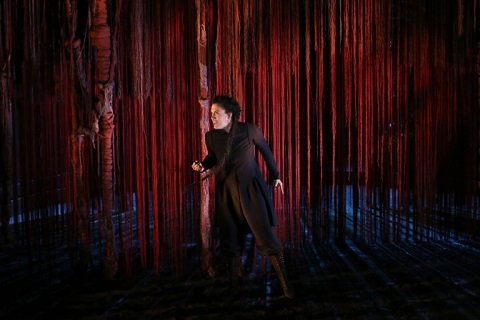
The stage production at Aix isn't quite as rich and expressive, but it rightly defers to the music and the singing. The set design has a makeshift quality, dimly lit, with a wire mesh platform employed and canopy of light-bulbs. The costumes too are in that mix-and-don't-match style that nevertheless reflects characters who have many contradictory facets and might not don't really know who they are yet. Francesca Aspromonte sings Erismane in a way accentuates her essential beauty, firmness and brightness. Susanna Hurrell captures a sense of lightness and innocence in Aldimira that makes her character's inconstancy charming rather than flirtatious and damaging. Carlo Vistoli's Idraspe/Erineo is beautifully sung, reflecting his dual nature and identity and his desire to control his nature, but all of the roles are sung with bright youthful pureness and great skill, weaving around the Cappella Mediterranea's beautiful interpretation of Cavalli's melodies, to striking effect.

Links: Festival d'Aix-en-Provence, Culturebox

Monday, 17 April 2017

Cavalli - Il Giasone (Geneva, 2017)


Francesco Cavalli - Il Giasone

Grand Théâtre de Genève, Geneva - 2017

Leonardo García Alarcón, Serena Sinigaglia, Valer Sabadus, Kristina Hammarström, Kristina Mkhitaryan, Alexander Milev, Günes Gürle, Raúl Giménez, Willard White, Migran Agadzhanyan, Dominique Visse, Mariana Flores, Mary Feminear

ARTE Concert - February 2017

The first opera composers, back in Venice in the 17th century, believed that the Greek tragedies were meant to be performed to musical accompaniment, and the invention of opera was a way of reinstating music as a key component of dramatic expression. The notion about Greek drama proved to be a mistaken one, but from it developed a whole new way of expressing classic tales and drawing out underlying subtexts, ideas and themes. Realising its potential, the first great opera composer Monteverdi soon extended the scope of opera beyond the gods and myths of the classics and into the more commonplace earthly sentiments of human love, loss and lust. His student Francesco Cavalli took these ideas even further.

It's only now as more of the composer's works are being examined and performed that we are beginning to realise the extent to which Cavalli developed the art of lyric drama. Central to the rediscovery of many rare Cavalli works is the Argentinean baroque specialist conductor Leonardo García Alarcón. The success of his Elena at Aix-en-Provence in 2013 is being followed with a premiere this year of Erismena, and he unearthed the wonderful Eliogabalo for the Paris Opera in 2016. Alarcón and Geneva's contribution to the development of the Cavalli catalogue is another rarity, Il Giasone, composed in 1649. It's also derived from those classical Greek epics, but it's given what we can now see as a characteristic humanly rich and down-to-earth treatment from Cavalli.


Cavalli's Il Giasone gives us a different perspective on the story of Jason that the less than flattering one that we would be more accustomed to hearing from the perspective of Euripides's Medea. So has Jason just had bad ancient Greek PR? Well, Cavalli's Il Giasone gives a more rounded account of the leader of the Argonauts and judging by the tender duets that he shares with Medea, there seems to be genuine love, affection and respect there for the Queen of Colchis. On the other hand, Jason's promiscuity is also made quite apparent in Cavalli's opera, a habit that will get him into trouble further down the line by the time he gets to Corinth. Here, having had what Wikipedia amusingly describes as having "extensive relations" with the women of Lemnos, Jason has already fathered twins to Hypsipyle (Isifile in the opera) and Medea's nurse Delfa claims that he has had another set of twins with her. He certainly puts it about a bit.

What is Jason's response to all these accusations? Well, Serena Sinigaglia's direction for Il Giasone seems to be perfectly in the spirit of Cavalli's usual treatment of such situations; deny everything. Or he at least has the wit to claim, while wearing a cheesy grin at the thought of all these women claiming paternity, that it could have been him, but who's to know and how he is supposed to keep count of his conquests and the resulting progeny? That really sets the tone for a work that is far fresher and more entertaining than a work almost 400 years old has any right to be. The delightful Geneva production and Leonardo García Alarcón's conducting of the Cappella Mediterranea contributes to this impression with a staging that is simple, captivating and musically invigorating.

The set and costume designs by Ezio Toffolutti are just perfect for every purpose, and Cavalli has plenty of purpose to put them towards. There are no extravagant gestures or clever concepts applied, just an effort placed into making the stage look stylish attractive and dramatically effective. The main prop is a dark circle of standing stones with surrounding flat-panel bushes that serve as hiding places and platforms for romantic assignations, as well as providing a suitable location for Medea to work invocations and cast spells. The costumes, mainly on the part of Isifile and her Lemnos entourage, are 1920s' period elegance, while there is also good use made out of body suits for the muscular Ercole, the hunchbacked Demo and the nursing attributes of Delfa. They also come hilariously complete with miniature appendages for the dancing cherub Amore.


The plot has something of a 'Carry on Jason' kind of comic farce to it with Demo (Migran Agadzhanyan) providing stuttering double-entendres and the nurse Delfa (who else can do this role better than Dominique Visse) leaping on any sailor who is game enough to take her on, but that's only part of Cavalli's rich entertainment. The situations can also convey something of the underlying menace of Medea's formidable reputation, but at the same time show an unexpected tenderness and even sensitivity for Jason, seeking protection for him in his quest for the Golden Fleece. It might seem like there are far too many little side-plots and situations, but even with a large cast of mythological heroes, villains, gods, dwarfs, queens and kings in complex arrangements, they all display recognisably human characteristics and contribute to the central subject of the relations between men and women. Cavalli scores the music for it all wonderfully, with invigorating dance rhythms, touching laments and reflective love duets.

Medea is a gift of a character in whatever dramatic or operatic incarnation she appears and Kristina Hammarström takes the role well here in the Geneva Il Giasone alongside countertenor Valer Sabadus as Jason. Cavalli rarely goes in for showy arias, preferring instead to give the performers strong characters that they can really get their teeth into, and that's certainly the case here. Even so, there are a number of duets between Jason and Medea that are just beautifully written and performed here. Kristina Mkhitaryan also has a substantial role as Hypsipyle/Isifile which she sings wonderfully, bringing a lovely clear brightness to the character. Musically, it's a real treat with Leonardo García Alarcón's conducting the Cappella Mediterranea, the period instruments bringing out a lovely percussive rhythmic edge to the score with a deep low continuo accompaniment.

Links: ARTE ConcertGrand Théâtre de Genève

Thursday, 1 December 2016

Cavalli - Eliogabalo (Paris, 2016)


Francesco Cavalli - Eliogabalo

L'Opéra de Paris, 2016

Leonardo García Alarcón, Thomas Jolly, Franco Fagioli, Paul Groves, Nadine Sierra, Valer Barna-Sabadus, Elin Rombo, Mariana Flores, Matthew Newlin, Emiliano Gonzalez Toro, Scott Conner

Culturebox - October 2016

You wouldn't think it to look at it today in Thomas Jolly's production for the Paris Opera, but Cavalli's opera Eliogabalo was considered "old-fashioned" back in 1667 and consequently never performed until it was rediscovered in 1999. It's true that Monteverdi had pretty much set the standard for a Roman ruler involved in a twisted love affair that threatens the stability of the empire back in 1643 with The Coronation of Poppea, but ironically, stories of cruel kings who thwart lovers' unions for his own twisted desires would continue to be a staple of 18th century opera seria. Even Mozart's Don Giovanni owes much to the convention, and if there's any opera that comes close to Mozart's reinvention of the genre, it's this bold "old-fashioned" work by Cavalli.

The Emperor Eliogabalo (based on the Syrian-born Elagabalus, emperor of Rome from 218 at the age of fourteen until his death in 222 AD) is a special kind of monster. Eliogabalo here has an all-female Senate in the Capitol so that he could control them and use the Senate like a harem (although in real-life the emperor's tastes were supposedly inclined more towards men). Thomas Jolly's production directs this particular scene in the opera with real flair, the gender-bending Eliogabalo even presenting himself as an extravagantly made-up woman when he goes to the Capitol. But Jolly doesn't go overboard in the manner of the camp countertenor fest of Silviu Purcărete 2012 Opéra National de Lorraine production of Vinci's Artaserse. He keeps it stylised, but still manages to capture the dangerous allure of Eliogabalo's power and his abuse of it.


That's just one aspect of Eliogabalo's character, one that shows that he is sexually perverse and won't let anyone stand in his way when he sets his sights on a woman he wants. The main part of the conflict that drives the opera then is the emperor's determination to marry Gemmira. Gemmira is already promised to Alessandro (Severus Alexander, who would succeed Elagabalus), who has just returned to Rome after restoring order to a revolt within the Pretorian guard. Despite being warmly welcomed, Gemmira warns Alessandro that Eliogabalo is suspicious of the respect that the Senate and people have for him.

Gemmira is also the sister of Giuliano, who is upset that the Emperor has seduced his beloved Eritea. Having heard Etirea demand marriage from the emperor as a way to restore her honour, Giuliano blames Eritea for the betrayal, not realising that Eliogabalo has no intention of marrying her. Like his relationship with the law - when he breaks a law it is to honour it - a marriage vow means nothing to the emperor. Eliogabalo's advisors warn him that he is playing with fire, since Giuliano is the commander of the army and it would be dangerous to make an adversary of him.

Do you think Eliogabalo cares? Determined to seduce and (if necessary) marry Gemmira, he plans to introduce her into his all-female Senate. He pushes another woman, Atila, Alessandro's way, hoping to create a division and dispute between the lovers. As for Giuliano, well, the good old-fashioned poison drink should sort out that problem for him. Eliogabalo is wonderfully constructed in this way. Twisted but utterly believable for the dark schemes and plotting that are enacted, and all the more gripping for it. What really makes Cavalli's work exceptional however is his musical colour and characterisation for this intriguing conflict of personalities, emotions and motivations.

There are other colourful characters like Nerbalone - who could well be almost a prototype Leporello for Don Giovanni - who accepts the love of Lenia, a grotesque old rich woman (played by a man of course) who advises Eliogabalo. The origins of much of the conventions of opera seria can also be seen to develop from this work, but even if that originally goes back to Monteverdi and L'incoronazione di Poppea, Cavalli develops harmony and musical colour, with arias and ariosos that are not lengthy or extravagant, but do show what the human voice is capable of doing in a dramatic context. Particularly the castrati.


If there were any justice in the opera world, countertenors like Franco Fagioli would be feted and revered as superstars in the same way as castrati like Senesino and Farinelli once were. Fashions have changed and nasty operations are no longer required, but thankfully we have singers who can really make something of these roles. Cavalli gives the perfect musical setting for the quality of the voice to shine, but he has created a gourmet character in Eliogabalo and a tasty dramatic construction for the countertenor to get his teeth into, and Fagioli's performance has real bite. The rest of the roles are no leftovers with only Paul Groves's Alessandro coming across as a little stale, but Alessandro does have a lot of dry recitative to work with. (Not sure there's any justification for these culinary metaphors, but hey...) Nadine Sierra's Etirea is impassioned and agonised, Valer Barna-Sabadus strong in the other countertenor role of Guliano and there's a wonderful turn from Emiliano Gonzalez Toro as the lusty Lenia.

At 34, Thomas Jolly is already making a name for himself as a director with adventurous Shakespeare productions in France. Directing his first opera in Paris at the Palais Garnier, he's clearly in touch with the spirit and intent of Cavalli, bringing all the qualities of the work to life. The touches of humour are all there amidst the dark scheming and imperious declamation, and the extravagant camp is present but reined in on the side of grandeur with occasional deranged flourishes. Underneath it all however is always the underlying sentiment of love and heartbreak that is the result of Eliogabalo's actions on the individual. Taking its lead from Leonardo García Alarcón's lively and dynamic arrangements of the score, the colours, moods and tone are perfectly balanced in the stage presentation, with bold costumes, minimal sets and effective use of crossing light beams to suggest grander structures and themes.

Links: Paris Opera, Culturebox

Friday, 2 August 2013

Cavalli - Elena


Francesco Cavalli - Elena

Festival d'Aix-en-Provence, 2013

Leonardo García Alarcón, Jean-Yves Ruf, Emőke Baráth, Valer Barna-Sabadus, Fernando Guimarães, Solenn' Lavanant Linke, Rodrigo Ferreira, Emiliano Gonzalez Toro, Anna Reinhold, Scott Conner, Mariana Flores, Majdouline Zerari, Brendan Tuohy, Christopher Lowrey, Job Tomé

Medici Live Internet Streaming - 11 July 2013

Cavalli operas present considerable difficulties at the best of times, but Elena, one of composer's rarest works, is perhaps one of the most challenging. Quite what tone to set for the work is complicated by the nature of the writing itself, its libretto finished by Nicolò Minato after the death of Cavalli's regular collaborator Giovanni Faustini in 1651. First performed in 1659, the work moreover hasn't been produced in full for over 350 years, and attitudes towards how opera is performed have changed a lot in that time. Is Elena meant to be played as a relatively straight account of the abduction of Helen of Troy or is it more of what the Aix programme describes as a "vaudeville mythologique" or indeed in reference to Offenbach, a "Baroque Belle Hélène"?


The 2013 Aix-en-Provence production, conducted by Leonardo García Alarcón and directed by Jean-Yves Ruf seems to be a little uncertain quite how to play Elena in this regard. When in doubt however, it seems that the best model for playing Cavalli is to look back at his master and mentor, Claudio Monteverdi and in particular at his masterpiece L'Incoronazione di Poppea. Following its innovative approach to mixing of the vulgar and the sublime, the human and the heavenly, Elena seems to assert its own tone quite successfully.

The opera starts out light and humorous, with folk-like dance rhythms marked out on harpsichord, but it's given tremendous colour through Cavalli's writing for woodwind and trumpet, with the lute-like Theorbo used as well for more plaintive laments. The dominant tone however is established when the central relationship of Elena and Menelaus emerges from the complications that ensue when the colourful cast comes into contact with the face that launched a thousand ships, and probably just as many operas. Even the manner in which the situation arises here is a combination of the mythic and the comic, the Prologue being a familiar early Baroque one where the Gods are in dispute. It's an undignified affair to say the least, with Discordia (in disguise as Concordia), setting Juno, Venus and Pallas against one another in a dispute over who is most worthy of the Golden Apple. Discord sown (so to speak), it's determined that the fate of Helen to be joined with Menelaus is not going to be smooth sailing.


That meddling in the affairs of mortals leads, as it does in most Baroque operas, to great complications in the main part of Elena. It's Theseus who abducts Helen, having abandoned his intended Hippolyta (which will have repercussions later), but in doing so he also takes Elisa, an Amazonian slave who has been engaged by King Tyndareus of Sparta as a wrestling assistant for Helen. Elisa however is none other than Meneleas dressed in female clothing, but so good is his disguise that not only has Theseus's colleague Pirithous fallen in love with her, but so too has King Tyndareus. As much then to bring back Elisa as his abducted daughter, the King sends his jester Irus out to find them.

That's just a simplified version of what happens in Act I, but even without bringing in the other players - in disguise and cross-dressing - it's not too difficult to see how such a plot can seem a little bit ridiculous as it descends into bitterness, rivalry and misunderstandings. On the other hand, it also provides plenty of opportunity for a variety of situations and tones, all fuelled by overwhelming mad desires. If what ensues is almost farcical, the sentiments expressed are nonetheless heartfelt. Helen's maid, Astianassa for example, only wishes that someone cared enough to abduct her and sings a beautiful aria of sadness for her position. The same is the case for the spurned Hippolyta, for the Prince Menestheus, who falls in love with Helen on first sight, and for King Tyndareus. Their passions might seem silly to others, but they are real to them.


In its example of showing important historical figures like Nero, Seneca and Poppea to be humans with the same sentiments as everyone else, Monteverdi's L'Incoronazione di Poppea may indeed be the model to follow in terms of setting the variations of tone to be found in Elena. In many other respects however, Cavalli's writing goes beyond Monteverdi in the richness of the instrumentation, in the supplementation of the basso continuo, but particularly in the writing for voices. In addition to the expected solo laments, much of the plot and interaction between the characters is developed though beautiful duets, and it's used as well to express their compatibility and common accord. Often both voices sing the same words, one a beat behind the other, but the harmony of the voices and the expressions of lyrical beauty are quite extraordinary.

Despite the intervention of many characters and the expression of their desires towards them, it's the duets then between Menelaus and Helen that affirm the rightness of their union. Theseus and Hippolyta also put their differences aside (Theseus apologises to Castor and Pollux, "Sorry for abducting Helen", "That's ok, forgive and forget" they reply!), which also allows Concordia to reign again (temporarily) and the opera to end with a short but beautiful quartet of voices in union. The singing is excellent particularly from these main players - Emőke Baráth as Helen, Fernando Guimarães as Theseus, and Solenn' Lavanant Linke as Hippolyta, but the stand-out performance is undoubtedly that of countertenor Valer Barna-Sabadus as Menelaus.

The stage direction by Jean-Yves Ruf and the set designs by Laure Pichat keep things relatively simple. The stage is small and resembles an arena or a bullring, with a semi-circle of wood fencing behind the players. The period is not classical but closer to 17th century, the production even employing old-style special effects for wind and storms, with billowing sails for those sea journeys. It doesn't always sustain visual interest in what is a long 3-hour opera with a great deal of characters and repetitive situations, but the simplicity and intimacy of the setting is undoubtedly the best way to play a work of this type, and it frames the strengths of Cavalli's writing and supports the fine singing.

Elena at the Aix-en-Provence Festival is available for viewing on-line (with French subtitles) from the Medici and ARTE Live Web sites.