Monday, 25 September 2023

Saariaho - Innocence (Aix, 2021)


Kaija Saariaho - Innocence

Festival d'Aix-en-Provence, 2021

Susanna Mälkki, Simon Stone, Magdalena Kožená, Sandrine Piau, Tuomas Pursio, Lilian Farahani, Markus Nykänen, Jukka Rasilainen, Lucy Shelton, Vilma Jää, Beate Mordal, Julie Hega, Simon Kluth,Camilo Delgado Díaz, Marina Dumont

ARTE Concert - 10th July 2021

The loss of Kaija Saariaho in June 2023 came as a shock to those who recognised her as one of the most brilliant of contemporary composers. I saw her twice in person, once at the premiere of her opera Only the Sound Remains in Amsterdam in 2016, where she was present in the foyer posing for press photos. It was a surprise however to walk into a coffee shop in Dundalk in Ireland in June 2019 and see her sitting there with her husband Jean-Baptiste Barrière. Even though I knew she was there as a guest for a performance of her works at the Louth Contemporary Music Society's annual two-day summer festival, and Dundalk has seen many famous modern composers appear in town, it still felt strange to see the composer of such sublime music in such an everyday place. I think I made a brief nod and smile of acknowledgement, unwilling to disturb her. The performance of Terra Memoria that evening by the Meta4 string quartet was extraordinary and thrilling.

I greatly admired her music, even though like most contemporary music, you had to search it out and rarely had the opportunity to have it brought to you. For various reasons I never found the time to watch the streaming of Innocence at the Aix-en-Provence festival in 2021 even though I had read good reports about it. Sadly, now that there won't be another, this final work will remain her last contribution to the world of lyric drama and, belatedly taking the opportunity to view it now, the work is even more poignant now, deeply moving and surely a masterpiece, a fine testament to the wondrous complexity of her musical range. The beauty and power of her music is fully evident here, the restless striving to push her music into new ground through the use of unconventional instruments like the kantele and exploring the range of the voice as an instrument.

Innocence is in almost complete contrast to her previous opera Only the Sound Remains. It exudes menace and sorrow from the outset even as the drama opens on the day of a wedding that is a supposedly happy occasion for the bride, the groom and his family. But not everyone is happy, the celebrations tainted, almost overwhelmed by a greater emotion; the shock and horror of the caterer Tereza who has been asked to provide service at the last moment. To her horror, she has just come to the realisation that the eldest son of the family she is working for killed her daughter Markéta along with a number of other children in a gun rampage through a school ten years previously. As she relives the experience, the family are forced to confront the reality that this event cannot be erased or forgotten about.

Going into the opera without knowing what is to take place, there is nonetheless an evident rawness and complexity in the situation, one that is trying to bring together two contrasting events that do not sit well together. The music tries to encapsulate these conflicting sentiments, as well as find a way to suggest that something has taken place that is almost too deeply disturbing and horrific to depict or even speak out loud. It takes a while before the libretto make that realisation explicit, the present and past playing out at the same time, and when it comes it still feels painful, even if it remains too horrific to show with any kind of dramatic realism. And yet, through the music and the direction, it manages to truly get to the heart of the mixed emotions surrounding it in place and time.

Simon Stone is a good director to bring out the complexity of undercurrents and contrasting viewpoints (see his extraordinary Tristan und Isolde, also performed at Aix in 2021) and he finds a creative way of allowing it to work coherently, but it's Saariaho's music, conducted at the premiere by Susanna Mälkki, that really brings it together. The score gets to the heart of the situation and sentiments without resorting to cinematic techniques or the conventional dramatic orchestration that you might expect, but rather with a delicacy and sensitivity of touch, the music plunging deeply into the interior world rather than the external drama.

That's quite a challenge. For a start there is a large cast of individual figures in Sofi Oksanen's original libretto, each of the children international students, speaking in a mix of languages, who each tell their own story while simultaneously living and reliving their experience. Some are now dead, others express fear blended with survivor guilt, constantly questioning how they reacted at the time, how they could possibly have helped. This plays out at the same time and alongside the parents of the killer feeling concern about bringing an innocent new bride into this family, mixed with guilt about their son's actions, questioning whether they are in some way to blame, whether they failed to notice the warning signs, whether they were complicit to one extent or another in what has happened.

Then there is the challenge of exploring the act of the school shooting itself, trying to present a rounded account of the complex motivations that may have lain behind it; was it inspired by racism? was it a terrorist act? and the impossibility of even being able to fully explaining it. The stage shows commemorations taking place simultaneously with the bloodbath, the occasion contaminated by a sense of anger at the tragedy being used and exploited for political gain, with politicians making fake promises of changes to gun laws. The pain of some has value, the pain endured by others none at all, as one of the victims puts it, words and good intentions replacing any real action; nothing will be done, until the next shooting.

The singing has its own complexity, in a multiplicity of languages, English, Finnish, French, Spanish and German are spoken, and even the singing voices have an uncommon range, from background choral voices used as an instrument, to spoken recitative and folk-inspired arrangements on the part of Markéta, the dead daughter of the catering server at the wedding party. The work also captures Saariaho's fascination for time, how it can be subjective, seeming to stretch out when one is bored and in other moments it can feel like time seems to stop. This feeds into how she composes the music for each overlaid and overlayered scene. Time has stopped for some, it is repeating for others, past and present coexist. The music ambitiously attempts to bring this all together, bringing together the experiences of many into the same period of time.

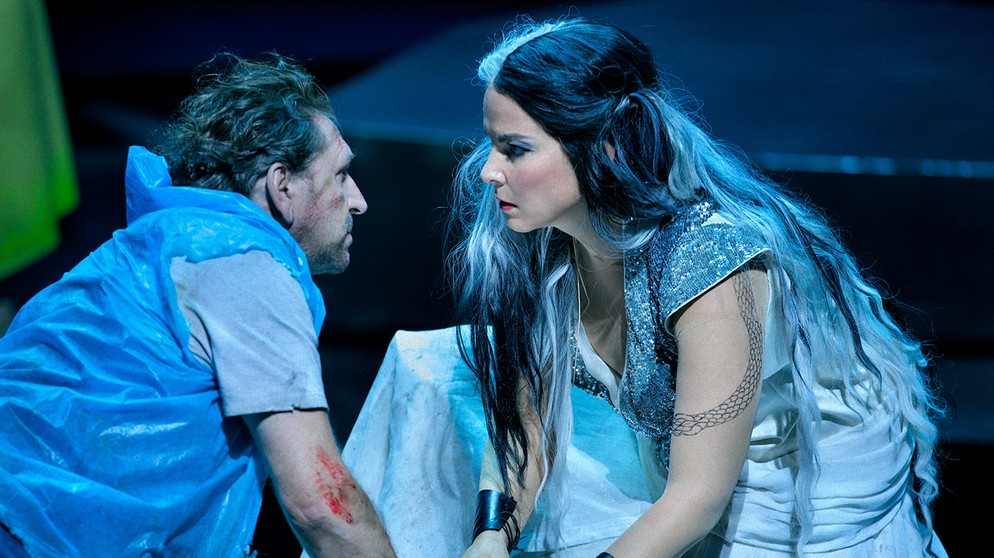
The opera is superbly directed by Simon Stone for the Aix festival. It's not just the concept of the rotating box of rooms and split levels that keep the continuity flowing and scenes overlapping, but much like how the same idea was applied to his Wozzeck, the clarity with which the complexity of the story is allowed to unfold is impressive. The scene of the shooting is horrific enough without it requiring blazing guns, the testimonies from blood-splattered victims and survivors tells the story in its own horrific fashion, but the scene where Tereza confronts the family and the new bride with the deception they have been carrying out, pouring out all the pain she has had to live with is truly harrowing. Nothing however is as clear cut as we would like it to be when it comes to identifying who is a victim. The performances here from Sandrine Piau and Magdalena Kožená is this scene are extraordinary, but then they are both remarkable throughout. The filming for screen is also superb, the close-ups in this scene showing the intensity of the dramatic performances.

The singing is outstanding, Saariaho writing beautifully for the voice with singers clearly chosen as best for the roles and all of them outstanding. Markus Nykänen as Tuomas, the Finnish groom, and Lilian Farahani, his Romanian bride Stela, both give notable performances of great emotion and intensity at the situation they find themselves in. Saariaho is not afraid to use spoken recitation when it is required for its own effect, for the direct expression of the students, rising into singing under the strain of the experience. Choral arrangements of chants and humming vocalisations underline the ambiguity of the unspoken and the inexplicable. The high pitch yelps of Vilma Jää's Finnish folk singing for the dead Markéta takes getting used to but have their part to play also and work effectively for the dramatic purposes of the opera. Combined, it makes Innocence an almost overwhelming experience, for all it takes in, for all it expresses, for it being a work of unparalleled ambition and genius. 


External links: Festival d'Aix-en-Provence

Wednesday, 20 September 2023

Verdi - Nabucco (Geneva, 2023)


Verdi - Nabucco

Grand Théâtre de Genève, 2023

Antonino Fogliani, Christiane Jatahy, Nicola Alaimo, Saioa Hernández, Riccardo Zanellato, Davide Giusti, Ena Pongrac, Giulia Bolcato, Omar Mancini, William Meinert

OperaVision - 17th June 2023

At my last count I have written reviews of 100 Verdi opera productions, probably more than necessary on La Traviata, Rigoletto and Aida, although I seem to see Don Carlos, Simon Boccanegra, Otello and Macbeth featuring more regularly now. Nabucco I've covered only once in the last 15 years (at Vienna in 2015), but it doesn't seem to be one quite as often performed these days. Which is surprising in some ways but - having watched this Geneva production - not surprising in others. It's surprising since it is 'pure opera' (which is a bit of a vague claim, but I'll try to clarify that), but also unsurprising in the way that it's hard to do anything with it that will allow it to connect with a modern opera audience - if that's not a contradiction with the assertion that it is pure opera. In any case, it strikes me that at least as far as the Brazilian filmmaker and director Christiane Jatahy handles it, the Geneva production of Nabucco comes across as little more than abstract 'pure opera'.

By pure opera, I of course mean classic Italian opera and Verdi is perhaps the greatest proponent of that form of opera, although claims could also be made for Rossini leading the way before him and Puccini taking it further after him. And in those early works at least, it's pure opera in as far as adherence to the conventions of the Italian opera style, where the tailoring of a familiar arrangement of numbers, arias, cabalettas, choruses were arguably more important - or at least as important - as any narrative coherence, message or personal style. Verdi of course had plenty of substance to say and frequently ran into trouble with the censors for his outspoken attacks on religion, politics and his stance on Italian independence, but the emphasis tends to sit more on the individual personal and familial conflicts within the greater scheme of the abuse of power. You can see this in Aida, La Forza del destino, Simon Boccanegra, I due Foscari and many others. It can also be seen in the shift of emphasis in his Shakespearean adaptations, and even the ambitious Don Carlos doesn't quite overcome those challenges of striking the right balance.

It's a format nonetheless that clearly inspired Verdi and gave the composer great material to work with, even when the plot development, weak libretti and inadequate character development forced to meet the conventions of grand opera numbers and expectations of a conservative opera audience didn't allow for any deep exploration of the human experience. Only latterly in his career would Verdi find strong librettists like Arrigo Boito and be presented with material that could measure up to the quality of his musical talent. Nabucco belongs to the power and passion of his early works, never quite satisfying, never really giving the audience much of a challenge. There is certainly plenty for the composer to get his teeth into however in a charged dramatic situation, but it's a lot of sound and fury, signifying not very much. 'Va, pensiero' notwithstanding.

Having failed to find any enthusiasm to put myself through a streamed viewing of Aida at the Bavarian State Opera, abandoning it after 'Celeste Aida' (never a favourite Verdi opera), I thought it might be better watching a Verdi opera I was less familiar with. The Geneva production of Nabucco up there on the OperaVision site seemed ideal, and even though I've only watched the opera once in the last 15 years, I was sure I could follow it without needing to read the synopsis. It's an early Verdi opera after all - written in 1841, only his third opera - and surely not too difficult to follow, particularly as it looked like this production has no intention of being restricted to a Biblical setting. I was however a little bit lost in the opening scenes, but fully enjoying the performance and presentation for the impact alone. This is what I consider to be pure Verdi opera; a lot of highly charged scenes with expression of high romantic melodrama in a setting of religious, political or national conflict. Without really knowing what is at stake, it's enough just to see how the main characters express their struggle to put across the power of the work.

And in some respects that is largely all that the Geneva production does. Avoiding the Biblical Nebuchadnezzar period, it's the kind of production style I personally enjoy; an abstract and timeless spectacle, finding a fairly unique way of presenting a work, not trying too hard to make a statement. It's early Verdi on fire, it's Nabucco and that's enough, a blockbuster writ large for the big screen. The stage production makes use of a camera for live projection of close-ups, a mirror hangs over the proceedings and a shallow pool of water with spotlights permit filmed footage and other special effects. A large cloth robe is draped over the stage that Abigaille will wrap around her in dramatic and regal fashion. The charged situation spills over from the stage, with chorus members arising out of the audience in the stalls, enveloping the theatre in the full Verdi.

All this is very impressively supported by musical direction of the Orchestre de la Suisse Romande under Antonino Fogliani, who captures the straightforward force of the work, but also its dramatic precision. This is an opera and a production to just give yourself over to, which is often what you have to do with Verdi and the rewards can be great. The musical qualities however shouldn't be underestimated, nor the challenges of the singing roles. When you have the right kind of singers who have strength, force and precision, as well as the ability to emotionally engage with these highly charged arias and scenes, the impact is like nothing else. Nabucco offers many such opportunities, and the are well taken. For the Verdian who has tired of the overplayed main three (La Traviata, Aida, Rigoletto), Nabucco (and Macbeth) offer new life for those who just want to experience the classicism of Italian opera in its purest form.

Maybe it's just lazy to say that the production offers nothing more than this; there has clearly been great effort put into every element, from the set design to the orchestration, casting and the singing. After watching the stream, I went back and checked the synopsis, read some background information, listened to the director's presentation and reconsidered the production in that light, but it didn't enlighten or improve my opinion of what I had seen. I enjoyed this purely as a - for me - not-so-familiar Verdi opera given a thoroughly skilled and entertaining performance and presentation. The nature of the modern production in everyday dress allows others to see contemporary application of the themes brought out by this work if they so want to, but you are not obliged to do so.

That's the nature of opera. It's not just notes on a page, it only lives in the moment it is performed, and a modern audience with greater familiarity of the world of opera and history in the following almost 200 years will have an entirely different response to a work like Nabucco than the audience who first saw it performed. Each individual will also respond to an opera differently, speaking to them in different ways. In fact, often it's more successful when a production allows room for personal identification and connection, rather than imposing a strict idea or over-worked concept. Verdi's full-blooded musical scores for the subjects in his early operas often go for the heart rather than for the head, but dealing with basic human emotions and struggles, they are just as capable of touching as deeply with as the grander concepts and philosophical pursuits in Wagner's operas.

Rather than impose a reading beyond the idea of an oppressed people in the abstract, Christiane Jatahy's cinematic techniques served at least to highlight the impassioned performances of the cast. I particularly liked the character that Saioa Hernández brought to Abigaille, with a performance that could pin you to your seat, fully living up to the challenging role Verdi had composed for Giuseppina Strepponi. Having seen her singing impressively in the otherwise weak Verdi opera Attila, this comes as no surprise. There were solid performances for the reliable Italian Verdian singers Nicola Alaimo as Nabucco and Riccardo Zanellato as Zaccaria. Ena Pongrac made a fine impression as Fenena, and Davide Giusti also delivered with the requisite charged singing performance. An excellent cast all-round and, of course, the all-important chorus impressed with their contribution to this work. 

It was conducted well by Antonino Fogliani, who also composed a brief closing intermezzo before a final repeat acapella version of 'Va, pensiero' from the chorus placed all around the Grand Théâtre de Genève. Perhaps they felt the opera lacked the right kind of impact at the finale - and certainly the final act doesn't measure up to the first half of Nabucco - but if you want the audience to leave the with a lasting impression of what it means to live oppressed but unbowed, with Verdi's stirring composition ringing in your head, this serves very well indeed.


External links: Grand Théâtre de GenèveOperaVision

Friday, 15 September 2023

Puccini - Tosca (Belfast, 2023)

Giacomo Puccini - Tosca

Northern Ireland Opera, 2023

Eduardo Strausser, Cameron Menzies, Svetlana Kasyan, Peter Auty, Brendan Collins, Matthew Durkan, Niall Anderson, Aaron O'Hare, Connor Campbell, Paul McQuillan, Mollie Lucas, Alexa Thompson

Grand Opera House, Belfast - 12th September 2023

You can't go wrong with Tosca and not going wrong is important to a company like Northern Ireland Opera, a company trying to get on its feet again after the pandemic, in a time of cuts to arts budgets and with no working Assembly in place in Stormont. Tosca is also a safe bet, like the previous two operas staged by NIO, La Bohème and La Traviata, neither of which inspired me to go and see live opera in my home town. But then it strikes me that NIO are not appealing to an opera audience - which is probably indeed limited here - but, as collaborations with musicals at the Lyric Theatre suggest, aiming to win over a certain class of theatre-going audience. Even then, there is a presumption that even there isn't a large enough audience or budget to put on more than one full scale opera a year. Oliver Mears, who directed the company with a more ambitious programme from 2011 to 2018, might disagree with that, but clearly we are in different times.

Tosca however strikes me as being a good test to judge how successfully an opera company might be able to meet its current challenges. It's a perfectly calibrated drama with music scored for maximum impact on those dramatic points, with carefully placed arias in each act and each act delivering a highly charged emotional climax. The good news is that Cameron Menzies's production rightly went for spectacle and impact and delivered on expectations for this opera. I originally typed 'minimum expectations' there, but I suppose that is subjective and dependent on what you expect from this opera. As far as the majority of the audience are concerned, which is more important, it delivered pure operatic drama. As far as expectations for commercial viability, NIO also delivered four sold out shows. You can't reasonably ask for more than within the current limitations, but there is surely a case for suggesting that four performances of one full-scale opera a year must be considered a bare minimum.

Whatever budget the Northern Ireland Opera had been allocated for Tosca, it was however well used in Niall McKeever's decoration of the elaborate stage set. In the past NIO would take Tosca to site specific locations and a new audience in Derry/Londonderry and bring a meaningful context to the story as a way of illustrating its power. If you're only going to put on one full-length opera a year in Belfast to appeal to a regular theatre-going audience hoping attract future funding, donations and investment, you might as well make it impressive. Act 1 of Tosca does look very impressive, the portrait of the Madonna encased in a huge circular stone frame, looking something like a fresco in the dome of a cathedral. Other than that though, the setting was worryingly unimaginative, sticking close to the original period and stage directions with scaffolding, naves and the Angelotti private chapel. Still, when you have room for the chorus of nuns and altar-boys filling the stage for the Te Deum and the Ulster Orchestra booming it out to the audience, there's no ground for complaint at the effectiveness of the direction here.

Any concerns about this being a staid by-the-book production were put aside as Menzies had more up his sleeve for the sets and continuity between them through Act II and Act III. The surrounding scaffolding remained in place for no meaningful reason other than perhaps for it being difficult to move, but the period is less easily tied down. Scarpia's dining room sits on a raised platform looking like it was fitted by IKEA, with a huge backdrop of a topless woman throwing off what looks like a transparent veil. Visually this worked well, not just to put Scarpa's lust up in the stage (this would hardly be needed considering the expression of the libretto and the score), but it also provided good sightlines so that everyone in the Grand Opera House could get a good view of one of the most powerful scenes in the opera repertoire (not to mention the Act III finale, which is similarly very well staged). This also serves to bring the opera's themes into a more contemporary post-#MeToo age, and there is after all no reason why it should hark back to the troubled history of the province as the Oliver Mears's production did. Different times, different audience, different requirements to achieve the necessary impact. It's not as if Puccini's Tosca was any kind of commentary on police and politics of its time.

Act III likewise found a novel and effective way to present that all-important Castel St. Angelo finale by having Cavaradossi led onto a raised gallows-like platform for execution, the firing squad taking aim from the surrounding scaffolding. The stone circle is present behind this, looking like a deep void into which the heroine plunges at the conclusion. It could hardly be more dramatic. Arguably the scene could hardly fail to be, but I have seen productions where it has been less effective than it should be. The audience were suitably impressed here, and from some reactions I heard, taken totally by surprise.

I wasn't totally won over by the singing. Peter Auty singing Cavaradossi has a beautiful dramatic tenor line, but the challenges of hitting and sustaining the high notes showed. He hit them consistently of course but I found myself wincing and willing him on. Russian soprano Svetlana Kasyan had no trouble with the high notes, sustaining them or projecting them to the back of the opera house, but the accuracy of her notes was inconsistent and I'm afraid the clarity of her diction wasn't strong. Floria Tosca is a big challenge however and Kasyan commanded attention as the diva and in a strong 'Vissi d'arte'. Brendan Collins was an effective Scarpia, never resorting to pantomime bad-guy swaggering, but a bigger baritone voice is needed to really deliver that villainous bile.

Tosca is not just all about love, sex, violence, betrayal and murder between the three major roles, and it's not just a showcase for a leading soprano, tenor and baritone, or at least it doesn't have to be. Personally I enjoyed some of the little touches and smaller roles more than the big ones and Puccini adds plenty of other colour and detail in the likes of the scene stealing chorus Te Deum finale to Act I, although that is hardly what you would call a little touch. Niall Anderson's sacristan and the shepherd heard (and seen) on the streets of Rome at the beginning of Act III (either Mollie Lucas or Alexa Thompson) sang well and it's a credit to the casting and direction that attention was paid to these details.

As it was to the orchestration. It's always a pleasure to hear the Ulster Orchestra play and conducted by Eduardo Strausser, Puccini's score wasn't too shabby about delivering its notorious shocks, musical as well as dramatic. Tosca is a great opera and, albeit with minor misgivings, I enjoyed this performance. It was also nice to see opera at the Grand Opera House in Belfast again - even the touring companies have abandoned us. It would be a shame if we have to wait another year for the next one.


External links: Northern Ireland Opera

Saturday, 9 September 2023

Prokofiev - War and Peace (Munich, 2023)


Sergei Prokofiev - War and Peace

Bayerische Staatsoper, 2023

Andrei Zhilikhovsky, Olga Kulchynska, Alexandra Yangel, Kevin Conners, Alexander Fedin, Violeta Urmana, Olga Guryakova, Mischa Schelomianski, Arsen Soghomonyan, Victoria Karkacheva, Bekhzod Davronov, Alexei Botnarciuc, Christian Rieger, Emily Sierra, Martin Snell, Christina Bock, Sergei Leiferkus, Alexander Roslavets, Oksana Volkova, Elmira Karakhanova, Roman Chabaranok, Stanislav Kuflyuk, Maxim Paster, Dmitry Cheblykov, Nikita Volkov, Alexander Fedorov, Xenia Vyaznikova

ARTE Concert - March 2023

Neither the Bavarian State Opera nor director Dmitri Tcherniakov really knew what they were letting themselves in for when they chose to present Prokofiev's War and Peace on the 5th March 2023, on the 70th anniversary of the death of Prokofiev (not to mention the 70th anniversary of the death of Stalin). They evidently knew about the challenges of putting on a complex Russian opera with huge orchestral and choral forces and a large number of principal roles, but at the time it was planned they hadn't really counted on the Russian invasion of Ukraine on the 24th February 2022. By the time it came to put stage the opera in 2023, it was even more of a challenge in a climate where some Russian artists were being cancelled and there were second thoughts about programming works by Russian composers. Serge Dorny however believed that the production they had envisioned for this epic work could stand on its own merits and make its own points. The reception it received justified that decision, but looking at it more critically now away from the heat of March 2023, while it's still a powerful piece, it's just a little less impressive.

Lately there have been two sides to the operas directed by Dmitri Tchernaikov, or maybe just two sides of the same coin. On one side is the psychoanalytical, taking a distanced perspective and exploring the undercurrents to familiar stories from a kind of laboratory experiment (Les Troyens, Pelléas et Mélisande, Carmen, Das Rheingold) and on the other a kind of deflating of grand myths and legends (Der Freischütz, Parsifal, most of his Wagner actually) reducing them down into human terms. You could see them both as the same approach, finding the human element within grand sweeps of history and legend. His approach to Russian giants of Rimsky-Korsakov, Tchaikovsky, Shostakovich, Borodin and Prokofiev has been a little different, seeing in them something of the history, character and nature of ordinary Russian people, something that perhaps comes more from the original literary sources. There is no greater Russian literary source than Tolstoy's 'War and Peace', but how is a director of Russian origin supposed to approach a Russian opera when there is war in Ukraine?

Well, as it happens, almost exactly the same way as Tcherniakov has done before. If 'War and Peace' tells us anything, it's how ordinary lives are disrupted by war, how our stories and loves are coloured by war, how our view on life and history is irrevocably transformed by war. That goes for the lives of the high society aristocracy that Tolstoy grew up in and primarily writes about in the novel, and it perhaps brings them down to the same level as everyone else and reminds them of their essential humanity. So, it's a given that there is going to be no glamour in Tchernikov's production of Prokofiev's opera version of War and Peace, but a reminder, as if anyone needed it at the moment, of the nature of life in a time of war.

The director chooses to set the opera not in the grand mansions an ballrooms of Russian high society, nor on the battlefields of Ostrovno or Berezina (and indeed avoids the burning down of Moscow altogether), but instead locates the whole opera in the Hall of Unions in Moscow (which actually survived the burning), where in the past Lenin, Stalin and Brezhnev have all lain in state. Here it's become something of a refugee centre, even before the war has started in the opera timeline. The room is filled with camp beds, mattresses, where masses of civilians are dressed in everyday clothes that they have presumably been wearing for days. The whole scope of the high society engagement of Natasha Rostova and Prince Andrei Bolkonsky takes place among this mess of humanity in peacetime, but even as that relationship is thrown into turmoil by the playboy Khuragin's attempt to elope with Natasha, the very real threat of war looms nonetheless.

The love lives of the aristocracy may seems trivial however when compared to the upheaval that is to take place when Napoleon Bonaparte invades, but it's far from trivial in Tolstoy's eyes. He, like Pierre, who although married loves Natasha deeply himself, comes to despise the trappings of wealth and privilege, society, but nonetheless in his search for meaning and value in life, finds the essence of humanity lies at the heart of it. It may be torn apart by war, but love and family are the essence of society or a nation and it is what keeps people going and enduring the hardships they face. Tcherniakov, while not quite going as far as Graham Vick in explicitly reversing the idea of 'War' and 'Peace' in his Mariinsky production, nonetheless similarly opens his production with Prince Andrei Bolkonsky contemplating suicide, and gives more or less equal weight to both sides of the equation.

The second half when war breaks out is however more of a challenge to accept within the limitations of the House of Unions setting that the director has set for himself and the progress of the opera. It's understandable that you would want to downplay any sense of wartime heroics - not that there is much of that in Tolstoy's vision of the horror of Napoleon's 1812 invasion - but it's harder to work it into the context of a room of refugees who indulge in a "Military-patriotic game ‘Battle of Boprodino' ". It risks downplaying the horror of the reality of the war - and by extension the unavoidable comparison to Ukraine. It's a tough balance to strike, but I would like to think he could have done more with this. Even Les Troyens, while succumbing to it being a play-acting of traumatised victims of war, was able to find a way around the traditional and humanise it without trivialising it. It might have had impact in the theatre, but looking at it now, it seems faintly ridiculous and ill-judged alongside a Russia currently at war in Ukraine.

There's certainly a case for ridiculing the world leaders and warmongers, but the scene of Napoleon played out like a comedy act for the entertainment of the assembled, prancing around throwing wine and food around, chewing his tie to hoots and howls of laughter, doesn't really get across the greater loss of life his ambitions and actions cause for ordinary soldiers and citizens. For all those irritating tropes of it looking like a madhouse, there is however more to direction than scene setting, and the fact that it takes place entirely within Moscow does allude to the fact that the war is within and that figures arise out of this mass and horror begins. This is at least borne out fully in the stage directions and acting performances, which do delve into those deep emotional and life upheavals, particularly on the part of Pierre who is central to the whole work. Its also there evidently in the music, which depicts all the inhumanity that war visits on the ordinary people. 

Given Tcherniakov's previous explorations of the nature of the Russian people through their legends, their literature and their composers, his take on Prokofiev's War and Peace could be seen a lament for the state of Russia perhaps, or the Russian people, or their victims. Which is another way to look at war, but hardly insightful either in the light of war in Ukraine or indeed in the depth to which Tolstoy explores the subject. Bearing in mind the challenges that had to be faced at the time of the production however, and the delicate balance that had to be maintained, it's about as much as you could expect, and it certainly hit the mark with the audience in Munich. Tcherniakov, who is more accustomed to facing boos and howls of derision at a curtain-call, is met here with roars of approval from an audience who clearly have been deeply emotionally engaged with what has been shown on the stage.

That may have been partly due to the highly charged atmosphere in a time of war - opera should be 'of the moment' and meaningful to a modern audience and Tcherniakov undoubtedly succeeded in striking a chord with his audience - but the director also did it on his own terms, finding the essential human quality within the work and also finding a way to explore the essential idea of Russian character and nature facing the upheaval of life that lies at the heart of the work ('Russian' in spite of the fact that many of singers are also from former soviet states), taking nothing away from the challenge of striking a balance and finding a universal character to the work. The highest praise in that regard however has to be reserved for the central singing performances: Moldovan Andrei Zhilikhovsky as Prince Andrei Bolkonsky, Ukrainian Olga Kulchynska as Natasha Rostova as Armenian Arsen Soghomonyan as Count Pierre Besukhov all never anything less than impressive.

The success of how that is put across is also testament to the power of Prokofiev's musical "reduction" of War and Peace, but reduction is hardly the appropriate term for this opera. With its huge cast required for the principal roles, its huge chorus and huge orchestral forces required to play Prokofiev's complex score, no undertaking of War and Peace is taken lightly. Vladimir Jurowski took a measured approach to the score, including some significant cuts, but only in terms of managing sensitivities which could not be ignored or taken lightly in the present climate. It's clear however that he takes on such challenges without losing any of the impact or intent of the score. The decision to go ahead with some judicious cuts was clearly the right one, Tcherniakov's production might not look now like it really addresses the complexities of the work, but it was the right one for the time, the power of the work and its importance enhanced by the reality of current events.


External Links: Bayerische Staatsoper, ARTE Concert

Sunday, 27 August 2023

Benjamin - Picture A Day Like This (Aix-en-Provence, 2023)


George Benjamin - Picture A Day Like This

Festival d’Aix-en-Provence, 2023

George Benjamin, Daniel Jeanneteau, Marie-Christine Soma, Marianne Crebassa, Anna Prohaska, Beate Mordal, Cameron Shahbazi, John Brancy, Lisa Grandmottet, Eulalie Rambaud, Matthieu Baquey

ARTE Concert - 14 July 2023

I have to say that my first impression of the new opera from George Benjamin and Martin Crimp premiered at the 2023 Aix-en-Provence Festival was that it appeared to be a slight work; a simple story, a fable, a fairy tale with a fairly obvious moral and meaning. Such thoughts were also there to an extent while viewing the previous two operas, Written on Skin and Lessons in Love and Violence, at least in as far as they seemed overly studied and mannered, removed from the everyday. Both those operas however nonetheless left a great impression and have rewarded further listening for detail and substance, and I have little doubt that Picture A Day Like This will be the same.

Running to around 65 minutes Picture A Day Like This is certainly shorter and perhaps even slighter than the previous two operas by Benjamin and Crimp, but it is by no means a lesser work, since it deals with deep emotional reaction to difficult human experiences and situations. It doesn't employ a full orchestra, nor does it appear to take in the wide range of emotions and dramatic action as the previous two works. Rather it's a chamber opera with a smaller cast and orchestra, although it does have at least as few principal roles as Written on Skin. Like that work, it's equally as intense and bristling with underlying menace and unease, only here it does so in an appropriately more concentrated form. Such is the impact that it's only when you come out of it that you realise how successfully the composer and librettist have gripped you in their world.

The plot is related in the simplistic manner of a fairy-tale, but also similarly touching on deep human emotions and universal experiences the way a fairy-tale can do. And, in the opera form, that means that it has the benefit of music to delve even further, and we know that Benjamin's music is highly capable of doing that. The story relates the loss of a child by the Woman (the creators like to operate on the idea of general human rather than specific), who is so distraught she searches for a means to bring him back to life. She is told that if by the end of the day she can find a single person who is happy with their life and cut a button from their sleeve, her child will be returned to her, and she is given a list of a number of people who all seem to be living a life of perfect bliss. Evidently, their lives are not as filled with contentment as they appear to be.

The implication or moral is clearly evident. Everyone carries their own burdens, and if they appear to be happy, it's only because they have had to learn live with their fears and trauma - some more successfully than others. Ultimately, many of those strategies have failed and there is no real pleasure to be found in material possessions, in fame or success, even love has its limitations. None of these situations is comparable to living with the death of your young child, nor is it that the intention when it comes to the Woman's final encounter with Zabelle and the beautiful garden she has created to suggest that it's in any way similar to a composer's struggle with their art, but the latter suggests that is important is finding a way of living with your unhappiness, making it a part of you, not denying it.

It's a simple moral or message then, one that shouldn't need dressed up in a fairy-tale situation with intense music, but here is no question that bereavement - particularly of a child - is a challenging and multi-faceted subject to explore. The coming to any realisation is a journey that the Woman has to make and be experienced, and - to a much lesser extent obviously - the listener has to make that same journey over the course of the opera. And to be honest, that would be hard to endure over anything longer than the running time of just over an hour. Nonetheless, George Benjamin uses every minute of that to find the right note, taking care not to overload it, using space and silence as important elements to give room for the music, the situation and the content to breathe and express itself to the fullest extent. There are few if any dramatic flourishes, and nothing seems superfluous. At times the score feels like 'mood music' or soundtrack backing in the way that it rarely draws attention to itself, but it nonetheless weaves a complex way through the emotional and dramatic content.

The impression that this is slight and lacking in dramatic action is probably also due to the mostly dark, minimalist stage direction, but this is also deceptive. Carefully directed by Daniel Jeanneteau and Marie-Christine Soma, as well has handling the set design, dramaturgy and lighting design, it's actually appropriate and essential that the attention isn't drawn away from the emotional impact of the primary expression of the music and the singers. As such it's highly effective, using glass and mirrors so that figures seem to appear from nowhere and vanish like in a dream. When it comes then to stressing the vital importance of the impact of Zabelle's garden then, the effects are extraordinary and almost magical. All of it contributes to enveloping you in this otherworldly place, the otherworldly place where grief takes you.

Since all the singers were hand-picked by the composer, who worked with them to play to their strengths, it's no wonder that the singing is so effective in the part it plays in this. The performances are as carefully calibrated as the music, with Marianne Crebassa creating the vital central role of the Woman. Crebassa's ability is well known on these pages, but here in such a role where a huge journey has to be undertaken over the running time of little more than an hour, it goes beyond technical ability and into timing, delivery, expression, feeling and being. Similarly, you might regret that Anna Prohaska doesn't have a larger and more showy role, but again it's a case of providing only what is essential to the work. The other singing roles of the happy but not happy people the Woman encounters - Beate Mordal, Cameron Shahbazi and John Brancy - are likewise impressive in their ability to tap into the essence of the situation and what lies behind in the music.

Benjamin, as is customary for this composer, conducts the score himself, leading the Mahler Chamber Orchestra through the dark intricacies of the score. It's a short work with few characters, few situations and minimal orchestration, but when Marianne Crebassa gazes out as the dying notes remain suspended in the air and the listener emerges out of this dream-like state, any suggestion or impression that this is a minor work is immediately erased. I've no doubt that not only does it reach as deep as Benjamin and Crimp's previous collaborations. but as well as standing on its own terms, Picture A Day Like This actually contributes another level to their body of work as a whole.


External links: Festival d’Aix-en-Provence, ARTE Concert

Monday, 21 August 2023

Verdi - Macbeth (Salzburg, 2023)


Giuseppe Verdi - Macbeth

Salzburger Festspiele, 2023

Philippe Jordan, Krzysztof Warlikowski, Vladislav Sulimsky, Tareq Nazmi, Asmik Grigorian, Caterina Piva, Jonathan Tetelman, Evan LeRoy Johnson, Aleksei Kulagin, Grisha Martirosyan, Hovhannes Karapetyan

ARTE Concert - 29th July 2023

By now, we are probably all familiar enough with Krzysztof Warlikowski's bag of tricks to have some idea of how his opera productions are likely to play out. They are almost always willfully subversive of the stage directions, imposing a period updating on them, usually relating to whatever movie is currently popular or indeed willfully subversive, such as David Lynch or Nicolas Winding Refn. Pasolini's Salò too is often a favourite for opera directors, not just Warlikowski. The question is whether his approach is ideally suited to the tone and themes of the opera or whether it brings anything new out of them, but often it can be surprisingly effective. I'm not convinced that the directness of Verdi works from this kind of overly elaborate approach, even in a work as emotionally complex as Don Carlos, where I felt Warlikowski was lost for ideas. In the case of his Macbeth for Salzburg, it has the disappointing and for this opera the somewhat unfortunate effect of rendering it essentially bloodless.

Ordinarily, failing to live up to Verdi's dark tone for Macbeth would be almost fatal, but there are some compensations here. Up until relatively recently it was a largely neglected Verdi opera, particularly in the UK where it was considered lacking the depth and poetry of Shakespeare, too condensed into little more than the sound and fury of the play. Now it can be recognised for the magnificence of its set pieces and the musical attunement to the work's dramatic power. It's the consummate blood and thunder Verdi opera, one that also provides great roles and arias, notably for Lady Macbeth, and a famous chorus in 'Patria oppressa'. If nothing else, the greatness of those elements remains apparent in the Salzburg production, although muted slightly by the musical and stage direction.

Warlikowski chooses to align this production of Macbeth with Pasolini's film Edipo Re (Oedipus Rex), both in term of its visual look and period inconsistency, as well as using it as a way to delve into the underlying psychology for the murderous couple deriving from their inability to have children. This is hinted at in Shakespeare's drama but never made explicit (although many productions have similarly explored this angle). Lady Macbeth is shown visiting a gynaecologist in similar period costume to the framing 1920's Italy of Pasolini's Oedipus Rex, and being told she will never have children. That film is also referenced explicitly in a clip of a mother breastfeeding her baby. This presumably is the suggestion for Macbeth's murderous campaign against any successor, incited by jealousy and fear of being supplanted at the breast by his or indeed any child. It's an idea certainly, but whether it holds up in terms of Shakespeare or even Verdi's version of Shakespeare is debatable/doubtful.

Krzysztof Warlikowski retains the 1920s imagery for the main part of the production design, giving it also something of the feel of the Godfather or a 1930s' Hollywood gangster movie. Mixing periods, a widescreen television is used for Macbeth's viewing of Edipo Re (setting off his fear of a successor), which could stand in for a projector, although no effort made to make it look so. Live projections and filmed segments are of course used (a still photo from the production shows Pasolini's The Gospel According to St. Matthew is also referenced, but I didn't see this while viewing the production from the online steaming) and this is effective not just for showing behind-the-scenes views like the killing of Duncan, but helping lay the psychological groundwork and set mood. It's a dark mood certainly, but all of the suggestion and explicit explaining avoids a more direct and dangerous bloodletting drama, and the murder scenes of Duncan and Banquo consequently fall rather flat.

I'm not sure what to make of the weird sisters chorus in this production either. A mix of women in dark sunglasses and children wearing sinister masks, they seem to hint at a more radioactive doom for no apparent reason. The banquet scene for the appearance of the ghost of Banquo is more effective, the period used to establish Lady Macbeth like a vampish singer in Hollywood movie night club. Macbeth's breakdown is effective as he reacts to a balloon where he has unconsciously drawn Banquo's face, although its impact on his high society guests less apparent. Serving up a dead child at the climax of breakdown hits the mark however, and this becomes a running theme, with children in masks continually haunting Macbeth.

This leads to an unconventional approach to 'Patria oppressa', which becomes less about a downtrodden and despairing people rising up against the horror that Macbeth has inflicted upon a nation but is tied nonetheless into the obsessive idea of total genocidal destruction through its connection to the murder of Macduff's family. The chorus remaining offstage, replaced by about 20 children of Macduff dressed all in white underwear, who all partake of a drugged drink passed around by their mother to end their lives. Macduff's despair is somewhat heightened then - 'Ah, la paterna mano' suitably heartfelt and expressive in Jonathan Tetelman's delivery - as the bodies of the innocents are laid out. It's certainly effective as such, but some might think this traditional highlight of the opera has been underplayed.

A lot of the impact being dissipated is I feel partly due to the large size of the Grosses Festspielhaus stage. Warlikowski is partly forced to fill the large space with projections and supernumeraries, but Macbeth is an intense intimate drama that doesn't scale up effectively. Or not here in any case. Verdi's music often makes up for such failings, but filling in for an unwell Franz Welser-Möst, Phillippe Jordan's conducting felt a little too slick in places. Although the drive and impact was effective in the key scenes, there was perhaps not enough unbridled passion in it for me, which I think is also the main failing of the direction also. 

One place where there were few such qualms was in the singing. The huge choral forces certainly filled the space in vocal presence and the principals similarly all had the personality and singing ability to make an impression. Asmik Grigorian is superb as Lady Macbeth. Along with recent performances over the last few years, particularly at Salzburg, where she has worked with Warlikowski before on Elektra she is proving to be one of the best dramatic sopranos in the world. She doesn't quite bring the full fireworks you would like for a Lady Macbeth, but I would fault the direction on that point, as her acting and singing delivery can scarcely be faulted. The same could apply to Vladislav Sulimsky's Macbeth. It's a solid performance, the passion and fear are evident when the direction is effective (the banquet scene), less so in others (the assassination of Duncan). Bass Tareq Nazmi's Banco was astonishing in his depth and lyricism. It's unfortunate that Banco is not given a greater role and is killed off too soon, but we at least were able to enjoy an excellent 'Studia il passo, o mio figlio'.

If it was a bit of struggle to connect Warlikowski's ideas, direction and production design to Verdi's opera and at the same time make it fully inhabit the stage, the production gained force as the opera progressed. The downward spiral of Macbeth and Lady Macbeth was well depicted, the murder of Macduff's family during ''Patria oppressa' hit home, as the opera made its way towards its suitably dramatic conclusion. I can't help feel that a little less over-thinking in the direction and the conducting, a smaller scale production and a little more trusting in Verdi's score would have been much more effective.


External linke: Salzburg Festival, ARTE Concert, Photographs - © SF/Bernd Uhlig

Saturday, 12 August 2023

Wagner - Parsifal (Bayreuth, 2023)

Richard Wagner - Parsifal

Bayreuther Festspiele, 2023

Pablo Heras-Casado, Jay Scheib, Andreas Schager, Derek Welton, Georg Zeppenfeld, Elīna Garanča, Jordan Shanahan, Tobias Kehrer, Siyabonga Maqungo, Jens-Erik Aasbø, Betsy Horne, Margaret Plummer, Jorge Rodríguez-Norton, Garrie Davislim, Evelin Novak, Camille Schnoor, Julia Grüter, Marie Henriette Reinhold

BR-Klassik livestream - 25th July 2023

There is obviously more than one way to view an opera, particularly so in a work as rich, abstract and enigmatic as Parsifal, but this year's new production by American director Jay Scheib for the 2023 Bayreuther Festspiele actually went as far as delivering a production where the audience watching it could see two different productions playing out at the same time. The was achieved by 'augmented reality', allowing a small proportion of the audience (330 of the almost 2,000 capacity) to see enhanced elements while the majority got the plain vanilla version. As if there could be anything 'vanilla' about Parsifal. While I can't say much about the enhanced version - having watched the non-augmented reality version (or simply 'reality' as most people know it) via a livestream, I have doubts that it could offer anything more than the regular version. And even if that wasn't particularly revelatory, this Parsifal had a few interesting ideas and some fine musical and singing performances.

It's just my opinion of course, but no Wagner opera should be exempt from the kind of restless experimentation, updating, reworking, rethinking, modernisation, whatever you want to call it that Bayreuth often exercises in their stage productions of his works. Some works appear to be more suited to this than others, some are just incoherently thought out, but often they do succeed in inspiring new ways of considering some of the greatest works of opera. Parsifal has less surface narrative than most and is often interpreted in a wide variety of ways, but there are nonetheless deep important spiritual intentions in the work that should not be neglected. But if you can find other ways to tap into this, why not try?

Wagner's music score is more than capable of withstanding any conceptual conceit a stage director throws at it, and it can be just as intriguing hearing what the individual interpretation a conductor can bring to the pace, delivery and detail of the score. If you have that and when you have a good cast, you know the work has everything it needs, and anything else that the stage director decides to focus on is a bonus that you can choose to consider or not. As far as the new Bayreuth production is concerned, the musical under Pablo Heras-Casado is. I've liked others better, but that's just personal preference and as long as the purpose of the music and its relation to the underlying sentiments, philosophy, mood and drama is maintained - which it is here - then that's the basic minimum you can expect. The singing is essential also - you simply can't do Parsifal without strong experienced voices - and looking at the cast here for the roles of Gurnemanz, Parsifal and the Kundry here, there are no worries on that account, but it's supported also by fine performances in the roles of Amfortas, Klingsor, and Titurel. There can be few complaints, if any, on that score.

The deeper message of Parsifal lies in the musical expression, and perhaps even more in the responsiveness of the listener, all of which are more expressive than the relative and deceptive simplicity of the plot outline, which you would think would not allow for any great variance - although many directors have managed to successfully find other creative ways to relate to the underlying tone of the work. One can glance through past reviews here just to see how varied interpretations can be. This long preamble might suggest that I don't have a lot to say about this specific production that I haven't said before and which hasn't been expressed better in other productions - including of course Stefan Herheim's Parsifal at Bayreuth, which I have yet to say anything about - and to some extent it's true that there is not a lot that was inspired about this new version (non-augmented reality version anyway), but it was still good enough to impress.

Leaving aside the augmented reality aspect, one way a director can choose to impose or highlight a certain crucial aspect of Parsifal or any opera work, is by the use of additional silent actors. While most of us don't see the visual overlays, we do see at least one 'invisible' figure, a kind of mirror image of Kundry, or simply 'woman'. Gurnemanz upon waking, or in his waking moments, is seen grappling in the embrace of an unknown woman during the prelude. She appears to be a holy woman, judging from the image of a saint or holy figure on the back of her shirt, or perhaps just appears that way to the devout Gurnemanz. She remains in the background in Act I, tending to the unhealing wound of Amfortas and appears elsewhere throughout the work. Is she a mirror image or expansion of Kundry? In a work where the presence of woman outside of Kundry barely makes an impression other than to lead good righteous men into ruin, Kundry's expansive presence can be extended in a work where compassion is important.

And yet, although many other productions make a powerful Kundry central to the whole ethos and philosophy of the work, that aspect is not emphasised as much, or seemingly as central to the other significant spin that the director places on the work, which is in how the Grail and the worship of the Grail is depicted here. The Grail is shown as a large purple-blue crystal, but more than its physical presence, what it important is how it is depicted as something painful, an adherence to old traditions (and religions?), that need to be cast off for mankind to be free from the weight of the past in order to achieve transcendence. This is hinted at in the second Act, where there is a connection established between the Grail and the cavern where Klingsor resides, which is the same shape and colour as the crystal in Act I. This is taken through to Act III which goes as far as Parsifal destroying the 'grail', the crystal thrown to the ground and shattering into pieces.

Although pain and suffering has always been an essential part of Parsifal, the path to enlightenment being essentially a painful journey, it's a significant departure nonetheless to actually destroy the Grail at the conclusion. Yet somehow this doesn't really achieve the redemptive quality of the work that you expect, but there is clearly an effort made to tie it in with the transformative impact that all the principal figures - and even secondary ones - undergo. Personally, while the set design is at least wholly sympathetic to the work, I think the fine singing is key to bringing this together as successfully as it does. Act I at least has all the beauty, agony and magnificence you could hope for and expect, laying the seeds for what it proposed in the subsequent acts. The set is open and spacious, simple and abstract - a pool, a platform/bed/coffin, a high steel pillar and a circle of light that rises to fill the stage with light during the transubstantiation offering (this one very reminiscent of a Catholic mass communion processional), but it's Amfortas's pain and the performance of it from Derek Welton that hits the mark.

Act II is much more exotically coloured and lit than is usual for the garden of the flower-maidens, appearing genuinely enchanted (and I imagine even more so in the AR version) but again, what really brings it to life is the singing. The struggle between Klingsor and Kundry as he exerts his power over her is excellent, mainly on account of the performances and singing of Jordan Shanahan as Klingsor and Elīna Garanča as Kundry. Andreas Schager has a key role to play as Parsifal of course, and does so with characeristic intensity in this act. Building on the view of the Grail that this production takes, poor Sir Ferris exists as here as a blood splattered dummy in the background while Kundry attempts her seduction of Parsifal. Parsifal is moved to rip out his heart out and compare it to a stone, as he reflects on his failing to recognise what has prevented him from understanding Amfortas/The Saviour's suffering for our sins and begin the search for redemption. Schager makes it feel real and is matched by Garanca's expression of Kundry's torment. It's hard not to be won over, even if there is little that is new expressed here.

I can't say I've ever seen a production of Parsifal that matches the description stage directions for Act III as "A pleasant, open spring landscape with a background of gently rising flowery meadows". More often it looks more like a post-apocalyptic landscape. Here indeed the stage is dominated by some monstrous looking rock crushing truck that houses Gurnemanz, and by a crater in the centre of the stage that doesn't look much like a holy spring. The rock crushing extends then to Parsifal's destruction of crystal, ending the worship of the Grail and the ways of the past. This is also the idea emblazoned on the back of the shirts of Kundry and Parsifal, the former saying 'Forget Me', the latter 'Remember Me', the two of them united in the holy spring. Even Gurnemanz embraces his shadow Kundry. It would seem to have little to do with Wagner's idea of redemption, but it is impossible nonetheless not to be moved by the extraordinary beauty and majesty of this work and what it achieves across four hours.

That at least is supported by truly impressive singing performances and an outstanding chorus. Georg Zeppenfeld is his usual solid impressive Gurnemanz, with grave, clear intonation and authority. Andreas Schager sings with such intensity that he inevitably show a little bit of strain. Elīna Garanča makes her debut appearance at Bayreuth, but I've seen her sing the role of Kundry in an ambitious production of Parsifal at Vienna in 2021 (which interestingly doubled the role of Parsifal as they do with Kundry here). She is even more impressive here and takes the curtain call at the premiere of this new production to deservedly thunderous applause. Pablo Heras-Casado is warmly received for a consistent measured performance dramatically attuned to the stage, that nonetheless (although limited to the sound mix on the livestream) I thought sounded a little lacking in detail in places. There was inevitably a mixed reception for the production team, the louder boos trying to drown out what sounded in the main like welcome applause.

This was not a great production though. Depending on your view it fails to make the essential point of the work or you could think that it finds its own roundabout way around to it, but it has moments that are successful and it looks suitably impressive. Like many of the recent Bayreuth productions however it feels like a kind of halfway house between the extreme much-maligned but fascinating excesses of the last decade and a more traditional production that at least touches base with the original stage directions. The new developments like the use of AR here - which I've read about subsequently and it seems genuinely interesting if a little overdone (reminding me of an initial misguided and eventually rejected idea to do something similar in Robert Dornhelm's greenscreen experiments for his film version of La Bohème way back in 2006) - are welcome, showing a willingness to still trying to extend the word, the music, the significance and the legacy of Wagner into the future while at the same time trying not to lose the traditional unadventurous audience who expect something more respectful or reverential.


External links: Bayreuther Festspiele, BR-Klassik