Richard Wagner - Tannhäuser
Staatsoper Unter den Linden Berlin, 2015
Daniel Barenboim, Sasha Waltz, Peter Seiffert, Ann Petersen, Marina Prudenskaya, Peter Mattei, René Pape, Peter Sonn, Tobias Schabel, Jürgen Sacher, Jan Martiník, Sónia Grané
Staatsoper Video on Demand
Some of Wagner's later operas lend themselves well to a more abstract expression by directors in collaboration with artists and sculptors, finding new ways to delve into the philosophical, spiritual and transcendental qualities of Tristan und Isolde and Parsifal. When it comes to Tannhäuser directors generally take a more conventional and literal approach to its divisions between the physical and the spiritual, and it has tended to be less effective when directors take the artistic conceptual approach like the one in the 2014 Bayreuth production. The work's big, bold and direct nature even constrains the more experimental directors like Calixto Bieito and Romeo Castellucci, limiting their ability to explore aspects of the work entirely successfully. And yet the limited dramatic potential versus the poetry of Wagner's libretto and the flow of his music does seem to call out for an imaginative response. Perhaps dance is the way?
There's certainly a ritualistic almost religious ceremonial aspect to Tannhäuser that can be developed as Castellucci did in a rather obscure fashion with topless archers during the work's overture, but recognising that there is a flow in Wagner's score throughout the opera, director and choreographer Sasha Waltz extends this sense of ritualised movement with additional dance elements. It should also be noted that Wagner introduced a ballet into the work for its infamous French premiere, so there's justification for seeing dance as very much part of the work.

Waltz's choreography moreover doesn't dominate or take over from the dramatic expression but it certainly enhances it and brings out or highlights that essential character in the score. Again, the limitations of this work are still felt, and although the Act 1 Venusberg Bacchanal features semi-naked dancers writhing languidly and feverishly to Wagner's music, capturing the hedonistic side of the scene, it goes on a long time in this hybrid version of the opera and - despite the nudity - runs out of ways to keep it dramatically interesting. The set is simple but beautiful, a cone at back of the stage that pours out bodies spilling over occasionally onto the stage, a whirlpool that holds Heinrich in a centrifugal force that proves difficult to escape.
Dancers also capture the rhythmic chants of the pilgrims in the subsequent scene, skipping around Landgrave and the singers of Wartburg who are dressed in stuffy formal costumes of tradition and convention as they try to spin Heinrich back into their orbit. Movement also ties into music and song, showing it as a force that Elisabeth can't live without, Waltz striving to make visible that fact that there is life and truth contained within this gracious. There are no static solid beams in the Wartburg hall either, the walls thick bamboo-like pillars that sway in response to the drama contained within them. These are simple sets yet they provide space for movement, even if it is just the flow of the figures with them, never allowing the work to become static and unyielding.

Choreography is not something I usually comment on in opera productions, for the obvious reason that they rarely have a significant presence in opera, but Sasha Waltz's choreography is superb here, keeping the work moving, only bringing the dance to the forefront to emphasise certain scenes, stepping back in others so that it never overshadow the singers or Barenboim's progression of the score, managing to be expressive and as one with the music. The procession of the pilgrims in Act III whirling to the chorus in the misty morning is just glorious. The dance choreography definitely contributes then, but it's also just good direction.
As a concept Waltz perhaps doesn't particularly have anything new to say but very much finds a personal expression for Tannhäuser. If nothing else, she finds an appropriate way to handle the miracle conclusion that fits with the overall theme of the production, visualising the staff sprouting green leaves as a human body, which is a nice touch and all the more effective for not bombarding the work with symbolism and imagery as others mentioned above. It's a beautifully designed and costumed production with lovely lighting that is moody and dramatic, all of which is very much in tune with the nature of Tannhäuser.

In musical and singing terms it's a ravishing account, persuasive that this is a work of balletic grace. Daniel Barenboim measures that flow of sensuous delight to perfection, glorying in the rousing majesty of the opera's choruses, and the singing performances are all outstanding. Ann Petersen brings a sweet lyric softness as Elisabeth. Peter Seiffert is magisterial as Heinrich, Peter Mattei is an outstanding Wolfram, René Pape a reliable Landgrave, and Marina Prudenskaya is an excellent Venus. Whether the dance elements work for you or not, this is a glorious Tannhäuser to listen to and see performed to this standard.
Links: Staastoper Unter den Linden
Richard Strauss - Die Frau ohne Schatten
Wiener Staatsoper, 2019
Christian Thielemann, Vincent Huguet, Camilla Nylund, Nina Stemme, Evelyn Herlitzius, Wolfgang Koch, Stephen Gould, Wolfgang Bankl
Wiener Staatsoper Live at Home - 25 May 2019
It's not difficult to see what is attractive about the Vienna State Opera's production of Die Frau ohne Schatten. Of course any performance of Richard Strauss's glorious epic masterwork is alone reason enough, but in this case there is also the chance to hear it conducted by Christian Thielemann who you can be sure will provide at the very least a precise, detailed and soaring interpretation of the work. The opportunity of to see Evelyn Herlitzius, Nina Stemme and Camilla Nylund working together, three of the leading ladies of Strauss (and Wagner) of the moment, is also to die for. That's not to mention Stephen Gould and Wolfgang Koch in the other significant roles. Evidently you can expect this to deliver the musical goods, but unfortunately it turns out that the only thing missing in the Vienna production is any shadow of an idea from the director Vincent Huguet how to to make the most of what is available here.
What is most disappointing is that Huguet doesn't find any way to approach a work that is rich in symbolism and ideas, much less find any way to illuminate its mysteries. The subject of a flawed Utopia that runs through the fantastical German opera of this period in the lush seductive creations of Korngold, Schreker and many other post-Wagnerians, reveals a fin de siècle fascination with history and humanity reaching a turning point. There is a magical quality in such works that shows that humanity has the capacity to aspire to be better and change the world, but perhaps with a recognition that inherent weaknesses in human nature will result in a flawed creation. That would at least be the case in later works that may also have had an eye on the direction that Germany was heading in under a regime that would ban their works as 'degenerate', but in 1919, Strauss and Hoffmansthal - taking a lead from Mozart (it's hard to do better) - still had a cautiously optimistic outlook.

There's huge potential for growth exploring this idea on any number of levels within Die Frau ohne Schatten. In the worlds of the Kaiser and Kaiserin and that of the dyer Barak and his wife there are all kinds of contrasts between the high and the low, between the spiritual needs and the physical needs of humanity that could be brought out, but this production doesn't even really succeed in differentiating between these contrasting planes of reality. There is an argument to be made that they are just different facets of the same thing. On one side there's the dyer's wife and her dreams of a more comfortable life fantasising about a love that is perhaps no deeper than physical lust, but her marriage to Barak is lacking more than that. On the other side, in the elevated symbolism of Deer and Falcons, the Emperor and Empress have a deeper spiritual and emotional attachment, but their relationship lacks substance; the Empress has no shadow.
More than just reductively being about fertility, the woman without shadow is woman without an essential part of herself, a woman of no substance. The Empress is admired and adored by the Emperor for a being a magical creature, not a being of substance. The nurse knows where people have shadows and it's down in the misery of the human world. The poor dyer and his wife in fact have rather too much 'substance' and it prevents them from being able to truly love each other on a higher spiritual level. Perhaps that comes through more clearly when it's presented, as it is here, shorn of most of its fantasy elements and symbolism, letting the power of Strauss's music speak for itself. Certainly by the end of Act 1 the chorus that meaning comes across that it's the love of a married couple that can be the bridge that spans the chasm "which the dead cross to return to life". What gives substance is the understanding and acceptance that we are all part of something bigger, physical and spiritual, fathers and sons, mothers and daughters, all family, all connected to the past and to a better future.

Perhaps striving more for mood and downplaying any distracting attempt at extravagant fairy-tale imagery, there's consequently a darkness to Vincent Huguet's production as a whole, a shadow hanging over it if you like, the characters each struggling to not be enveloped by it, a dark curtain falling at the end of each scene. Projections are used for effects of rocky outcrops and grottoes, and Act III is set in an impressive causeway of stone columns, all of which brings a real-world earthiness. It feels a little generic in that respect, very much like a leftover set from Elektra or Pelléas et Mélisande, but you can get a sense of the deep underlying forces at work striving to connect it all together. Too much of the opera remains obscure however and it's meaning impenetrable. There's nothing wrong with Die Frau ohne Schatten retaining some or much of its enigma - you can say much the same about the model it aspires to Mozart's Die Zauberflöte - but the opera's huge message of the unifying force of love and brotherhood should be made more explicit.
On a musical level the Wiener Staatsoper production certainly delivers on any prior expectations you might have here. Christian Thielemann's conducting reminds us that beneath the lushness of the extravagant large-scale orchestration lies the same Strauss capable of unleashing the thundering dissonant chords effectively employed in Salome, combining it with the expressive colouration of his tone poems and the elegance and depth of sentiment that is there in the deceptive lightness of Der Rosenkavalier. The performance of the Vienna State Opera orchestra is just amazing, and Thielemann puts them to work harnessing those immense resources to expose all the beauty, detail of the "higher powers" that are expressed in the music.

You really need an all-star cast of tested singers to even think about taking on Die Frau ohne Schatten and they all measure up here. If there are any minor reservations about performance and interpretation, they are likely to be in relation to Evelyn Herlitzius, who has a tendency to head towards shrill and shriek. This is compensated for, as it often is, by her usual committed and charismatic performance. That's in spite of a seeming lack of acting direction that often leaves the performers to their own devices in reactions and interaction, occasionally leaving them standing not knowing what to do. With much of the heavy work being done in the music and in the vocal performances, these are by no means critical issues, but you sense a wasted opportunity.
Regardless of individual performances there's just a lovely contrast between the sound of the voices and expression of Nina Stemme, Camilla Nylund and Evelyn Herlitzius, each distinctive, each well matched to their respective roles, each impressive in meeting the demands of what are extraordinarily challenging roles. Stephen Gould looks like he is starting to feel the strain but he still can carry punishing roles like the Kaiser impressively and Wolfgang Koch is practically synonymous with Barak the dyer in recent years. When it comes to his Act III duet with Stemme and the subsequent healing forces that resolve the opera, it's glorious and emotional, touching on all those gorgeous complex Straussian (and Hoffmansthal-ian) sentiments of love and regret, nostalgia for the past and cautious hopeful optimism for the future.
Links: Wiener Staatsoper Live at Home

Karlheinz Stockhausen - Samstag aus Licht
Le Balcon - Paris, 2019
Maxime Pascal, Damien Bigourdan, Damien Pass, Alphonse Cemin, Henri Deléger, François-Xavier Plancqueel, Mathieu Adam, Ayumi Taga
Philharmonie de Paris, 28 & 29 June 2019
Opera has evolved considerably as an artform over the last 400 years, partly due to its very nature of incorporating a wide range of disciplines, from poetry and writing to dancing and singing, dramatic theatre and spectacle, and evidently music. As each of those disciplines have developed over the centuries so too has opera incorporated this growth, and some of the greatest opera composers have been those that have embraced change and actually extended those disciplines further into new areas. At heart however what has remained important is the ability of those works to express something about humanity that relates to their own personal experience and vision and find a complete operatic expression for it.
Quite where Karlheinz Stockhausen fits into people's conception of great composers is undoubtedly a matter of taste and changing perceptions, but there can be little doubt that he pushed music into previously unimaginable zones like no-one else. In opera too he created one of the most extraordinary and original, not to mention challenging and controversial opera works ever written in the 29 hour long, 7-day opera cycle Licht, 'Light'. Evidently few have had the opportunity to see that work performed and staged in its entirety, but Maxime Pascal and Le Balcon took on that ambitious task on 2018, starting with a production of Donnerstag aus Licht, 'Thursday from Light'.

As you might expect from a radically experimental composer like Stockhausen no two works in the cycle are going to be alike and certainly Samstag takes a very different approach from the mysticism of Donnerstag with its comprehensive globe-spanning worldview of the battle between Good and Evil and, from the semi-autobiographical elements within, presumably a similar battle within Stockhausen himself. Written in 1984, the second work in the Licht cycle, Samstag serves the function of a day of transition, a liberation from one state of being to the next, the liberation of the soul from mortal restraints, which for Lucifer means the death of humanity. In one respect however Samstag aus Licht still very much adheres to the underlying philosophy that music can illuminate and save the world through its Light (Licht), specifically if you like through Stockhausen's music and his self-image as the Saviour of the Earth.
It's the predominance and importance of music and ritual as a liberating force that immediately strikes the listener and indicates the overall tone of Samstag aus Licht. Its opening fanfare of Luzifers-Gruss (Lucifer's Greeting), is followed by a long solo piano opening Luzifers-Traum (Lucifer's Dream) section. Having been resisted by Michael through the power of his music in Donnerstag, Lucifer - sung by bass Damien Pass - is of course not completely eradicated from Earth and his dreams take on form in music that soothes his wounds and fills him with strength again. Music likewise is very much a character in Samstag aus Licht as it was in Donnerstag aus Licht, and Stockhausen blurs the lines as to where one discipline ends and another begins in the expression of a character or even a theme.

The second scene in Samstag for example involves a black cat Kathinka who plays 24 pieces on the flute as a requiem for Lucifer (Kathinkas-Gesang als Luzifers-Requiem). The music is accompanied by singing into the flute in places, while six percussionists representing the six mortal senses ('thought' being the sixth sense) play 'magical' instruments. Damien Bigourdan and Maxime Pascal capture the fluid musical qualities and expression superbly for the Le Balcon production, visually representing the music and the ritualistic side of the unconventional requiem to Satan, the percussionists dispersed around the auditorium of the Philharmonie in Paris. Once the senses are liberated however, despite the requiem performed in his name, Lucifer proves to still be very much alive.
Part Three, Luzifers-Tanz (Lucifer's Dance), illustrates quite literally how different and strikingly original Stockhausen's approach to opera is in its utter disregard for convention, choosing rather to exploit its endless possibilities far beyond its normal range. Stockhausen refuses to accept any limits to expression (see the Helicopter String Quartet from Mittwoch aus Licht as another extreme example) in order to represent something that takes place on a higher cosmic level. The different sections of the orchestra are all directed to form the face of Lucifer piece by piece, building it up on sections musically with instructions from Lucifer himself.
That takes some imagination not only to stage but stage and play effectively in a way that summons up the necessary character and ritualistic aspect of this scene. It's superbly visualised by Nieto here with live projections overlaying the ranged players on the various levels of La Philharmonie moving to the twitches of eyebrows and rolling of eyes. Michael as a trumpet player challenges Lucifer but proves unable to set himself against the renewed force of evil. This is opera but very much not how anyone else does it.

So to follow that, the dance descends into a cacophony, the musicians protest and walk off the stage and the final part of Samstag, Luzifers-Abschied (Lucifer's Farewell) takes place in the nearest church. Here it's the Ëglise Saint-Jacques Saint Christophe de la Villette, where 13+13 bass and 13 tenor Franciscan monks sing St Francis of Assisi's 13 part Hymn to the Virtues with increasing intensity as they run around the church. After the ritual to banish the blasts of a row of diabolic trombonists, a caged wild bird is released and the monks smash 39 coconuts (no, really) on the steps outside the church in a solemn vow of purification. Bells, clacking of clogs, hammering of wood instruments, some organ, clapping and Gregorian-like chants; again full use is made of spacial surround to envelop the audience in the sound experience, bringing this extraordinary rarely performed work that is completely unlike anything else to a solemn but fervent and slightly manic conclusion.
Aside from the traditional opera characteristics of narrative, theatre and music, there is clearly much more to a performance of any of the works of the Licht cycle than that, which is of course why Stockhausen's innovation in his musical direction is so important. Maxime Pascal refers to Licht being Stockhausen's attempt to make the sound an invisible force and why the use of spacial dispersion of sound is important. The impact of that is quite noticeable when this is heard live with music and sounds bombarding you invisibly from all sides. It's something that takes more than just rationalisation or interpretation, it very much needs to be immersively experienced to be truly felt. Even watching it as a streamed recording it's clear that Samstag is an extraordinary work in a unique and absorbing cycle of operas.
Stockhausen doesn't appear to leave much room for reinterpretation of his work as there are precise instructions and an element of ritual throughout Licht, but the subjects themselves demand a personal response on the part of the creatives as much as the audience. Maxime Pascal and the Le Balcon are fortunately among the finest ensembles promoting new music and the championing of the music of Karlheinz Stockhausen. With full-scale productions of Donnerstag and Samstag from the Licht cycle completed now, their dedication and fidelity to Stockhausen's monumental vision has so far proved to be impressive and revelatory. This is proving to be one of the most important opera projects of our time.
Links: Philharmonie de Paris Live, Le Balcon, Licht Paris
Pascal Dusapin - Macbeth Underworld
La Monnaie-De Munt, 2019
Alain Altinoglu, Thomas Jolly, Magdalena Kožená, Georg Nigl, Ekaterina Lekhina, Lilly Jørstad, Christel Loetzsch, Kristinn Sigmundsson, Graham Clark, Christian Rivet, Elyne Maillard, Naomi Tapiola
La Monnaie MM Channel - October 2019
Shakespeare continues to be a source of inspiration for opera but it still remains a challenge for any composer not just to approach the greater plays but tread in the footsteps of previous opera adaptations as well. To take on King Lear (which Verdi never managed to complete) you not only have to live up to Shakespeare but also Aribert Reimann's thunderous epic opera version, Lear. Brett Dean however was successful in the unenviable task of adapting Hamlet for opera, drawing more intensely from the original than other adaptations. It's hard to imagine how Verdi's Otello or Falstaff could be bettered but arguably Macbeth could be improved with greater fidelity to the source than Verdi, even though his opera is superb in its own right. That's not the approach that Pascal Dusapin takes however in his reworking of Shakespeare for Macbeth Underworld.

What Dusapin attempts is respecting fidelity to the work while also attempting to bring it to life through his own interpretation; a Macbeth Underworld related the events of Shakespeare's Macbeth through a glass darkly, so to speak. In the opera, the ghosts of Macbeth, Lady Macbeth, Duncan/Banquo and the Weird Sisters are brought back during the prologue by Hecate to relive their crimes and perhaps reflect on them. In order for this not to appear as Shakespeare at a remove, Dusapin employs a similar technique to Reimann in terms of amplification and concentration of the drama. It's a technique that applies to opera in general of course, heightened through music and singing, but there are other means available and Dusapin uses those as well.
There's good justification for this technique of examining Macbeth at a remove and from the grave; the Weird Sisters in a way already have the ability to see what will happen, so to them Macbeth is already a ghost, dead to them, the future laid out and unchangeable. The notion of Time is very much a thing in Macbeth (see the recent RSC theatrical production) and here it's Hecate who controls time, using the witches as a chorus to taunt and torment Macbeth, as their constant chorus of "fair is foul and foul is fair" emphasises. They appear in various guises throughout, a host of holy horrors, the witches the multiple guests at the dinner where Banquo appears, Hecate also playing the Gatekeeper and in a way the Fool, quoting Corinthians 'Death where is thy victory, o death where is thy sting' even though strictly of course there isn't a Fool in this play.

It's proposed in Macbeth Underworld (and of course indicated in Shakespeare's Macbeth) that it's a ghost who also haunts Lady Macbeth and drives her ambition to murder in the play; the ghost of a dead child. Dusapin makes this child one of the agents of the underworld who make them re-enact their crime, and in the same way, Duncan and Banquo are blended together as a ghostly representation of murder and guilt, one that can also stand for all the other deaths that occur under Macbeth's bloody reign, there to present him with a constant reminder of his crimes while he suffers torment in the underworld.
Elsewhere the drama doesn't entirely work, the libretto relying on recital of the most famous lines of the play in a cut-and-paste way without succeeding in tying them together into a fluid through-narrative, even though it largely follows the linear path of the original drama. Arguably it's not the narrative that is important in this version however since it's intended to be a shadow version of the play, the events blending into a dreamlike succession of horror. The emphasis is placed strongly on the iconic scenes which it manages to compress and amplify effectively; the apparition of the Weird Sisters, Lady Macbeth's 'unsex me' monologue, the chilling 'Is this a dagger I see before me?' build-up to the killing of Duncan, the appearance of Banquo's ghost, Lady Macbeth's 'Out damned spot' and 'Who would have thought the old man to have had so much blood in him', and crucially as far as this Underworld version goes, 'What's done cannot be undone'.
Getting all that in is one thing, but as an opera it needs a little more to engage with in order to have its own voice. That is partly supplied by the music which is moody and effective, much as it was in Dusapin's 2015 adaptation of Heinrich von Kleist's Penthesilea. Reimann certainly comes to mind in moments of loud dark dissonance here but Dusapin also, like Verdi, uses a chorus of Weird Sisters to multiply the horror (albeit pitched at Reimann levels, strikingly so during the Requiem sung at the burial of Duncan/coronation of Macbeth) and in a finale that matches the thunder of Reimann's storm scene in Lear. The combination of means is highly effective. Magdalena Kožená is magnetic in terms of delivery and performance, and as Lady Macbeth she gets all the best Shakespeare lines in this version. Georg Nigl gets the 'Tomorrow, and tomorrow, and tomorrow' soliloquy of course but his role appears to have rather more spoken delivery of Shakespearean lines in English, so it's not quite as lyrical.

The other element that certainly contributes to the success of the opera as a whole is the direction of Thomas Jolly. Jolly is known in France for directing Shakespeare in the theatre and, whether you consider it appropriate or not, his characteristic slightly camp dark Gothic feel certainly has style in a colour scheme of predominately black, white and red. A large part of Bruno de Lavenère's impressive set design is a moving tangle of roots, branches and twisted tree-trunks that house the Weird Sisters in wispy costumes. The ghost of Duncan/Banquo walks around with a dagger in his back, the blood jewelled in crystals that down his back and across his head. Macbeth and Lady Macbeth are ghostly white, wearing white robes, their hair and faces whitened. Lighting is used effectively, a flash of red in dark from Duncan's room during the killing of the King, an eerie blue light as Birnam Wood closes in. It looks great, visually stunning in fact, and it matches the mood that Dusapin's ominous score evokes, as well as the nightmarish ways that scenes and characters blend together.
In collaboration with Jolly's direction, Dusapin's Macbeth Underworld does look and have the mood of a true Macbeth, even if it doesn't hit the same points as Shakespeare. As a Macbeth Underworld however the intention is clearly to be more of a Macbeth experience, and from a musical, theatrical and operatic viewpoint, with Alain Altinoglu marshalling the forces of the music through the orchestra of La Monnaie, it's a very striking work in its own right.
Links: La Monnaie, La Monnaie Streaming

Ottorino Respighi - La bella dormente nel bosco
Teatro Lirico di Cagliari 2017
Donato Renzetti, Leo Muscato, Veta Pilpenko, Angela Nisi, Antonio Gandía, Vincenzo Taormina, Shoushik Barsoumian, Lara Rotili, Claudia Urru, Enrico Zara, Nicola Ebau
Naxos Blu-ray
Ottorino Respighi's La bella dormente nel bosco (The Sleeping Beauty in the Woods) is unusual and largely unheard of because it wasn't strictly composed as a traditional opera, but as a puppet theatre opera. Whether that has any bearing on the quality of the opera doesn't show, and certainly not in this Cagliari production directed by Leo Muscato. First performed in 1922 and revised in 1934, it comes across rather as colourful and as engaging as any other fairy-tale based opera.
Considering the potential it offers in it's surprising that Sleeping Beauty hasn't been a more popular choice of fairy-tale to set to an opera. It has a strong layout and variety of scenes that are sure to provide drama and entertainment, and that's certainly been borne out at least in ballet. Respighi clearly recognises that potential and introduces ballet as one of the elements that he incorporates quite successfully into this rich blend of music, drama, magical fairy-tale, panto, singing and dancing. Perrault's fairy tale is such that there should be no limits to expression and the composer uses everything at his disposal. As indeed does the director Leo Muscato here.

The opening is a good example of how the story can be enriched, the opera opening indeed in the woods, where the animals of the forest are the first to learn about the birth of the princess from the king's page. The animal noises and gossiping of the creatures puts one in mind of Janacek's The Cunning Little Vixen and if you're looking for a model to engage children and tap into deeper sentiments, that's not a bad example to follow. Muscato's production design captures the tone well here, allowing the colour to flow from this into colourful arrival of the fairies in a semi-ballet sequence, using full-stage projections of magical dust sparkle as the fairies bestow their gifts on the princess. It's utterly enchanting.
The arrival of the Green Fairy casting her curse brings an edge of pantomime to the proceedings, which isn't out of place either in a piece devised originally as puppet theatre. The wonderful opportunities for colour and invention are not neglected in the subsequent scenes which put the emphasis on spindles and weaving, using young children as human spindles that are paraded through the court on their banishment by decree of the king. This is elaborated on further in the next scene, where huge balls of yarn and a weave decorate the set that will entrap the princess, and in the giant mice that bear the sleeping beauty funeral-like into the court when all medical efforts to revive her have been exhausted.

The story of La bella dormente nel bosco is as magical on its own account and it can certainly be enhanced by a creative production like this, but that shouldn't preclude some musical enchantment. For his part, Leo Muscato judges the balance perfectly in the scene setting, in the colours, in the traditional costumes, but there's a suspicion that it may all be dazzle and sparkle to enliven what can seem like a lovely but unadventurous composition that rather mechanically runs through all the expected situations in a compact 90 minute opera.
Perhaps one shouldn't expect much of a score written originally for a puppet theatre, but puppet theatre is a valid artform in some places in Europe and Respighi takes the commission seriously and duly delivers. The orchestration is evidently reduced with some piano led arrangements, but this allows occasional solo instruments to leap out beautifully and, when required, to still provide surprisingly big sweeping arrangements. Respighi even takes into account the 300 years that pass while Beauty is Sleeping and introduces some modern Gershwin jazz-like touches into Act III.

Far from academic, it's easy to get lost in the beautiful music and it's lovingly conducted by Donato Renzetti. If it never really dazzles thrills or excites, it certainly has the capacity to enchant and that's exactly what you want from a fairy-tale opera. The singing too has its challenges even none of the roles are large enough to attract starry performances, with much doubling-up and playing of multiple roles. Shoushik Barsoumian stands out however as the good Blue Fairy and Angela Nisi as the Principessa. La bella dormente nel bosco may not be the most obvious choice of revival for the under-represented Respighi, but it's a good popular choice by Cagliari, and one must hope that it leads to others being revived.
The Naxos Blu-ray release is region-free, with subtitles in Italian, English, German, Japanese and Korean. It's not a long opera, running to under 90 minutes, so it fits comfortably onto a BD25 disc. The HD image quality is fine, just lacking that fine clarity when there is movement. The usual PCM stereo and DTS MA 5.1 surround options are there and sound great here for the lighter touches, the solo instruments and broader sweeps. There are no extra features, but the booklet provides information on the history of the work and there is a synopsis.
Links: Teatro Lirico di Cagliari
Carl Maria von Weber - Euryanthe
Theater an der Wien, 2018
Constantin Trinks, Christof Loy, Jacquelyn Wagner, Norman Reinhardt, Theresa Kronthaler, Andrew Foster-Williams, Stefan Cerny, Eva-Maria Neubauer
Naxos - Blu-ray
There are often good reasons why some works remain neglected and rarely performed, but it's at least nice to be able to have the opportunity to hear them and judge for yourself, even if in most cases you have to admit that few are really lost masterpieces. Carl Maria Von Weber's 1823 opera Euryanthe however may genuinely be considered a neglected masterpiece.
Euryanthe is one of those works whose reputation is better known than the work itself, that reputation being that it has some lovely music but is let down by a poor libretto. Considering Weber's importance in the world of German music and his huge influence on Richard Wagner, it's surely a shame that other than Der Freischütz, the composer's operas haven't been given due attention in performance. Christof Loy's production of Euryanthe for the Theater an der Wien however suggests that this is a great work worthy of re-evaluation.
In terms of plot Euryanthe does indeed just appear to adopt another variation on a classic Romantic theme based around challenges against the virtue of innocent women. It's there in Schumann's only opera Genoveva, but the subject can also be seen in Shakespeare's The Rape of Lucretia and Cymbeline. Mozart also took an apparently more light-hearted comic angle on the subject in Così fan tutte, but as several recent productions have demonstrated (Teatro Real 2013, Aix 2016), Mozart and Da Ponte's approach is far more subtle, balanced, darker and nuanced than it might seem. Despite the reputation of its libretto and plot, and the relentless darkness of the treatment, Christof Loy successfully shows that there is similar nuance and sophistication worth exploring in Euryanthe.

Like The Rape of Lucretia there's an underlying context of war having a dehumanising impact on men and influencing how they behave towards women in Euryanthe. At the beginning of the opera Count Adolar is returning from war, disillusioned but revived at the thought of returning to his wife Euryanthe. Having only seen the worst of what man is capable, the one thing that can restore his faith in humanity is the assurance of his wife's purity and fidelity. Count Lysiart however is rather more cynical and bets Adolar that he could seduce Euryanthe. Adolar is outraged and ready to duel Lysiart for this insult to his wife's honour, but has such faith in Euryanthe that, with King Ludwig's intervention, he is prepared to accept the bet to prove the point beyond dispute.
So far there's nothing unusual in a subject like that, it's a stirring situation that gives rise to conflicts of passions and moral dilemmas. There is however a complicating factor here in Eglantine, the daughter of a disgraced noble that Adolar has taken into their home, and her being in love with Adolar adds more than just another level of dramatic conflict. The introduction of a kind of ghost story around the untimely death of Adolar's sister Emma, who killed herself after her betrothed Udo died in battle, is another factor that comes into play, a shameful secret that Eglantine plans to use against Euryanthe in collaboration with Lysiart, but it also relates to Emma and Udo both being victims of war as a destructive force.

All this can seem like the plot has a few too many high-flown Romantic sentiments - the opera is subtitled 'A Great Heroic Romantic Opera' - but Christof Loy's approach to this melodrama is as usual to find the real human feeling in the work. Not unexpectedly that can be found with considerable depth in the music of Carl Maria Von Weber. It might fall back now and again on conventional elements of dramatic villainy, ghostly apparitions and wistful musing of innocents, but only in the same way that Mozart also made use of a similar wide range of means to plunge ever deeper into the darkness of Don Giovanni's soul. Weber's music, conducted her by Constantin Trinks, is beautifully aligned to the mood and the drama of Euryanthe and it's not difficult to see how Wagner would develop on this to an epic scale, particularly evident in a similar confrontation between innocence impugned and villainy given credence in Lohengrin.
Loy seizes on the power of such situations and music applies it to characterisation that can be seen to be much more three-dimensional than its reputation would have you believe. The director never lets the characters emote alone or soliloquise to the audience in an indulgent manner, but rather shows them tapping into the deepest human feelings of love, jealousy, lust and betrayal. And if that means having the object of one's affections present when their spirit - and other parts - are being bared, then so be it. Rather like the spirit of Emma, it makes these emotions present and tangible, generating a highly charged atmosphere.
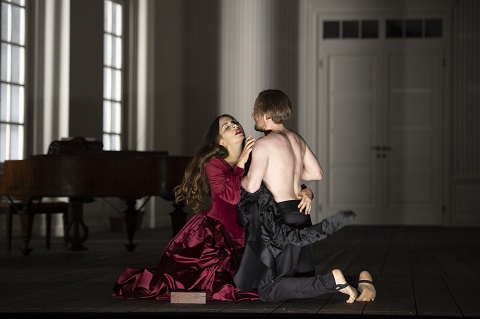
The stage design is appropriate for the context and, rather than relying on typical Der Freischütz-like Romantic locations of woods, glens and dramatic landscapes, Loy keeps the drama confined to an elegant mansion. The cool minimalism of the rooms only serves to heighten and contrast the surface manners of high society with the barely contained lusts and prejudices simmering beneath. It's not so far away from Loy's more recent take on Schreker's similarly heated drama Die ferne Klang, or indeed his stripping of those emotional charges literally stark naked as with his production of Korngold's Das Wunder der Heliane. Andrew Foster Williams is the unfortunate who has to bear all this time, his "wild impulses of glowing desire" out there for the viewer to see, but spared anything too close up. It certainly makes the idea of intended rape more viscerally real and the subsequent teaming up of Lysiart with Eglantine after this is deliriously demented and utterly convincing.
It's the singing too of course that makes this convincing and the principal cast, as well as the chorus, are simply superb. Jacquelyn Wagner has a perfect clean soaring timbre that is perfect for the part of Euryanthe. She's more than just an innocent victim, but the vocal line tells us more than the words alone about her firmness of purpose and her pureness of heart, and Wagner brings out the real human feeling that is scored into the role. Norman Reinhardt shows how Adolar is a prototype Heldentenor, an idealist conflicted between the purity of vision and his response to the baseness of the world.
Theresa Kronthaler and Andrew Foster-Williams bring a chilling edge of menace in roles that are even more villainous and - in this production at least - even more deranged and cruel than Ortrud and Telramund. Looking at the opera this way pointing towards towards Lohengrin, King Ludwig IV is very much a Heinrich der Vogler type of role and it's one that bass Stefan Cerny is not only capable of performing to a Wagnerian level but he also brings some character and personality to make it count within the dramatic development of the plot. Rather than being a forgotten minor work by a respected but neglected composer, Euryanthe turns out to be essential listening for any Wagnerian, a wondrous rediscovery, and Loy's treatment of the work at Theater an der Wien will not disappoint.
The production looks good on the High Definition Blu-ray release from Naxos, although there are some minor niggles. The strong contrasts make whites look a little blown-out, and the image is a little bit shimmery and blurring in movement. Whether that's an authoring issue with the transfer bit-rate I don't know, but it's not too distracting. It doesn't appear that radio mics are used so there's a wider open acoustic theatrical sound here, which means that it also picks up a bit of ambient noise, including creaking floorboards, but the LPCM 2.0 and DTS HD-Master Audio 5.1 mixes still capture the power and the detail of the performance. The BD is all-region compatible, with German, English, French, Japanese and Korean subtitles. The booklet contains a synopsis and an interview with Christof Loy.
Links: Theater an der Wien
Jacques Offenbach - Les Contes d'Hoffmann
La Monnaie-De Munt, 2019
Alain Altinoglu, Krzysztof Warlikowski, Eric Cutler, Patricia Petibon, Michèle Losier, Sylvie Brunet-Grupposo, Gábor Bretz, François Piolino, Willard White, Loïc Félix, Yoann Dubruque, Alejandro Fonte, Byoung-Jin Lee
ARTE Concert streaming - December 2019
It's not hard to recognise that there's a darker side to the stories and the fate of the character Hoffman in The Tales of Hoffmann, but it's by no means certain in my experience that Jacques Offenbach actually manages to draw them out in his opera. The composer's only true opera aside from his delightful comic operetta entertainments, The Tales of Hoffmann is often treated the same way as his opéra-comique works and it's rare that a director will address the underlying issues of alcoholism and mental illness in any serious way. You might expect Krzysztof Warlikowski to try to do a little more with this at La Monnaie, and he does even if it feels he's trying a little too hard.
Always keen to give a classic work a contemporary treatment that addresses the issues in a way that we are more familiar with, often using references to whatever is currently hot in the movie world, Warlikowsi goes the whole hog this time and updates the drunken fantasist of ETA Hoffman's tales into a Hollywood screenwriter-director going through a personal crisis. Obsessed with his leading actress Stella, who whatever way you look at this opera is very much the muse for his creativity, he strives to find a way to overcome his own demons through the roles he develops for her.

When it comes to movie references it's well known that Warlikowsi often relies on the films of David Lynch for inspiration, and since Lynch has tackled similar subjects of Hollywood chewing up its stars in his films Mulholland Drive and Inland Empire, it makes sense (some kind of sense) to employ the same sinister qualities and techniques that Lynch evokes in those movies. Warlikowski doesn't stop there however, borrowing the three pink showgirls from the casino from Twin Peaks: The Return, sets the Olympia segment in Twin Peaks's The Black Lodge, has a microphone stand from similar sequences in Blue Velvet or Mulholland Drive and even has Nicklausse and Giulietta swap identities wearing black and blonde wigs in a nod to Lynch's surreal noir Lost Highway. I'm sure Wild at Heart must be in there somewhere too.
The other current hot movie reference is where the villain(s) of the piece, Lindorf/Coppélius/Doctor Miracle/Dapertutto and his crew all adopt the make-up and look of the Joker. As far as getting underneath the surface these references are definitely in the right zone for using farce and fantasy to suggest a sinister undercurrent where drawing on personal resources and responses for the sake of entertainment can take its toll on creative artists. It's most evident in the Olympia story where the automaton becomes a kind of manufactured starlette groomed for stardom, Hoffmann's "beer goggles" blinding him to the superficiality and fakeness that his assistant Nicklausse is able to see. Olympia indeed becomes a Mulholland Drive-like victim of the Hollywood system.

As far as that goes Warlikowski gets the point across effectively in Act I, but even though the concept permits Hoffmann as director to pour his auteur obsessions out on the screen in the other sections of Offenbach's Tales of Hoffmann, it does - as I often find with this work - tend to drag and get somewhat unwieldy. Warlikowski's references, interventions, interpolations, twisting of the narrative and adding layers doesn't really add much more to this, but tends rather to make it all even harder to follow than usual. In the Antonia section for example, Patricia Petibon breaks out of character (see Laura Dern in Inland Empire) and into another character as an actress who uses her own trauma of the death of her son to feed into her performance of Antonia, and show how it takes a lot out of her emotionally.
Essentially Krzysztof Warlikowski just wants to bring an edge of realism/surrealism to the work, showing that behind Hoffmann's fantasies are real people with real personal lives and drama that Hollywood exploits for the sake of entertainment. If you want to you can extend that another level in that this also makes you aware that the performers of the opera also have their own lives and baggage that it can be difficult to reconcile with an artistic lifestyle. Certainly the fake Oscar ceremony that Warlikowski inserts before the conclusion hits those points about home in a hugely effective and even slightly discomforting way.

Unfortunately it's just all too much, Warlikowski as he is wont to do throwing everything at the opera, much more than I feel Offenbach's writing can sustain, and as a result it feels like a bit of a mess. Which, to be frank, and accepting that Offenbach left the work unfinished at the time of his death, would be how I regard The Tales of Hoffmann as an opera anyway. Less is often more with this work in my experience, and it's telling that the only wholly successful stage productions I have seen are those that scale the whole thing down. The 2015 ETO production (which also used Hoffmann as a movie director much more effectively than Warlikowski) and the Irish National Opera's 2018 version demonstrate that despite my misgivings the work can indeed aspire to something greater.
Whatever its structural or narrative weaknesses, the one redeeming quality of The Tales of Hoffmann as far as I'm concerned is in its melodies and songs that run through the work, in the repetitive catchiness of the "Chanson de Kleinzach" and in the charm of "Belle nuit, ô nuit d'amour" and it's there that the real strength of the La Monnaie production conducted by Alain Altinoglu can be found. The latter sung by Patricia Petibon and Michèle Losier is certainly worth waiting for - well, almost worth waiting for as I found my patience running out as usual with this work. Losier is superb, genuinely making something greater out of the Nicklausse role, Petibon not always able to meet the challenges of the demanding soprano roles in the opera. Eric Cutler's Hoffman is sympathetically engaging and Gábor Bretz cuts a suitably sinister figure as The Joker basically, in a production of Hoffmann that is certainly no laughing matter.
Links: La Monnaie-De Munt, ARTE Concert


